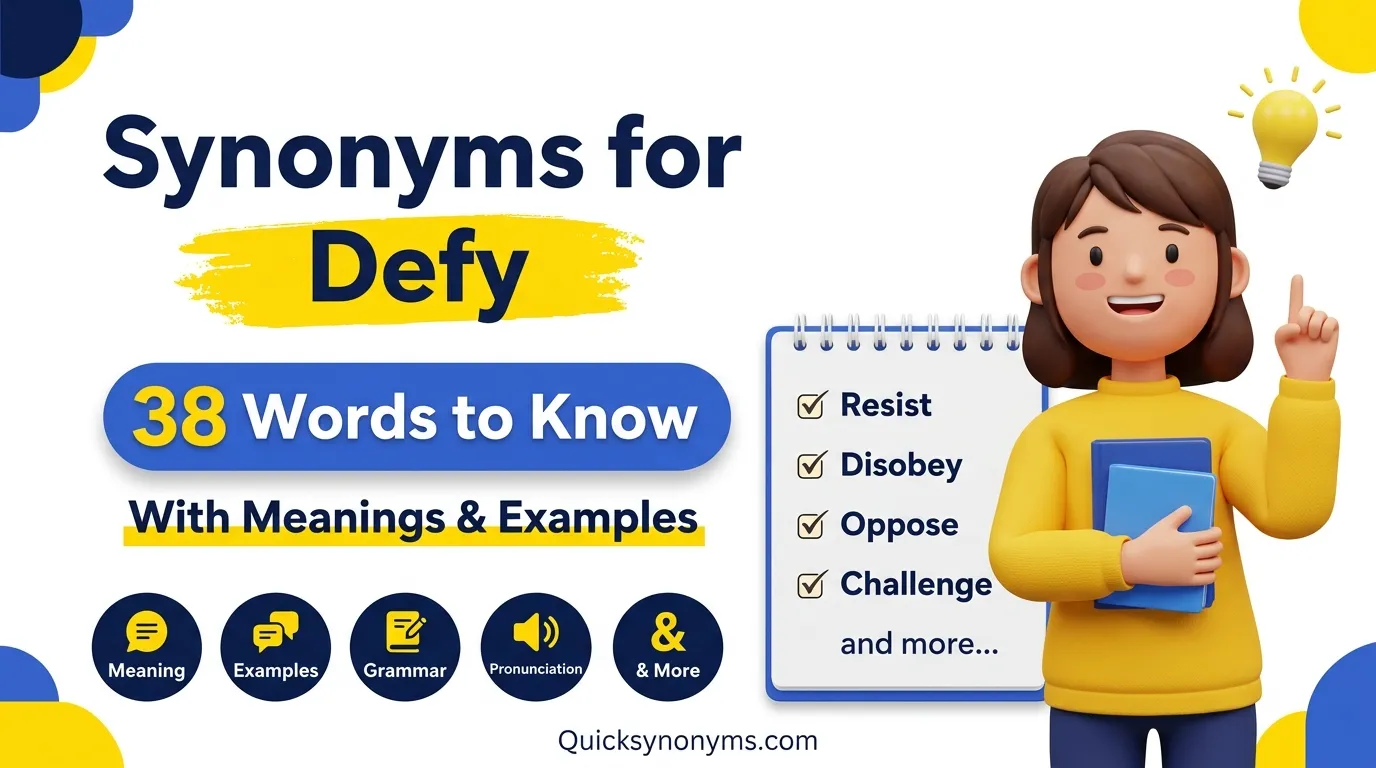
Synonyms for Defy are words that describe refusing to obey, resist, or challenge someone or something. You might defy a rule, an order, an authority, or even expectations.
Synonyms help English learners express resistance with greater accuracy. They also help writers avoid repeating the same word and choose terms that match the strength and context of the action.
This article covers the meaning of defy, examples, grammar, history, pronunciation, and 38 useful synonyms. It also groups the words by meaning to make them easier to learn and use.
Meaning of Defy
Definition
Defy (verb): to refuse to obey someone or something, or to resist a rule, order, or expectation.
Examples
- She chose to defy the unfair rule.
- The young player defied his coach’s instructions.
Connotative Meaning
- Positive tone: Brave, independent, or courageous.
- Negative tone: Disobedient, stubborn, or rebellious.
- Neutral tone: Refusing to obey or accept something.
Etymology
Defy comes from Old French desfier, meaning “to challenge” or “to renounce one’s allegiance.” It is related to the idea of challenging someone openly.
- Old French: desfier meant “to challenge” or “renounce allegiance.”
- Middle English: The word entered English as defien and referred to challenging or resisting.
- Modern English: Defy means to resist, refuse to obey, or challenge something.
Pronunciation (IPA)
- IPA: /dɪˈfaɪ/
- Syllables: de-fy
Affixation Pattern of Defy
- Root: fy
- Prefix: de-
- Suffix: None
- Word formations:
- defy: verb
- defied: verb, past tense
- defying: verb, present participle
- defiance: noun
- defiant: adjective
- defiantly: adverb
38 Synonyms of Defy: With Meaning and Examples
1. Resist (verb)
Meaning: To fight against or refuse to accept something.
Examples:
- The workers resisted the unfair policy.
- She resisted pressure from her friends.
2. Disobey (verb)
Meaning: To refuse to follow an order or rule.
Examples:
- The child disobeyed his parents.
- He was punished for disobeying the rules.
3. Oppose (verb)
Meaning: To act against someone, something, or an idea.
Examples:
- Many citizens opposed the new plan.
- She opposed the proposed changes.
4. Challenge (verb)
Meaning: To question or refuse to accept something.
Examples:
- She challenged the old tradition.
- The lawyer challenged the decision.
5. Rebel (verb)
Meaning: To fight against or refuse to accept authority.
Examples:
- The people rebelled against the ruler.
- He rebelled against strict school rules.
6. Refuse (verb)
Meaning: To say no or decline to do something.
Examples:
- She refused to follow the order.
- He refused to change his decision.
7. Resist (verb)
Meaning: To try not to accept or obey something.
Examples:
- The team resisted the demand.
- She resisted the pressure to quit.
8. Contradict (verb)
Meaning: To say that something is not true or correct.
Examples:
- His statement contradicted the official report.
- She contradicted her manager during the meeting.
9. Confront (verb)
Meaning: To face someone or something directly.
Examples:
- He confronted the unfair decision.
- She confronted the problem immediately.
10. Protest (verb)
Meaning: To publicly show disagreement.
Examples:
- Students protested against the new rule.
- Workers protested outside the building.
11. Rebel against (verb)
Meaning: To resist or fight against authority.
Examples:
- The group rebelled against the strict law.
- She rebelled against family expectations.
12. Flout (verb)
Meaning: To openly ignore or disobey a rule.
Examples:
- Some drivers flout traffic laws.
- He openly flouted the safety rules.
13. Violate (verb)
Meaning: To break a rule, law, or agreement.
Examples:
- The company violated the safety standard.
- He violated the terms of the contract.
14. Ignore (verb)
Meaning: To choose not to follow or pay attention to something.
Examples:
- She ignored the warning.
- He ignored the instructions.
15. Defy authority (verb)
Meaning: To refuse to obey a person or institution with power.
Examples:
- The workers defied authority during the dispute.
- He decided to defy authority and speak out.
16. Buck (verb)
Meaning: To resist or oppose something.
Examples:
- The company bucked the usual trend.
- She bucked tradition and chose a different career.
17. Buck against (verb)
Meaning: To resist something strongly.
Examples:
- He bucked against the strict system.
- She bucked against the expected role.
18. Resist authority (verb)
Meaning: To refuse to accept or follow someone’s authority.
Examples:
- The group resisted authority peacefully.
- He resisted authority when the order seemed unfair.
19. Stand up to (verb)
Meaning: To refuse to be controlled or intimidated by someone.
Examples:
- She stood up to the bully.
- He stood up to unfair treatment.
20. Fight (verb)
Meaning: To struggle against someone or something.
Examples:
- They fought against the unfair system.
- She fought for her rights.
21. Contest (verb)
Meaning: To challenge a decision or claim.
Examples:
- He contested the court decision.
- She contested the result.
22. Dispute (verb)
Meaning: To question whether something is true, fair, or valid.
Examples:
- The company disputed the claim.
- She disputed the accuracy of the report.
23. Deny (verb)
Meaning: To refuse to accept or admit something.
Examples:
- He denied the accusation.
- She denied the request.
24. Reject (verb)
Meaning: To refuse to accept something.
Examples:
- The committee rejected the proposal.
- She rejected the unfair offer.
25. Oppugn (verb)
Meaning: To challenge or question something strongly.
Examples:
- The scholar oppugned the accepted theory.
- She oppugned the argument in her paper.
26. Withstand (verb)
Meaning: To resist something harmful or difficult.
Examples:
- The bridge withstood the strong winds.
- The material withstood high pressure.
27. Defend (verb)
Meaning: To protect someone or something from attack or criticism.
Examples:
- She defended her decision.
- He defended his friend against unfair criticism.
28. Counter (verb)
Meaning: To act against something or respond to it.
Examples:
- The team countered the attack.
- They countered the proposal with a new idea.
29. Thwart (verb)
Meaning: To stop someone from doing what they planned.
Examples:
- The police thwarted the robbery.
- The barrier thwarted their escape.
30. Foil (verb)
Meaning: To prevent a plan or attempt from succeeding.
Examples:
- The guards foiled the escape plan.
- Quick action foiled the attack.
31. Oppugnate (verb)
Meaning: To challenge or oppose a claim or idea.
Examples:
- The researcher opposed the claim in the debate.
- The writer challenged the accepted view.
32. Transgress (verb)
Meaning: To go against a law, rule, or moral limit.
Examples:
- He transgressed the rules.
- The action transgressed accepted standards.
33. Contravene (verb)
Meaning: To act against a law, rule, or agreement.
Examples:
- The action contravened the regulations.
- The decision contravened the agreement.
34. Flout (verb)
Meaning: To openly ignore a rule or convention.
Examples:
- The company flouted the regulations.
- He flouted the accepted practice.
35. Defiance (verb)
Meaning: To act in a way that openly resists authority.
Examples:
- The protesters defied the order.
- She defied expectations with her choice.
36. Go against (verb)
Meaning: To act contrary to a rule, person, or idea.
Examples:
- He went against his family’s wishes.
- The decision went against company policy.
37. Buck tradition (verb)
Meaning: To reject or resist a traditional way of doing something.
Examples:
- She bucked tradition by choosing a new path.
- The designer bucked tradition with the unusual style.
38. Disregard (verb)
Meaning: To deliberately ignore something.
Examples:
- He disregarded the warning.
- She disregarded the usual procedure.
Prototype Meaning
The most typical meaning of defy is to openly refuse to obey or accept authority, rules, or expectations. People often imagine someone standing against an order, rule, or powerful person.
Prototype Categorization
- Refusing authority: Resist, Disobey, Rebel, Refuse, Rebel against, Flout, Stand up to, Resist authority. Use these when someone refuses to follow or accept authority.
- Opposing or challenging: Oppose, Challenge, Confront, Protest, Contest, Dispute, Oppugn, Counter, Go against. Use these when someone actively challenges an idea, decision, or position.
- Breaking rules: Violate, Ignore, Disregard, Transgress, Contravene. Use these when someone fails to follow a rule, law, or instruction.
- Blocking or resisting force: Withstand, Thwart, Foil, Fight, Defend. Use these when someone resists force or prevents an action or plan.
- Rejecting accepted ways: Buck, Buck against, Buck tradition, Deny, Reject. Use these when someone refuses to accept an idea, tradition, claim, or expected behavior.
Grouping synonyms helps writers see the difference between refusing, opposing, challenging, and breaking rules. It also helps you choose a word that fits the exact situation.
Antonyms of Defy
- Obey (verb): To follow an order or rule.
- Comply (verb): To act according to a request or rule.
- Submit (verb): To accept authority or control.
- Accept (verb): To agree to receive or recognize something.
- Follow (verb): To act according to instructions.
- Agree (verb): To have the same opinion or accept something.
- Respect (verb): To show regard for authority or rules.
Short Questions and Answers
What does Defy mean?
Defy means to refuse to obey, resist, or openly challenge someone or something.
When should Defy be used?
Use defy when someone refuses to follow a rule, order, authority, or expectation.
Is Defy positive or negative?
Defy can be positive or negative depending on the context. It may suggest courage when resisting something unfair, but it can suggest disobedience when refusing a reasonable rule.
How is it different from similar words?
Resist focuses on fighting against something. Disobey means refusing to follow an order or rule, while challenge focuses on questioning or opposing something.
Conclusion
Learning defy and its synonyms can make your vocabulary stronger and more precise. Words such as resist, disobey, oppose, and challenge describe different forms of resistance.
Some words are best for rules and authority, while others work better for ideas, decisions, or plans. For example, flout suggests openly ignoring a rule, while withstand focuses on resisting pressure or force.
Using these words can improve both writing and speaking. Practice a few synonyms each day, create your own sentences, and notice how they are used in real English. Regular vocabulary practice can build confidence and improve communication.
Keep Reading: Synonyms for Cry: 40 Words to Know

English Teacher & Linguistics Writer
Grace Whitmore creates engaging educational content on vocabulary, word usage, and effective communication. Her goal is to help learners build confidence through clear and practical English guidance.