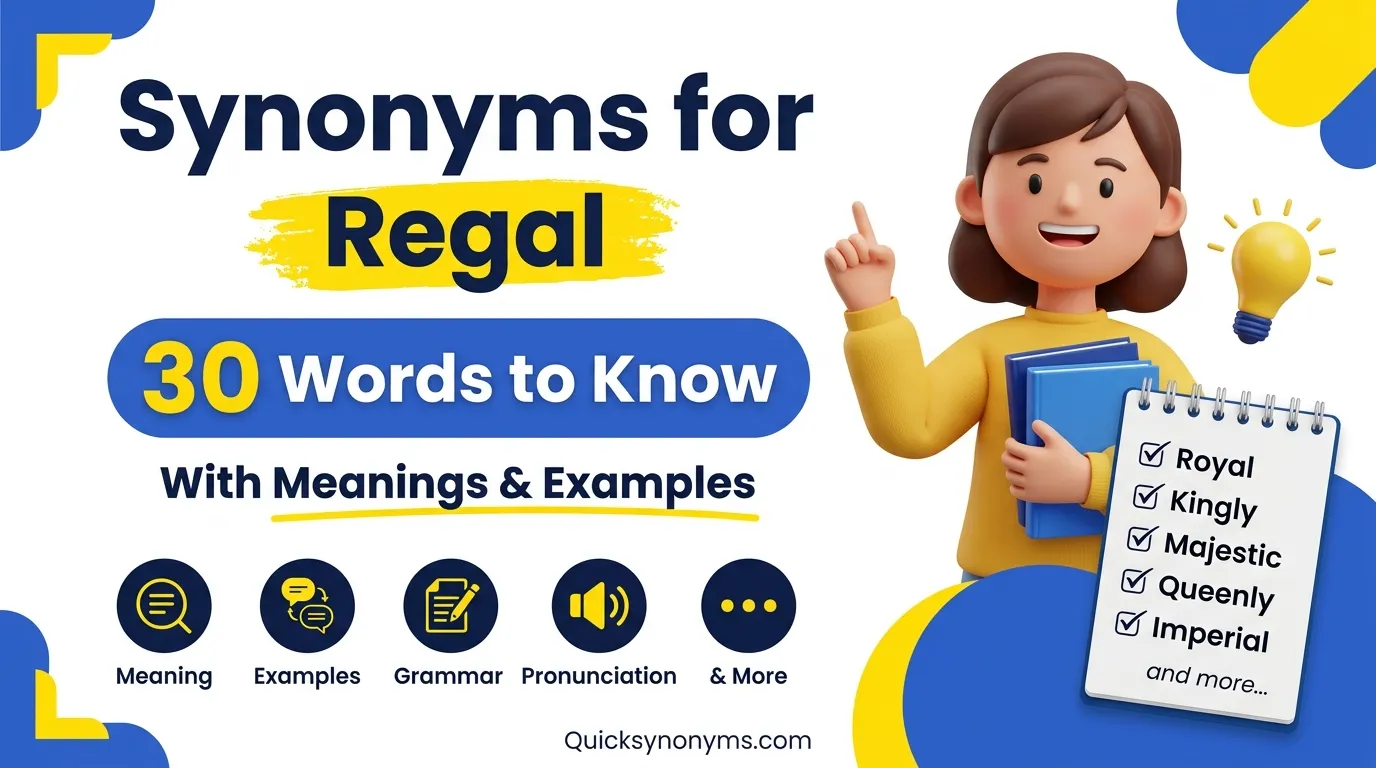
Synonyms for Regal are words that describe something royal, majestic, grand, or fit for a king or queen. You might use regal to describe a palace, a royal robe, a grand room, or someone who looks calm and dignified.
Synonyms help English learners understand small differences between similar words. They also help writers avoid repeating the same word and choose a word that fits the exact tone.
This article covers the meaning of regal, examples, grammar, history, pronunciation, and 30 useful synonyms. It also groups the words by meaning to make them easier to learn and use.
Meaning of Regal
Definition
Regal (adjective): relating to a king or queen, or having a grand and royal appearance.
Examples
- The palace had a regal entrance with tall golden doors.
- She walked into the room with a regal air.
Connotative Meaning
- Positive tone: Grand, noble, elegant, and impressive.
- Negative tone: Sometimes overly proud or too grand.
- Neutral tone: Connected with royalty or royal style.
Etymology
Regal comes from Latin regalis, meaning “royal” or “of a king.” It entered English through Old French and has been used in English since the Middle English period.
- Latin: regalis meant “royal” or “of a king.”
- Old French: regal developed from the Latin word.
- Middle English: The word entered English with meanings linked to royalty and kingship.
- Modern English: Regal now means royal, majestic, grand, or dignified.
Pronunciation (IPA)
- IPA: /ˈriːɡəl/
- Syllables: re-gal
Affixation Pattern of Regal
- Root: reg
- Prefix: None
- Suffix: -al
- Word formations:
- regal: adjective
- regally: adverb
- regality: noun
- regalian: adjective
30 Synonyms of Regal: With Meaning and Examples
1. Royal (adjective)
Meaning: Connected with a king, queen, or royal family.
Examples:
- The museum displayed a royal crown.
- They attended a royal ceremony.
2. Kingly (adjective)
Meaning: Having the qualities or appearance of a king.
Examples:
- His kingly manner impressed the guests.
- The statue showed him in a kingly pose.
3. Majestic (adjective)
Meaning: Very grand, impressive, and dignified.
Examples:
- The mountain looked majestic at sunrise.
- The horse made a majestic entrance.
4. Queenly (adjective)
Meaning: Having the dignity or appearance of a queen.
Examples:
- Her queenly posture caught everyone’s attention.
- She gave a queenly smile.
5. Imperial (adjective)
Meaning: Relating to an empire or having great royal power.
Examples:
- The hall had an imperial design.
- The museum holds several imperial treasures.
6. Sovereign (adjective)
Meaning: Relating to a ruler with supreme authority.
Examples:
- The ruler wore a sovereign crown.
- The painting showed a sovereign figure.
7. Stately (adjective)
Meaning: Impressive, dignified, and grand in appearance.
Examples:
- They entered a stately old mansion.
- The trees gave the garden a stately look.
8. Noble (adjective)
Meaning: Having a dignified, honorable, or grand quality.
Examples:
- The horse had a noble appearance.
- Her noble manner made her stand out.
9. Princely (adjective)
Meaning: Having the qualities or luxury linked with a prince.
Examples:
- The guests received a princely welcome.
- He lived in a princely home.
10. Grand (adjective)
Meaning: Large, impressive, or important in appearance.
Examples:
- The hotel has a grand entrance.
- We admired the building’s grand design.
11. Magnificent (adjective)
Meaning: Extremely beautiful, impressive, or grand.
Examples:
- The palace had a magnificent ceiling.
- They watched a magnificent parade.
12. Splendid (adjective)
Meaning: Very impressive, beautiful, or excellent.
Examples:
- The room had a splendid view.
- She wore a splendid dress.
13. Dignified (adjective)
Meaning: Calm, serious, and worthy of respect.
Examples:
- The leader gave a dignified speech.
- He remained dignified during the ceremony.
14. August (adjective)
Meaning: Respected and impressive because of importance or dignity.
Examples:
- The august building stood above the square.
- An august guest joined the ceremony.
15. Imposing (adjective)
Meaning: Impressive because of size, appearance, or power.
Examples:
- An imposing gate stood at the entrance.
- The castle had an imposing appearance.
16. Aristocratic (adjective)
Meaning: Having qualities linked with the upper social class or nobility.
Examples:
- She had an aristocratic style.
- The house had an aristocratic feel.
17. Courtly (adjective)
Meaning: Polite, graceful, and linked with a royal court.
Examples:
- He gave a courtly bow.
- Her courtly manners impressed the visitors.
18. Sovereignly (adverb)
Meaning: In a way that suggests the authority or manner of a ruler.
Examples:
- She spoke sovereignly before the crowd.
- He acted sovereignly during the formal event.
19. Regalistic (adjective)
Meaning: Relating strongly to royal authority or royal ideas.
Examples:
- The artist used a regalistic style in the portrait.
- The room had a regalistic design.
20. Royalistic (adjective)
Meaning: Supporting or strongly connected with royalty.
Examples:
- The painting had a royalistic theme.
- The ceremony followed a royalistic style.
21. Kinglike (adjective)
Meaning: Similar to a king in appearance, behavior, or quality.
Examples:
- The lion had a kinglike presence.
- His kinglike posture made him easy to notice.
22. Queenlike (adjective)
Meaning: Similar to a queen in appearance or manner.
Examples:
- Her queenlike confidence filled the room.
- The actress had a queenlike appearance.
23. Heroic (adjective)
Meaning: Showing great courage, strength, or noble qualities.
Examples:
- The statue showed a heroic figure.
- His heroic pose made the painting powerful.
24. Grandiose (adjective)
Meaning: Very grand, sometimes in a way that seems excessive.
Examples:
- The building had a grandiose entrance.
- His grandiose plans surprised everyone.
25. Lavish (adjective)
Meaning: Very rich, costly, or generous in style.
Examples:
- The palace had lavish decorations.
- They held a lavish celebration.
26. Luxurious (adjective)
Meaning: Very comfortable, expensive, and elegant.
Examples:
- The hotel offered a luxurious suite.
- The room had a luxurious interior.
27. Ornate (adjective)
Meaning: Highly decorated with many detailed features.
Examples:
- The palace had an ornate doorway.
- We admired the ornate ceiling.
28. Splendiferous (adjective)
Meaning: Extremely impressive, splendid, or grand.
Examples:
- The theater had a splendiferous interior.
- They enjoyed a splendiferous celebration.
29. Noble-minded (adjective)
Meaning: Showing honorable and high-minded qualities.
Examples:
- Her noble-minded actions earned respect.
- He was known for his noble-minded approach.
30. Lofty (adjective)
Meaning: Grand, elevated, or impressive in style or character.
Examples:
- The hall had a lofty appearance.
- His lofty manner made him seem important.
Prototype Meaning
The most typical meaning of regal is royal and majestic. People often imagine a king or queen wearing fine clothing, sitting in a grand palace, or carrying themselves with dignity and authority.
Prototype Categorization
- Royal and ruler-related: Royal, Kingly, Queenly, Imperial, Sovereign, Princely, Kinglike, Queenlike. Use these words when the idea is directly linked to rulers, royalty, or royal qualities.
- Grand and impressive: Majestic, Stately, Grand, Magnificent, Splendid, Imposing, August, Lofty. Use these when something looks powerful, impressive, or grand.
- Dignified and noble: Noble, Dignified, Courtly, Aristocratic, Heroic, Noble-minded. Use these for people, behavior, or qualities that suggest dignity and high character.
- Rich and luxurious: Lavish, Luxurious, Ornate, Grandiose. Use these when describing expensive, highly decorated, or overly grand things.
- Royal-style terms: Regalistic, Royalistic, Sovereignly, Splendiferous. Use these less common words when a specific royal or highly grand style is intended.
Grouping synonyms helps writers see small differences between similar words. It also makes it easier to choose a word that matches the exact context.
Antonyms of Regal
- Common (adjective): Ordinary or not special.
- Humble (adjective): Modest and not proud.
- Plain (adjective): Simple and without decoration.
- Ordinary (adjective): Normal and not unusual.
- Modest (adjective): Simple and not showy.
- Informal (adjective): Relaxed and not formal.
- Lowly (adjective): Having a low social position or status.
Short Questions and Answers
What does Regal mean?
Regal means royal, majestic, grand, or connected with the qualities of a king or queen.
When should Regal be used?
Use regal when describing a person, place, object, or manner that looks royal, dignified, grand, or majestic.
Is Regal positive or negative?
Regal is usually positive because it suggests beauty, dignity, power, and grandeur. However, it can sound negative when someone seems too proud or overly grand.
How is it different from similar words?
Royal directly relates to kings, queens, or royal families. Majestic focuses on impressive beauty or greatness, while stately suggests dignity and grand appearance.
Conclusion
Learning regal and its synonyms can make your English more precise and interesting. Words such as royal, majestic, stately, and noble can help you describe people, places, objects, and styles without repeating the same word.
Each synonym has a slightly different use. Royal is closely tied to kings and queens, while majestic focuses on greatness and luxurious focuses on comfort and richness. Knowing these differences helps you choose the right word for your sentence.
Practice these words in short sentences each day. Read them, write them, and use them in conversation. Daily vocabulary practice can build stronger English skills and greater confidence.
Explore More: Synonyms for Lucrative: 30 Words to Know

Content Editor & Language Researcher
Daniel Foster specializes in editing educational content and researching English language topics. He is committed to creating well-structured, reader-friendly articles that make learning easier.