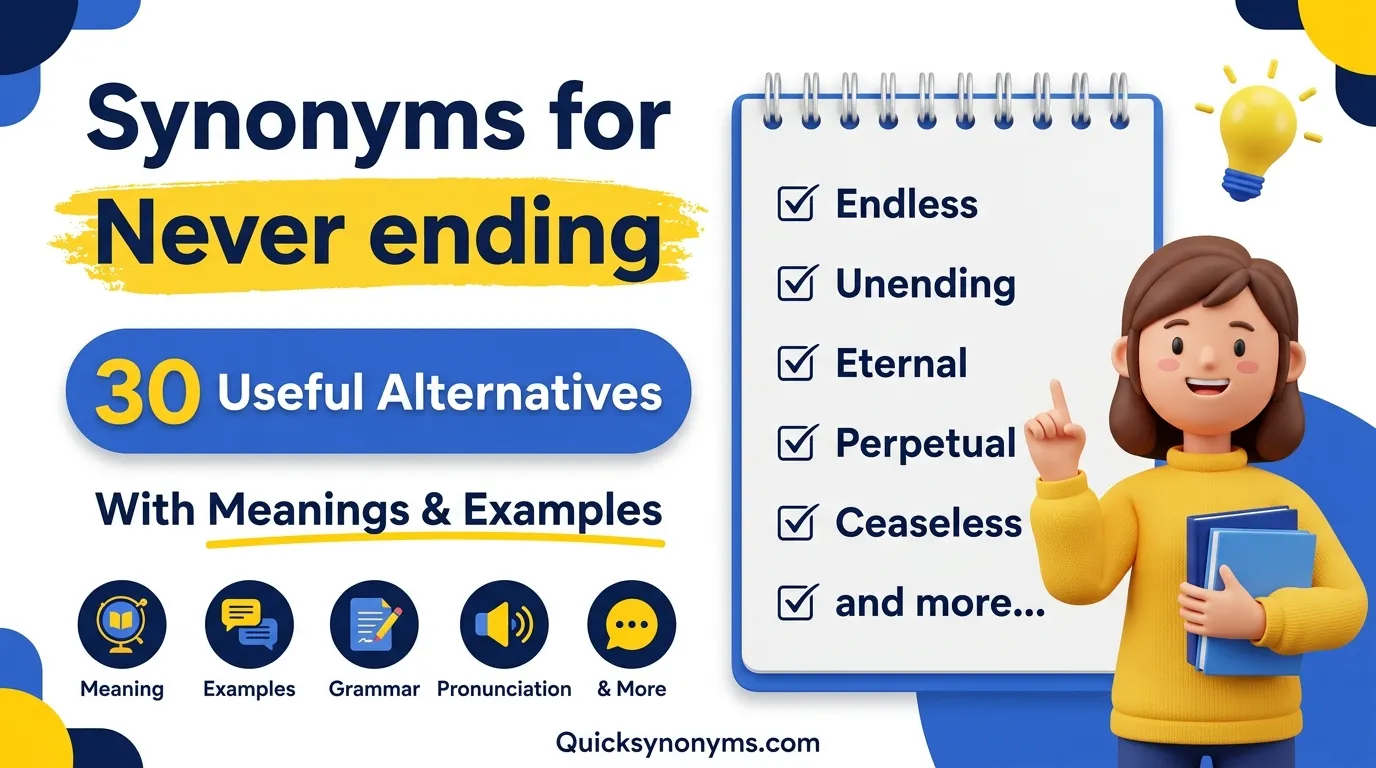
Never ending means something that seems to have no end or does not stop. Imagine waiting in a long traffic line that keeps moving slowly but never seems to finish. You might call the wait never ending. The phrase is common when people talk about time, events, tasks, stories, problems, or things that continue for a very long time.
Learning synonyms for never ending helps English learners use more exact words. It also helps content writers avoid using the same phrase again and again. In this article, you will learn the meaning of never ending and 30 useful synonyms. You will also see examples, grammar, word history, pronunciation, and semantic groups to help you choose the right word for each situation.
Meaning of Never ending
Definition
Never ending (Adjective): Continuing for a very long time without stopping or seeming to have an end.
Examples
- The never ending rain made the roads wet for days.
- She felt trapped in a never ending cycle of work.
Connotative Meaning
Connotation: The feeling or idea that a word suggests beyond its basic meaning.
- Positive tone: Can suggest lasting love, endless joy, or lasting beauty.
- Negative tone: Can suggest boredom, frustration, pain, or a task that will not finish.
- Neutral tone: Can simply describe something that continues without an apparent end.
Etymology
The phrase never ending comes from two common English words, never and ending. It developed from the idea of something that does not reach an end.
- Old English (450–1100): Never came from Old English næfre, meaning “not ever.” The word end came from Old English ende, meaning a limit, boundary, or conclusion.
- Middle English (1100–1500): Forms of never and end continued in Middle English. The word end was used for a final point or limit.
- Modern English (1500–Present): The words developed into modern never and ending. The phrase never ending is used to describe something that appears to continue without reaching a final point.
Pronunciation (IPA)
- IPA: /ˌnevər ˈendɪŋ/
- Syllables: nev-er end-ing
Affixation Pattern of Never ending
- Root: end
- Prefix: never functions as a modifying word rather than a traditional prefix.
- Suffix: -ing forms ending from the verb end.
- Word formations:
- end (verb, noun)
- ends (verb, noun)
- ended (verb)
- ending (noun, adjective)
- never (adverb)
- never-ending (adjective)
30 Synonyms of Never ending: With Meaning & Examples
1. Endless (Adjective)
Meaning: Continuing without an end or limit.
Examples:
- The desert seemed endless.
- They talked about their endless plans.
2. Unending (Adjective)
Meaning: Continuing without stopping or finishing.
Examples:
- The unending noise made it hard to sleep.
- She was tired of the unending debate.
3. Eternal (Adjective)
Meaning: Lasting forever or for an extremely long time.
Examples:
- They promised eternal friendship.
- The poem speaks of eternal love.
4. Everlasting (Adjective)
Meaning: Continuing for a very long time or forever.
Examples:
- The couple hoped for everlasting happiness.
- The story became a symbol of everlasting hope.
5. Perpetual (Adjective)
Meaning: Continuing repeatedly or without stopping.
Examples:
- The machine needs perpetual care.
- His perpetual questions slowed the class.
6. Ceaseless (Adjective)
Meaning: Continuing without a pause or break.
Examples:
- The ceaseless rain flooded the streets.
- We heard the ceaseless sound of waves.
7. Incessant (Adjective)
Meaning: Continuing without stopping, often in an annoying way.
Examples:
- The incessant barking kept us awake.
- She complained about the incessant noise.
8. Interminable (Adjective)
Meaning: Seeming to have no end, especially because it lasts too long.
Examples:
- The meeting felt interminable.
- We sat through an interminable speech.
9. Infinite (Adjective)
Meaning: Having no end or limit.
Examples:
- The sky seemed to hold infinite space.
- The universe may contain infinite possibilities.
10. Perennial (Adjective)
Meaning: Continuing or appearing again for a long time.
Examples:
- Traffic is a perennial problem in the city.
- She is a perennial favorite among readers.
11. Continual (Adjective)
Meaning: Happening again and again with short breaks.
Examples:
- The continual interruptions slowed our work.
- His continual efforts finally paid off.
12. Continuous (Adjective)
Meaning: Continuing without a break or interruption.
Examples:
- The continuous rain lasted all afternoon.
- The machine makes a continuous sound.
13. Constant (Adjective)
Meaning: Continuing without much change or stopping.
Examples:
- The constant noise was distracting.
- She gave him constant support.
14. Uninterrupted (Adjective)
Meaning: Continuing without being stopped or broken.
Examples:
- We enjoyed three hours of uninterrupted sleep.
- The team worked for five hours of uninterrupted time.
15. Perpetuating (Adjective)
Meaning: Continuing something for a long time or causing it to continue.
Examples:
- The policy was perpetuating an old problem.
- His actions were perpetuating the conflict.
16. Timeless (Adjective)
Meaning: Not limited by a particular time and able to remain meaningful for a long time.
Examples:
- The song has a timeless appeal.
- Her advice contains timeless wisdom.
17. Ageless (Adjective)
Meaning: Not seeming to grow old or lose its value with time.
Examples:
- The story has an ageless message.
- Her style has an ageless quality.
18. Boundless (Adjective)
Meaning: Having no apparent limit or boundary.
Examples:
- The child showed boundless energy.
- He has boundless curiosity about nature.
19. Limitless (Adjective)
Meaning: Having no clear limit or end.
Examples:
- The internet offers almost limitless information.
- Her imagination seems limitless.
20. Bottomless (Adjective)
Meaning: Seeming to have no bottom, end, or limit.
Examples:
- He seemed to have a bottomless supply of ideas.
- The story opened a bottomless world of mystery.
21. Unceasing (Adjective)
Meaning: Continuing without stopping.
Examples:
- The unceasing rain filled the river.
- Her unceasing work helped the team succeed.
22. Undying (Adjective)
Meaning: Continuing forever or lasting for a very long time.
Examples:
- He showed undying loyalty to his team.
- The novel became a symbol of undying love.
23. Deathless (Adjective)
Meaning: Continuing forever or never losing its lasting importance.
Examples:
- The poet created a deathless work of art.
- The story became a deathless classic.
24. Agelong (Adjective)
Meaning: Lasting for a very long time.
Examples:
- The two families had an agelong friendship.
- The town preserved its agelong traditions.
25. Ever-present (Adjective)
Meaning: Always present or constantly existing.
Examples:
- The ever-present sound of traffic filled the city.
- She was aware of the ever-present risk.
26. Everlasting (Adjective)
Meaning: Continuing forever or for an extremely long time.
Examples:
- The monument was built as a sign of everlasting peace.
- Their friendship became an everlasting memory.
27. Unremitting (Adjective)
Meaning: Continuing without becoming weaker or stopping.
Examples:
- The doctor praised her unremitting effort.
- The team worked with unremitting focus.
28. Persistent (Adjective)
Meaning: Continuing for a long time despite problems or attempts to stop it.
Examples:
- The persistent rain caused delays.
- He had a persistent cough.
29. Long-lasting (Adjective)
Meaning: Continuing for a long period of time.
Examples:
- This battery provides long-lasting power.
- They built a long-lasting friendship.
30. Never-ending (Adjective)
Meaning: Continuing for an apparently endless period without reaching an end.
Examples:
- The children seemed to have never-ending energy.
- We faced a never-ending list of small tasks.
Prototype Meaning
The most typical meaning of never ending is something that continues for a very long time and does not appear to reach a final point. When people hear this phrase, they often imagine something such as an endless task, a long wait, constant rain, or a problem that keeps returning. The phrase can describe both real and abstract things.
Prototype Categorization
- No apparent end: endless, unending, interminable, infinite, limitless describe things that seem to have no final point.
- No stopping: ceaseless, unceasing, incessant, continuous, uninterrupted focus on something that keeps going without a break.
- Very long duration: everlasting, eternal, agelong, long-lasting, perpetual focus on how long something continues.
- Lasting value: timeless, ageless, deathless, undying often describe ideas, love, stories, or works that remain important over time.
- Repeated continuation: continual, perennial, persistent, perpetual can describe things that keep happening or return again and again.
- No clear limit: boundless, bottomless, limitless describe something that appears to have no clear boundary or limit.
This grouping helps writers choose a synonym based on the exact idea they want to express. Some words focus on time, while others focus on repetition, limits, or lasting value.
Antonyms of Never ending
- Ending (Adjective/Noun): Coming to a close or final point.
- Finite (Adjective): Having a limit or end.
- Temporary (Adjective): Lasting only for a limited time.
- Brief (Adjective): Lasting for a short time.
- Short-lived (Adjective): Continuing for only a short period.
- Limited (Adjective): Having a clear boundary or limit.
- Intermittent (Adjective): Stopping and starting at intervals.
- Terminated (Adjective): Brought to an end.
- Concluded (Adjective): Finished or brought to a close.
- Momentary (Adjective): Lasting for only a very short time.
Short Questions and Answers
What does never ending mean?
Never ending means continuing for a very long time without appearing to stop or finish.
When should never ending be used?
Use never ending when you want to describe something that seems to continue without an end. It can describe tasks, events, problems, feelings, or time.
Is never ending positive or negative?
It depends on the context. It can be positive when describing never ending love or hope. It can be negative when describing a never ending problem or task.
How is it different from similar words?
Never ending is a general phrase. Words such as incessant stress nonstop activity, while eternal often suggests something lasting forever. Interminable often suggests that something feels unpleasantly long.
Conclusion
Learning the meaning of never ending gives English learners a useful way to describe things that continue for a very long time. However, knowing its synonyms can make your speech and writing more exact. Words such as endless, eternal, ceaseless, perpetual, and unending can express similar ideas while adding different shades of meaning.
A strong vocabulary also helps you avoid repetition. Instead of using never ending in every sentence, you can choose a word that fits the exact situation. This makes your writing clearer and more natural. It can also build confidence when you speak or write in English. Try learning a few new words each day, and use them in your own sentences. Regular practice is a simple way to grow your vocabulary.
Explore More: Synonyms for Seeing: 30 Smart Alternatives

Content Editor & Language Researcher
Daniel Foster specializes in editing educational content and researching English language topics. He is committed to creating well-structured, reader-friendly articles that make learning easier.



1 thought on “Synonyms for Never Ending: 30 Useful Alternatives”