A little kid walks into the kitchen wearing a cape and tells you, in full seriousness, that he is a dragon guarding treasure. You play along and act scared. That moment is a perfect picture of the word pretend. It means to act as if something is true when it is not, whether for fun, for a game, or to hide a feeling.
Adults pretend too. We pretend to be fine after a bad day. We pretend not to notice an awkward moment. Because this word shows up so often in daily life, writers and English learners need more than one way to say it. Repeating “pretend” in every sentence gets boring fast.
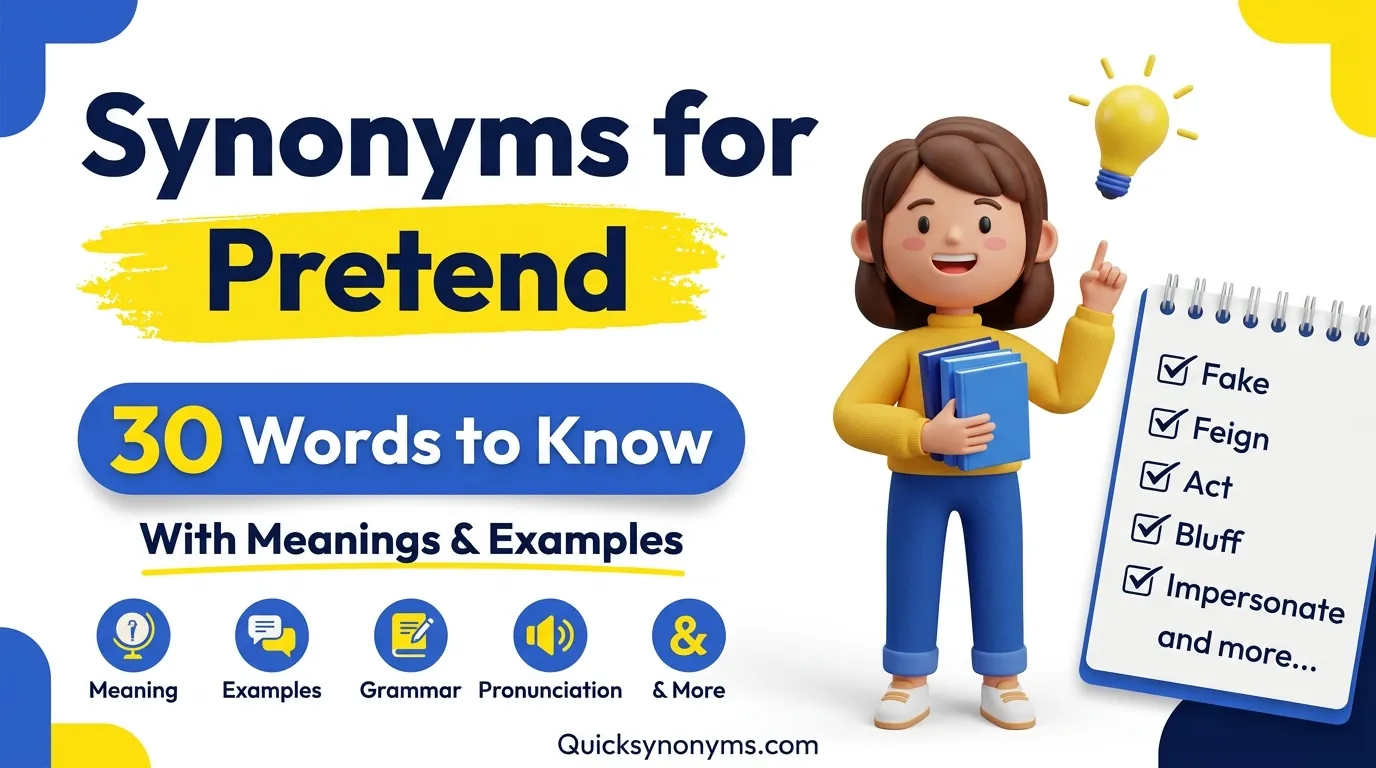
This article covers the meaning of pretend, its history, pronunciation, word family, and 30 useful synonyms with examples so your writing and speech sound more natural and varied.
Meaning of Pretend
Definition
Pretend (Verb):
To behave as if something is true or real, even though it is not, usually to fool someone or to play a game.
Examples
- The children pretend to be pirates in the backyard.
- She pretended not to hear the question.
Connotative Meaning
The tone of “pretend” shifts depending on the situation.
- Positive tone: Used for play, imagination, or harmless fun, such as kids pretending to fly.
- Negative tone: Used when someone hides the truth to trick or mislead another person.
- Neutral tone: Used in general descriptions of acting or role-play without judgment.
(Connotation: the feeling or association a word carries beyond its basic meaning)
Etymology
The word pretend comes from the Latin verb “praetendere,” which combined “prae” (before) and “tendere” (to stretch). The original sense was to stretch something out in front, almost like holding up a claim.
- Old English (450–1100): The word did not yet exist in English; the concept was expressed with native verbs.
- Middle English (1100–1500): English borrowed “pretenden” from Old French, meaning to claim or assert.
- Modern English (1500–Present): The meaning shifted toward faking or acting, the sense we use today.
Pronunciation (IPA)
- IPA: /prɪˈtɛnd/
- Syllables: pre-tend
Affixation Pattern of Pretend
- Root: tend (from Latin “tendere,” to stretch)
- Prefix: pre- (before)
- Suffix: none in the base form
- Word formations:
- Pretend (verb)
- Pretender (noun)
- Pretense / Pretence (noun)
- Pretending (noun, adjective)
- Pretended (adjective)
30 Synonyms of Pretend : With Meaning & Examples
1. Fake (Verb)
Meaning: To act in a false way to make something appear true.
Examples:
- He tried to fake a smile during the meeting.
- She faked an injury to skip the race.
2. Feign (Verb)
Meaning: To put on a false appearance of a feeling or state, often used in formal writing.
Examples:
- The soldier feigned sleep to avoid guard duty.
- She feigned surprise at the news.
3. Simulate (Verb)
Meaning: To create a copy or imitation of something real, often used in technical settings.
Examples:
- The training program simulates a real flight.
- Doctors simulate emergencies to train nurses.
4. Act (Verb)
Meaning: To behave in a certain way that is not your true state.
Examples:
- Try not to act surprised when they arrive.
- He acted calm even though he was nervous.
5. Bluff (Verb)
Meaning: To pretend confidence or knowledge you do not actually have, often to gain an advantage.
Examples:
- She bluffed her way through the job interview.
- He bluffed in the poker game with a weak hand.
6. Playact (Verb)
Meaning: To behave in an exaggerated, unreal way, often used to describe insincere behavior.
Examples:
- Stop playacting and tell me what really happened.
- The kids playact scenes from their favorite movie.
7. Dissemble (Verb)
Meaning: To hide your true feelings or intentions behind a false manner, a formal and literary word.
Examples:
- The politician dissembled when asked about the scandal.
- She dissembled her anger with a polite tone.
8. Sham (Verb)
Meaning: To fake an illness, feeling, or event to deceive others.
Examples:
- He shammed a headache to leave work early.
- The wrestler shammed pain after the fall.
9. Counterfeit (Verb)
Meaning: To imitate something closely enough to pass it off as genuine.
Examples:
- The company counterfeited the brand’s packaging.
- He counterfeited concern he did not feel.
10. Impersonate (Verb)
Meaning: To pretend to be a different, specific person.
Examples:
- The comedian impersonated a famous singer.
- The scammer impersonated a bank employee.
11. Mimic (Verb)
Meaning: To copy someone’s actions, speech, or behavior, often for humor.
Examples:
- The parrot mimics its owner’s voice.
- She mimics her teacher’s accent perfectly.
12. Affect (Verb)
Meaning: To put on a manner or feeling that is not natural to you.
Examples:
- He affected a British accent for the role.
- She affected indifference about the breakup.
13. Put on (Phrasal Verb)
Meaning: To fake a behavior or emotion, common in casual speech.
Examples:
- She put on a brave face for the interview.
- He is just putting on an act.
14. Fabricate (Verb)
Meaning: To invent something false, often a story or excuse.
Examples:
- He fabricated an excuse for being late.
- The witness fabricated part of her statement.
15. Make believe (Verb)
Meaning: To imagine or act out something untrue, often used with children’s play.
Examples:
- The kids make believe they are astronauts.
- Let’s make believe the floor is lava.
16. Masquerade (Verb)
Meaning: To present yourself falsely as something you are not.
Examples:
- The spy masqueraded as a diplomat.
- The app masquerades as a harmless game.
17. Pose (Verb)
Meaning: To pretend to be someone else, usually for a specific purpose.
Examples:
- The reporter posed as a customer to get the story.
- He posed as an expert on the topic.
18. Assume (Verb)
Meaning: To take on a false identity, role, or manner.
Examples:
- The actor assumed a heavy limp for the role.
- She assumed an air of authority in the meeting.
19. Fool (Verb)
Meaning: To act in a joking or false way, often used informally.
Examples:
- I’m just fooling, don’t take it seriously.
- He fooled around pretending to be hurt.
20. Deceive (Verb)
Meaning: To make someone believe something false, often with harmful intent.
Examples:
- He deceived his friends about his true feelings.
- The ad deceived customers about the product.
21. Dupe (Verb)
Meaning: To trick someone by pretending something false is true.
Examples:
- The con artist duped several investors.
- She was duped into signing the contract.
22. Delude (Verb)
Meaning: To make yourself or someone else believe something untrue.
Examples:
- Don’t delude yourself into thinking he’ll change.
- He deluded his team about the project’s progress.
23. Posture (Verb)
Meaning: To behave in a way meant to impress or mislead others about your position.
Examples:
- The leaders postured for the cameras.
- He postured as an expert without any real experience.
24. Role-play (Verb)
Meaning: To act out a scenario or character, often for training or fun.
Examples:
- The team role-plays customer complaints during training.
- The kids role-play a doctor visit.
25. Malinger (Verb)
Meaning: To pretend to be sick to avoid work or duty.
Examples:
- The soldier was accused of malingering.
- He malingered to skip the exam.
26. Disguise (Verb)
Meaning: To hide your true nature or identity behind a false appearance.
Examples:
- She disguised her disappointment with a smile.
- He disguised himself as a delivery worker.
27. Con (Verb)
Meaning: To trick someone through a false pretense, often for money or gain.
Examples:
- The scammer conned an elderly couple out of savings.
- He tried to con his way into the event.
28. Act out (Phrasal Verb)
Meaning: To perform or physically show a scene, feeling, or situation.
Examples:
- The students act out scenes from the play.
- She acted out the whole argument for her friend.
29. Trick (Verb)
Meaning: To fool someone using a clever or false method.
Examples:
- He tricked his brother into believing it was a holiday.
- The magician tricks the audience with sleight of hand.
30. Pantomime (Verb)
Meaning: To act something out silently or in an exaggerated way, without real words.
Examples:
- She pantomimed being exhausted after the run.
- He pantomimed opening a door that wasn’t there.
Prototype Meaning
When most people hear the word pretend, they picture a child playing make-believe, wearing a costume or holding a toy sword, fully lost in an imaginary world. This is the most typical, everyday image tied to the word. It carries a light, playful feeling even though the word can also describe adults hiding their true feelings in serious situations.
Prototype Categorization
Grouping these synonyms helps writers pick the right word for the right tone.
- Playful pretending: Playact, make believe, role-play, pantomime, act out
- Deceptive pretending: Deceive, dupe, delude, con, trick
- Acting a role or identity: Impersonate, pose, masquerade, disguise, assume
- Faking a feeling or state: Feign, fake, sham, affect, put on, malinger
- Formal or literary tone: Dissemble, counterfeit, posture, simulate, fabricate
This grouping lets a writer match tone and context. A children’s story calls for “make believe,” while a news article about fraud calls for “con” or “dupe.”
Antonyms of Pretend
Reveal (Verb)
To show the truth openly.
Admit (Verb)
To confess something honestly.
Confirm (Verb)
To state something is definitely true.
Expose (Verb)
To uncover a hidden fact or truth.
Be genuine (Phrase)
To act with honest, real feelings.
Short Questions and Answers
What does pretend mean?
It means to act as if something is true or real when it actually is not, whether for play or to hide the truth.
When should pretend be used?
Use it when describing imaginary play, acting, or situations where someone hides their real feelings or intentions.
Is pretend positive or negative?
It depends on context. In children’s play it feels positive and fun, but in situations involving lies it carries a negative tone.
How is it different from similar words?
Words like “feign” and “dissemble” sound more formal and often describe hiding emotions, while “fake” and “sham” more directly suggest deception.
Conclusion
Learning synonyms for pretend gives your writing and speech more color and precision. Instead of repeating the same word, you can choose “feign” for a formal tone, “playact” for something lighthearted, or “dupe” when describing deception.
This kind of vocabulary practice strengthens both your writing and your speaking. It helps you avoid repetition and express exact shades of meaning, from innocent childhood games to serious cases of dishonesty.
Keep exploring new words daily, and try using a few of these synonyms in your own sentences this week. Small habits like this build real confidence in English over time.
For more useful vocabulary, check out our related list of Synonyms for Drab to expand your range even further.

Content Editor & Language Researcher
Daniel Foster specializes in editing educational content and researching English language topics. He is committed to creating well-structured, reader-friendly articles that make learning easier.