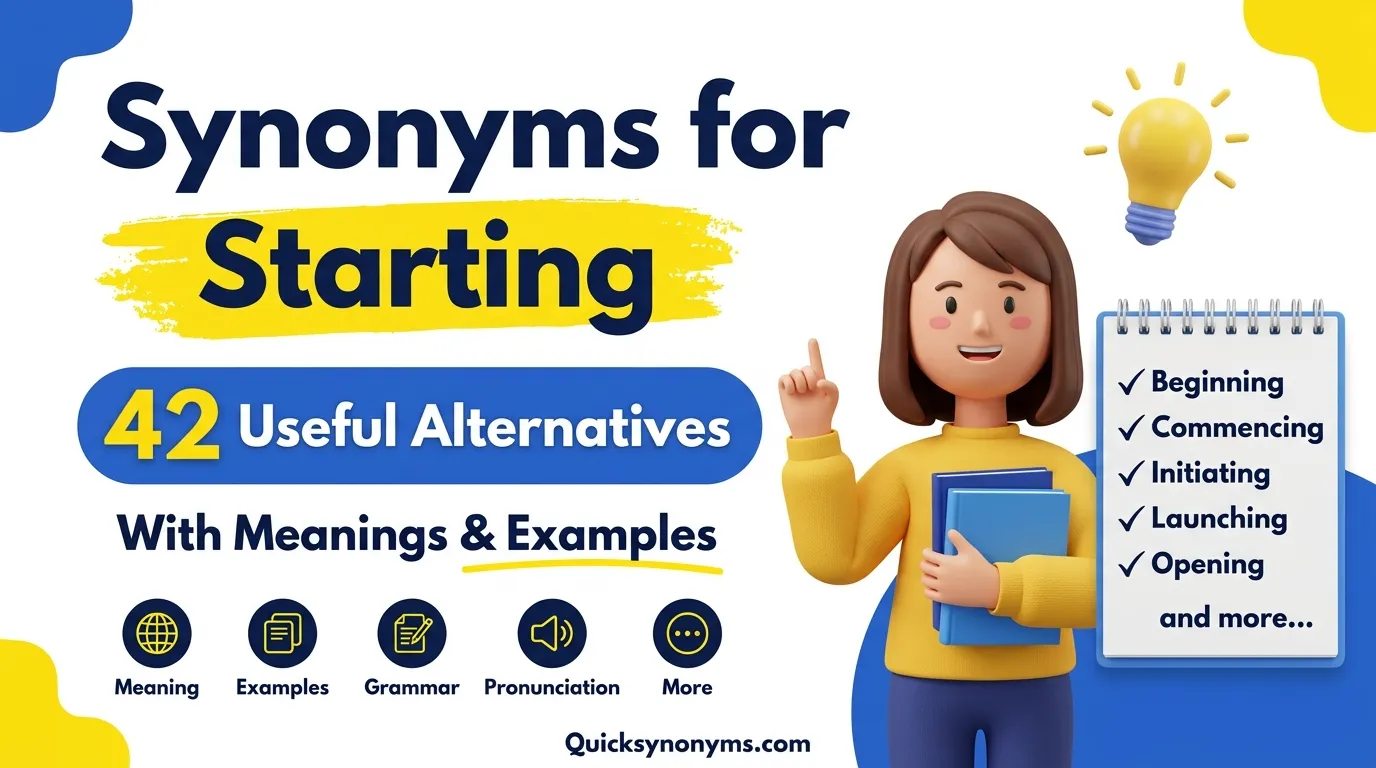
Starting means beginning something or causing something to begin. Imagine a student opening a new book before class, a runner getting ready for a race, or a team beginning a new project. In each case, something is starting. The word is common because it can describe actions, events, work, trips, and new activities.
Learning synonyms for starting helps English learners express ideas in more ways. It also helps content writers avoid using the same word again and again. In this guide, you will learn the meaning of starting, its grammar, history, pronunciation, and 42 useful synonyms. Each word includes a simple meaning and examples, so you can choose the right word for each situation.
Meaning of Starting
Definition
Starting (Verb, Noun, Adjective): Starting means beginning something, making something begin, or being at the beginning of an activity or event.
Examples
- She is starting a new job next week.
- The starting time for the meeting is 9 a.m.
Connotative Meaning
Connotation: The feeling or idea that a word suggests beyond its basic meaning.
- Positive tone: Starting can suggest a fresh chance, new goal, or exciting beginning.
- Negative tone: Starting can sometimes suggest an unwanted task or a difficult first step.
- Neutral tone: Starting can simply describe the point when something begins.
Etymology
The word starting comes from the verb start, which has Germanic roots and has been used in English for many centuries.
- Old English (450–1100): The related word styrtan meant to leap, jump, or spring up.
- Middle English (1100–1500): Forms related to starten developed meanings such as suddenly moving, jumping, or beginning an action.
- Modern English (1500–Present): Start developed its common meaning of beginning an activity, event, process, or action. Starting is its present participle and gerund form.
Pronunciation (IPA)
- IPA: /ˈstɑːr.tɪŋ/
- Syllables: start-ing
Affixation Pattern of Starting
- Root: start
- Prefix: None
- Suffix: -ing
Word formations:
- start (verb, noun)
- started (verb, past tense and past participle)
- starting (verb, present participle and gerund)
- starter (noun)
- starts (verb, third-person singular and noun, plural)
42 Synonyms of Starting, With Meaning & Examples
1. Beginning (Noun, Adjective)
Meaning: The point at which something starts.
Examples:
- The beginning of the movie was exciting.
- We are at the beginning of a new project.
2. Commencing (Verb)
Meaning: Beginning something, often in a formal way.
Examples:
- The ceremony is commencing at noon.
- Work is commencing on Monday.
3. Beginning (Verb)
Meaning: Starting to do or experience something.
Examples:
- She is beginning a new course.
- The rain is beginning to fall.
4. Initiating (Verb)
Meaning: Causing an action or process to begin.
Examples:
- The manager is initiating a new plan.
- Pressing this button is initiating the system.
5. Launching (Verb)
Meaning: Starting something in an active or official way.
Examples:
- The company is launching a new product.
- They are launching the campaign today.
6. Opening (Verb, Noun)
Meaning: Beginning an event, activity, discussion, or period.
Examples:
- The speaker is opening the meeting.
- Her speech marked the opening of the event.
7. Commencement (Noun)
Meaning: The beginning of something.
Examples:
- The commencement of the project was delayed.
- We celebrated the commencement of construction.
8. Initiation (Noun)
Meaning: The act of making something begin.
Examples:
- The initiation of the project took several weeks.
- The meeting marked the initiation of a new program.
9. Inception (Noun)
Meaning: The beginning or creation of something.
Examples:
- The idea has grown since its inception.
- She was involved from the inception of the project.
10. Onset (Noun)
Meaning: The beginning of something, especially a condition, period, or event.
Examples:
- The onset of winter brought colder days.
- He noticed symptoms at the onset of the illness.
11. Origination (Noun)
Meaning: The point or process where something begins or is created.
Examples:
- The origination of the plan was unclear.
- We studied the origination of the idea.
12. Creation (Noun)
Meaning: The act of making or bringing something into existence.
Examples:
- The creation of the website took three months.
- The team worked on the creation of a new system.
13. Establishment (Noun)
Meaning: The act of starting or setting up something.
Examples:
- The establishment of the school changed the town.
- They supported the establishment of a new program.
14. Inauguration (Noun)
Meaning: A formal beginning or official opening.
Examples:
- The inauguration of the new building was held Friday.
- Many guests attended the inauguration.
15. Debut (Noun)
Meaning: The first public appearance or performance of someone or something.
Examples:
- The singer made her debut last night.
- His first novel made its debut this year.
16. Kickoff (Noun)
Meaning: The start of an event, activity, or project.
Examples:
- The project kickoff is scheduled for Monday.
- We held a meeting before the kickoff.
17. Opening (Noun)
Meaning: The beginning or first part of something.
Examples:
- The opening of the store attracted many customers.
- I liked the opening of the story.
18. Outset (Noun)
Meaning: The very beginning of something.
Examples:
- We knew the risks from the outset.
- She supported the project from the outset.
19. Dawn (Noun)
Meaning: The first appearance or beginning of something.
Examples:
- The dawn of the digital age changed communication.
- They worked together at the dawn of a new era.
20. Birth (Noun)
Meaning: The beginning or creation of an idea, movement, or organization.
Examples:
- The meeting led to the birth of a new company.
- The invention marked the birth of a new industry.
21. Emergence (Noun)
Meaning: The beginning of something becoming known, visible, or important.
Examples:
- The emergence of new technology changed the market.
- We watched the emergence of a new trend.
22. Advent (Noun)
Meaning: The arrival or beginning of something important or new.
Examples:
- The advent of computers changed office work.
- The advent of spring brought warmer weather.
23. Inaugurating (Verb)
Meaning: Formally starting or opening something.
Examples:
- The mayor is inaugurating the new library.
- They are inaugurating a new public service.
24. Initiating (Adjective)
Meaning: Beginning an action, process, or activity.
Examples:
- The initiating step is often the hardest.
- This is the initiating stage of the process.
25. Launch (Noun)
Meaning: The act of starting or introducing something.
Examples:
- The product launch is next month.
- The campaign had a successful launch.
26. Activation (Noun)
Meaning: The act of making something active or starting its operation.
Examples:
- Account activation takes only a few minutes.
- The system requires user activation.
27. Activation (Verb)
Meaning: Causing something to start working or operating.
Examples:
- Pressing the button is activating the alarm.
- The device is activating automatically.
28. Triggering (Verb)
Meaning: Causing an event, action, or process to begin.
Examples:
- The message is triggering a new process.
- The error was triggering an automatic alert.
29. Beginning Phase (Noun)
Meaning: The first stage of an activity or process.
Examples:
- We are still in the beginning phase of the project.
- The beginning phase requires careful planning.
30. First Step (Noun)
Meaning: The first action taken toward a goal or process.
Examples:
- Learning the basics is the first step.
- The application is the first step in the process.
31. Getting Underway (Phrase)
Meaning: Beginning or starting to happen.
Examples:
- The meeting is getting underway now.
- Work is finally getting underway.
32. Getting Started (Phrase)
Meaning: Beginning an activity or task.
Examples:
- We are getting started on the project.
- She is getting started with her homework.
33. Setting Off (Phrasal Verb)
Meaning: Beginning a journey or moving toward a place.
Examples:
- We are setting off early tomorrow.
- They set off before sunrise.
34. Kicking Off (Phrasal Verb)
Meaning: Beginning an event, project, or activity.
Examples:
- We are kicking off the campaign today.
- The team is kicking off the new project.
35. Embarking (Verb)
Meaning: Starting a new activity, journey, or important task.
Examples:
- She is embarking on a new career.
- They are embarking on a long journey.
36. Entering (Verb)
Meaning: Beginning to take part in a period, activity, or situation.
Examples:
- The company is entering a new market.
- We are entering a busy season.
37. Taking Up (Phrasal Verb)
Meaning: Beginning to do an activity or use something.
Examples:
- He is taking up photography.
- She took up a new hobby last year.
38. Undertaking (Verb)
Meaning: Beginning a task, project, or responsibility.
Examples:
- The team is undertaking a major project.
- She is undertaking a new research task.
39. Proceeding (Verb)
Meaning: Beginning or continuing with an action after a point.
Examples:
- We are proceeding with the next step.
- The team is proceeding with the plan.
40. Initiating Action (Noun Phrase)
Meaning: The first action taken to make something happen.
Examples:
- Initiating action can solve the problem quickly.
- The manager is responsible for initiating action.
41. Setting in Motion (Phrase)
Meaning: Causing a process or series of events to begin.
Examples:
- The decision is setting in motion major changes.
- Her idea set in motion a new project.
42. Opening the Way (Phrase)
Meaning: Creating a beginning or opportunity for something to happen.
Examples:
- The new policy is opening the way for change.
- Their work is opening the way for future research.
Prototype Meaning
The most typical meaning of starting is beginning something. When people hear this word, they usually imagine an activity moving from a point where nothing has happened yet to a point where action begins. It can describe a simple task, such as starting homework, or a major event, such as starting a business.
Prototype Categorization
- General beginning: beginning, commencing, opening, outset, commencement describe the basic idea of something starting.
- Formal beginning: commencement, initiation, inauguration, inception are useful in formal or professional writing.
- Starting a project or activity: launching, kicking off, getting started, undertaking, initiating work well for tasks, plans, and projects.
- Starting a journey: setting off, embarking, getting underway are useful when someone begins a trip or journey.
- Creating something new: creation, birth, origination, emergence, establishment focus on something coming into existence.
- Causing something to begin: triggering, activation, setting in motion, initiating show that an action causes another process to start.
- First stage or point: first step, beginning phase, outset, dawn focus on the early part of something.
This grouping helps writers choose a synonym based on context. For example, launching fits a product or campaign, while embarking often fits a journey or major activity.
Antonyms of Starting
- Ending (verb/noun): Bringing something to an end.
- Finishing (verb/noun): Completing something.
- Stopping (verb/noun): Bringing an action or process to a halt.
- Ending (noun): The final part of something.
- Conclusion (noun): The point where something finishes.
- Completion (noun): The state of being finished.
- Closing (verb/noun): Bringing something to an end or shutting it.
- Terminating (verb): Ending something completely.
- Ceasing (verb): Stopping an action or activity.
Short Questions and Answers
What does starting mean?
Starting means beginning something or making something begin. It can describe an action, event, process, journey, or activity.
When should starting be used?
Use starting when you want to describe the act of beginning something. It is useful in both everyday speech and formal writing.
Is starting positive or negative?
Starting is usually neutral. Its tone depends on the situation. Starting a new job may feel exciting, while starting a difficult task may feel stressful.
How is it different from similar words?
Starting is a broad word. More specific words change the meaning slightly. For example, launching often suggests introducing something, embarking often suggests beginning a journey or major activity, and initiating often sounds more formal.
Conclusion
Learning the meaning of starting and its synonyms can make your English clearer and more flexible. Words such as beginning, launching, initiating, commencing, opening, and embarking can help you express the same basic idea in different ways. However, each word has its own tone and best use.
Using synonyms also helps you avoid repetition in writing and speaking. Instead of using starting in every sentence, you can choose a word that fits the exact context. This makes your writing more natural and precise. It can also build confidence when you speak or write in English.
Try learning a few new words each day. Practice them in short sentences, and soon you will know which synonym fits each situation best.
Keep Reading: Synonyms for Deliver: 45 Useful Alternatives

English Teacher & Linguistics Writer
Grace Whitmore creates engaging educational content on vocabulary, word usage, and effective communication. Her goal is to help learners build confidence through clear and practical English guidance.









1 thought on “Synonyms for Starting: 42 Useful Alternatives”