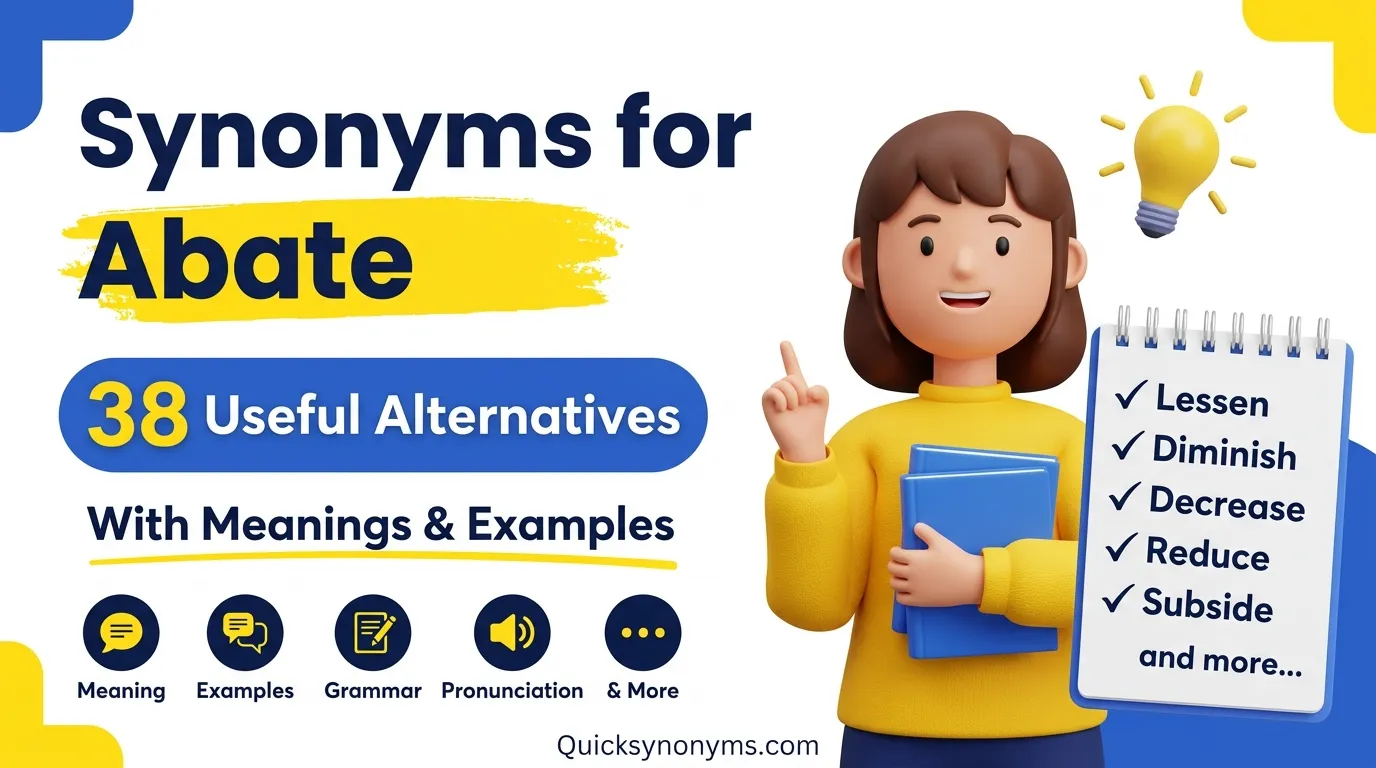
When a storm begins to abate, the wind slows, the rain becomes lighter, and the danger starts to fade. The word means to become less strong, severe, or intense. It is often used for storms, pain, anger, fear, noise, pressure, and other things that can become weaker.
Learning synonyms for abate gives English learners more ways to express a decrease in strength or intensity. It also helps writers avoid repeating the same word. However, not every synonym works in every situation. Some fit weather, some fit feelings, and others fit pain or conflict. This guide explains abate with simple meanings, examples, pronunciation, word history, grammar, and useful synonym groups.
Meaning of Abate
Definition
Abate (Verb): To become less strong, severe, or intense, or to make something less strong or severe.
Examples
- The heavy rain began to abate after midnight.
- The medicine helped abate the pain.
Connotative Meaning
Positive tone: It can suggest relief when something unpleasant becomes weaker.
Negative tone: It may describe a problem, threat, pain, or force that is still present but less strong.
Neutral tone: It can simply describe a decrease in strength, force, level, or intensity.
(Connotation: the feeling or idea that a word suggests beyond its basic meaning.)
Etymology
- Old English (450–1100): Abate is not an Old English word. Its history comes from later French and Latin sources.
- Middle English (1100–1500): The word entered Middle English through Old French and Anglo-French forms related to abatre, meaning “to beat down” or “to reduce.”
- Modern English (1500–Present): Abate developed its modern meaning of becoming less strong or making something less severe. It is now used in everyday, formal, legal, and literary English.
Pronunciation (IPA)
- IPA: /əˈbeɪt/
- Syllables: a-bate
Affixation Pattern of Abate
- Root: bate
- Prefix: a-
- Suffix: None in the base form
- Word formations:
- Abate – verb
- Abated – verb, past tense and past participle
- Abating – verb, present participle
- Abatement – noun
- Abater – noun
- Abatable – adjective
38 Synonyms of Abate, With Meaning & Examples
1. Lessen (Verb)
Meaning: To become or make something less in amount, strength, or severity.
Examples:
- The pain began to lessen.
- The noise slowly lessened.
2. Diminish (Verb)
Meaning: To become or make something weaker, smaller, or less important.
Examples:
- The storm began to diminish.
- Her fear gradually diminished.
3. Decrease (Verb)
Meaning: To become or make something lower in amount, level, or intensity.
Examples:
- The rainfall began to decrease.
- The pain decreased after treatment.
4. Reduce (Verb)
Meaning: To make something smaller, lower, or less intense.
Examples:
- The medicine helped reduce the pain.
- We need to reduce the noise.
5. Subside (Verb)
Meaning: To become less strong, violent, or intense.
Examples:
- The storm finally subsided.
- Her anger began to subside.
6. Weaken (Verb)
Meaning: To become or make something less strong.
Examples:
- The wind began to weaken.
- The treatment helped weaken the symptoms.
7. Ease (Verb)
Meaning: To become or make something less severe, painful, or intense.
Examples:
- The pain started to ease.
- The tension slowly eased.
8. Wane (Verb)
Meaning: To gradually become weaker or less powerful.
Examples:
- His interest began to wane.
- The excitement waned after a few hours.
9. Taper (Verb)
Meaning: To gradually become smaller, weaker, or less intense.
Examples:
- The rain began to taper.
- The noise tapered off by midnight.
10. Recede (Verb)
Meaning: To move back or become less strong, noticeable, or serious.
Examples:
- The floodwaters began to recede.
- Her anger slowly receded.
11. Ebb (Verb)
Meaning: To gradually become weaker or less strong.
Examples:
- The crowd’s excitement began to ebb.
- His confidence started to ebb.
12. Decline (Verb)
Meaning: To become lower, weaker, or less in amount or strength.
Examples:
- Demand began to decline.
- The wind speed continued to decline.
13. Dwindle (Verb)
Meaning: To gradually become smaller, weaker, or less.
Examples:
- Their hope began to dwindle.
- The noise slowly dwindled.
14. Slack (Verb)
Meaning: To become less active, strong, or intense.
Examples:
- The wind began to slack.
- Business slacked during the winter.
15. Soften (Verb)
Meaning: To become or make something less harsh, severe, or intense.
Examples:
- The wind began to soften.
- His anger eventually softened.
16. Moderate (Verb)
Meaning: To make something less extreme or intense.
Examples:
- The treatment helped moderate the symptoms.
- Trees can moderate extreme heat.
17. Mitigate (Verb)
Meaning: To make something harmful or severe less serious.
Examples:
- The plan may mitigate the damage.
- These steps can mitigate the risk.
18. Alleviate (Verb)
Meaning: To make pain, suffering, or a problem less severe.
Examples:
- The treatment helped alleviate the pain.
- The changes may alleviate the problem.
19. Temper (Verb)
Meaning: To make something less strong, extreme, or severe.
Examples:
- The cool air tempered the heat.
- The facts helped temper his anger.
20. Dampen (Verb)
Meaning: To make something less strong, active, or intense.
Examples:
- The rain dampened the noise.
- The news dampened their excitement.
21. Calm (Verb)
Meaning: To make something less disturbed, excited, or intense.
Examples:
- The medicine helped calm the pain.
- The rain helped calm the dusty streets.
22. Soothe (Verb)
Meaning: To make pain, worry, anger, or discomfort less strong.
Examples:
- The treatment helped soothe the pain.
- Her words soothed his worry.
23. Relieve (Verb)
Meaning: To reduce pain, pressure, stress, or discomfort.
Examples:
- The medicine helped relieve the pain.
- A short break can relieve stress.
24. Allay (Verb)
Meaning: To reduce fear, worry, doubt, or concern.
Examples:
- The news helped allay her fears.
- The explanation allayed their concerns.
25. Assuage (Verb)
Meaning: To make an unpleasant feeling less strong or severe.
Examples:
- His apology helped assuage her anger.
- Nothing could assuage his grief.
26. Attenuate (Verb)
Meaning: To make something weaker or less intense.
Examples:
- The material helps attenuate sound.
- The filter can attenuate the signal.
27. Mollify (Verb)
Meaning: To make someone less angry or upset.
Examples:
- The apology helped mollify the customer.
- She tried to mollify the angry crowd.
28. Pacify (Verb)
Meaning: To make a person or group calmer and less hostile.
Examples:
- The leader tried to pacify the crowd.
- She offered an explanation to pacify the angry customer.
29. Appease (Verb)
Meaning: To calm someone by satisfying a demand or reducing anger.
Examples:
- The company offered a refund to appease the customer.
- He tried to appease the angry group.
30. Quell (Verb)
Meaning: To stop or greatly reduce something strong, such as anger, fear, or unrest.
Examples:
- The police worked to quell the unrest.
- Her words helped quell his fears.
31. Quiet (Verb)
Meaning: To make something less loud, active, or intense.
Examples:
- The medicine helped quiet the pain.
- The rain quieted the noisy streets.
32. Mute (Verb)
Meaning: To make a sound, feeling, or effect less strong.
Examples:
- Thick walls mute outside noise.
- The change muted the impact of the news.
33. Blunt (Verb)
Meaning: To make something less strong, sharp, or effective.
Examples:
- The new rule may blunt the impact of the change.
- The drug can blunt the pain.
34. Dilute (Verb)
Meaning: To make something less strong by adding another substance or element.
Examples:
- Water diluted the strong solution.
- Extra details diluted the main message.
35. De-escalate (Verb)
Meaning: To make a conflict, argument, or tense situation less intense.
Examples:
- The officers tried to de-escalate the situation.
- Both sides agreed to de-escalate the conflict.
36. Lighten (Verb)
Meaning: To make something less serious, heavy, or difficult.
Examples:
- The joke helped lighten the mood.
- Extra workers lightened the workload.
37. Tone Down (Phrasal Verb)
Meaning: To make something less strong, extreme, or forceful.
Examples:
- The editor asked him to tone down the language.
- She toned down her criticism.
38. Die Down (Phrasal Verb)
Meaning: To gradually become less strong, loud, or active.
Examples:
- The wind finally died down.
- The applause slowly died down.
Prototype Meaning
The most typical meaning of abate is for something strong or unpleasant to become weaker. People often use it for storms, rain, pain, anger, fear, noise, pressure, and other intense conditions.
When a storm abates, for example, it does not always stop at once. It simply becomes less severe. This idea of reduced strength is the central meaning of the word.
Prototype Categorization
- Direct reduction: lessen, diminish, decrease, reduce, weaken describe a clear drop in strength, amount, or intensity.
- Natural weakening: subside, wane, taper, recede, ebb, dwindle often describe something becoming weaker over time.
- Reducing severity: ease, moderate, mitigate, alleviate, temper, soften are useful when a problem, condition, or effect becomes less severe.
- Reducing feelings: calm, soothe, relieve, allay, assuage often describe weaker pain, fear, anger, worry, or stress.
- Making something weaker: dampen, attenuate, mute, blunt, dilute focus on reducing force, sound, effect, strength, or intensity.
- Reducing conflict: mollify, pacify, appease, quell, de-escalate are mainly used for anger, hostility, unrest, or tense situations.
- Informal reduction: tone down and die down are common in everyday English and are useful when describing reduced intensity.
This grouping helps writers choose the right synonym instead of treating all 38 words as exact replacements. Abate is broad, while many alternatives work best in specific contexts.
Antonyms of Abate
- Increase (Verb): To become or make something greater in amount or strength.
- Intensify (Verb): To become or make something more intense.
- Strengthen (Verb): To make or become stronger.
- Escalate (Verb): To become or make a situation more serious or intense.
- Rise (Verb): To move to a higher level or amount.
- Grow (Verb): To become greater in size, amount, or strength.
- Worsen (Verb): To become more severe or unpleasant.
- Amplify (Verb): To make something stronger, louder, or greater.
Short Questions and Answers
What does abate mean?
Abate means to become less strong or severe, or to make something less strong or severe.
When should abate be used?
Use abate when talking about a decrease in strength, force, severity, or intensity. It works well with words such as rain, storms, pain, anger, fear, and noise.
Is abate positive or negative?
Abate is usually neutral. It can describe a positive change when something unpleasant becomes weaker, but the word itself does not express strong emotion.
How is it different from similar words?
Abate is a broad word for reduced strength or intensity. Subside often describes something becoming weaker on its own. Alleviate is common with pain or suffering. Mitigate focuses on reducing harm or severity. Curb is more about controlling something, so it is not a direct synonym in every situation.
Conclusion
Learning abate and its synonyms can make your English more flexible and precise. Instead of repeating one word, you can choose an alternative that fits the exact situation. For example, subside works well for a storm, alleviate fits pain, and allay works well with fear or worry.
These words can strengthen both writing and speaking. Understanding their small differences helps you create clearer and more natural sentences. It also makes it easier to understand these words when you see them in books, news stories, schoolwork, and everyday English.
Try learning a few synonyms each day. Write simple sentences with them and compare how each word changes the meaning. With regular practice, abate and its related words will become easier to remember and use correctly.
Keep Reading: Synonyms for Located: 38 Useful Alternatives

English Teacher & Linguistics Writer
Grace Whitmore creates engaging educational content on vocabulary, word usage, and effective communication. Her goal is to help learners build confidence through clear and practical English guidance.






1 thought on “Synonyms for Abate: 38 Useful Alternatives”