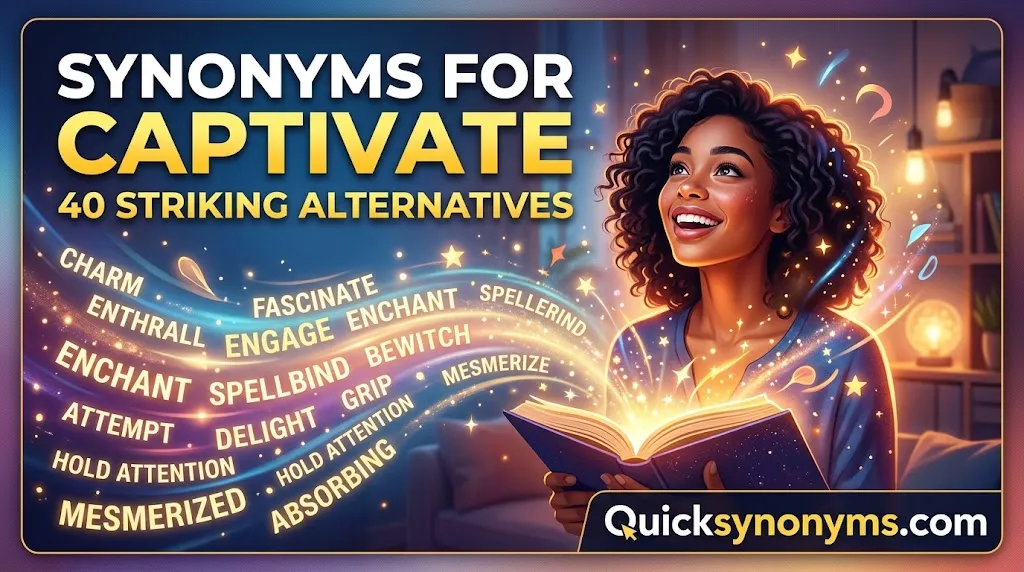
Some useful synonyms for captivate are fascinate, enchant, charm, mesmerize, enthrall, attract, engage, delight, intrigue, and absorb.
Captivate means to hold someone’s attention or interest in a strong and lasting way. Imagine watching a movie that keeps you focused from the first scene to the last. The story has captivated you because you cannot look away.
The word is common in everyday English. We use it when talking about people, stories, performances, ideas, beauty, or experiences that strongly attract our attention.
Learning synonyms for captivate helps English learners express ideas with greater detail. It also helps content writers avoid using the same word again and again.
In this guide, you will learn the meaning of captivate, its examples, connotative meaning, etymology, pronunciation, word formation, and 40 useful synonyms. You will also see semantic categories that make it easier to choose the right word for each situation.
Meaning of Captivate
Definition
Captivate (Verb): To attract and hold someone’s attention, interest, or admiration very strongly.
Examples
- The speaker captivated the audience with her powerful story.
- The beautiful view captivated everyone who visited the mountain.
Connotative Meaning
Connotation: The feeling or idea that a word suggests beyond its basic meaning.
- Positive tone: Captivate often suggests strong attraction, beauty, pleasure, or admiration.
- Negative tone: In some contexts, it can suggest being unable to stop watching or thinking about something.
- Neutral tone: It can simply describe something that holds attention strongly without expressing a clear emotional judgment.
Etymology
The word captivate comes from Latin and is connected to the idea of taking or holding someone captive. It later developed the figurative sense of holding a person’s attention.
- Old English (450–1100): The exact modern word captivate was not part of Old English. However, English had related words for holding, taking, and capturing.
- Middle English (1100–1500): English increasingly borrowed vocabulary from French and Latin. Words related to captivity and capture became established.
- Modern English (1500–Present): Captivate developed its figurative sense of strongly attracting and holding someone’s attention, interest, or admiration.
The word ultimately traces to Latin captivare, related to captivus, meaning “captive.”
Pronunciation (IPA)
- IPA: /ˈkæptɪveɪt/
- Syllables: cap-ti-vate
Affixation Pattern of Captivate
- Root: captiv
- Prefix: None in the modern English form
- Suffix: -ate
- Word formations:
- Captivate – verb
- Captivated – adjective/past participle
- Captivating – adjective/present participle
- Captivation – noun
- Captivator – noun
- Captively – adverb, rare and related to captive
40 Synonyms of Captivate With Meaning & Examples
1. Fascinate (Verb)
Meaning: To attract someone’s strong interest or curiosity.
Examples:
- Space exploration fascinates young students.
- The strange painting fascinated everyone in the room.
2. Enchant (Verb)
Meaning: To delight someone greatly through beauty, charm, or magic.
Examples:
- The peaceful garden enchanted the visitors.
- Her gentle voice enchanted the audience.
3. Charm (Verb)
Meaning: To please or attract someone through pleasant qualities.
Examples:
- The little village charmed us immediately.
- His friendly personality charmed everyone.
4. Mesmerize (Verb)
Meaning: To hold someone’s attention so strongly that they seem unable to look away.
Examples:
- The dancer mesmerized the crowd.
- The bright colors mesmerized the children.
5. Enthrall (Verb)
Meaning: To completely absorb and excite someone’s attention.
Examples:
- The novel enthralled me from the first page.
- Her performance enthralled the audience.
6. Attract (Verb)
Meaning: To draw someone’s attention, interest, or desire.
Examples:
- The bright sign attracted many customers.
- The museum attracts visitors from around the world.
7. Engage (Verb)
Meaning: To hold someone’s attention or interest.
Examples:
- The teacher used games to engage the students.
- The article engages readers with simple language.
8. Delight (Verb)
Meaning: To give someone great pleasure or enjoyment.
Examples:
- The children’s performance delighted their parents.
- The delicious meal delighted every guest.
9. Intrigue (Verb)
Meaning: To make someone very curious or interested.
Examples:
- The mysterious letter intrigued me.
- The unusual design intrigued the visitors.
10. Absorb (Verb)
Meaning: To completely occupy someone’s attention or thoughts.
Examples:
- The book absorbed my attention for hours.
- She was absorbed by the exciting story.
11. Bewitch (Verb)
Meaning: To attract someone so strongly that they seem unable to resist.
Examples:
- The singer’s voice bewitched the audience.
- The old castle seemed to bewitch every visitor.
12. Beguile (Verb)
Meaning: To attract or entertain someone through charm or pleasant qualities.
Examples:
- The storyteller beguiled the children with funny tales.
- The beautiful scenery beguiled the travelers.
13. Enamor (Verb)
Meaning: To make someone strongly attracted or pleased by something.
Examples:
- The city quickly enamored the young traveler.
- She was enamored with the artist’s work.
14. Allure (Verb)
Meaning: To attract someone through an appealing or mysterious quality.
Examples:
- The island allures travelers with its natural beauty.
- The promise of adventure allured him.
15. Entice (Verb)
Meaning: To attract someone by offering something appealing.
Examples:
- The restaurant enticed customers with a special menu.
- The colorful display enticed shoppers to enter.
16. Seduce (Verb)
Meaning: To strongly attract someone, often by appealing to desire or temptation.
Examples:
- The luxurious hotel seduced visitors with its elegant design.
- The promise of quick success seduced many investors.
17. Woo (Verb)
Meaning: To try to attract, persuade, or win someone’s interest or support.
Examples:
- The company is trying to woo new customers.
- The candidate worked hard to woo undecided voters.
18. Please (Verb)
Meaning: To make someone feel happy, satisfied, or entertained.
Examples:
- The performance pleased the audience.
- The simple design pleased many users.
19. Entertain (Verb)
Meaning: To hold someone’s attention by providing enjoyment or amusement.
Examples:
- The comedian entertained the crowd.
- The video entertained millions of viewers.
20. Excite (Verb)
Meaning: To create strong interest, enthusiasm, or anticipation.
Examples:
- The announcement excited the fans.
- The new project excited the entire team.
21. Thrill (Verb)
Meaning: To give someone a strong feeling of excitement or pleasure.
Examples:
- The roller coaster thrilled the children.
- The final scene thrilled the audience.
22. Delight (Verb)
Meaning: To make someone very happy or pleased.
Examples:
- The surprise delighted her.
- The colorful show delighted the children.
23. Amaze (Verb)
Meaning: To surprise someone greatly through something impressive or unusual.
Examples:
- The magician amazed the audience.
- Her progress amazed her teacher.
24. Astonish (Verb)
Meaning: To surprise someone very strongly.
Examples:
- The athlete’s performance astonished everyone.
- The discovery astonished the scientists.
25. Impress (Verb)
Meaning: To make someone admire or respect something because it is good or remarkable.
Examples:
- Her confidence impressed the judges.
- The new building impressed every visitor.
26. Interest (Verb)
Meaning: To make someone curious or attentive.
Examples:
- History interests many students.
- The topic interested me immediately.
27. Occupy (Verb)
Meaning: To take up someone’s attention, time, or thoughts.
Examples:
- The puzzle occupied his mind all afternoon.
- The activity occupied the children’s attention.
28. Preoccupy (Verb)
Meaning: To fill someone’s thoughts so strongly that other things receive less attention.
Examples:
- The problem preoccupied her all day.
- His future plans preoccupied his thoughts.
29. Hook (Verb)
Meaning: To capture someone’s attention and make them want to continue.
Examples:
- The opening scene hooked the viewers.
- The first chapter hooked me instantly.
30. Grip (Verb)
Meaning: To hold someone’s attention or emotions very strongly.
Examples:
- The thriller gripped the audience.
- The dramatic story gripped readers until the end.
31. Rivet (Verb)
Meaning: To hold someone’s complete attention.
Examples:
- The documentary riveted the audience.
- Her speech riveted everyone in the hall.
32. Engage (Verb)
Meaning: To attract and maintain someone’s attention or involvement.
Examples:
- Good stories engage readers.
- The activity engaged the students for hours.
33. Draw (Verb)
Meaning: To attract someone toward something.
Examples:
- The unusual sculpture drew many visitors.
- Her performance drew a large crowd.
34. Lure (Verb)
Meaning: To attract someone toward something appealing or tempting.
Examples:
- The bright lights lured tourists into the market.
- The offer lured many new customers.
35. Tempt (Verb)
Meaning: To attract someone by making something seem desirable.
Examples:
- The delicious smell tempted me to enter the bakery.
- The discount tempted shoppers to buy more.
36. Seduce (Verb)
Meaning: To attract someone powerfully by making something seem desirable.
Examples:
- The luxurious lifestyle seduced him.
- The beautiful design seduced potential buyers.
37. Fascinate (Verb)
Meaning: To make someone extremely interested in something.
Examples:
- Ancient history fascinates her.
- The strange machine fascinated the children.
38. Enthuse (Verb)
Meaning: To make someone feel excited and enthusiastic.
Examples:
- The coach’s speech enthused the players.
- The new idea enthused the whole team.
39. Captivate (Verb)
Meaning: To hold someone’s attention or admiration strongly.
Examples:
- The singer captivated the crowd.
- The story captivated readers from beginning to end.
40. Enrapture (Verb)
Meaning: To fill someone with great delight or pleasure.
Examples:
- The beautiful music enraptured the audience.
- The breathtaking view enraptured the travelers.
Prototype Meaning
The most typical meaning of captivate is to hold someone’s attention so strongly that they become deeply interested or fascinated. When people hear this word, they often imagine a powerful story, beautiful performance, charming person, or amazing sight that makes it difficult to look away. The word usually suggests more than simple interest. It often describes a strong emotional or mental attraction.
Prototype Categorization
The 40 synonyms can be grouped by the type of attraction they express:
- Strong Attention: Fascinate, mesmerize, enthrall, absorb, grip, rivet, hook, engage. These words work well when something holds a person’s full attention.
- Beauty and Charm: Enchant, charm, bewitch, beguile, allure, enamor, enrapture. These are useful when attraction comes from beauty, personality, or emotional appeal.
- Curiosity and Interest: Intrigue, interest, amaze, astonish, impress. These words fit situations where something makes people curious, surprised, or impressed.
- Pleasure and Enjoyment: Delight, please, entertain, thrill, excite, enthuse. These are best when something creates happiness, excitement, or enjoyment.
- Temptation and Desire: Entice, seduce, woo, lure, tempt. These words suggest attraction toward something desirable or tempting.
- Drawing Attention: Attract, draw, occupy, preoccupy. These are useful when something pulls attention, thoughts, or people toward it.
This categorization helps writers choose a synonym based on the exact kind of attraction they want to express. For example, intrigue is better for curiosity, while enchant is stronger for beauty and charm.
Antonyms of Captivate
1. Bore (Verb)
Meaning: To make someone lose interest or feel uninterested.
2. Repel (Verb)
Meaning: To make someone strongly dislike or avoid something.
3. Distract (Verb)
Meaning: To take someone’s attention away from something.
4. Disinterest (Verb)
Meaning: To cause someone to lose interest.
5. Ignore (Verb)
Meaning: To give no attention to someone or something.
6. Dull (Verb)
Meaning: To make something less interesting or exciting.
7. Offend (Verb)
Meaning: To cause someone to feel upset, hurt, or angry.
8. Discourage (Verb)
Meaning: To reduce someone’s interest, confidence, or desire to continue.
Short Questions and Answers
What does captivate mean?
Captivate means to attract and hold someone’s attention, interest, or admiration very strongly.
When should captivate be used?
Use captivate when something holds a person’s attention in a powerful or lasting way. It works well for stories, people, performances, ideas, views, and experiences.
Is captivate positive or negative?
Captivate is usually positive. It often suggests strong interest, admiration, beauty, or enjoyment. The exact feeling depends on the context.
How is it different from similar words?
Captivate is a broad word for strongly holding attention. Fascinate focuses on intense interest, enchant suggests beauty or charm, mesmerize suggests almost hypnotic attention, and intrigue focuses more on curiosity.
Conclusion
Learning captivate and its synonyms can make your English more flexible and expressive. Instead of using the same word every time, you can choose a word that shows the exact type of attraction you mean.
For example, use fascinate for strong interest, enchant for beauty and charm, intrigue for curiosity, and mesmerize for powerful attention.
These small vocabulary choices can strengthen both writing and speaking. They also help you avoid repetition and make your ideas clearer.
For English learners and content writers, building a strong synonym bank is a simple way to grow vocabulary. Practice a few new words each day, write your own sentences, and use each synonym in the right context. With regular practice, your English will become more natural, varied, and confident.
Explore More Synonyms: Synonyms for Received: 38 Better Words to Use

English Teacher & Linguistics Writer
Grace Whitmore creates engaging educational content on vocabulary, word usage, and effective communication. Her goal is to help learners build confidence through clear and practical English guidance.



1 thought on “Synonyms for Captivate: 40 Striking Alternatives”