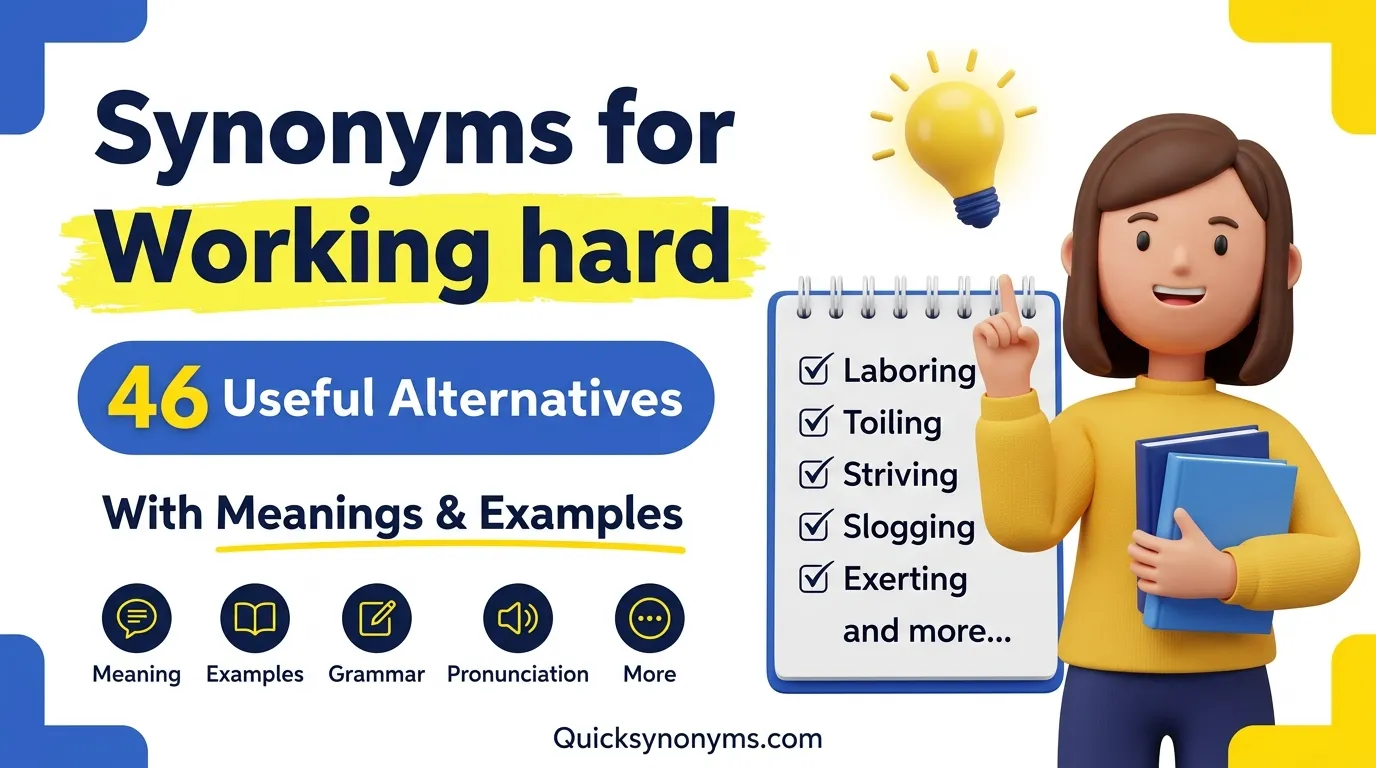
Working hard means putting in a lot of effort to finish a task or reach a goal. A student may work hard to pass an exam, while a parent may work hard to support a family. People use this phrase every day because it describes effort, care, and the desire to do well.
Learning synonyms for working hard helps you express ideas in fresh and clear ways. English learners can use these words to build vocabulary and speak with more confidence. Writers can use them to avoid repetition and make their work more engaging.
This article covers the meaning of working hard, its examples, pronunciation, grammar, word history, and related word forms. You will also learn 46 synonyms, their meanings, and examples, along with antonyms and useful ways to choose the right word.
Meaning of Working hard
Definition
Working hard (verb phrase): Putting a lot of effort, time, or energy into a task to achieve a goal.
Examples
- She is working hard to improve her English.
- They were working hard to finish the project on time.
Connotative Meaning
- Positive tone: Shows effort, dedication, and a desire to succeed.
- Negative tone: Can suggest stress, exhaustion, or too much work.
- Neutral tone: Describes putting a lot of effort into a task.
(Connotation: the emotional or cultural feeling a word carries beyond its literal meaning.)
Etymology
The phrase working hard combines two old English words: work and hard. Both have roots in Old English, and their meanings have stayed close to their modern uses.
- Old English (450 to 1100): Work came from Old English weorc for a task or effort. Hard came from heard, meaning strong, firm, or difficult.
- Middle English (1100 to 1500): The words developed into forms such as work and hard. They were used to describe tasks, effort, and difficulty.
- Modern English (1500 to present): Working hard became a common phrase for giving strong effort to a task, job, or goal.
Pronunciation (IPA)
- IPA: /ˌwɜːrkɪŋ ˈhɑːrd/ (American English)
- Syllables: work-ing hard
Affixation Pattern of Working hard
- Root: Work and hard.
- Prefix: None.
- Suffix: -ing in working, which forms the present participle of work.
- Word formations:
- Work (verb or noun): To do a task, or the task itself.
- Working (verb form or adjective): Doing a task or operating.
- Worker (noun): A person who does a job.
- Workload (noun): The amount of work a person must do.
- Hard (adjective or adverb): Difficult, strong, or with great effort.
- Hardworking (adjective): Putting much effort into work.
- Hardness (noun): The quality of being hard or firm.
46 Synonyms of Working hard: With Meaning and Examples
1. Laboring (verb)
Meaning: Working with great effort, often on a difficult task.
Examples:
- The workers were laboring in the hot sun.
- She spent the day laboring over her report.
2. Toiling (verb)
Meaning: Working very hard for a long time.
Examples:
- Farmers were toiling in the fields.
- He kept toiling until the job was done.
3. Striving (verb)
Meaning: Making a strong effort to reach a goal.
Examples:
- She is striving to become a better teacher.
- They are striving for success through daily practice.
4. Slogging (verb)
Meaning: Working hard at a tiring or difficult task.
Examples:
- We were slogging through a long list of tasks.
- He spent hours slogging away at his homework.
5. Exerting (verb)
Meaning: Using physical or mental energy to do something.
Examples:
- She was exerting herself to finish the race.
- The team kept exerting effort during the final hour.
6. Endeavoring (verb)
Meaning: Trying hard to do or achieve something.
Examples:
- He was endeavoring to solve the problem.
- They kept endeavoring to improve their service.
7. Persevering (verb)
Meaning: Continuing to work despite problems or delays.
Examples:
- She was persevering through a hard course.
- He kept persevering until he found a solution.
8. Hustling (verb)
Meaning: Working quickly and energetically to get things done.
Examples:
- The staff were hustling to serve every guest.
- She has been hustling to grow her small business.
9. Grinding (verb)
Meaning: Working hard for a long time, often with steady effort.
Examples:
- He was grinding through his daily tasks.
- They kept grinding until they reached their target.
10. Grafting (verb)
Meaning: Working very hard, especially through physical effort.
Examples:
- The builders were grafting all day.
- She has been grafting to save enough money for college.
11. Drudging (verb)
Meaning: Doing tiring or dull work with steady effort.
Examples:
- He was drudging through piles of old papers.
- They spent the morning drudging through routine tasks.
12. Slaving (verb)
Meaning: Working extremely hard, often for a long time.
Examples:
- She was slaving over the stove before the guests arrived.
- He spent all weekend slaving over his assignment.
13. Sweating (verb)
Meaning: Putting in great physical effort to complete a task.
Examples:
- The team was sweating through a tough training session.
- He was sweating over the final details of the project.
14. Persisting (verb)
Meaning: Continuing an effort even when something is difficult.
Examples:
- She kept persisting with her language lessons.
- He was persisting despite several setbacks.
15. Applying oneself (verb phrase)
Meaning: Giving full attention and effort to a task.
Examples:
- She is applying herself to her studies.
- He applied himself to learning new skills.
16. Buckling down (verb phrase)
Meaning: Starting to work seriously and with focus.
Examples:
- We are buckling down to prepare for the exam.
- He buckled down and finished the report.
17. Knuckling down (verb phrase)
Meaning: Beginning to work hard instead of wasting time.
Examples:
- She knuckled down and studied for two hours.
- The team is knuckling down before the deadline.
18. Plugging away (verb phrase)
Meaning: Continuing to work steadily on something difficult.
Examples:
- He kept plugging away at the puzzle.
- She is plugging away at her writing goals.
19. Pressing on (verb phrase)
Meaning: Continuing to work despite challenges.
Examples:
- They kept pressing on despite the rain.
- She was pressing on to complete the project.
20. Pushing oneself (verb phrase)
Meaning: Making oneself work harder than usual.
Examples:
- He was pushing himself to improve his speed.
- She kept pushing herself during training.
21. Working diligently (verb phrase)
Meaning: Working with care, effort, and attention.
Examples:
- The students were working diligently on their essays.
- She is working diligently to meet her goals.
22. Working tirelessly (verb phrase)
Meaning: Working very hard without seeming to tire.
Examples:
- The nurses were working tirelessly through the night.
- He worked tirelessly to support the project.
23. Working earnestly (verb phrase)
Meaning: Working with sincere effort and serious intent.
Examples:
- She was working earnestly to improve her skills.
- They worked earnestly to solve the issue.
24. Working steadily (verb phrase)
Meaning: Working at a regular pace without giving up.
Examples:
- He was working steadily toward his goal.
- The crew worked steadily until the room was clean.
25. Working persistently (verb phrase)
Meaning: Continuing to put in effort over time.
Examples:
- She was working persistently on her research.
- They worked persistently to improve their results.
26. Working intensively (verb phrase)
Meaning: Working with strong focus and effort in a short period.
Examples:
- The team was working intensively before launch day.
- She worked intensively to prepare for the competition.
27. Working vigorously (verb phrase)
Meaning: Working with great energy and force.
Examples:
- The volunteers were working vigorously to clear the path.
- He worked vigorously to finish the repairs.
28. Working industriously (verb phrase)
Meaning: Working hard and making good use of time.
Examples:
- The children were working industriously on their models.
- She worked industriously throughout the afternoon.
29. Working overtime (verb phrase)
Meaning: Working beyond normal work hours.
Examples:
- He was working overtime to meet the deadline.
- The staff worked overtime during the busy season.
30. Making efforts (verb phrase)
Meaning: Taking action and trying hard to reach a result.
Examples:
- She is making efforts to improve her writing.
- They are making efforts to reduce waste.
31. Exerting oneself (verb phrase)
Meaning: Using a lot of energy to do something.
Examples:
- He was exerting himself during the final climb.
- She exerted herself to complete the heavy work.
32. Applying effort (verb phrase)
Meaning: Using energy and attention to complete a task.
Examples:
- He is applying effort to every lesson.
- The group applied effort to solve the challenge.
33. Giving effort (verb phrase)
Meaning: Putting energy and care into an activity.
Examples:
- She is giving effort to her daily practice.
- They gave effort to every part of the task.
34. Laboring away (verb phrase)
Meaning: Continuing to work hard on a demanding task.
Examples:
- He was laboring away in the workshop.
- She kept laboring away at her research paper.
35. Toiling away (verb phrase)
Meaning: Working hard for a long time without stopping.
Examples:
- The cooks were toiling away in the kitchen.
- He was toiling away at his project all evening.
36. Slogging away (verb phrase)
Meaning: Keeping up hard work through a tiring task.
Examples:
- She was slogging away at her revision notes.
- They kept slogging away until the field was clear.
37. Grinding away (verb phrase)
Meaning: Continuing to work hard in a steady, often tiring way.
Examples:
- He was grinding away at his coding project.
- The team kept grinding away through the long season.
38. Hustling hard (verb phrase)
Meaning: Working with speed, energy, and strong purpose.
Examples:
- She was hustling hard to grow her shop.
- They are hustling hard to finish before Friday.
39. Striving hard (verb phrase)
Meaning: Making a strong effort to achieve something.
Examples:
- He is striving hard to earn a scholarship.
- They were striving hard to reach their goal.
40. Trying hard (verb phrase)
Meaning: Making a serious effort to do something well.
Examples:
- She is trying hard to learn new words.
- He tried hard to fix the broken bike.
41. Studying hard (verb phrase)
Meaning: Spending much time and effort learning a subject.
Examples:
- She is studying hard for her final exams.
- They studied hard to prepare for the test.
42. Practicing hard (verb phrase)
Meaning: Repeating an activity with strong effort to improve.
Examples:
- He is practicing hard for the school concert.
- She practiced hard to improve her tennis serve.
43. Training hard (verb phrase)
Meaning: Exercising or learning skills with great effort.
Examples:
- The runners are training hard for the race.
- She trained hard to build her strength.
44. Concentrating (verb)
Meaning: Giving close attention to a task or activity.
Examples:
- He was concentrating on his difficult assignment.
- She concentrated on each step of the process.
45. Laboring diligently (verb phrase)
Meaning: Working hard with care and steady attention.
Examples:
- The researchers were laboring diligently over their findings.
- He labored diligently to complete the repairs.
46. Working assiduously (verb phrase)
Meaning: Working with great care, effort, and persistence.
Examples:
- She was working assiduously on her thesis.
- The team worked assiduously to meet its target.
Prototype Meaning
The most typical meaning of working hard is putting strong effort into a task to achieve a clear goal. People often imagine a student studying for an exam, a worker finishing a demanding job, or an athlete training for a competition. The phrase usually suggests focus, time, energy, and a willingness to keep going when a task is difficult.
Prototype Categorization
– Strong effort and struggle: Laboring, toiling, slogging, exerting, grinding, grafting, drudging, slaving, sweating, laboring away, toiling away, slogging away, grinding away. Use these words when the work feels tiring, demanding, or physically hard.
– Goals and determination: Striving, endeavoring, persevering, persisting, pressing on, pushing oneself, striving hard, trying hard. Use these when someone wants to reach a goal or overcome a challenge.
– Focus and discipline: Applying oneself, buckling down, knuckling down, plugging away, working diligently, working earnestly, working steadily, working persistently, working assiduously, laboring diligently. Use these for careful, serious, and steady effort.
– Energy and speed: Hustling, hustling hard, working intensively, working vigorously. Use these when a person works with strong energy or under time pressure.
– Long hours and sustained effort: Working tirelessly, working overtime, giving effort, making efforts, applying effort, exerting oneself. Use these to show the amount of energy or time someone gives to a task.
– Specific practice and learning: Studying hard, practicing hard, training hard, concentrating, working industriously, working hard. Use these for school, sports, skill building, and focused tasks.
Grouping synonyms helps writers choose words that match the task and mood. It also makes writing more precise and less repetitive.
Antonyms of Working hard
- Slacking (verb): Making less effort than needed.
- Idling (verb): Spending time without doing useful work.
- Loafing (verb): Avoiding work or taking it easy.
- Procrastinating (verb): Delaying a task that needs to be done.
- Neglecting (verb): Failing to give a task proper care.
- Wasting time (verb phrase): Using time without making useful progress.
- Giving up (verb phrase): Stopping an effort before reaching a goal.
- Lazing (verb): Resting instead of doing work.
Short Questions and Answers
What does Working hard mean?
Working hard means using a lot of time, energy, or effort to finish a task or achieve a goal.
When should Working hard be used?
Use working hard when you want to describe serious effort at school, work, sports, or personal goals. It fits both formal and casual speech.
Is Working hard positive or negative?
It is usually positive because it suggests effort and dedication. However, it can sound negative when it points to stress, exhaustion, or too much work.
How is it different from similar words?
Striving focuses on trying to reach a goal. Toiling often suggests tiring or demanding work. Persevering means continuing despite problems, while working diligently highlights care and attention.
Conclusion
Learning the meaning of working hard and its synonyms helps you express effort in many ways. Words such as striving, toiling, and persevering describe different parts of hard work. Some focus on reaching a goal, while others show steady effort, energy, or the challenge of a task.
Using synonyms can make your writing clearer and more interesting. They help you avoid repeating the same phrase in essays, emails, stories, and daily conversations. They also help English learners understand small differences between similar words and choose the best fit for each situation.
Build your vocabulary by learning a few synonyms each day. Write simple sentences, read them aloud, and use the new words in real conversations. With daily practice, you can speak and write with greater confidence.
Explore More: Synonyms for Coalition: 46 Powerful Words

ESL Writing Coach
Olivia Bennett helps English learners strengthen their writing, expand their vocabulary, and communicate more naturally. Her content is designed to make everyday and professional English simple and accessible.










1 thought on “Synonyms for Working hard: 46 Useful Alternatives”