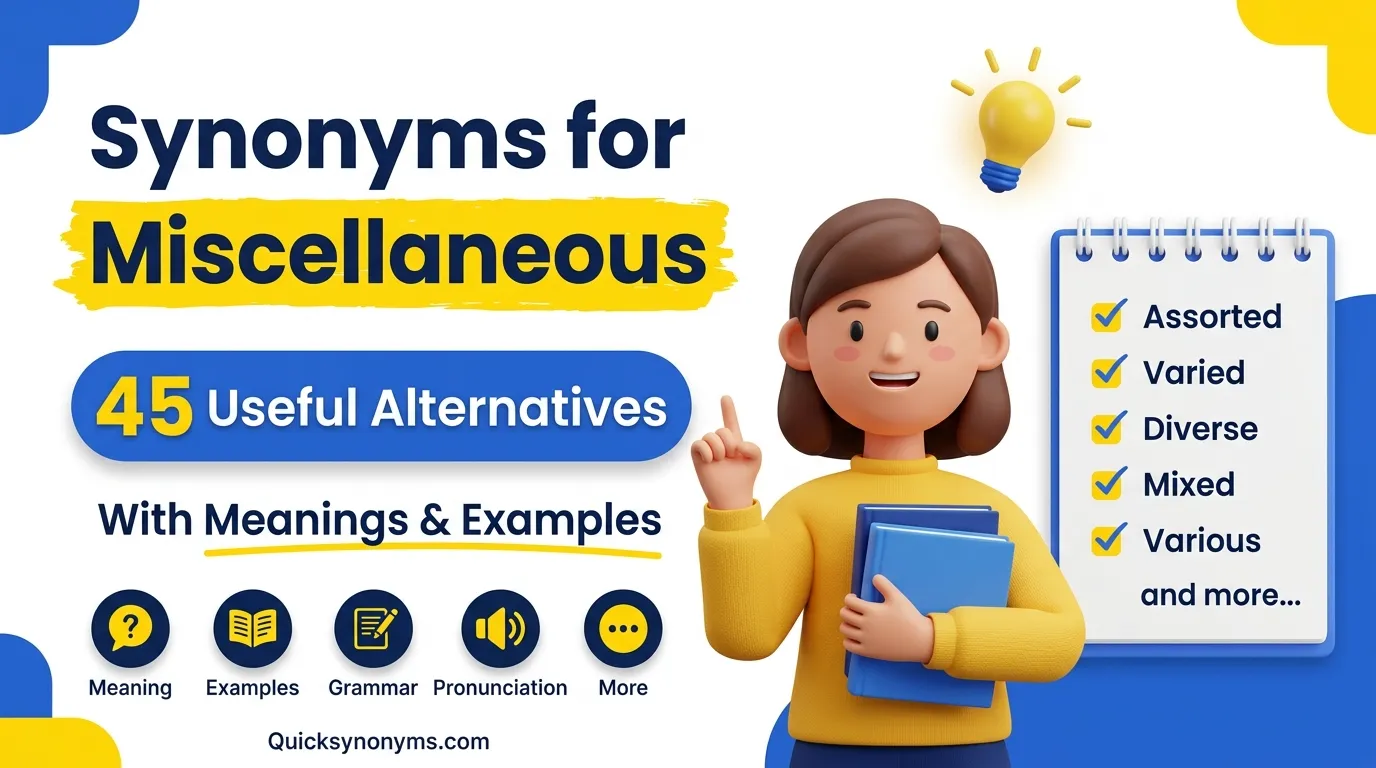
The word miscellaneous means made up of different kinds of things that do not all belong to one group. For example, a drawer with pens, keys, coins, and paper clips holds miscellaneous items. People often use this word when they want to describe a mix of things without naming each one.
Learning synonyms for miscellaneous helps English learners understand new words and express ideas more clearly. It also helps writers avoid repeating the same word in essays, reports, articles, and daily messages. Choosing the right synonym can make a sentence shorter, clearer, and more natural.
This guide covers the meaning of miscellaneous, 45 useful synonyms, simple examples, pronunciation, grammar, word history, and related words. It also explains how these words differ in meaning and tone so you can choose the best word for each situation.
Meaning of Miscellaneous
Definition
Miscellaneous (adjective): Made up of different kinds of things that do not all belong to one main group.
Examples
- I keep miscellaneous papers in a folder on my desk.
- The store sells miscellaneous items, from toys to kitchen tools.
Connotative Meaning
- Positive tone: Shows variety, choice, and a useful mix of things.
- Negative tone: May suggest clutter, poor order, or a lack of clear groups.
- Neutral tone: Simply describes things of different types collected together.
(Connotation: the emotional or cultural feeling a word carries beyond its literal meaning.)
Etymology
The word miscellaneous entered English in the 16th century through Latin-based forms. It comes from Medieval Latin miscellaneus, meaning mixed or made up of different kinds, related to Latin miscere, meaning to mix.
- Latin: Miscellaneus meant mixed or varied. It is related to miscere, meaning to mix.
- Old English (450 to 1100): Not applicable. The word was not part of Old English.
- Middle English (1100 to 1500): Not applicable. The word entered English later.
- Modern English (1500 to present): Miscellaneous became an English adjective for things of different kinds, especially items gathered into one collection.
Pronunciation (IPA)
- IPA: /ˌmɪsəˈleɪniəs/
- Syllables: mis-cel-la-ne-ous
Affixation Pattern of Miscellaneous
- Root: Miscellane, from a Latin word meaning mixed.
- Prefix: None.
- Suffix: -ous, an adjective-forming suffix that means having a quality or being characterized by something.
- Word formations:
- Miscellaneous (adjective): Made up of different kinds.
- Miscellaneously (adverb): In a miscellaneous way. This form is rare.
- Miscellany (noun): A collection of different kinds of things.
- Miscellanea (noun): A collection of varied items, facts, or writings.
45 Synonyms of Miscellaneous: With Meaning and Examples
1. Assorted (adjective)
Meaning: Made up of different types of things collected together.
Examples:
- The shop sells assorted chocolates in one box.
- We bought assorted tools for the repair job.
2. Varied (adjective)
Meaning: Including different kinds or types of things.
Examples:
- The library has a varied collection of books.
- She packed a varied selection of snacks.
3. Diverse (adjective)
Meaning: Containing many different types, forms, or qualities.
Examples:
- The museum displays a diverse range of objects.
- Our club welcomes people with diverse interests.
4. Mixed (adjective)
Meaning: Made by bringing different kinds of things together.
Examples:
- He put the mixed papers into one folder.
- The basket contained mixed fruits and nuts.
5. Various (adjective)
Meaning: Including several different kinds or types.
Examples:
- We discussed various topics in class.
- The website offers various learning tools.
6. Sundry (adjective)
Meaning: Consisting of different items that are not listed separately.
Examples:
- The receipt included sundry expenses.
- She stored sundry household items in a box.
7. Heterogeneous (adjective)
Meaning: Made up of different kinds of people or things.
Examples:
- The collection contains heterogeneous art styles.
- A heterogeneous group shared ideas at the meeting.
8. Motley (adjective)
Meaning: Made up of many different and often unrelated parts.
Examples:
- A motley collection of toys filled the shelf.
- The team brought together a motley group of performers.
9. Eclectic (adjective)
Meaning: Combining ideas, styles, or items from different sources.
Examples:
- Her room has an eclectic mix of furniture.
- The gallery displays an eclectic range of artwork.
10. Multifaceted (adjective)
Meaning: Having many different parts, features, or aspects.
Examples:
- The report explores a multifaceted set of issues.
- His work covers a multifaceted range of subjects.
11. Manifold (adjective)
Meaning: Having many different forms, kinds, or parts.
Examples:
- The project offers manifold learning opportunities.
- The town faces manifold challenges each year.
12. Multifarious (adjective)
Meaning: Including many different kinds or varieties.
Examples:
- The archive holds multifarious historical records.
- Her duties cover multifarious office tasks.
13. Many-sided (adjective)
Meaning: Having several different aspects or types.
Examples:
- The book presents a many-sided view of history.
- The discussion covered a many-sided problem.
14. Wide-ranging (adjective)
Meaning: Covering many different subjects, types, or areas.
Examples:
- The report includes wide-ranging facts about the region.
- We had a wide-ranging discussion about science.
15. Broad (adjective)
Meaning: Covering many different kinds or areas.
Examples:
- The course gives a broad selection of study topics.
- The store stocks a broad range of supplies.
16. Extensive (adjective)
Meaning: Covering a large amount or a wide variety of things.
Examples:
- The archive contains extensive records of local life.
- She has extensive notes on many subjects.
17. Comprehensive (adjective)
Meaning: Covering nearly all parts or details of a subject.
Examples:
- The guide offers comprehensive information about travel.
- We received a comprehensive list of school supplies.
18. General (adjective)
Meaning: Not limited to one narrow type or subject.
Examples:
- The store sells general household goods.
- She wrote general notes on several topics.
19. Different (adjective)
Meaning: Not the same as one another.
Examples:
- The box holds different types of buttons.
- We collected different objects for the school display.
20. Disparate (adjective)
Meaning: Made up of things that are very different from one another.
Examples:
- The folder contained disparate documents.
- The study compared disparate views on education.
21. Dissimilar (adjective)
Meaning: Not alike in kind, nature, or appearance.
Examples:
- The drawer held dissimilar pieces of equipment.
- They combined dissimilar materials for the project.
22. Distinct (adjective)
Meaning: Clearly different from other things.
Examples:
- The display featured distinct styles of pottery.
- The box held objects with distinct shapes and uses.
23. Divergent (adjective)
Meaning: Moving or developing in different directions or ways.
Examples:
- The report examined divergent ideas about health.
- The meeting brought together divergent views on art.
24. Unrelated (adjective)
Meaning: Having no clear connection with one another.
Examples:
- The folder contained unrelated letters and notes.
- She asked several unrelated questions during class.
25. Unconnected (adjective)
Meaning: Not linked by a clear relationship.
Examples:
- The file held unconnected records from past years.
- He collected unconnected facts for his research.
26. Random (adjective)
Meaning: Chosen or arranged without a clear plan or pattern.
Examples:
- The bag contained random items from his desk.
- She wrote random words on the whiteboard.
27. Haphazard (adjective)
Meaning: Arranged or done without care, order, or planning.
Examples:
- Haphazard notes covered the pages of his notebook.
- The box held a haphazard mix of old tools.
28. Unsorted (adjective)
Meaning: Not arranged into groups or categories.
Examples:
- The office received a pile of unsorted papers.
- She placed unsorted photographs on the table.
29. Unclassified (adjective)
Meaning: Not placed into a specific group or category.
Examples:
- The archive contained unclassified records.
- Several unclassified items remained in the storage room.
30. Uncategorized (adjective)
Meaning: Not organized into named groups or categories.
Examples:
- The website keeps uncategorized posts in one section.
- She found uncategorized files on the old computer.
31. Unorganized (adjective)
Meaning: Not arranged in a clear or orderly way.
Examples:
- The desk was covered with unorganized papers.
- He kept unorganized notes from several classes.
32. Unordered (adjective)
Meaning: Not arranged in a particular order.
Examples:
- The list contained unordered entries from many sources.
- The folder held unordered pages from old reports.
33. Unsystematic (adjective)
Meaning: Done without a clear plan or organized method.
Examples:
- The researcher collected unsystematic notes during the visit.
- Their unsystematic records were hard to review.
34. Heterogeneous (adjective)
Meaning: Made up of parts that differ in type or nature.
Examples:
- The box held a heterogeneous group of spare parts.
- The class used a heterogeneous collection of learning materials.
35. Nonuniform (adjective)
Meaning: Not the same throughout or not following one pattern.
Examples:
- The sample contained nonuniform pieces of fabric.
- The report described nonuniform results across the groups.
36. Irregular (adjective)
Meaning: Not following a regular or consistent pattern.
Examples:
- The drawer held irregular pieces of scrap wood.
- The collection included irregular shapes and sizes.
37. Variegated (adjective)
Meaning: Showing different colors, patterns, or types.
Examples:
- The garden had variegated plants of many kinds.
- The artist used variegated patterns in the design.
38. Medley (noun)
Meaning: A mixture of different things, sounds, or styles.
Examples:
- The performance was a medley of songs.
- The basket held a medley of nuts and dried fruit.
39. Assortment (noun)
Meaning: A collection of different kinds of things.
Examples:
- The gift box contained an assortment of sweets.
- The shop offers an assortment of school supplies.
40. Mixture (noun)
Meaning: A combination of different things brought together.
Examples:
- The container held a mixture of buttons and beads.
- The recipe uses a mixture of herbs and spices.
41. Collection (noun)
Meaning: A group of items gathered together.
Examples:
- His collection includes coins, stamps, and postcards.
- The museum keeps a collection of historic tools.
42. Variety (noun)
Meaning: A range of different kinds or types.
Examples:
- The market sells a variety of household goods.
- The library offers a variety of reading materials.
43. Selection (noun)
Meaning: A group of items chosen from several options.
Examples:
- We chose a selection of books for the class.
- The shop has a selection of art supplies.
44. Medley-like (adjective)
Meaning: Combining different elements in one group or work.
Examples:
- The artist created a medley-like display of colors.
- The show had a medley-like mix of music styles.
45. All-purpose (adjective)
Meaning: Suitable for many different uses or tasks.
Examples:
- She bought an all-purpose box for household supplies.
- The team chose an all-purpose tool for small repairs.
Prototype Meaning
The most typical meaning of miscellaneous is a collection of different items that do not fit neatly into one category. People often imagine a drawer filled with spare keys, pens, coins, batteries, and other small objects. The items may be useful, but they do not all share one clear purpose. The word is common in lists, office records, shop labels, school tasks, and storage systems. It helps describe a mixed group without naming every item.
Prototype Categorization
– Direct synonyms: Assorted, varied, diverse, mixed, various, sundry. Use these words when a group contains different kinds of items.
– Rich variety: Heterogeneous, motley, eclectic, multifaceted, manifold, multifarious, many-sided, wide-ranging. Use these when you want to highlight variety, differences, or many aspects.
– Broad scope: Broad, extensive, comprehensive, general. Use these when a collection or subject covers many areas or types.
– Differences between items: Different, disparate, dissimilar, distinct, divergent. Use these when the items or ideas are unlike one another.
– Lack of connection: Unrelated, unconnected. Use these when the items do not share a clear link.
– Lack of order: Random, haphazard, unsorted, unclassified, uncategorized, unorganized, unordered, unsystematic. Use these when things have not been arranged into clear groups or a set order.
– Uneven or varied form: Nonuniform, irregular, variegated. Use these when things differ in shape, pattern, color, or consistency.
– Collections and combinations: Medley, assortment, mixture, collection, variety, selection. Use these nouns when naming a group of different items.
– Special combinations and uses: Medley-like, all-purpose. Use these when a mix resembles a blend of different elements or when something serves many purposes.
Grouping synonyms helps writers see which words fit a particular situation. It also makes it easier to choose a word that expresses the right meaning and tone.
Antonyms of Miscellaneous
- Uniform (adjective): The same in form, type, or appearance.
- Consistent (adjective): Staying the same in quality or behavior.
- Homogeneous (adjective): Made up of similar parts or members.
- Identical (adjective): Exactly the same as another thing.
- Single (adjective): Consisting of only one item or type.
- Specific (adjective): Clearly defined or limited to one particular thing.
- Particular (adjective): Referring to one exact person, thing, or type.
- Standardized (adjective): Made to follow one accepted pattern or set of rules.
Short Questions and Answers
What does Miscellaneous mean?
Miscellaneous means made up of different kinds of things that do not all belong to one group. It often describes mixed items, papers, tasks, or information.
When should Miscellaneous be used?
Use miscellaneous when you need to describe several different items together. It works well in reports, lists, storage labels, office records, and everyday writing.
Is Miscellaneous positive or negative?
The word is usually neutral. It can suggest a useful range of choices in one context or a messy mix of items in another.
How is it different from similar words?
Assorted often describes different items gathered together, such as assorted sweets. Varied highlights differences within a group, while diverse often emphasizes a wide range of types, ideas, or people. Miscellaneous is especially useful when the items do not fit into one clear category.
Conclusion
Learning miscellaneous and its synonyms helps you describe mixed groups of items, ideas, and information with greater care. Words such as assorted, varied, diverse, and mixed are useful in daily speech, while heterogeneous and multifarious suit more formal writing. Each word adds a slightly different meaning, so the best choice depends on the context.
Using synonyms also makes your writing clearer and helps you avoid repeating the same words in essays, emails, reports, and online articles. For English learners, studying meanings and examples builds stronger vocabulary, improves speaking skills, and makes new words easier to remember. Start by learning a few synonyms each day, writing your own sentences, and using the words in real conversations. With daily practice, you can build confidence and express your ideas more naturally.
See Synonyms: Synonyms for Aquatic: 37 Useful Alternatives

Content Editor & Language Researcher
Daniel Foster specializes in editing educational content and researching English language topics. He is committed to creating well-structured, reader-friendly articles that make learning easier.

1 thought on “Synonyms for Miscellaneous: 45 Useful Alternatives”