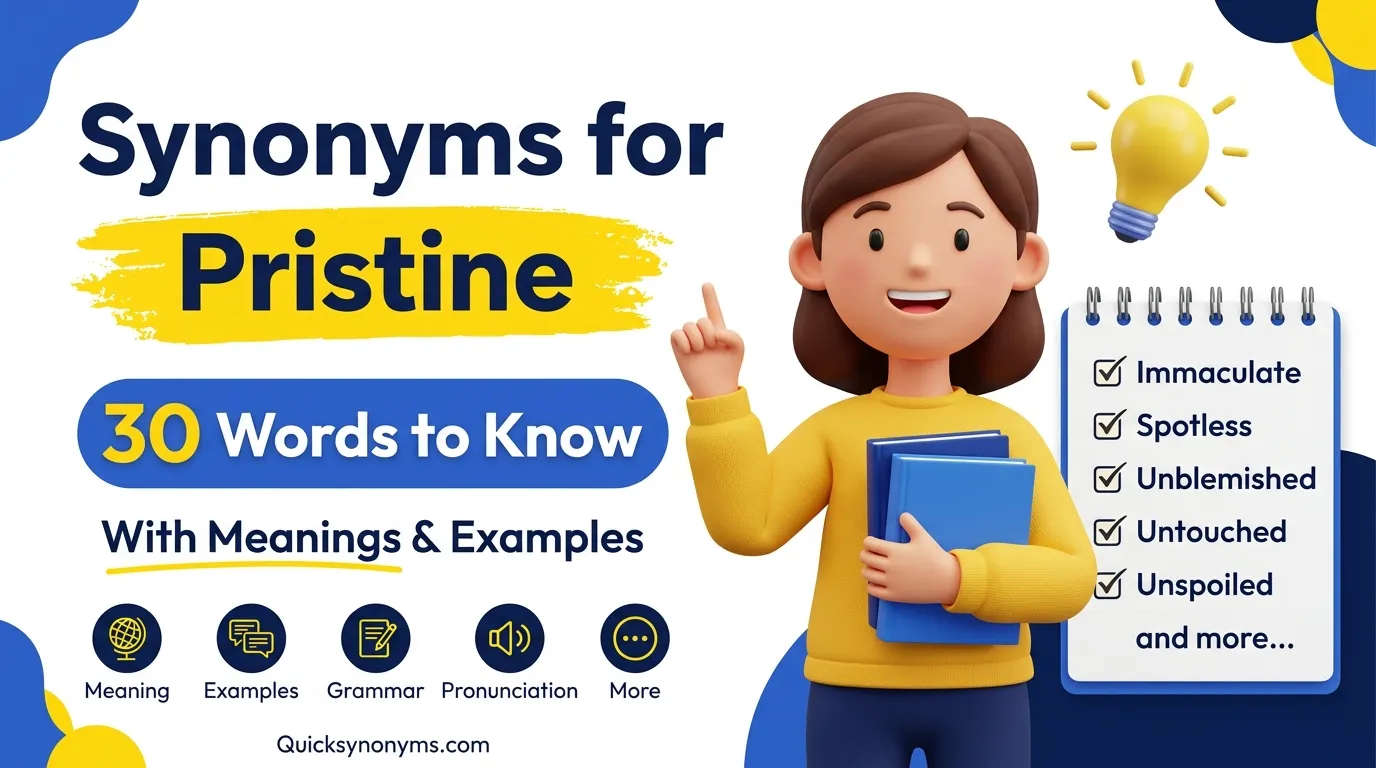
Pristine means perfectly clean, fresh, pure, or untouched. You might use it to describe a beach with clear sand, a spotless room, or a forest that has not been changed by people. The word is common when something looks fresh and free from damage or pollution.
Synonyms help English learners understand small differences between similar words. They also help writers avoid repetition and choose a word that gives the exact feeling they want.
In this guide, you will learn the meaning, examples, grammar, history, pronunciation, and semantic groups of pristine. You will also find 30 useful synonyms with simple meanings and examples.
Meaning of Pristine
Definition
Pristine (adjective): perfectly clean, pure, fresh, or untouched.
Examples
- The hotel room was pristine when we arrived.
- They found a pristine lake deep in the forest.
Connotative Meaning
- Positive tone: Suggests beauty, purity, freshness, and excellent condition.
- Negative tone: Usually has no negative feeling, but it can sometimes suggest something is too perfect or untouched.
- Neutral tone: Simply describes something that is clean, pure, or unchanged.
(Connotation: the emotional or cultural feeling a word carries beyond its literal meaning.)
Etymology
The word pristine comes from Latin pristinus, meaning “former,” “original,” or “ancient.” It entered English through French and was first linked to something original or ancient. Later, its meaning developed toward something pure, fresh, and untouched.
- Latin: Pristinus meant former, original, or ancient.
- French: The word passed into French before entering English.
- Modern English: Its common modern sense describes something pure, clean, fresh, or unspoiled.
Pronunciation (IPA)
- IPA: /ˈprɪstiːn/
- Syllables: pris-tine
Affixation Pattern of Pristine
- Root: Pristine, from Latin pristinus
- Prefix: None
- Suffix: None
- Word formations:
- Pristine: adjective
- Pristinely: adverb
- Pristineness: noun
30 Synonyms of Pristine: With Meaning and Examples
1. Immaculate (adjective)
Meaning: Completely clean and free from any marks or faults.
Examples:
- Her white dress remained immaculate all day.
- The kitchen was immaculate after cleaning.
2. Spotless (adjective)
Meaning: Completely clean and without any dirt or stains.
Examples:
- His shoes were spotless after polishing.
- The new apartment was spotless.
3. Unblemished (adjective)
Meaning: Having no marks, damage, or flaws.
Examples:
- She had an unblemished record at work.
- The painting was still unblemished after many years.
4. Untouched (adjective)
Meaning: Not changed, damaged, or used.
Examples:
- The hikers discovered an untouched valley.
- The meal was left untouched on the table.
5. Unspoiled (adjective)
Meaning: Not damaged or changed in a harmful way.
Examples:
- They visited an unspoiled island.
- The village has an unspoiled natural landscape.
6. Unsullied (adjective)
Meaning: Not spoiled, stained, or damaged.
Examples:
- The snow looked unsullied in the morning.
- He wanted to keep his reputation unsullied.
7. Unblemished (adjective)
Meaning: Free from visible marks or imperfections.
Examples:
- The fruit had an unblemished surface.
- The athlete had an unblemished career.
8. Flawless (adjective)
Meaning: Having no faults, mistakes, or imperfections.
Examples:
- The diamond had a flawless appearance.
- Her performance was flawless from start to finish.
9. Unmarred (adjective)
Meaning: Not damaged, spoiled, or marked.
Examples:
- The old building remained unmarred by the storm.
- The view was unmarred by tall buildings.
10. Untainted (adjective)
Meaning: Not spoiled or affected by something harmful.
Examples:
- The spring provided untainted water.
- The child had an untainted view of the world.
11. Uncontaminated (adjective)
Meaning: Not made dirty or unsafe by harmful substances.
Examples:
- The laboratory needs uncontaminated samples.
- They searched for uncontaminated drinking water.
12. Unpolluted (adjective)
Meaning: Free from harmful pollution.
Examples:
- The mountain air was unpolluted.
- Fish lived in the unpolluted river.
13. Unadulterated (adjective)
Meaning: Pure and not mixed with anything unwanted.
Examples:
- The product contains unadulterated honey.
- She enjoyed the unadulterated taste of fresh fruit.
14. Untarnished (adjective)
Meaning: Not damaged, stained, or made less valuable.
Examples:
- The silver remained untarnished.
- She kept an untarnished reputation.
15. Unsoiled (adjective)
Meaning: Not made dirty or stained.
Examples:
- The towel was still unsoiled.
- His shirt stayed unsoiled during the trip.
16. Pure (adjective)
Meaning: Clean and free from unwanted substances or qualities.
Examples:
- The bottle contains pure spring water.
- They enjoyed the pure beauty of nature.
17. Clean (adjective)
Meaning: Free from dirt, marks, or unwanted substances.
Examples:
- The room was clean and bright.
- We found a clean source of water.
18. Fresh (adjective)
Meaning: New, clean, or natural in a pleasing way.
Examples:
- We woke up to fresh mountain air.
- The garden was full of fresh flowers.
19. Perfect (adjective)
Meaning: Having no faults or unwanted changes.
Examples:
- The beach was in perfect condition.
- We found the perfect place for a picnic.
20. Natural (adjective)
Meaning: Existing in nature without being changed much by people.
Examples:
- The park protects the area’s natural beauty.
- They prefer natural materials.
21. Virgin (adjective)
Meaning: Not used, developed, or changed before.
Examples:
- The explorers entered virgin forest.
- The project will protect virgin land.
22. Unworn (adjective)
Meaning: Not used or worn before.
Examples:
- She packed an unworn dress for the trip.
- The store displayed a pair of unworn shoes.
23. Unused (adjective)
Meaning: Not used before or not used yet.
Examples:
- The hotel gave us an unused room.
- He found an unused notebook in the drawer.
24. Unopened (adjective)
Meaning: Not opened or used.
Examples:
- The package was still unopened.
- She placed the unopened bottle on the shelf.
25. Unaffected (adjective)
Meaning: Not changed or harmed by something.
Examples:
- The forest remained unaffected by the nearby fire.
- The old house was unaffected by the storm.
26. Untouched (adjective)
Meaning: Left in its original condition.
Examples:
- Much of the coastline remains untouched.
- The ancient site was almost untouched.
27. Original (adjective)
Meaning: Existing in its first or natural form.
Examples:
- The museum protects the original structure.
- Workers restored the original design.
28. Clear (adjective)
Meaning: Free from dirt, cloudiness, or unwanted material.
Examples:
- The mountain stream was clear.
- We could see through the clear water.
29. Unspoiled (adjective)
Meaning: Still natural and free from harmful change.
Examples:
- The remote beach is unspoiled.
- They hope to keep the countryside unspoiled.
30. Unsullied (adjective)
Meaning: Completely free from dirt, damage, or disgrace.
Examples:
- The white fabric looked unsullied.
- The place offered an unsullied view of nature.
Prototype Meaning
The most typical meaning of pristine is something that is perfectly clean, pure, fresh, and untouched. People often imagine a beautiful natural place, such as a clear lake, clean beach, or quiet forest.
Prototype Categorization
- Perfectly clean: Immaculate, spotless, clean, unsoiled. Use these words when the main idea is freedom from dirt or stains.
- Free from damage: Unblemished, flawless, unmarred, untarnished. Use these when something has no visible faults or damage.
- Untouched and natural: Untouched, unspoiled, unsullied, virgin, unaffected. Use these for places or things that remain in their original state.
- Pure and safe: Pure, uncontaminated, unpolluted, unadulterated, clear. Use these when talking about water, air, food, or other substances.
- New or unused: Fresh, unworn, unused, unopened, original. Use these when something has not been used, opened, or changed.
- General excellence: Perfect, natural. Use these when the idea focuses on ideal quality or natural beauty.
Grouping synonyms helps writers see small differences between similar words. This makes it easier to choose the word that best matches the situation.
Antonyms of Pristine
- Dirty (adjective): Covered with dirt or unwanted material.
- Stained (adjective): Marked by a dirty or colored spot.
- Damaged (adjective): Harmed or broken in some way.
- Polluted (adjective): Made dirty or harmful by pollution.
- Contaminated (adjective): Made unsafe or impure by harmful substances.
- Spoiled (adjective): Damaged or made less pleasant or useful.
- Tarnished (adjective): Made less clean, bright, or valuable.
- Used (adjective): Previously used by someone.
Short Questions and Answers
What does Pristine mean?
Pristine means perfectly clean, pure, fresh, or untouched.
When should Pristine be used?
Use pristine when something is in an extremely clean, pure, or original condition. It often describes nature, places, objects, and conditions.
Is Pristine positive or negative?
Pristine is usually positive. It suggests that something is beautiful, clean, pure, and well preserved.
How is it different from similar words?
Immaculate mainly focuses on perfect cleanliness. Untouched focuses on something that has not been changed or used, while unspoiled often describes natural places that have not been harmed.
Conclusion
Learning pristine and its synonyms can make your English more precise and interesting. Instead of using the same word again and again, you can choose words such as immaculate, spotless, unspoiled, or untouched based on the exact meaning you need.
These words can strengthen both writing and speaking. They also help you describe clean spaces, natural places, pure materials, and things in excellent condition with greater detail.
Keep practicing new vocabulary in short sentences every day. Over time, learning synonyms like these will help you write clearly, speak naturally, and build confidence in English.
Explore More: Synonyms for Homeless: 39 Words to Know

Content Editor & Language Researcher
Daniel Foster specializes in editing educational content and researching English language topics. He is committed to creating well-structured, reader-friendly articles that make learning easier.