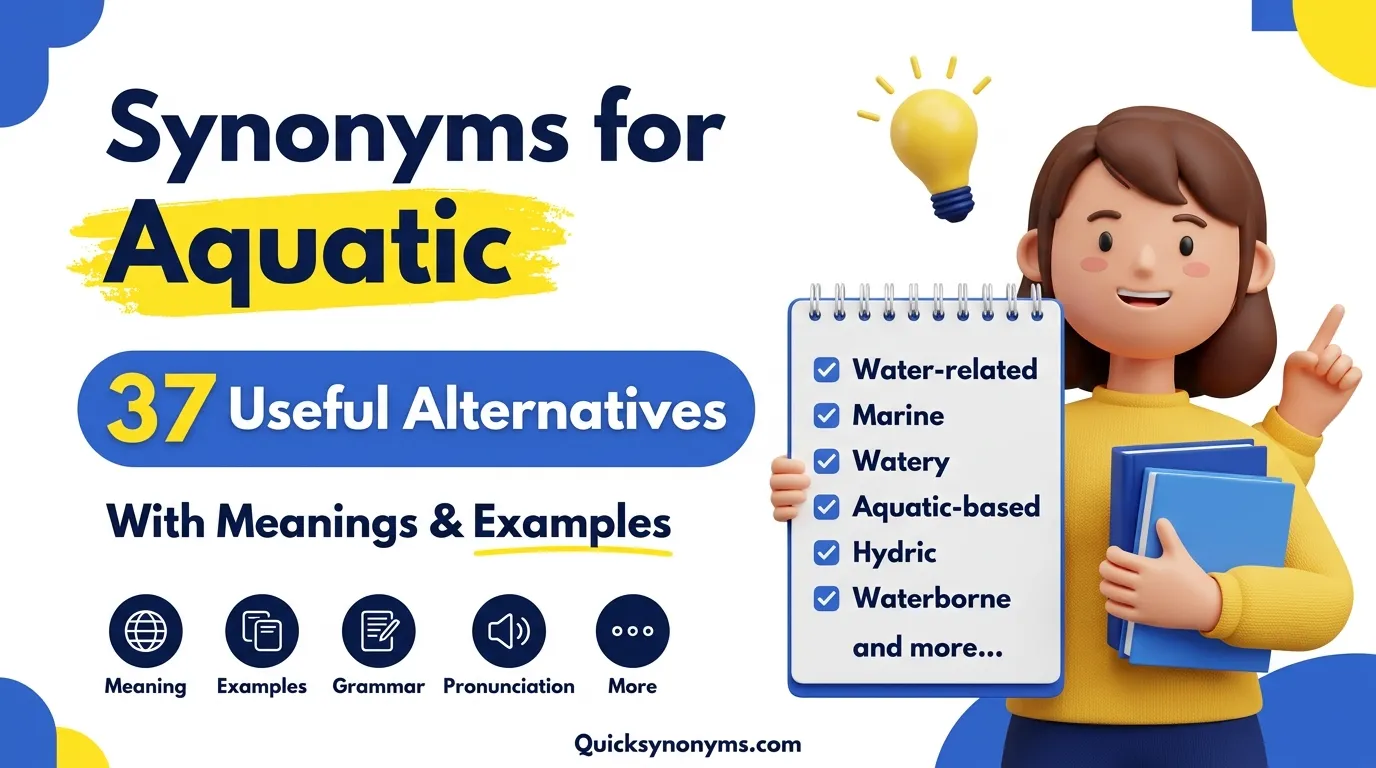
The word aquatic describes things that relate to water or live and grow in it. When you visit a lake, watch fish swim, or see plants floating in a pond, you can use this word to describe what you see. It is common in science, nature writing, and daily speech because water plays a key role in life on Earth.
Learning synonyms for aquatic helps you choose words that fit different settings. English learners can build vocabulary, while students and content writers can make their sentences clearer and more varied. The right word can describe ocean life, freshwater habitats, or plants that need water to grow.
This guide covers the meaning of aquatic, 37 related words, and examples of how to use them. It also explores pronunciation, grammar, word history, antonyms, and semantic categories to help you use each word with confidence.
Meaning of Aquatic
Definition
Aquatic (adjective): Relating to water or living or growing in water.
Examples
- The aquarium has many aquatic animals, including fish and sea turtles.
- We studied aquatic plants during our science class.
Connotative Meaning
- Positive tone: Suggests a calm, fresh, or beautiful water setting.
- Negative tone: May suggest a wet environment that feels cold, muddy, or unsafe.
- Neutral tone: Simply describes something linked to water.
(Connotation: the emotional or cultural feeling a word carries beyond its literal meaning.)
Etymology
The word aquatic comes from the Latin word aquaticus, meaning “of or relating to water.” It is based on aqua, the Latin word for water. English adopted the word in the late Middle Ages.
- Latin origin: Aqua means “water,” while aquaticus means “related to water.”
- Middle English (1100 to 1500): The word entered English during this period, with Latin and French influencing its form and use.
- Modern English (1500 to present): Aquatic became widely used in science, nature studies, sports, and everyday descriptions of water-related things.
Pronunciation (IPA)
- IPA: /əˈkwætɪk/
- Syllables: a-quat-ic
Affixation Pattern of Aquatic
- Root: Aqu, from Latin aqua, meaning water.
- Prefix: None.
- Suffix: -atic, forming an adjective that expresses a relation or connection.
Word formations
- Aquatic (adjective): Relating to water.
- Aquatically (adverb): In a way that relates to water.
- Aquatics (noun): Activities or sports performed in or on water.
- Aquaculture (noun): The raising of fish and other aquatic organisms.
- Aquacultural (adjective): Relating to the farming of aquatic organisms.
37 Synonyms of Aquatic: With Meaning and Examples
These words are ordered from close alternatives to more specialized or context-dependent choices. Not every word fits every sentence, so consider what kind of water environment or organism you mean.
1. Water-related (adjective)
Meaning: Connected with water in some way.
Examples:
- The school planned a water-related science project.
- She enjoys reading water-related news.
2. Marine (adjective)
Meaning: Relating to the sea or ocean.
Examples:
- Marine animals live in salt water.
- He studies marine ecosystems at college.
3. Watery (adjective)
Meaning: Containing water or having the qualities of water.
Examples:
- The watery mixture covered the seeds.
- Watery soil made the path hard to cross.
4. Aquatic-based (adjective)
Meaning: Built around water or water activities.
Examples:
- The resort offers aquatic-based games for children.
- They created an aquatic-based fitness program.
5. Hydric (adjective)
Meaning: Relating to water or conditions with plenty of moisture.
Examples:
- The plant thrives in hydric soil.
- The study examined hydric conditions in wetlands.
6. Waterborne (adjective)
Meaning: Carried, spread, or transported by water.
Examples:
- The team studied waterborne organisms in the lake.
- Waterborne seeds traveled down the stream.
7. Hydrological (adjective)
Meaning: Relating to the movement and distribution of water.
Examples:
- The report described hydrological changes in the river.
- Hydrological data helped the team study the wetland.
8. Marine-based (adjective)
Meaning: Connected with the sea or built around ocean resources.
Examples:
- The class visited a marine-based research center.
- They developed a marine-based learning program.
9. Oceanic (adjective)
Meaning: Relating to the ocean or its features.
Examples:
- Oceanic currents affect the local climate.
- Scientists recorded oceanic changes over time.
10. Freshwater (adjective)
Meaning: Relating to water with little dissolved salt.
Examples:
- Freshwater fish live in rivers and lakes.
- The park protects freshwater habitats.
11. Saltwater (adjective)
Meaning: Relating to water that contains salt.
Examples:
- Saltwater plants grow along the coast.
- The aquarium has a saltwater tank.
12. Nautical (adjective)
Meaning: Relating to ships, sailing, or navigation on water.
Examples:
- He learned nautical terms before the sailing trip.
- The museum displays nautical maps.
13. Subaqueous (adjective)
Meaning: Existing, occurring, or taking place under water.
Examples:
- Divers explored a subaqueous cave.
- The team mapped a subaqueous rock formation.
14. Subaquatic (adjective)
Meaning: Located or occurring beneath the water’s surface.
Examples:
- The camera recorded subaquatic life.
- They found a subaquatic tunnel near the shore.
15. Underwater (adjective)
Meaning: Situated, performed, or found below the surface of water.
Examples:
- The diver used an underwater camera.
- Underwater plants swayed in the current.
16. Submerged (adjective)
Meaning: Covered or completely placed under water.
Examples:
- Submerged rocks made the river dangerous.
- The garden path was submerged after the flood.
17. Hydrophilic (adjective)
Meaning: Attracted to water or able to mix with it.
Examples:
- The hydrophilic material absorbed water quickly.
- Scientists tested a hydrophilic coating in the lab.
18. Hydrophytic (adjective)
Meaning: Relating to plants that grow in water or very wet places.
Examples:
- The pond supports hydrophytic plants.
- Researchers studied hydrophytic growth in the marsh.
19. Hydroponic (adjective)
Meaning: Relating to growing plants without soil, using water with nutrients.
Examples:
- The farm uses hydroponic methods to grow lettuce.
- She built a hydroponic garden in her kitchen.
20. Amphibious (adjective)
Meaning: Able to live or operate on land and in water.
Examples:
- The amphibious vehicle crossed the river.
- Frogs are amphibious animals.
21. Semiaquatic (adjective)
Meaning: Living partly on land and partly in water.
Examples:
- Otters are semiaquatic mammals.
- The semiaquatic animal rested beside the pond.
22. Limnetic (adjective)
Meaning: Relating to the open water of a lake, away from its shore and bottom.
Examples:
- Limnetic organisms live in open lake water.
- The class examined the limnetic zone of the lake.
23. Pelagic (adjective)
Meaning: Relating to the open sea, away from the shore and seabed.
Examples:
- Pelagic fish travel through open ocean waters.
- The research team tracked pelagic species.
24. Littoral (adjective)
Meaning: Relating to the shore or shallow water near land.
Examples:
- Littoral plants grew along the lake’s edge.
- The birds searched for food in the littoral zone.
25. Benthic (adjective)
Meaning: Relating to the bottom of a sea, lake, or other body of water.
Examples:
- Benthic animals live on or near the seabed.
- The study measured benthic life in the lake.
26. Estuarine (adjective)
Meaning: Relating to an estuary, where river water meets seawater.
Examples:
- Estuarine habitats support many young fish.
- The researchers counted estuarine birds.
27. Lacustrine (adjective)
Meaning: Relating to lakes.
Examples:
- Lacustrine sediments built up over time.
- The team studied lacustrine habitats.
28. Fluvial (adjective)
Meaning: Relating to rivers or streams.
Examples:
- Fluvial processes shape the river valley.
- The report described fluvial erosion.
29. Riparian (adjective)
Meaning: Relating to the banks of rivers and streams.
Examples:
- Riparian trees provide shade for fish.
- The project restored riparian habitats.
30. Palustrine (adjective)
Meaning: Relating to marshes, swamps, and other inland wetlands.
Examples:
- Palustrine habitats support frogs and insects.
- The survey recorded plants in a palustrine wetland.
31. Hygrophilous (adjective)
Meaning: Thriving in damp or very moist conditions.
Examples:
- Hygrophilous plants grew beneath the wet rocks.
- The botanist identified several hygrophilous species.
32. Hydrous (adjective)
Meaning: Containing water or combined with water.
Examples:
- The sample contained a hydrous mineral.
- The scientist examined the hydrous material.
33. Hydrated (adjective)
Meaning: Containing absorbed or chemically combined water.
Examples:
- The hydrated crystals changed shape.
- The lab stored the hydrated compound in a sealed jar.
34. Aquicultural (adjective)
Meaning: Relating to the farming or raising of aquatic organisms.
Examples:
- The team explored aquicultural methods for raising shellfish.
- Aquicultural practices can support local food supplies.
35. Hydrographic (adjective)
Meaning: Relating to the measurement and mapping of bodies of water.
Examples:
- The crew prepared a hydrographic survey.
- Hydrographic maps showed the shape of the seabed.
36. Hydrothermal (adjective)
Meaning: Relating to hot water, especially hot water circulating through rocks.
Examples:
- Hydrothermal vents support unusual deep-sea life.
- The scientists studied hydrothermal activity near the volcano.
37. Hydrospheric (adjective)
Meaning: Relating to the hydrosphere, or all the water on Earth.
Examples:
- The lesson explored hydrospheric changes.
- Hydrospheric processes affect Earth’s climate.
Prototype Meaning
The most typical meaning of aquatic is relating to water or describing an organism that lives or grows in water. People often picture fish swimming in a lake, plants floating on a pond, or sea animals moving through the ocean.
The word can also describe places, habitats, activities, and scientific processes linked to water. Its exact meaning depends on the noun it describes.
Prototype Categorization
– General water connection: Water-related, watery, hydric, waterborne, hydrological. Use these for broad links to water, moisture, or water movement.
– Sea and ocean: Marine, marine-based, oceanic, saltwater, pelagic, nautical. Use these for ocean life, saltwater settings, ships, and sailing.
– Freshwater and inland waters: Freshwater, limnetic, lacustrine, fluvial, littoral, riparian, estuarine. Use these for lakes, rivers, shores, and places where fresh and salt water meet.
– Underwater settings: Subaqueous, subaquatic, underwater, submerged, benthic. Use these for things below the surface or on the bottom of a water body.
– Water-loving organisms and plants: Hydrophilic, hydrophytic, hydroponic, amphibious, semiaquatic, hygrophilous. Use these for organisms, materials, or growing methods associated with water or damp conditions.
– Wetlands and water-rich environments: Palustrine, hydrous, hydrated. Use these for wetlands, water-containing substances, or materials that contain water.
– Specialized scientific terms: Aquatic-based, subaquatic, aquicultural, hydrographic, hydrothermal, hydrospheric. Use these in technical writing about water systems, aquatic farming, surveys, or Earth’s water.
These groups help writers choose a word that matches the subject and setting. A precise term can make scientific writing clearer, while a general term often works better in everyday speech.
Antonyms of Aquatic
- Terrestrial (adjective): Relating to land rather than water.
- Land-based (adjective): Located or operating on land.
- Dry (adjective): Free from water or moisture.
- Arid (adjective): Having very little rain or moisture.
- Aerial (adjective): Relating to the air rather than water.
- Desert (adjective): Relating to a dry region with little rainfall.
- Non-aquatic (adjective): Not relating to water or water habitats.
- Land-dwelling (adjective): Living mainly on land.
Short Questions and Answers
What does Aquatic mean?
Aquatic means relating to water or living or growing in water. It commonly describes fish, water plants, and water habitats.
When should Aquatic be used?
Use aquatic when discussing water life, habitats, plants, or activities. For example, an aquatic animal lives in water, while an aquatic sport takes place in or on water.
Is Aquatic positive or negative?
The word is usually neutral. It describes a connection to water, but the context can make it sound pleasant, beautiful, cold, or dangerous.
How is it different from similar words?
Marine refers specifically to the sea or ocean. Freshwater describes water with little dissolved salt, such as that found in lakes and rivers. Amphibious describes something able to live or operate on both land and water.
Conclusion
Learning aquatic and its synonyms helps you describe water, plants, animals, and habitats with greater accuracy. Words such as marine, freshwater, and underwater offer clear alternatives when the setting matters. More specialized terms, such as benthic and estuarine, are useful in science and nature writing.
Using a wider range of words also makes your writing and speech more interesting. You can avoid repeating the same word, explain ideas more clearly, and choose language that fits your audience. English learners can use these words to build vocabulary and improve reading comprehension, while writers can use them to create precise descriptions.
Practice by choosing one new synonym each day and writing two sentences with it. Over time, daily vocabulary practice can strengthen your English skills and build confidence.
Keep Reading: Synonyms for Cafe: 39 Powerful Words

Content Editor & Language Researcher
Daniel Foster specializes in editing educational content and researching English language topics. He is committed to creating well-structured, reader-friendly articles that make learning easier.










1 thought on “Synonyms for Aquatic: 37 Useful Alternatives”