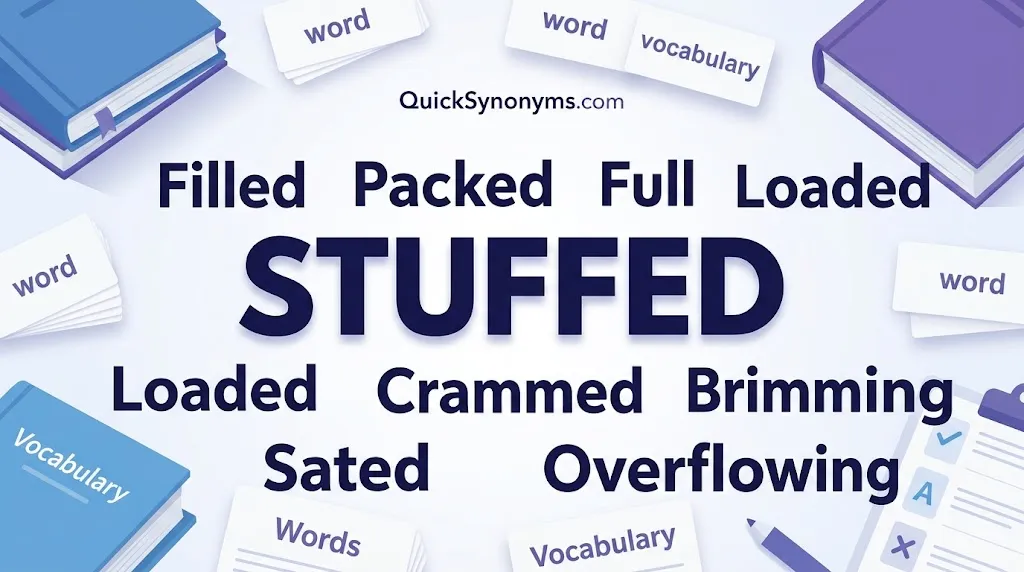
Synonyms for stuffed include filled, packed, full, loaded, crammed, jammed, crowded, overflowing, brimming, sated, satisfied, replete, and gorged. The best synonym depends on the context.
Stuffed usually means completely filled or packed with something. It can also describe the feeling of being very full after eating a large meal.
For example, after a big dinner, you might say, “I’m stuffed.” The word is common in everyday English because it works in many situations.
Learning synonyms for stuffed helps you avoid repetition. It also lets you choose words that better match the exact meaning you want to express.
In this guide, you will learn the meaning, examples, pronunciation, etymology, word formation, synonyms, antonyms, and common uses of stuffed.
You will also see how its synonyms differ by context. This makes it easier to choose the right word for food, objects, rooms, and other situations.
Meaning of Stuffed
Definition
Stuffed (Adjective / Past Participle):
Filled completely or tightly with something, or feeling very full after eating.
Examples
- The suitcase was stuffed with clothes.
- I was stuffed after the huge dinner.
Connotative Meaning
Connotation means the feeling or idea associated with a word beyond its basic meaning.
- Positive tone: It can suggest satisfaction after enjoying a good meal.
- Negative tone: It can suggest discomfort from eating too much.
- Neutral tone: It can simply describe something that is completely filled.
Etymology
The word stuffed comes from the verb stuff.
The English word stuff entered Middle English through Old French estoffer, meaning to furnish, equip, or fill.
- Old English (450–1100): The modern form of stuff was not commonly used in Old English.
- Middle English (1100–1500): Stuff developed from Old French and referred to materials, supplies, or things used to fill or furnish something.
- Modern English (1500–Present): Stuff developed several meanings related to filling, packing, materials, and objects. Stuffed became its past tense and past participle.
Today, stuffed is also widely used to describe someone who feels extremely full after eating.
Pronunciation (IPA)
- IPA: /stʌft/
- Syllables: stuffed – 1 syllable
Affixation Pattern of Stuffed
- Root: stuff
- Prefix: None
- Suffix: -ed
Word Formations
- Stuff – noun / verb
- Stuffs – noun / verb
- Stuffed – adjective / verb
- Stuffing – noun / verb
- Stuffy – adjective
- Stuffiness – noun
25 Synonyms of Stuffed With Meaning & Examples
1. Filled (Adjective / Past Participle)
Meaning: Containing something until there is little or no empty space.
Examples:
- The box was filled with old books.
- Her bag was filled with clothes.
2. Packed (Adjective / Past Participle)
Meaning: Filled tightly with people or things.
Examples:
- The suitcase was packed with clothes.
- The room was packed with visitors.
3. Full (Adjective)
Meaning: Containing as much as something can hold.
Examples:
- The glass is full of water.
- I am full after lunch.
4. Loaded (Adjective)
Meaning: Filled or supplied with a large amount of something.
Examples:
- The truck was loaded with boxes.
- The table was loaded with food.
5. Crammed (Adjective / Past Participle)
Meaning: Filled with things in a very tight or crowded way.
Examples:
- The drawer was crammed with papers.
- We were crammed into a small room.
6. Jammed (Adjective)
Meaning: Filled so tightly that there is almost no space left.
Examples:
- The closet was jammed with clothes.
- The shelves were jammed with books.
7. Crowded (Adjective)
Meaning: Filled with many people or things.
Examples:
- The restaurant was crowded with customers.
- The street was crowded with shoppers.
8. Overflowing (Adjective / Present Participle)
Meaning: So full that the contents spread beyond the normal space.
Examples:
- The basket was overflowing with fruit.
- The sink was overflowing with water.
9. Brimming (Adjective / Present Participle)
Meaning: Filled almost to the top.
Examples:
- The cup was brimming with tea.
- The bowl was brimming with soup.
10. Bursting (Adjective / Present Participle)
Meaning: Extremely full or almost unable to contain more.
Examples:
- The bag was bursting with clothes.
- The room was bursting with people.
11. Overfilled (Adjective / Past Participle)
Meaning: Filled beyond the normal or suitable amount.
Examples:
- The glass was overfilled with juice.
- The box was overfilled with toys.
12. Heaped (Adjective / Past Participle)
Meaning: Filled or covered with a large pile of something.
Examples:
- The plate was heaped with rice.
- The bowl was heaped with fresh fruit.
13. Sated (Adjective)
Meaning: Completely satisfied, especially after eating.
Examples:
- We felt sated after the feast.
- The guests were sated after dinner.
14. Satisfied (Adjective)
Meaning: Feeling that you have had enough, especially food.
Examples:
- I felt satisfied after breakfast.
- She was satisfied with the meal.
15. Replete (Adjective)
Meaning: Completely filled or supplied with something.
Examples:
- The garden was replete with flowers.
- The article is replete with useful information.
16. Surfeited (Adjective / Past Participle)
Meaning: Having had too much of something, especially food.
Examples:
- The guests were surfeited after the feast.
- He felt surfeited after eating several desserts.
17. Gorged (Adjective / Past Participle)
Meaning: Having eaten a very large amount of food.
Examples:
- We gorged on pizza at the party.
- He felt gorged after the huge meal.
18. Engorged (Adjective)
Meaning: Excessively filled or swollen with fluid, blood, or another substance.
Examples:
- The tick was engorged with blood.
- The tissue became engorged with fluid.
19. Padded (Adjective / Past Participle)
Meaning: Filled or covered with soft material for comfort or protection.
Examples:
- The chair was padded with foam.
- She wore a padded jacket.
20. Inflated (Adjective / Past Participle)
Meaning: Filled with air or gas so that something becomes larger.
Examples:
- The balloon was inflated with air.
- The tires were fully inflated.
21. Saturated (Adjective / Past Participle)
Meaning: Completely filled or soaked with something.
Examples:
- The soil was saturated with water.
- The cloth became saturated with oil.
22. Congested (Adjective)
Meaning: Too crowded or full for easy movement.
Examples:
- The roads were congested with traffic.
- The hallway became congested with people.
23. Dense (Adjective)
Meaning: Closely packed together with little empty space.
Examples:
- The forest was dense with trees.
- The crowd was dense near the entrance.
24. Stuffed-Full (Adjective)
Meaning: Completely filled with something.
Examples:
- The suitcase was stuffed-full of clothes.
- The cupboard was stuffed-full of dishes.
25. Sated-Full (Adjective)
Meaning: Completely full and satisfied after eating.
Examples:
- We felt sated-full after the large meal.
- She was sated-full after dinner.
Prototype Meaning
The most common meaning of stuffed is completely filled. People often imagine a bag, box, room, or container packed with things.
In everyday conversation, stuffed also commonly means extremely full after eating. For example, “I’m stuffed” usually means that someone has eaten enough or more than enough food.
The meaning depends on the context. A stuffed bag is filled with objects, while a stuffed person is usually very full after a meal.
Prototype Categorization
The synonyms for stuffed can be grouped according to their main meanings.
- General filling: filled, full, loaded, replete, and saturated describe something containing a lot of something.
- Tight packing: packed, crammed, jammed, and stuffed-full suggest that there is very little empty space.
- Extreme fullness: overflowing, brimming, bursting, and overfilled describe something that is almost or completely beyond capacity.
- Food-related fullness: sated, satisfied, surfeited, and gorged describe different levels of fullness after eating.
- Physical filling: engorged, padded, and inflated describe specific physical states.
- Crowded conditions: crowded, congested, and dense are useful for people, traffic, spaces, or closely grouped things.
- Piled contents: heaped works well when food or objects are arranged in a pile.
This grouping helps writers choose a synonym that matches the exact situation. It also prevents awkward word choices and unnecessary repetition.
Antonyms of Stuffed
1. Empty (Adjective)
Meaning: Containing nothing.
2. Vacant (Adjective)
Meaning: Having no people or contents inside.
3. Hollow (Adjective)
Meaning: Having an empty space inside.
4. Bare (Adjective)
Meaning: Having little or nothing covering or filling something.
5. Sparse (Adjective)
Meaning: Having only a small amount of something.
6. Unfilled (Adjective)
Meaning: Not filled with anything.
7. Spacious (Adjective)
Meaning: Having plenty of room or open space.
8. Hungry (Adjective)
Meaning: Wanting or needing food.
Short Questions and Answers
What does Stuffed mean?
Stuffed means completely filled or packed with something. It can also mean feeling very full after eating.
When should Stuffed be used?
Use stuffed when something is filled tightly or when a person feels extremely full after a meal.
Is Stuffed positive or negative?
It depends on the context. Stuffed can suggest satisfaction after a delicious meal, discomfort from overeating, or simply describe something that is completely filled.
How is it different from similar words?
Filled is a general synonym. Packed suggests tight filling, while crammed often suggests that something is filled uncomfortably. For food, sated is more formal, while stuffed is casual and common.
Conclusion
Learning synonyms for stuffed gives you more ways to describe fullness and filling. Words such as filled, packed, crammed, and loaded work well for objects and spaces.
For food-related situations, words such as sated, satisfied, and gorged can express different levels of fullness. Other words, such as brimming, overflowing, and heaped, describe how something is filled.
Understanding these differences helps you avoid repetition and make your writing more precise. It also improves everyday speaking because you can choose words that fit each situation.
Practice a few synonyms each day and use them in your own sentences. With regular practice, you can build a stronger vocabulary and become more confident in English.
Read more related words: Synonyms for Even more: 28 Powerful Alternatives

Content Editor & Language Researcher
Daniel Foster specializes in editing educational content and researching English language topics. He is committed to creating well-structured, reader-friendly articles that make learning easier.