A policy is a set of rules, ideas, or plans that guides decisions and actions. For example, a school may have a policy on homework, while a company may have a policy on working from home. The word is common in schools, businesses, governments, and daily life because it helps people understand what is allowed and what is expected.
Learning synonyms for policy helps English learners grow their vocabulary and express ideas more clearly. It also helps content writers avoid repeating the same word in articles, reports, emails, and essays. However, each synonym has its own meaning and works best in certain situations.
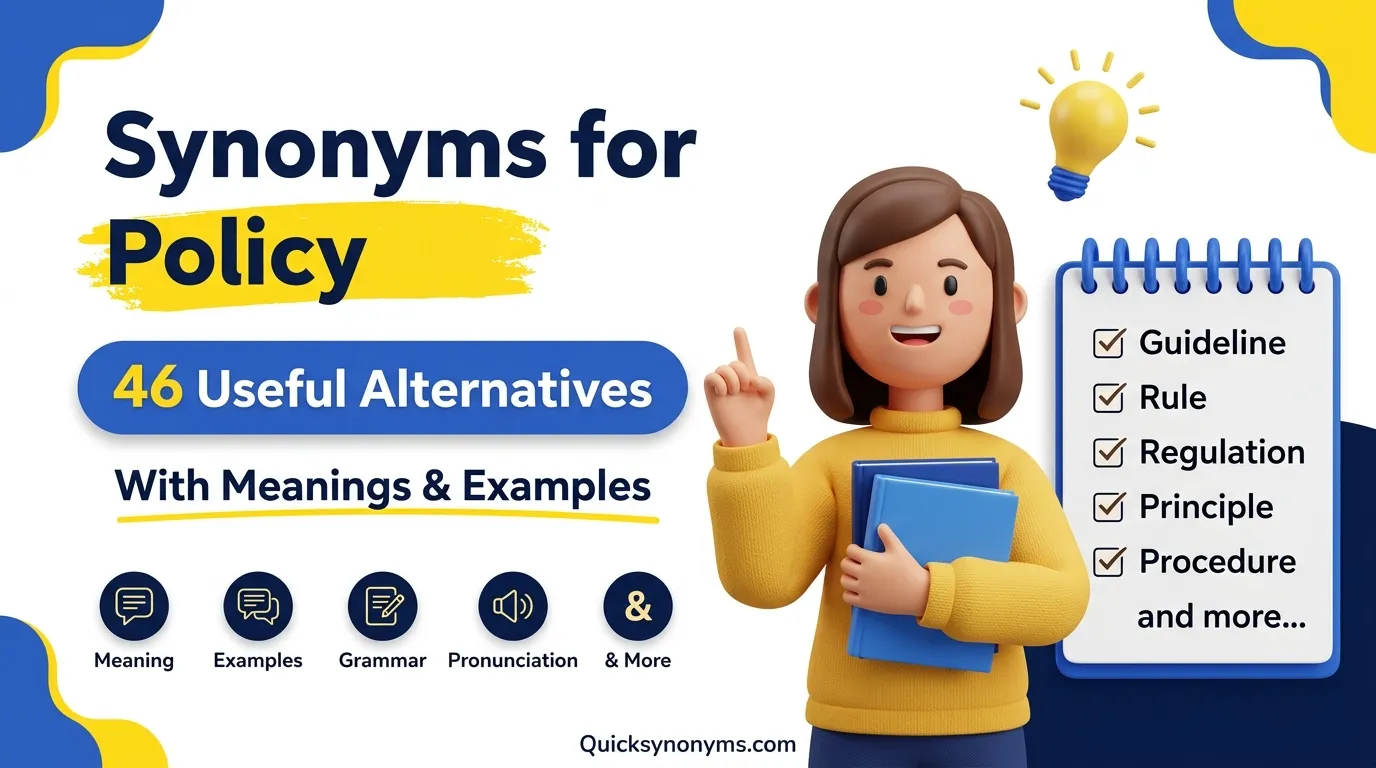
This guide covers 46 synonyms for policy, with simple meanings and examples. It also explains the word’s definition, pronunciation, history, grammar, emotional tone, and common categories. These details will help you choose the right word for your message.
Meaning of Policy
Definition
Policy (noun): A set of rules, ideas, or plans that guides decisions and actions.
Examples
- The school has a strict policy on attendance.
- Our company changed its policy on remote work.
Connotative Meaning
- Positive tone: Policy can suggest fairness, order, clear goals, and careful planning.
- Negative tone: Policy can suggest strict rules, limits, or too much control.
- Neutral tone: Policy can simply describe a plan or set of rules.
(Connotation: the emotional or cultural feeling a word carries beyond its literal meaning.)
Etymology
The word policy entered English through Anglo-French and Middle French forms related to government and public affairs. These forms came from Latin politia, which came from Greek politeia, meaning citizenship, government, or the organization of a state.
- Old English (450 to 1100): Not applicable. The word was not part of the regular Old English vocabulary.
- Middle English (1100 to 1500): The word entered English through French forms such as policie. It referred to government, public order, or the way a state was managed.
- Modern English (1500 to present): The meaning grew to include plans, rules, and principles used by governments, groups, and businesses.
Pronunciation (IPA)
- IPA: /ˈpɑːləsi/ in American English, /ˈpɒləsi/ in British English.
- Syllables: pol-i-cy, three syllables.
Affixation Pattern of Policy
- Root: Policy is the base word in modern English. Its older roots come through French, Latin, and Greek.
- Prefix: None.
- Suffix: None in the base word policy.
Word formations
- Policies (plural noun): More than one policy.
- Policymaker (noun): A person who creates or shapes policies.
- Policymaking (noun): The process of creating policies.
- Policyholder (noun): A person or group that owns an insurance policy.
- Policy-based (adjective): Guided by a policy or set of policies.
46 Synonyms of Policy: With Meaning and Examples
The best synonym depends on the type of policy. Some words refer to rules, while others focus on plans, beliefs, or ways of acting. The list starts with words that often have meanings closest to policy and moves toward more specific alternatives.
1. Guideline (noun)
Meaning: A piece of advice that helps people decide what to do.
Examples:
- The school shared a guideline for safe internet use.
- Each worker follows the safety guideline during training.
2. Rule (noun)
Meaning: An instruction that says what people must or must not do.
Examples:
- The club introduced a rule about late arrivals.
- Every player must follow the rule during practice.
3. Regulation (noun)
Meaning: An official rule made by an authority.
Examples:
- The new regulation protects workers from unsafe conditions.
- The agency checks each regulation before approval.
4. Principle (noun)
Meaning: A basic belief or idea that guides actions and choices.
Examples:
- Fairness is a key principle in the school system.
- The team follows a principle of equal treatment.
5. Procedure (noun)
Meaning: A set of steps used to complete a task.
Examples:
- The office updated its procedure for handling complaints.
- Staff must follow the procedure during an emergency.
6. Protocol (noun)
Meaning: An accepted set of rules for a task or situation.
Examples:
- The hospital follows a strict protocol for patient safety.
- The team reviewed the protocol before the event.
7. Standard (noun)
Meaning: A level of quality or conduct that people are expected to meet.
Examples:
- The company set a high standard for customer care.
- Every school must meet the safety standard.
8. Code (noun)
Meaning: A set of rules that guides behavior or professional conduct.
Examples:
- The staff signed a code of conduct.
- The group follows a code of fairness and respect.
9. Directive (noun)
Meaning: An official instruction that tells people what action to take.
Examples:
- The manager issued a directive about data security.
- Workers followed the directive from the head office.
10. Mandate (noun)
Meaning: An official order or requirement to take action.
Examples:
- The agency received a mandate to improve public safety.
- The new mandate requires schools to review their plans.
11. Edict (noun)
Meaning: An official order issued by a person or authority with power.
Examples:
- The ruler announced an edict on public behavior.
- The council rejected the edict after a long debate.
12. Decree (noun)
Meaning: An official order made by a leader or government body.
Examples:
- The government issued a decree on land use.
- The court reviewed the decree before it took effect.
13. Ordinance (noun)
Meaning: A law or rule made by a local government.
Examples:
- The city passed an ordinance on waste disposal.
- Residents learned about the new parking ordinance.
14. Statute (noun)
Meaning: A written law passed by a lawmaking body.
Examples:
- The statute sets rules for public schools.
- Lawyers studied the statute before the hearing.
15. Law (noun)
Meaning: A rule made by a government that people must obey.
Examples:
- The law protects workers from unfair treatment.
- The new law changed how schools report safety issues.
16. Legislation (noun)
Meaning: Laws made or proposed by a government or lawmaking body.
Examples:
- The legislation aims to reduce air pollution.
- Lawmakers debated the legislation before the vote.
17. Framework (noun)
Meaning: A basic structure that guides plans, rules, or decisions.
Examples:
- The school created a framework for student support.
- The framework helps leaders make fair choices.
18. Plan (noun)
Meaning: A set of ideas or steps designed to reach a goal.
Examples:
- The company made a plan to support new workers.
- The city approved a plan for safer roads.
19. Strategy (noun)
Meaning: A plan designed to reach a goal or solve a problem.
Examples:
- The team developed a strategy for staff training.
- The new strategy focuses on better customer service.
20. Approach (noun)
Meaning: A way of dealing with a task, issue, or situation.
Examples:
- The school chose a new approach to student discipline.
- Her approach to workplace safety puts people first.
21. Stance (noun)
Meaning: A clear position or opinion on an issue.
Examples:
- The group shared its stance on climate action.
- The minister explained her stance on public transport.
22. Position (noun)
Meaning: A stated opinion or view about an issue.
Examples:
- The company explained its position on equal pay.
- The council changed its position on the proposal.
23. Doctrine (noun)
Meaning: A set of beliefs or ideas that guides a group or system.
Examples:
- The party follows a doctrine of public service.
- The leader explained the doctrine to new members.
24. Tenet (noun)
Meaning: A basic belief or principle that guides thought or action.
Examples:
- Respect is a central tenet of the school.
- The group treats honesty as a key tenet.
25. Practice (noun)
Meaning: A usual way of doing something.
Examples:
- The office adopted a practice of sharing meeting notes.
- The school follows a practice of regular parent updates.
26. Custom (noun)
Meaning: A common way of acting that a group follows over time.
Examples:
- The village has a custom of welcoming new families.
- The team kept its custom of holding weekly meetings.
27. Convention (noun)
Meaning: A usual or accepted way of doing something.
Examples:
- The group followed the convention of taking turns.
- The meeting used a convention for formal introductions.
28. Rulebook (noun)
Meaning: A book or document that lists the rules of a group or activity.
Examples:
- Each player received the updated rulebook.
- The coach checked the rulebook before the match.
29. Charter (noun)
Meaning: A formal document that sets out the aims, rights, or duties of a group.
Examples:
- The board approved a charter for the new program.
- The charter explains the group’s main duties.
30. Bylaw (noun)
Meaning: A rule made by an organization or local authority.
Examples:
- The club changed a bylaw about membership fees.
- Each member must follow the bylaw.
31. Codebook (noun)
Meaning: A document that explains a set of codes or rules.
Examples:
- The research team used a codebook to classify responses.
- Staff checked the codebook before recording the data.
32. Requirement (noun)
Meaning: Something that must be done or met.
Examples:
- A background check is a requirement for the role.
- The school explained each requirement for enrollment.
33. Condition (noun)
Meaning: A rule or fact that must be met for something to happen.
Examples:
- The grant has a condition about how funds are spent.
- Each condition must be met before approval.
34. Restriction (noun)
Meaning: A rule that limits what people can do.
Examples:
- The library placed a restriction on loud calls.
- The travel restriction affected many visitors.
35. Control (noun)
Meaning: A rule or measure used to manage an activity or reduce risk.
Examples:
- The company added a control for online payments.
- Each safety control helps prevent workplace accidents.
36. Safeguard (noun)
Meaning: A measure that protects people, rights, or property.
Examples:
- The school added a safeguard for student records.
- The new safeguard protects private information.
37. Measure (noun)
Meaning: An action taken to reach a goal or deal with a problem.
Examples:
- The city introduced a measure to cut traffic noise.
- The company took a measure to improve safety.
38. Initiative (noun)
Meaning: A planned action or program designed to bring change.
Examples:
- The school launched an initiative to reduce waste.
- The new initiative supports small local businesses.
39. Program (noun)
Meaning: A planned set of activities designed to reach a goal.
Examples:
- The city started a program for youth training.
- The company created a program to support new parents.
40. Agenda (noun)
Meaning: A list of goals or issues that a person or group plans to address.
Examples:
- The council set an agenda for housing reform.
- The group’s agenda includes better public services.
41. Blueprint (noun)
Meaning: A detailed plan for how to create or achieve something.
Examples:
- The report offers a blueprint for school reform.
- The team prepared a blueprint for future growth.
42. Model (noun)
Meaning: A system or example that people can use to guide their actions.
Examples:
- The school adopted a model for fair assessment.
- The company tested a model for flexible work.
43. Philosophy (noun)
Meaning: A set of beliefs that guides how a person or group acts.
Examples:
- The company has a philosophy of putting customers first.
- The school follows a philosophy of learning through practice.
44. Ethos (noun)
Meaning: The values and beliefs that shape a group or organization.
Examples:
- The team’s ethos promotes trust and teamwork.
- The school has an ethos of kindness and respect.
45. Intent (noun)
Meaning: The purpose or aim behind an action or decision.
Examples:
- The policy’s intent is to make hiring fairer.
- The council explained its intent to improve public access.
46. Principle-based approach (noun phrase)
Meaning: A way of making decisions by following basic beliefs or values.
Examples:
- The school used a principle-based approach to resolve disputes.
- The team chose a principle-based approach to data privacy.
Prototype Meaning
The most typical meaning of policy is a set of rules or guiding ideas used by a person, group, business, or government. People often imagine a written document that explains what is allowed, what is expected, and how decisions should be made. For example, a school attendance policy tells students when they must arrive and what happens if they miss class. The main purpose is to guide actions and help people follow a shared plan.
Prototype Categorization
The 46 synonyms belong to several groups. Each group highlights a different part of the meaning of policy.
– Rules and official instructions: Guideline, rule, regulation, protocol, directive, mandate, edict, decree. Use these words for instructions that guide or control actions.
– Laws and legal rules: Ordinance, statute, law, legislation, bylaw. Use these terms for rules made by governments or official bodies.
– Values and beliefs: Principle, doctrine, tenet, philosophy, ethos. Choose these words when a policy reflects beliefs, values, or shared ideas.
– Plans and decision-making: Framework, plan, strategy, approach, agenda, blueprint, model, initiative, program. Use these words when the focus is on goals, methods, or planned change.
– Opinions and positions: Stance, position, intent. These words work when discussing a person’s or group’s views, aims, or intentions.
– Usual ways of acting: Practice, custom, convention. Use these terms for actions that people commonly follow over time.
– Formal documents and standards: Standard, code, rulebook, charter, codebook. Choose these words when referring to written guidance, expected quality, or formal rules.
– Duties and limits: Requirement, condition, restriction, control. Use these terms for things people must meet, limits they must follow, or ways to manage risk.
– Protection and action: Safeguard, measure. These words suit rules or actions designed to protect people or solve problems.
– General guiding ideas: Principle-based approach. Use this phrase when decisions are based on clear values rather than fixed rules alone.
Grouping synonyms helps writers understand the small differences between related words. It also makes it easier to choose a word that fits the situation, tone, and purpose.
Antonyms of Policy
There is no single perfect antonym for policy in every context. However, these words can express ideas that oppose rules, planned action, or formal guidance.
- Disorder (noun): A state without clear order or organization.
- Chaos (noun): A state of complete confusion.
- Lawlessness (noun): A condition in which laws are ignored or not enforced.
- Anarchy (noun): A state without effective government or authority.
- Spontaneity (noun): The act of doing something without prior planning.
- Discretion (noun): Freedom to make choices based on personal judgment.
- Noncompliance (noun): The failure to follow a rule or requirement.
- Uncertainty (noun): A lack of clear knowledge, direction, or decision.
Short Questions and Answers
What does Policy mean?
Policy means a set of rules, ideas, or plans that guides decisions and actions. Schools, businesses, and governments use policies to explain expectations and guide behavior.
When should Policy be used?
Use policy when talking about an official plan, set of rules, or guiding principles. It is common in workplaces, schools, public services, and government.
Is Policy positive or negative?
The word is usually neutral. It can sound positive when it promotes fairness and safety, but it can sound negative when rules seem too strict or unfair.
How is it different from similar words?
A rule tells people what they must or must not do. A guideline offers advice on what to do, while a regulation is an official rule made by an authority. A policy is often broader and may include several rules, goals, and principles.
Conclusion
Learning the meaning of policy and its synonyms helps you express ideas with greater care. Words such as rule, guideline, regulation, and strategy may be related, but each has a different use. Knowing these differences helps you choose words that fit your message and audience.
Using synonyms also makes writing and speaking clearer. You can avoid repeating the same word in essays, reports, emails, and everyday talks. This skill is useful for English learners, students, teachers, and content writers who want to build strong vocabulary.
Keep a list of new words and write a short sentence with each one. Practice a few synonyms every day, and soon you will feel more confident using English in real-life situations.
Learn More: Synonyms for Working hard: 46 Useful Alternatives

ESL Writing Coach
Olivia Bennett helps English learners strengthen their writing, expand their vocabulary, and communicate more naturally. Her content is designed to make everyday and professional English simple and accessible.