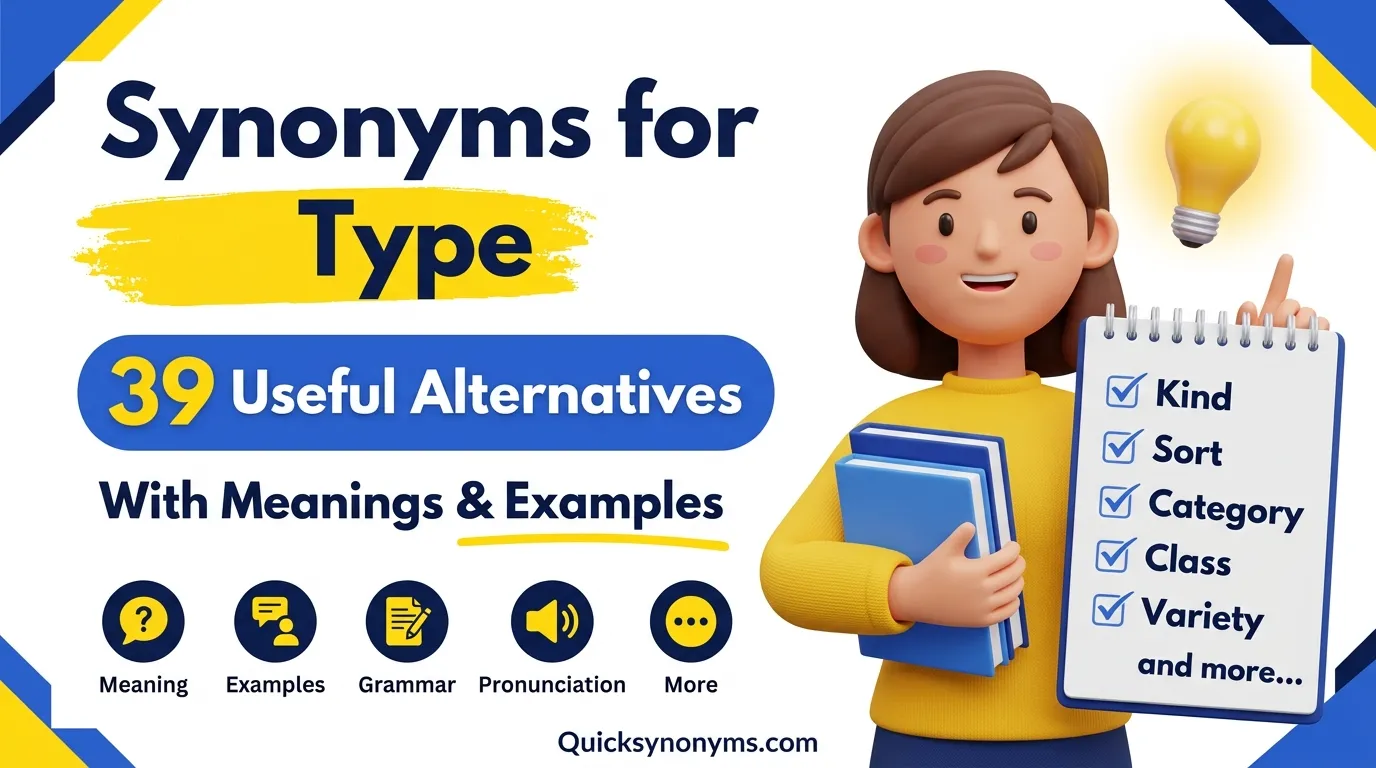
The word type means a kind, sort, or group of things that share similar features. For example, when you shop for clothes, you may look for a certain type of shirt. When you study English, you may learn about different types of words. The word is common because it helps us name, sort, and describe things in daily life.
Learning synonyms for type helps you express ideas in more ways. English learners can use these words to grow their vocabulary, while students and content writers can use them to make their writing clear and avoid repetition. Still, each synonym has its own meaning and works best in certain situations.
This guide covers the meaning of type, 39 synonyms with examples, pronunciation, grammar, word history, and related words. It also groups synonyms by meaning to help you choose the right word for speaking, schoolwork, and everyday writing.
Meaning of Type
Definition
Type (noun): A kind or group of people or things that share similar features.
Examples
- What type of music do you enjoy?
- This type of plant needs plenty of sunlight.
Connotative Meaning
- Positive tone: A type of person or thing that is admired or valued.
- Negative tone: A type of behavior or person that someone dislikes.
- Neutral tone: A simple way to name or group something.
(Connotation: the emotional or cultural feeling a word carries beyond its literal meaning.)
Etymology
The word type comes from the Latin typus, which came from the Greek typos. The Greek word referred to a mark, impression, or model. Over time, the word gained the meaning of a kind or class of things.
- Old English (450 to 1100): Not applicable. The word was not part of the usual Old English vocabulary.
- Middle English (1100 to 1500): The word entered English in the late Middle English period through Latin and French influence.
- Modern English (1500 to present): The word developed its common meanings, including a kind, category, printed letter, and style of person or thing.
Pronunciation (IPA)
- IPA: /taɪp/
- Syllables: type, one syllable.
Affixation Pattern of Type
- Root: type
- Prefix: None in the basic word.
- Suffix: None in the basic word.
- Word formations:
- Types (noun, plural): Different kinds or groups.
- Typed (verb, past tense): Entered text using a keyboard or similar device.
- Typing (noun or verb): The act of entering text.
- Typed (adjective): Written or entered as text.
- Typical (adjective): Usual or expected for a person or thing.
- Typically (adverb): In a usual or common way.
- Typify (verb): To represent the main features of something.
- Typology (noun): The study or system of grouping things by type.
39 Synonyms of Type: With Meaning and Examples
1. Kind (noun)
Meaning: A group of things that share similar features.
Examples:
- What kind of fruit do you like?
- This kind of chair is easy to move.
2. Sort (noun)
Meaning: A group of people or things with similar qualities.
Examples:
- We sell every sort of book.
- What sort of food is served here?
3. Category (noun)
Meaning: A group used to organize similar things.
Examples:
- Put each book in the correct category.
- This product belongs to the sports category.
4. Class (noun)
Meaning: A group of things with shared features.
Examples:
- These animals belong to the same class.
- The shop has a new class of products.
5. Variety (noun)
Meaning: A particular kind of thing among several kinds.
Examples:
- This variety of apple tastes sweet.
- Farmers grow a rare variety of rice.
6. Form (noun)
Meaning: A particular shape, structure, or version of something.
Examples:
- Water can take a solid form.
- This form of exercise builds strength.
7. Style (noun)
Meaning: A particular way something looks or is done.
Examples:
- I like this style of jacket.
- Her writing style is easy to follow.
8. Genre (noun)
Meaning: A group of works that share a similar style or subject.
Examples:
- Mystery is my favorite book genre.
- This film belongs to the comedy genre.
9. Group (noun)
Meaning: People or things gathered because they share something.
Examples:
- The birds form a small group.
- This group of tools is used for repairs.
10. Classification (noun)
Meaning: A system for arranging things into groups.
Examples:
- The library uses a clear classification system.
- The classification of plants helps students study them.
11. Species (noun)
Meaning: A group of living things with shared features that can reproduce with one another.
Examples:
- This species of bird lives near lakes.
- Scientists discovered a new species of frog.
12. Breed (noun)
Meaning: A particular group of animals with shared traits.
Examples:
- That breed of dog is very friendly.
- This breed of horse is known for its speed.
13. Model (noun)
Meaning: A particular design or version of a product or system.
Examples:
- This model of phone has a better camera.
- The company released a new model of car.
14. Version (noun)
Meaning: A particular form of something that may differ from others.
Examples:
- I prefer the latest version of this app.
- The new version of the game has better graphics.
15. Edition (noun)
Meaning: A particular form of a book, newspaper, or published work.
Examples:
- I bought the newest edition of the textbook.
- This edition of the magazine includes extra pages.
16. Format (noun)
Meaning: The way information or content is arranged or presented.
Examples:
- The website uses a simple format.
- Choose the correct format for your document.
17. Pattern (noun)
Meaning: A repeated design or a regular way something happens.
Examples:
- The fabric has a floral pattern.
- We noticed a pattern in the test results.
18. Manner (noun)
Meaning: A particular way of doing or showing something.
Examples:
- He spoke in a calm manner.
- The task was completed in a careful manner.
19. Ilk (noun)
Meaning: A kind or group of people or things with similar qualities.
Examples:
- I enjoy books of this ilk.
- The shop attracts artists and others of their ilk.
20. Stripe (noun)
Meaning: An informal term for a kind of person or thing.
Examples:
- We welcome visitors of every stripe.
- The club attracts musicians of a different stripe.
21. Family (noun)
Meaning: A group of related things that share important features.
Examples:
- These languages belong to the same family.
- The company makes products from one family of designs.
22. Division (noun)
Meaning: A section of a larger group or system.
Examples:
- This division handles computer products.
- The team works in a separate division of the company.
23. Branch (noun)
Meaning: A part of a larger field, group, or subject.
Examples:
- Genetics is a branch of biology.
- This branch of art focuses on sculpture.
24. Order (noun)
Meaning: A group used to classify related living things or other items.
Examples:
- The scientist studied an order of insects.
- This order of documents must stay together.
25. Rank (noun)
Meaning: A level or position within a system.
Examples:
- The products are arranged by rank.
- Each player has a rank in the competition.
26. Grade (noun)
Meaning: A level of quality or standard.
Examples:
- The store sells a higher grade of coffee.
- This grade of steel is made for heavy use.
27. Series (noun)
Meaning: A set of related items that share a theme or design.
Examples:
- The company launched a series of smart watches.
- I watched a series of science videos.
28. Set (noun)
Meaning: A collection of related things considered together.
Examples:
- The store sells a set of cooking tools.
- Each set of cards has a different design.
29. Subset (noun)
Meaning: A smaller group within a larger group.
Examples:
- Red apples are a subset of all apples.
- This subset of users prefers mobile apps.
30. Subclass (noun)
Meaning: A smaller class within a broader class.
Examples:
- The course covers a subclass of computer systems.
- Researchers studied a subclass of these insects.
31. Subgroup (noun)
Meaning: A smaller group within a larger group.
Examples:
- One subgroup focused on the history project.
- This subgroup of plants grows in wet soil.
32. Denomination (noun)
Meaning: A named category, often used for money, beliefs, or organized groups.
Examples:
- The bank gave me coins of a smaller denomination.
- The report lists each religious denomination.
33. Designation (noun)
Meaning: A name or label used to identify a person, role, or thing.
Examples:
- The product received a new designation.
- Her official designation is team leader.
34. Label (noun)
Meaning: A word or name used to identify or describe something.
Examples:
- The label shows the product’s size.
- The store uses a label for each product group.
35. Description (noun)
Meaning: Words that explain the features of a person or thing.
Examples:
- The catalog gives a short description of each item.
- His description helped us identify the bird.
36. Nature (noun)
Meaning: The basic qualities or character of something.
Examples:
- The nature of the problem is unclear.
- We studied the nature of this material.
37. Character (noun)
Meaning: The qualities that make a person or thing what it is.
Examples:
- The character of the wood makes it useful for furniture.
- The character of the work changed over time.
38. Make (noun)
Meaning: The brand or maker of a product, especially a vehicle or machine.
Examples:
- What make of car do you drive?
- This make of printer is easy to use.
39. Design (noun)
Meaning: The plan or arrangement of the parts of something.
Examples:
- I like the design of this chair.
- The team chose a simple design for the new device.
Prototype Meaning
The most typical meaning of type is a kind or category of something. When people hear this word, they usually imagine a way to group similar things, such as types of food, books, cars, or people. For example, mystery and romance are types of books, while tea and coffee are types of drinks. The word can also describe a particular style or model. Its exact meaning depends on the sentence, so it is helpful to check the context before choosing a synonym.
Prototype Categorization
The 39 synonyms above fit into several groups based on their main meanings and uses.
– General kinds: Kind, sort, category, class, variety, ilk, stripe. Use these words when talking about broad groups of similar people or things.
– Forms and styles: Form, style, manner, pattern, design, nature, character. Choose these words when describing how something looks, works, or behaves.
– Creative and published works: Genre, edition, version, series, format. Use these words for books, films, media, software, and other creative works.
– Scientific and living groups: Species, breed, family, order. These words are useful when discussing animals, plants, biology, and related classifications.
– Organized groups and levels: Group, classification, division, branch, rank, grade, set. Use these words for systems, collections, departments, and levels.
– Smaller groups: Subset, subclass, subgroup. These terms describe a smaller group within a larger one.
– Products and designs: Model, make. Choose these words when discussing products, machines, vehicles, or particular product versions.
– Names and descriptions: Denomination, designation, label, description. These words help identify, name, or explain people, objects, and categories.
Grouping synonyms makes it easier to choose words that fit your meaning. It also helps you avoid using a word that sounds similar but does not fit the context.
Antonyms of Type
There is no single perfect antonym for type in every context. These words can express the opposite idea when type means a general category or kind.
- Individual (noun): One person or thing considered separately from a group.
- Exception (noun): Something that does not follow a general rule.
- Anomaly (noun): Something that differs from what is normal or expected.
- Specific (adjective): Clearly defined rather than general.
- Particular (adjective): One distinct person or thing rather than a broad group.
- Unique (adjective): Unlike anything else.
- Individuality (noun): The qualities that make someone or something different from others.
Short Questions and Answers
What does Type mean?
Type means a kind or category of people or things that share similar features. For example, a rose is a type of flower.
When should Type be used?
Use type when you want to name a category or ask what kind of thing someone means. For example, you might ask, “What type of phone do you use?”
Is Type positive or negative?
The word type is neutral by itself. Its tone depends on the context. It can describe something good, bad, or neither.
How is it different from similar words?
Kind and sort are common, everyday alternatives to type. Category often refers to an organized system, while variety highlights differences within a broader group. Choose the word that best fits your sentence.
Conclusion
Learning synonyms for type can help you express ideas in a clear and natural way. Words such as kind, sort, category, class, and variety are useful alternatives, but each has its own purpose. Choosing the right word can make your writing more precise and easier to understand.
These words are useful in schoolwork, everyday conversations, reports, and online articles. They can also help you avoid repeating the same word too often. However, always consider the meaning and context before replacing type with another word.
The best way to build your vocabulary is to learn a few synonyms each day. Read their meanings, study their examples, and use them in your own sentences. With regular practice, you can improve your English writing, speaking, and confidence.
Explore More: Synonyms for Miscellaneous: 45 Useful Alternatives.

Content Editor & Language Researcher
Daniel Foster specializes in editing educational content and researching English language topics. He is committed to creating well-structured, reader-friendly articles that make learning easier.


1 thought on “Synonyms for Type: 39 Useful Alternatives”