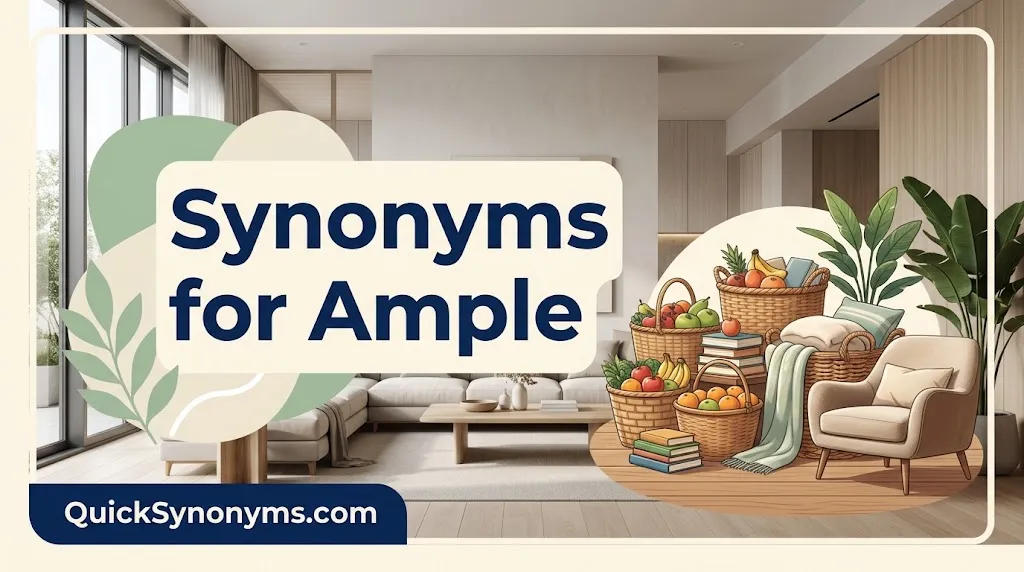
The best synonyms for ample include abundant, plentiful, sufficient, generous, copious, and spacious. These words describe something that is more than enough, available in a good quantity, or large enough to provide comfortable room.
Ample means more than enough of something. You might have ample time to finish a project, ample food for a party, or ample space for a growing family.
The word is common in everyday English, business writing, academic work, and formal speech. Learning its synonyms helps English learners and content writers avoid repetition and choose words that match the exact context.
In this guide, you will learn the meaning, pronunciation, history, grammar, and 45 useful synonyms for ample. You will also see clear examples and semantic categories that make each alternative easier to understand and use.
Meaning of Ample
Definition
Ample (Adjective): More than enough in amount, size, space, or capacity to meet a particular need.
In simple English, ample means enough and usually more than enough.
Examples
- We have ample time to complete the assignment.
- The hotel offers ample parking for its guests.
Connotative Meaning
Connotation: The feeling or idea a word suggests beyond its basic dictionary meaning.
- Positive tone: Ample often suggests comfort, abundance, readiness, and generosity.
- Negative tone: It can sometimes suggest something is larger than necessary, especially when describing physical size.
- Neutral tone: It commonly describes a sufficient or generous amount without strong emotion.
Etymology
The English word ample comes from Latin amplus, meaning “large,” “spacious,” “wide,” or “abundant.” It entered English through Old French ample and developed into its modern forms over time.
- Old English (450 to 1100): Ample was not a common native Old English word. Its Latin and French ancestry developed outside the native Old English vocabulary.
- Middle English (1100 to 1500): Ample entered English through Anglo-French and Old French, carrying meanings connected with largeness, spaciousness, and abundance.
- Modern English (1500 to Present): The word developed its modern senses of “more than enough,” “generous in amount,” and “large or spacious.”
Today, ample can describe time, money, evidence, opportunities, supplies, room, and physical dimensions. Major dictionaries recognize both its abundance and spaciousness senses.
Pronunciation (IPA)
- IPA: /ˈæm.pəl/
- Syllables: am-ple
- Stress: The first syllable is stressed.
Affixation Pattern of Ample
- Root: ampl-
- Prefix: None in modern English
- Suffix: -e in the spelling of ample
- Word formations:
- ample (adjective): more than enough or sufficiently large
- amply (adverb): in a sufficient or generous way
- ampleness (noun): the quality of being ample
- ampler (adjective): more ample
- amplest (adjective): most ample
The related word amplitude comes from the same broader Latin family, but it should not be treated as a simple modern English derivative of ample.
Synonyms of Ample With Meaning & Examples
The 45 synonyms below cover the main meanings of ample, including abundance, sufficiency, generosity, size, and spaciousness. Dictionary sources divide ample into two major senses: more than enough and more than adequate in size or capacity.
1. Abundant (Adjective)
Meaning: Existing in a large or plentiful amount.
Examples:
- The region has abundant natural resources.
- Fresh water is abundant after the rainy season.
2. Plentiful (Adjective)
Meaning: Available in a large quantity.
Examples:
- Fresh vegetables are plentiful in summer.
- There were plentiful opportunities to practice.
3. Sufficient (Adjective)
Meaning: Enough to meet a particular need.
Examples:
- We have sufficient money for the trip.
- The evidence was sufficient to support the claim.
4. Generous (Adjective)
Meaning: More than enough or larger than normally expected.
Examples:
- The recipe calls for a generous amount of cheese.
- She gave us a generous portion of dessert.
5. Copious (Adjective)
Meaning: Existing in a very large amount.
Examples:
- The researcher collected copious notes.
- He provided copious evidence for his argument.
6. Enough (Adjective)
Meaning: As much or as many as needed.
Examples:
- We have enough food for everyone.
- There is enough time to finish the work.
7. Adequate (Adjective)
Meaning: Good enough in amount or quality for a particular purpose.
Examples:
- The room has adequate lighting.
- We had adequate supplies for the journey.
8. Bountiful (Adjective)
Meaning: Present in a large and generous amount.
Examples:
- The farmers enjoyed a bountiful harvest.
- The garden produced a bountiful supply of vegetables.
9. Plenteous (Adjective)
Meaning: Existing in large quantities.
Examples:
- The valley has plenteous sources of fresh water.
- Food was plenteous during the celebration.
10. Bounteous (Adjective)
Meaning: Very generous in amount or supply.
Examples:
- The land produced a bounteous harvest.
- Guests enjoyed a bounteous meal.
11. Profuse (Adjective)
Meaning: Existing or occurring in very large quantities.
Examples:
- The garden was filled with profuse flowers.
- The author offered profuse examples throughout the book.
12. Lavish (Adjective)
Meaning: More generous or plentiful than necessary.
Examples:
- They prepared a lavish dinner for their guests.
- The event received lavish financial support.
13. Rich (Adjective)
Meaning: Containing a large amount of something valuable or useful.
Examples:
- The soil is rich in nutrients.
- The library has a rich collection of historical books.
14. Replete (Adjective)
Meaning: Filled or well supplied with something.
Examples:
- The report is replete with useful examples.
- The forest is replete with wildlife.
15. Overflowing (Adjective)
Meaning: Containing more than can fit or be held.
Examples:
- The basket was overflowing with fruit.
- The room was overflowing with excited visitors.
16. Teeming (Adjective)
Meaning: Filled with large numbers of people, animals, or things.
Examples:
- The river is teeming with fish.
- The city was teeming with tourists.
17. Abounding (Adjective)
Meaning: Existing in large numbers or amounts.
Examples:
- The area is abounding in wildlife.
- The book is abounding with practical advice.
18. Surplus (Adjective)
Meaning: More than what is needed or used.
Examples:
- The company sold its surplus equipment.
- Farmers stored the surplus grain.
19. Liberal (Adjective)
Meaning: Generous in amount or more than sufficient.
Examples:
- Add a liberal amount of seasoning.
- The manager allowed a liberal amount of time for the task.
20. Extra (Adjective)
Meaning: More than the usual or required amount.
Examples:
- Bring extra water for the hike.
- We have extra chairs for visitors.
21. Substantial (Adjective)
Meaning: Large or considerable in amount, size, or importance.
Examples:
- The project requires a substantial investment.
- She made a substantial contribution to the team.
22. Considerable (Adjective)
Meaning: Fairly large in amount, size, or degree.
Examples:
- The company has considerable experience.
- He spent a considerable amount of time studying.
23. Sizable (Adjective)
Meaning: Fairly large in size or amount.
Examples:
- They received a sizable donation.
- The house has a sizable backyard.
24. Spacious (Adjective)
Meaning: Having plenty of room.
Examples:
- The apartment has a spacious living room.
- We stayed in a spacious hotel suite.
25. Roomy (Adjective)
Meaning: Having more space than usual.
Examples:
- The car has a roomy interior.
- We booked a roomy family apartment.
26. Capacious (Adjective)
Meaning: Able to hold a large amount or provide a lot of space.
Examples:
- She carried a capacious travel bag.
- The house has a capacious kitchen.
27. Commodious (Adjective)
Meaning: Spacious, comfortable, and convenient.
Examples:
- They moved into a commodious new home.
- The hotel provided a commodious room.
28. Large (Adjective)
Meaning: Greater than average in size, amount, or extent.
Examples:
- They live in a large house.
- The company has a large customer base.
29. Big (Adjective)
Meaning: Great in size, amount, or degree.
Examples:
- We need a big table for the meeting.
- She made a big investment in the business.
30. Huge (Adjective)
Meaning: Extremely large in size or amount.
Examples:
- The warehouse has a huge storage area.
- The project attracted a huge amount of attention.
31. Vast (Adjective)
Meaning: Extremely large in size, area, or extent.
Examples:
- The country has vast natural resources.
- They explored a vast area of desert.
32. Wide (Adjective)
Meaning: Having a large distance from one side to another.
Examples:
- The road is wide enough for two trucks.
- She opened the wide gate.
33. Broad (Adjective)
Meaning: Wide in physical size or extensive in range.
Examples:
- The store offers a broad selection of products.
- He has a broad knowledge of history.
34. Extensive (Adjective)
Meaning: Covering a large area, range, or amount.
Examples:
- The company has extensive experience overseas.
- We conducted extensive research before publishing.
35. Expansive (Adjective)
Meaning: Covering a large area or having a broad range.
Examples:
- The house has an expansive garden.
- The report provides an expansive view of the issue.
36. Voluminous (Adjective)
Meaning: Very large in size, quantity, or volume.
Examples:
- The lawyer reviewed a voluminous collection of documents.
- The archive contains voluminous records.
37. Immense (Adjective)
Meaning: Extremely large in size or amount.
Examples:
- The project required an immense amount of effort.
- They faced an immense challenge.
38. Enormous (Adjective)
Meaning: Extremely large in size, quantity, or degree.
Examples:
- The company has an enormous amount of data.
- The new building provides enormous storage capacity.
39. Massive (Adjective)
Meaning: Very large, heavy, or substantial.
Examples:
- The factory has massive storage facilities.
- The campaign attracted a massive audience.
40. Extensive-ranging (Adjective)
Meaning: Covering a broad range or large scope.
Examples:
- The study offers extensive-ranging information on the topic.
- The organization has an extensive-ranging network of partners.
41. Outsize (Adjective)
Meaning: Larger than normal or expected.
Examples:
- The store sells outsize furniture.
- He made an outsize contribution to the project.
42. Bumper (Adjective)
Meaning: Exceptionally large or plentiful.
Examples:
- Farmers reported a bumper crop this year.
- The company enjoyed a bumper sales season.
43. Countless (Adjective)
Meaning: Too many to be counted.
Examples:
- She has received countless messages.
- The book contains countless useful ideas.
44. Inexhaustible (Adjective)
Meaning: So plentiful that it seems impossible to use it all.
Examples:
- The internet provides an inexhaustible source of information.
- Her curiosity seemed inexhaustible.
45. Fulfilling (Adjective)
Meaning: Providing what is needed or wanted to a satisfactory degree.
Examples:
- The program offers a fulfilling range of learning opportunities.
- The experience was fulfilling and educational.
Prototype Meaning
The prototype meaning of ample is more than enough for a particular need. When people hear the word, they usually imagine a comfortable supply of something, such as ample time, ample food, ample evidence, or ample opportunity.
The word does not always suggest an excessive amount. Instead, it often describes a generous amount that comfortably meets a requirement.
Prototype Categorization
The synonyms of ample can be divided into several semantic groups:
- Abundance: abundant, plentiful, bountiful, plenteous, bounteous, copious, profuse, overflowing, teeming, abounding describe large supplies or quantities.
- Sufficiency: sufficient, enough, adequate, satisfactory focus on having enough to meet a need.
- Generosity: generous, liberal, lavish, rich suggest an amount that is comfortably large or more than expected.
- Large quantity or scale: substantial, considerable, sizable, huge, immense, enormous, massive emphasize size or magnitude.
- Physical space: spacious, roomy, capacious, commodious, wide, broad work especially well for rooms, buildings, areas, and physical dimensions.
- Broad scope: extensive, expansive, voluminous, vast describe a wide range, area, volume, or amount.
This grouping helps writers select a synonym based on context. For example, spacious is better for a room, while copious is more natural for notes or information.
Antonyms of Ample
1. Insufficient (Adjective)
Meaning: Not enough to meet a need.
2. Inadequate (Adjective)
Meaning: Not sufficient for a particular purpose.
3. Limited (Adjective)
Meaning: Restricted in amount, size, or availability.
4. Scant (Adjective)
Meaning: Barely enough or less than expected.
5. Scanty (Adjective)
Meaning: Available only in a small amount.
6. Sparse (Adjective)
Meaning: Thinly distributed or present in small numbers.
7. Meager (Adjective)
Meaning: Smaller or less than what is needed.
8. Restricted (Adjective)
Meaning: Limited by size, quantity, or availability.
9. Cramped (Adjective)
Meaning: Having too little physical space.
10. Scarce (Adjective)
Meaning: Difficult to find because there is not enough available.
These antonyms reflect the opposite ideas of ample, including shortage, limitation, insufficient quantity, and lack of space. Cambridge lists words such as insufficient, inadequate, limited, restricted, scant, sparse, and meager among its antonyms.
Short Questions and Answers
What does ample mean?
Ample means more than enough or sufficiently large for a particular need. It can describe quantities, opportunities, time, evidence, money, or physical space.
Is ample a positive word?
Usually, yes. Ample often suggests comfort, readiness, abundance, or a generous supply.
Is ample formal or informal?
Ample is neutral to slightly formal. It is especially common in professional, academic, business, and polished everyday writing.
What is the difference between ample and abundant?
Both can mean more than enough, but abundant usually emphasizes a very large supply. Ample emphasizes having enough, often with some comfortable margin.
What is the difference between ample and sufficient?
Sufficient means enough to meet a requirement. Ample often suggests enough plus a comfortable extra amount.
Can ample describe physical space?
Yes. Ample can describe a large or comfortable amount of physical space, such as ample room, ample parking, or ample storage.
What is a stronger word than ample?
Depending on context, abundant, copious, immense, vast, or plentiful can sound stronger. The best choice depends on whether you are describing quantity, size, or space.
What is the best synonym for ample?
There is no single best synonym for every situation. Sufficient, abundant, plentiful, generous, spacious, and copious are strong choices for different contexts.
Conclusion
Learning synonyms for ample gives you more precise ways to describe quantity, space, size, and sufficiency. Words such as sufficient and adequate work well when you mean enough, while abundant and plentiful emphasize a rich supply.
For physical space, words like spacious, roomy, and capacious are more natural. Using the right synonym can make your writing clearer, reduce repetition, and help you express small differences in meaning.
English learners can build confidence by practicing a few new synonyms every day. Try using each word in a sentence, compare it with ample, and notice how native speakers use it in real contexts.
Looking for more word choices? See Synonyms for Cold Weather: 38 Words to Describe the Cold.

Lexicographer & Vocabulary Specialist
Nathan Carter focuses on English vocabulary, synonyms, antonyms, and word meanings. He is passionate about producing clear, accurate, and easy-to-understand language guides for readers of all levels.



1 thought on “Synonyms for Ample: 45 Words for Plenty and Space”