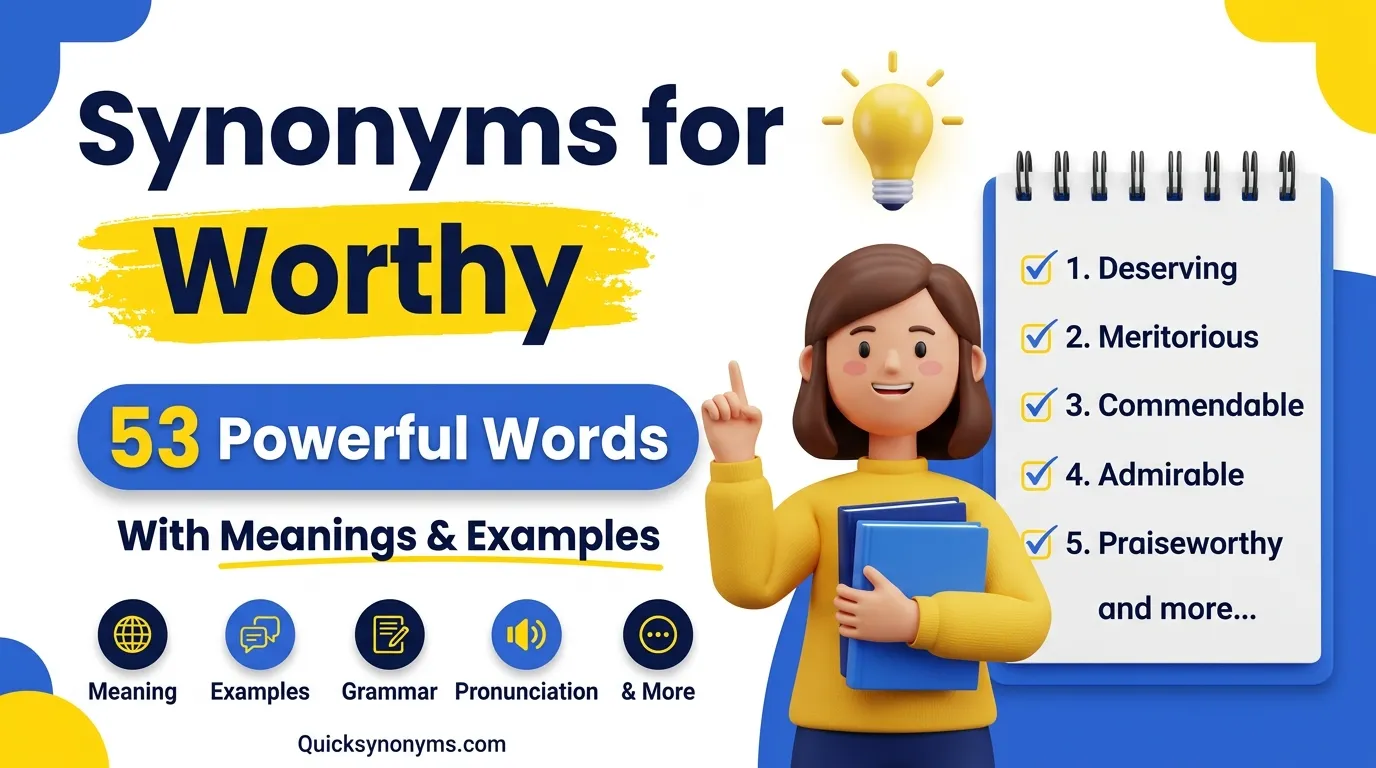
The word worthy means good enough to deserve respect, praise, trust, or attention. A student who works hard may be worthy of an award. A kind person may be worthy of respect because they care for others. We use this word to show that someone or something has value and deserves a good response.
Synonyms help English learners understand small differences between words. They also help writers create clear sentences, avoid repeated words, and share ideas with more care. For example, deserving, valuable, and admirable are close to worthy, but each has its own use.
This guide covers the meaning of worthy, its synonyms, simple examples, grammar, word history, and pronunciation. It also groups related words by meaning, explains common antonyms, and answers key questions. These tips can help you choose the right word in school, at work, and in daily life.
Meaning of Worthy
Definition
Worthy (adjective): Good enough to deserve respect, praise, support, or attention.
Examples
- She is a worthy winner of the prize.
- His honest work is worthy of praise.
Connotative Meaning
- Positive tone: Shows respect, value, honor, or merit.
- Negative tone: Can suggest doubt when used in a phrase such as “not worthy.”
- Neutral tone: States that someone or something deserves a certain response.
(Connotation: the emotional or cultural feeling a word carries beyond its literal meaning.)
Etymology
The word worthy comes from Old English weorþig, meaning worthy or valuable. It is linked to weorþ, meaning worth or value, and the word has Germanic roots.
- Old English (450 to 1100): Weorþig meant worthy or valuable.
- Middle English (1100 to 1500): The form changed to worthy as English spelling and sounds changed.
- Modern English (1500 to present): Worthy kept its main sense of deserving respect, praise, or attention.
Pronunciation (IPA)
- IPA: /ˈwɜːrði/ in many British and American dictionary transcriptions, with some variation by accent.
- Syllables: wor-thy, 2 syllables.
Affixation Pattern of Worthy
- Root: worth, meaning value or merit.
- Prefix: None.
- Suffix: -y, which forms an adjective meaning having or showing a quality.
- Word formations:
- Worth (noun): The value of something.
- Worthy (adjective): Deserving respect or attention.
- Worthily (adverb): In a way that deserves respect or praise.
- Worthiness (noun): The quality of being worthy.
- Unworthy (adjective): Not deserving respect or approval.
- Worthwhile (adjective): Worth the time, effort, or cost.
53 Synonyms of Worthy: With Meaning and Examples
1. Deserving (adjective)
Meaning: Good enough to receive something because of merit or effort.
Examples:
- The team is deserving of praise.
- She is a deserving winner of the award.
2. Meritorious (adjective)
Meaning: Showing value or good work that deserves praise.
Examples:
- His meritorious service earned him a medal.
- The school honored her meritorious efforts.
3. Commendable (adjective)
Meaning: Good enough to deserve approval or praise.
Examples:
- Her patience was commendable.
- The group made a commendable effort.
4. Admirable (adjective)
Meaning: So good that people respect or admire it.
Examples:
- His courage was admirable.
- She showed admirable kindness to the child.
5. Creditworthy (adjective)
Meaning: Deserving trust or credit for good conduct or reliable actions.
Examples:
- The firm has a creditworthy record.
- His creditworthy conduct impressed the board.
6. Praiseworthy (adjective)
Meaning: Deserving praise for being good or helpful.
Examples:
- Her praiseworthy work helped the whole class.
- The charity made a praiseworthy effort to feed families.
7. Honorable (adjective)
Meaning: Deserving respect because of good and fair behavior.
Examples:
- He made an honorable choice.
- Her honorable actions won public trust.
8. Laudable (adjective)
Meaning: Deserving praise or approval.
Examples:
- Their goal to help children is laudable.
- The team showed laudable patience.
9. Esteemed (adjective)
Meaning: Respected and valued by others.
Examples:
- She is an esteemed teacher.
- The esteemed leader spoke to the crowd.
10. Respected (adjective)
Meaning: Admired because of good qualities or actions.
Examples:
- He is a respected member of the community.
- The respected doctor listened to each patient.
11. Merited (adjective)
Meaning: Deserved because of effort, skill, or good conduct.
Examples:
- The player received merited praise.
- Her success brought merited attention to the project.
12. Valuable (adjective)
Meaning: Important or useful enough to deserve care or attention.
Examples:
- Her advice was valuable to the team.
- The museum holds valuable records of local history.
13. Worthwhile (adjective)
Meaning: Good enough to make the time or effort worthwhile.
Examples:
- The course was worthwhile for new workers.
- Their long trip proved worthwhile in the end.
14. Significant (adjective)
Meaning: Important enough to deserve attention.
Examples:
- The study made a significant contribution.
- Her speech had a significant effect on the group.
15. Important (adjective)
Meaning: Having enough value or effect to matter.
Examples:
- Safety is an important part of the plan.
- The meeting covered an important issue.
16. Notable (adjective)
Meaning: Worth noticing because of a special quality or result.
Examples:
- The artist made a notable contribution to the town.
- Her notable progress pleased her coach.
17. Exceptional (adjective)
Meaning: Much better than usual and deserving attention.
Examples:
- He gave an exceptional performance.
- The student showed exceptional skill in math.
18. Excellent (adjective)
Meaning: Very good in quality or performance.
Examples:
- She did an excellent job on the report.
- The chef prepared an excellent meal.
19. Outstanding (adjective)
Meaning: Better than most and worthy of notice.
Examples:
- His outstanding work won a prize.
- The team had an outstanding season.
20. Remarkable (adjective)
Meaning: So unusual or good that people notice it.
Examples:
- She made remarkable progress in a month.
- His remarkable patience helped solve the problem.
21. Impressive (adjective)
Meaning: Good or powerful enough to gain respect or attention.
Examples:
- The speaker gave an impressive talk.
- Her impressive skills helped the team win.
22. Respectable (adjective)
Meaning: Good enough to earn respect or meet a fair standard.
Examples:
- He earned a respectable score on the test.
- The shop has a respectable record of service.
23. Decent (adjective)
Meaning: Good enough to be acceptable or deserving of respect.
Examples:
- She found a decent place to live.
- He made a decent effort to fix the problem.
24. Reputable (adjective)
Meaning: Known for being honest and reliable.
Examples:
- They hired a reputable builder.
- She chose a reputable firm for the work.
25. Credible (adjective)
Meaning: Believable and worthy of trust.
Examples:
- The witness gave a credible account.
- We need credible evidence before making a claim.
26. Trustworthy (adjective)
Meaning: Honest and reliable enough to be trusted.
Examples:
- He is a trustworthy friend.
- The company needs a trustworthy manager.
27. Reliable (adjective)
Meaning: Able to be trusted to work well or do what is expected.
Examples:
- She is a reliable worker.
- We need a reliable source for this report.
28. Dependable (adjective)
Meaning: Someone or something that can be trusted to do what is needed.
Examples:
- Our dependable driver arrived on time.
- He is a dependable partner in every task.
29. Honored (adjective)
Meaning: Given respect or public praise for an achievement or service.
Examples:
- The honored guest thanked the crowd.
- She felt honored to receive the award.
30. Esteemable (adjective)
Meaning: Deserving esteem or respect, though this word is rare.
Examples:
- His esteemable conduct drew praise from the group.
- The writer described her as an esteemable public servant.
31. Virtuous (adjective)
Meaning: Showing strong moral values and good conduct.
Examples:
- She led a virtuous life.
- His virtuous choice helped a person in need.
32. Righteous (adjective)
Meaning: Morally right or guided by a strong sense of justice.
Examples:
- They stood for a righteous cause.
- The judge made a righteous effort to protect the weak.
33. Ethical (adjective)
Meaning: Following ideas of right and fair behavior.
Examples:
- The team made an ethical choice.
- Ethical research protects the people who take part.
34. Upright (adjective)
Meaning: Honest and guided by strong moral values.
Examples:
- The upright official refused the bribe.
- She is known as an upright citizen.
35. Noble (adjective)
Meaning: Showing high moral values or a generous purpose.
Examples:
- He worked for a noble cause.
- Their noble goal was to help poor families.
36. Worthy-minded (adjective)
Meaning: Focused on good values or aims, but rarely used in modern English.
Examples:
- The story presents a worthy-minded hero.
- Her worthy-minded goals guided her work.
37. Dignified (adjective)
Meaning: Showing calm self-respect and deserving respect from others.
Examples:
- She gave a dignified reply to the insult.
- The leader made a dignified exit.
38. Honorable-minded (adjective)
Meaning: Guided by a desire to act with honor, but uncommon in modern English.
Examples:
- The novel follows an honorable-minded young man.
- His honorable-minded approach put fairness first.
39. Esteem-worthy (adjective)
Meaning: Deserving esteem or respect, though uncommon.
Examples:
- Her esteem-worthy service helped the town.
- The group praised his esteem-worthy actions.
40. Meritable (adjective)
Meaning: Deserving merit or recognition, though uncommon in everyday speech.
Examples:
- The panel praised her meritable work.
- His meritable efforts improved the project.
41. Rewarding (adjective)
Meaning: Giving enough value or benefit to make an activity worthwhile.
Examples:
- Teaching can be a rewarding career.
- They found the volunteer work rewarding.
42. Fitting (adjective)
Meaning: Right or suitable for a person, event, or purpose.
Examples:
- A short speech was fitting for the event.
- Her award was a fitting tribute to her hard work.
43. Appropriate (adjective)
Meaning: Right for a certain situation or purpose.
Examples:
- A formal dress was appropriate for the ceremony.
- His response was appropriate for the moment.
44. Suitable (adjective)
Meaning: Right for a need, role, or purpose.
Examples:
- This room is suitable for a small meeting.
- She is suitable for the role of team leader.
45. Qualified (adjective)
Meaning: Having the skills or qualities needed for a role or task.
Examples:
- He is qualified to teach English.
- The qualified candidate answered each question well.
46. Eligible (adjective)
Meaning: Meeting the rules or conditions needed for a benefit or role.
Examples:
- She is eligible for the scholarship.
- Eligible workers may apply for the program.
47. Capable (adjective)
Meaning: Having the skill or ability to do something well.
Examples:
- He is a capable manager.
- The capable team finished the task on time.
48. Competent (adjective)
Meaning: Having enough skill and knowledge to do a job well.
Examples:
- The competent nurse cared for each patient.
- She is a competent editor.
49. Accomplished (adjective)
Meaning: Skilled or successful after much practice or effort.
Examples:
- He is an accomplished musician.
- The accomplished writer published her first novel.
50. Gifted (adjective)
Meaning: Having a natural ability that is better than usual.
Examples:
- The gifted child learned music quickly.
- She is a gifted speaker.
51. Promising (adjective)
Meaning: Showing signs of future success or value.
Examples:
- The young player is promising.
- Her promising idea gained support.
52. Prestigious (adjective)
Meaning: Respected because of high status or a strong reputation.
Examples:
- He won a prestigious award.
- She joined a prestigious research group.
53. Prized (adjective)
Meaning: Valued highly and treated as important.
Examples:
- The prized painting stayed in the family for years.
- Her prized collection filled a small room.
Prototype Meaning
The prototype meaning of worthy is deserving of something good, such as respect, praise, trust, or a reward. People often imagine a kind person, a hard-working student, or a brave leader who has earned respect through good actions. The word can also describe a goal, cause, or idea that deserves time and support.
Prototype Categorization
- Deserving praise: Deserving, meritorious, commendable, praiseworthy, laudable, merited. Use these words when someone earns praise through effort or good work.
- Deserving respect: Admirable, honorable, esteemed, respected, dignified, noble. Use these words to show respect for a person’s character or actions.
- Valuable or important: Valuable, worthwhile, significant, important, notable. Use these words for ideas, causes, work, or things that matter.
- Excellent or impressive: Exceptional, excellent, outstanding, remarkable, impressive. Use these words when someone or something stands out for its quality.
- Trust and good character: Creditworthy, reputable, credible, trustworthy, reliable, dependable, virtuous, righteous, ethical, upright. Use these words for honesty, trust, and moral conduct.
- Good quality or achievement: Respectable, decent, honored, accomplished, capable, competent, gifted, promising, prestigious, prized. Use these words for people, results, skills, or achievements.
- Right for a purpose: Fitting, appropriate, suitable, qualified, eligible, rewarding. Use these words when a person, action, or activity meets a need or deserves consideration.
- Less common forms: Esteemable, worthy-minded, virtuous-minded, esteem-worthy, meritable, honorable-minded. These forms are rare or unusual. In most everyday writing, choose a more common word such as admirable, honorable, or deserving.
Grouping words by meaning helps writers see which synonyms fit a sentence. It also helps English learners avoid words that seem similar but have different uses.
Antonyms of Worthy
- Unworthy (adjective): Not deserving respect, praise, or support.
- Undeserving (adjective): Not having earned a reward or good treatment.
- Unfit (adjective): Not suitable for a role or purpose.
- Unsuitable (adjective): Not right for a certain need or situation.
- Unqualified (adjective): Lacking the skills or conditions needed for a role.
- Dishonorable (adjective): Showing a lack of honor or good conduct.
- Disreputable (adjective): Having a poor reputation because of bad conduct.
- Contemptible (adjective): Deserving strong dislike or scorn because of bad behavior.
Short Questions and Answers
What does Worthy mean?
Worthy means deserving respect, praise, trust, attention, or support. It describes a person, action, idea, or thing that has enough merit to deserve a response.
When should Worthy be used?
Use worthy when you want to say that someone or something deserves a certain kind of treatment. Common phrases include worthy of respect, worthy of praise, and worthy of attention.
Is Worthy positive or negative?
Worthy is usually positive because it suggests value or merit. However, phrases such as not worthy and unworthy express a negative judgment.
How is it different from similar words?
Deserving focuses on earning something through actions or qualities. Admirable suggests that someone or something deserves respect because of good qualities. Valuable focuses on importance or usefulness rather than moral merit.
Conclusion
Learning the meaning of worthy helps you describe people, actions, and ideas that deserve respect, praise, or attention. Its synonyms, such as deserving, admirable, commendable, and praiseworthy, let you express your ideas with greater care. Each word has a slightly different meaning, so choosing the right one makes your message clearer.
Using synonyms also improves your writing and speaking. You can avoid repeating the same word, make school essays stronger, and express your thoughts with more confidence. English learners can build these skills by reading, writing, and using new words in daily talks.
Start with a few common synonyms and learn their meanings through simple examples. Practice one new word each day, write your own sentences, and review them often. Small steps can help you build a stronger vocabulary over time.
Learn More: Synonyms for Psychological: 51 Words to Know

Senior English Language Expert
Eleanor Brooks specializes in English grammar, vocabulary, and word usage. She enjoys simplifying complex language concepts and creating practical resources that help learners write and speak with confidence.



1 thought on “Synonyms for Worthy: 53 Powerful Words”