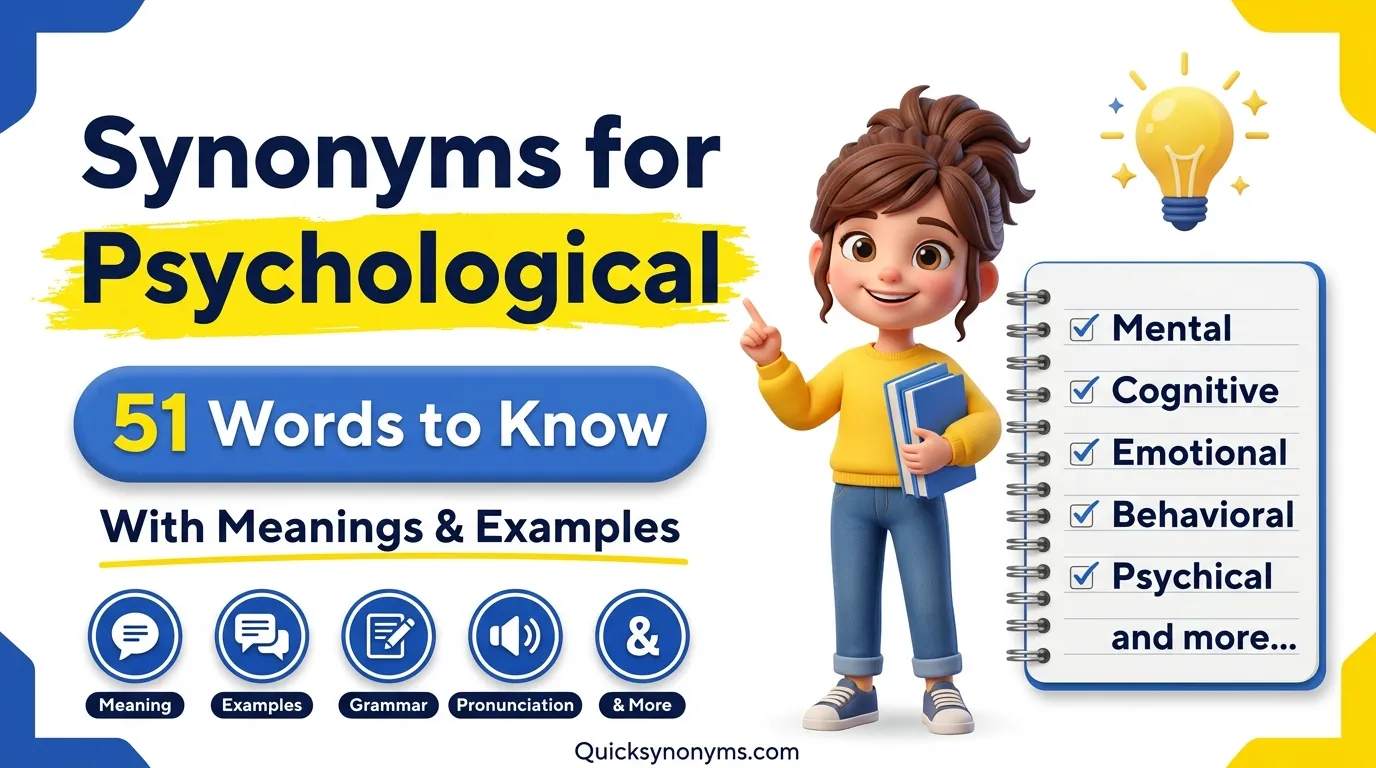
The word psychological relates to the mind, thoughts, feelings, and behavior. For example, a student may feel psychological stress before an important exam. A coach may also use psychological methods to help a team stay calm and focused. People often use this word when they talk about emotions, mental health, learning, and human behavior.
Learning synonyms for psychological helps English learners express ideas more clearly. It also helps writers avoid repeating the same word in essays, articles, reports, and everyday conversations. The right synonym can make a sentence more exact and easier to understand.
This guide explores the meaning, examples, pronunciation, grammar, and history of psychological. It also presents 51 synonyms with simple meanings and examples, groups related words by meaning, and explains common antonyms. These tips will help you choose the best word for each situation.
Meaning of Psychological
Definition
Psychological (adjective): Related to the mind, mental processes, emotions, or behavior.
Examples
- Stress can have a psychological effect on a person’s health.
- The team received psychological support before the final match.
Connotative Meaning
- Positive tone: Suggests mental strength, self-awareness, emotional growth, and healthy behavior.
- Negative tone: May suggest mental distress, emotional pressure, fear, or inner conflict.
- Neutral tone: Describes thoughts, feelings, mental processes, or behavior without judging them.
(Connotation: the emotional or cultural feeling a word carries beyond its literal meaning.)
Etymology
The word psychological comes from psychology, which is based on Greek roots. The Greek word psyche means “soul” or “mind,” while logia refers to study or an account. The adjective developed from psychology with the suffix -ical.
- Old English (450 to 1100): Not applicable. The word did not exist in Old English.
- Middle English (1100 to 1500): Not applicable. The word entered English later.
- Modern English (1500 to present): Psychology entered English in the 17th century. Psychological developed from this word and became a term for matters related to the mind.
Pronunciation (IPA)
- IPA: /ˌsaɪ.kəˈlɑː.dʒɪ.kəl/
- Syllables: psy-cho-log-i-cal
Affixation Pattern of Psychological
- Root: psych, linked to the Greek word for mind or soul.
- Prefix: None.
- Suffix: -ical, which helps form an adjective from psychology.
- Word formations:
- Psychology (noun): The study of the mind and behavior.
- Psychologist (noun): A person trained in the study of the mind and behavior.
- Psychologically (adverb): In a way related to the mind or mental processes.
- Psychologic (adjective): Related to psychology or the mind.
- Psychologize (verb): To explain or interpret something in psychological terms.
51 Synonyms of Psychological: With Meaning and Examples
The following synonyms range from close matches to words used in more specific contexts. Some focus on thinking, while others focus on feelings, behavior, or mental health. Choose the word that best fits your sentence.
1. Mental (adjective)
Meaning: Related to the mind, thoughts, or mental processes.
Examples:
- Mental health is important at every age.
- The game requires mental effort and focus.
2. Cognitive (adjective)
Meaning: Related to thinking, learning, memory, and understanding.
Examples:
- Reading can improve cognitive skills.
- The study measured cognitive development in children.
3. Emotional (adjective)
Meaning: Related to feelings and emotional responses.
Examples:
- The film had a strong emotional effect on viewers.
- She needed emotional support after the loss.
4. Behavioral (adjective)
Meaning: Related to the way a person acts or responds.
Examples:
- The teacher noticed a behavioral change in the child.
- The program aims to improve behavioral habits.
5. Psychical (adjective)
Meaning: Related to the mind rather than the physical body, often in specialized or older usage.
Examples:
- The book explores psychical experiences.
- The author discusses psychical processes in an early theory.
6. Cerebral (adjective)
Meaning: Related to the brain or intellectual thought.
Examples:
- The novel offers a cerebral challenge.
- Their discussion became more cerebral than emotional.
7. Intellectual (adjective)
Meaning: Related to reasoning, knowledge, and the use of the mind.
Examples:
- The course offers intellectual challenges.
- He enjoys intellectual debates about human nature.
8. Psychiatric (adjective)
Meaning: Related to the diagnosis or treatment of mental health conditions.
Examples:
- The patient received psychiatric care.
- The hospital opened a new psychiatric unit.
9. Affective (adjective)
Meaning: Related to emotions, moods, and feelings.
Examples:
- The research examined affective responses to music.
- Affective skills can help children understand their feelings.
10. Psychologic (adjective)
Meaning: Related to psychology, the mind, or mental processes.
Examples:
- The report describes psychologic factors in decision-making.
- The study considers psychologic responses to stress.
11. Psychosocial (adjective)
Meaning: Related to the connection between mental processes and social life.
Examples:
- Family support can improve psychosocial well-being.
- The program addresses psychosocial needs in young adults.
12. Neurological (adjective)
Meaning: Related to the nervous system and its functions.
Examples:
- The doctor checked for neurological problems.
- The condition may affect neurological development.
13. Mental-health (adjective)
Meaning: Related to mental well-being or mental health care.
Examples:
- The school launched a mental-health program.
- Mental-health support can help students manage stress.
14. Emotional-mental (adjective)
Meaning: Related to both feelings and mental processes.
Examples:
- The course explores emotional-mental well-being.
- Emotional-mental strain can affect daily life.
15. Introspective (adjective)
Meaning: Focused on examining one’s own thoughts and feelings.
Examples:
- Her introspective writing reveals her fears.
- He became more introspective after the experience.
16. Reflective (adjective)
Meaning: Involving careful thought about experiences or ideas.
Examples:
- She took a reflective approach to the problem.
- His reflective journal helped him understand his reactions.
17. Perceptual (adjective)
Meaning: Related to how the mind receives and understands information.
Examples:
- The test measures perceptual skills.
- Perceptual differences can affect how people see an image.
18. Intellectualized (adjective)
Meaning: Explained or handled mainly through reasoning rather than feelings.
Examples:
- His intellectualized response avoided the painful emotions.
- The discussion became intellectualized instead of personal.
19. Rational (adjective)
Meaning: Based on reason and clear thinking.
Examples:
- She made a rational choice under pressure.
- A rational discussion helped solve the disagreement.
20. Irrational (adjective)
Meaning: Not based on sound reason or clear thinking.
Examples:
- An irrational fear stopped him from speaking.
- The decision seemed irrational to the rest of the team.
21. Subconscious (adjective)
Meaning: Related to mental processes that happen without full awareness.
Examples:
- A subconscious fear shaped his reaction.
- The artist explored subconscious ideas in her work.
22. Unconscious (adjective)
Meaning: Related to mental processes outside conscious awareness.
Examples:
- An unconscious habit can influence daily choices.
- The therapist discussed unconscious patterns of behavior.
23. Conscious (adjective)
Meaning: Involving awareness of thoughts, feelings, or actions.
Examples:
- She made a conscious effort to stay calm.
- Conscious choices can help change old habits.
24. Motivational (adjective)
Meaning: Related to the reasons that encourage someone to act.
Examples:
- The coach gave a motivational speech before the game.
- The study examined motivational factors in learning.
25. Perceptive (adjective)
Meaning: Good at noticing and understanding thoughts, feelings, or details.
Examples:
- Her perceptive comments revealed the real problem.
- A perceptive teacher can notice changes in a student’s mood.
26. Intuitive (adjective)
Meaning: Based on an immediate understanding without conscious reasoning.
Examples:
- He made an intuitive choice about the design.
- Her intuitive response helped her read the situation.
27. Instinctive (adjective)
Meaning: Based on a natural reaction rather than careful thought.
Examples:
- His instinctive reaction was to protect the child.
- An instinctive response can happen before conscious thought.
28. Cognitive-behavioral (adjective)
Meaning: Related to the link between thoughts, feelings, and actions.
Examples:
- The clinic offers cognitive-behavioral therapy.
- A cognitive-behavioral approach can help people change unhelpful patterns.
29. Psychotherapeutic (adjective)
Meaning: Related to therapy that helps people address mental or emotional problems.
Examples:
- The patient received psychotherapeutic support.
- The book describes psychotherapeutic methods for managing anxiety.
30. Therapeutic (adjective)
Meaning: Helping to improve mental, emotional, or physical well-being.
Examples:
- Writing a journal can be therapeutic for some people.
- The group found therapeutic value in sharing their stories.
31. Psychiatric-related (adjective)
Meaning: Connected with psychiatry or the care of mental health conditions.
Examples:
- The report covered psychiatric-related services.
- The team reviewed psychiatric-related concerns during the meeting.
32. Psychogenic (adjective)
Meaning: Originating from mental or emotional factors rather than a direct physical cause.
Examples:
- The article discussed psychogenic symptoms.
- Researchers explored possible psychogenic causes of the condition.
33. Psychosomatic (adjective)
Meaning: Involving a connection between mental factors and physical symptoms.
Examples:
- Stress may contribute to psychosomatic symptoms.
- The doctor explained the role of psychosomatic factors in her pain.
34. Emotionalized (adjective)
Meaning: Marked by strong emotion or presented in an emotional way.
Examples:
- The emotionalized account focused on fear and hope.
- His emotionalized response made the debate more intense.
35. Sentimental (adjective)
Meaning: Strongly influenced by tender feelings, memories, or affection.
Examples:
- She kept a sentimental letter from her childhood.
- The film uses sentimental scenes to explore family bonds.
36. Arousal-related (adjective)
Meaning: Related to a state of mental or bodily alertness and excitement.
Examples:
- The study measured arousal-related responses to noise.
- Arousal-related changes can affect attention.
37. Behavioral-science (adjective)
Meaning: Related to the scientific study of human or animal behavior.
Examples:
- The team used a behavioral-science model.
- Behavioral-science research can explain patterns in group decisions.
38. Neuropsychological (adjective)
Meaning: Related to the links between brain function, thinking, and behavior.
Examples:
- The patient completed a neuropsychological assessment.
- The report examined neuropsychological effects after the injury.
39. Developmental (adjective)
Meaning: Related to growth and change in the mind, body, or behavior.
Examples:
- Play supports developmental learning in young children.
- The study examined developmental changes in memory.
40. Social (adjective)
Meaning: Related to people, groups, and interactions between them.
Examples:
- Social pressure can affect personal choices.
- The study explored social influences on behavior.
41. Interpersonal (adjective)
Meaning: Related to relationships and communication between people.
Examples:
- Interpersonal skills help people resolve conflict.
- The workshop focused on interpersonal communication.
42. Intrapersonal (adjective)
Meaning: Related to a person’s inner thoughts, feelings, and self-understanding.
Examples:
- Intrapersonal awareness can improve self-control.
- The lesson encouraged intrapersonal reflection.
43. Affective-cognitive (adjective)
Meaning: Related to the interaction between emotion and thinking.
Examples:
- The paper examined affective-cognitive processes.
- Affective-cognitive skills can influence how students learn.
44. Experiential (adjective)
Meaning: Related to personal experiences and how people understand them.
Examples:
- The course uses experiential learning activities.
- Her experiential knowledge shaped her view of stress.
45. Interpretive (adjective)
Meaning: Related to the way people explain or understand information.
Examples:
- The study used an interpretive approach to personal stories.
- Interpretive differences can shape people’s memories.
46. Subjective (adjective)
Meaning: Based on personal feelings, views, or experiences.
Examples:
- Pain can involve a subjective experience.
- The survey asked about subjective feelings of well-being.
47. Individual (adjective)
Meaning: Related to one person rather than a group.
Examples:
- The plan considers individual learning needs.
- Individual differences can shape emotional responses.
48. Personal (adjective)
Meaning: Related to a person’s own feelings, thoughts, or experiences.
Examples:
- She shared a personal response to the story.
- Personal beliefs can influence everyday decisions.
49. Internal (adjective)
Meaning: Existing within a person, rather than outside them.
Examples:
- Internal conflict made the choice difficult.
- He learned to recognize his internal reactions to stress.
50. Emotional-behavioral (adjective)
Meaning: Related to the connection between feelings and actions.
Examples:
- The school offers emotional-behavioral support.
- Emotional-behavioral changes may affect classroom learning.
51. Mind-related (adjective)
Meaning: Connected with thoughts, feelings, or mental activity.
Examples:
- The article explores mind-related aspects of memory.
- Mind-related factors may influence how people respond to stress.
Prototype Meaning
The most typical meaning of psychological is related to the mind and the way people think, feel, and behave. People often use it when discussing stress, motivation, memory, emotions, mental health, and personal choices. For example, psychological stress describes the mental strain a person may feel during a difficult time. The word often points to inner experiences rather than things that can be seen or touched.
Prototype Categorization
The 51 words above do not all mean exactly the same thing. Some are close synonyms, while others describe a specific part of psychology or a related field. The groups below show how to choose them more carefully.
– Mind and thought: Mental, cognitive, psychical, cerebral, intellectual, psychologic, rational, irrational, conscious, subconscious, unconscious. Use these words when discussing thinking, awareness, memory, reasoning, or mental activity.
– Feelings and emotions: Emotional, affective, sentimental, emotionalized, affective-cognitive. Use these when the main focus is feelings, moods, emotional responses, or the link between emotion and thought.
– Behavior and motivation: Behavioral, motivational, instinctive, cognitive-behavioral, behavioral-science, emotional-behavioral. Use these for actions, habits, motivation, and patterns of behavior.
– Mental health and treatment: Psychiatric, mental-health, psychotherapeutic, therapeutic, psychiatric-related, psychogenic, psychosomatic. Use these when discussing mental health care, therapy, or the relationship between mental and physical symptoms.
– Brain and development: Neurological, neuropsychological, developmental. Use these when describing the nervous system, brain function, or changes in mental abilities over time.
– Self-awareness and reflection: Introspective, reflective, perceptive, intuitive, intellectualized, intrapersonal. Use these when discussing self-knowledge, insight, inner reflection, or ways of understanding experiences.
– Perception and experience: Perceptual, experiential, interpretive, subjective. Use these when focusing on how people notice, experience, and interpret the world.
– Social relationships: Psychosocial, social, interpersonal. Use these when mental processes are shaped by relationships, social settings, or group experiences.
– Personal and inner states: Individual, personal, internal, mind-related, emotional-mental, arousal-related. Use these when describing a person’s private experience, internal state, or level of alertness.
Grouping synonyms helps writers find words that fit the exact idea they want to express. It also makes writing clearer and helps avoid using a related word in the wrong context.
Antonyms of Psychological
There is no single perfect antonym for psychological in every context. These words contrast with its common meaning in different ways.
- Physical (adjective): Related to the body rather than the mind.
- Bodily (adjective): Connected with the human body.
- Material (adjective): Related to physical things that can be touched or measured.
- Tangible (adjective): Real and able to be touched or clearly observed.
- Physiological (adjective): Related to how the body and its systems work.
- Mechanical (adjective): Related to machines or physical processes.
- Concrete (adjective): Specific and based on real things rather than abstract ideas.
- Nonmental (adjective): Not related to mental activity.
Short Questions and Answers
What does Psychological mean?
Psychological means related to the mind, thoughts, feelings, or behavior. It is often used when discussing mental health, stress, memory, and emotions.
When should Psychological be used?
Use psychological when describing mental processes, emotional effects, or behavior. For example, a psychological test may measure memory, attention, or other mental abilities.
Is Psychological positive or negative?
The word is usually neutral. It can describe positive ideas, such as psychological growth, or negative experiences, such as psychological stress.
How is it different from similar words?
Psychological is a broad term for the mind and behavior. Cognitive focuses on thinking, memory, and learning, while emotional focuses on feelings. Behavioral focuses on actions and responses.
Conclusion
Learning psychological and its synonyms helps you explain thoughts, feelings, and behavior with greater accuracy. Words such as mental, cognitive, emotional, and behavioral each highlight a different aspect of human experience. Choosing the right word makes your writing more natural and easier to understand.
These synonyms can improve essays, reports, work emails, conversations, and academic writing. They also help English learners build vocabulary, reduce repetition, and express complex ideas in simple words. Remember that related words may have different meanings, so always check how a word fits the sentence.
To build confidence, learn a few synonyms each day and use them in your own sentences. With regular practice, you will become a clearer writer and a more confident speaker.
Discover More: Synonyms for Unrealistic: 45 Useful Alternatives

Senior English Language Expert
Eleanor Brooks specializes in English grammar, vocabulary, and word usage. She enjoys simplifying complex language concepts and creating practical resources that help learners write and speak with confidence.











1 thought on “Synonyms for Psychological: 51 Words to Know”