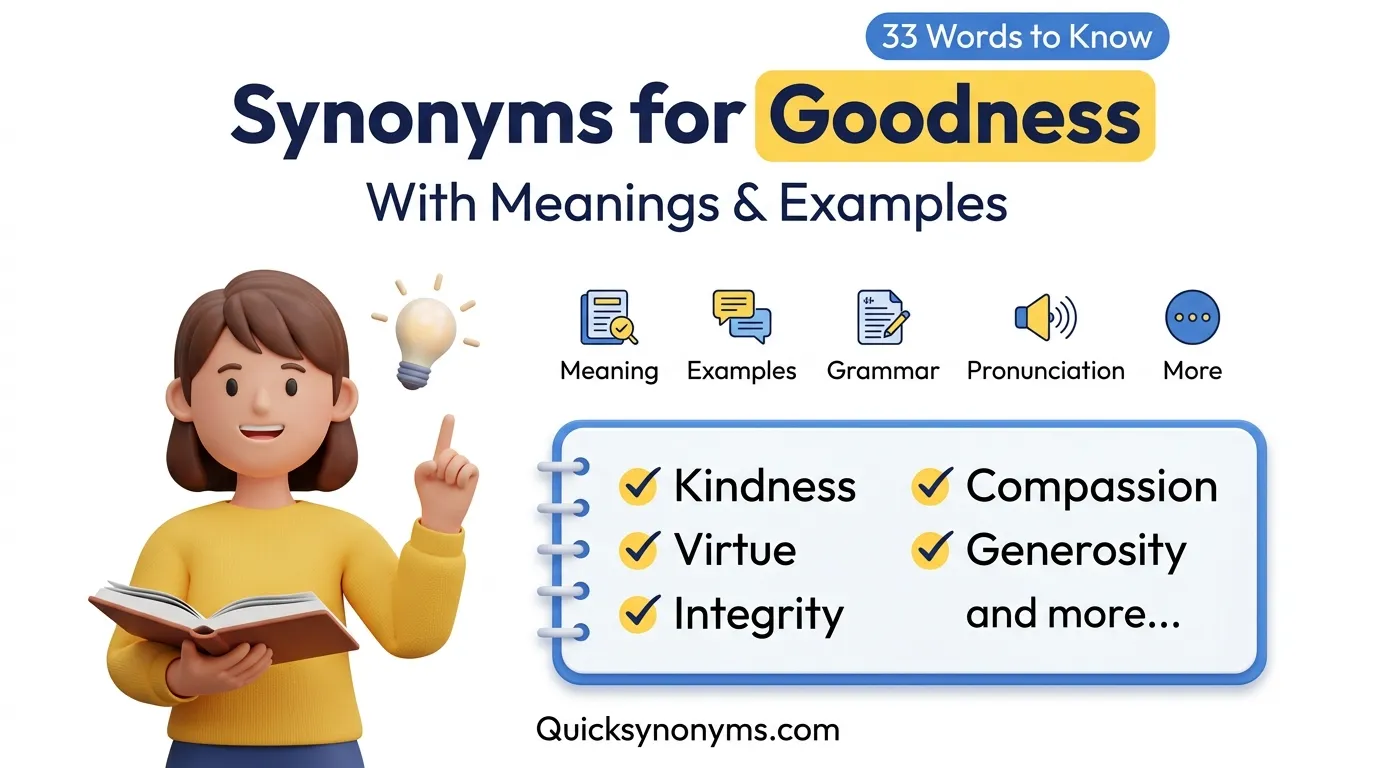
Goodness means the quality of being kind, honest, helpful, or morally good. Imagine a person who helps an elderly neighbor carry groceries without asking for anything back. That simple act shows goodness. The word is commonly used when we talk about kind behavior, strong character, or moral value.
Learning synonyms for goodness helps English learners and content writers express ideas with more variety and accuracy. Instead of using the same word again and again, you can choose a word that fits the exact meaning and feeling you want.
This article explains the meaning of goodness, its synonyms, examples, grammar, history, pronunciation, and semantic categories. It also shows how these words can make everyday English clearer and stronger.
Meaning of Goodness
Definition
Goodness (Noun): The quality of being kind, honest, moral, helpful, or good.
Examples
- Her goodness made everyone feel welcome.
- He is known for his goodness and kindness.
Connotative Meaning
Connotation: The feeling or idea that a word suggests beyond its basic meaning.
- Positive tone: Goodness usually suggests kindness, honesty, virtue, and moral strength.
- Negative tone: The word itself is not normally negative, but it can sound sarcastic in some contexts.
- Neutral tone: It can simply describe the quality or nature of something good.
Etymology
The word goodness comes from the word good combined with the suffix -ness, which forms a noun describing a quality or state.
- Old English (450–1100): Goodness developed from Old English gōdnes, based on gōd, meaning good, worthy, virtuous, or beneficial.
- Middle English (1100–1500): Forms such as goodnesse were used for the quality of being good or virtuous.
- Modern English (1500–Present): Goodness became the standard noun for moral virtue, kindness, quality, or the state of being good.
Pronunciation (IPA)
- IPA: /ˈɡʊdnəs/
- Syllables: good-ness
Affixation Pattern of Goodness
- Root: good
- Prefix: None
- Suffix: -ness
- Word formations:
- good (adjective, noun)
- goodness (noun)
- goodly (adverb, adjective)
- goodish (adjective)
- good-hearted (adjective)
- good-natured (adjective)
- goodness (interjection in expressions such as “Goodness!”)
33 Synonyms of Goodness, With Meaning & Examples
1. Virtue (Noun)
Meaning: A good moral quality or behavior.
Examples:
- Honesty is an important virtue.
- She is admired for her virtue and courage.
2. Kindness (Noun)
Meaning: The quality of being caring, gentle, and helpful.
Examples:
- His kindness made the stranger feel safe.
- A little kindness can brighten someone’s day.
3. Benevolence (Noun)
Meaning: A desire to help others and promote their well-being.
Examples:
- Her benevolence helped many poor families.
- The organization is known for its benevolence.
4. Morality (Noun)
Meaning: Principles about what is right and wrong.
Examples:
- The story raises questions about morality.
- He takes morality seriously in his work.
5. Righteousness (Noun)
Meaning: The quality of being morally right or good.
Examples:
- He believed strongly in righteousness.
- The character fights for righteousness.
6. Decency (Noun)
Meaning: Proper, respectful, and morally acceptable behavior.
Examples:
- She treated everyone with decency.
- Basic decency requires us to respect others.
7. Integrity (Noun)
Meaning: Strong honesty and firm moral principles.
Examples:
- She is a leader with great integrity.
- His integrity earned the team’s trust.
8. Honesty (Noun)
Meaning: The habit of telling the truth and avoiding deception.
Examples:
- Honesty is important in every relationship.
- I respect her honesty.
9. Compassion (Noun)
Meaning: A caring feeling toward someone who is suffering.
Examples:
- The nurse showed great compassion.
- Compassion can help people through difficult times.
10. Generosity (Noun)
Meaning: A willingness to give time, money, or help freely.
Examples:
- Her generosity helped the local shelter.
- We were touched by his generosity.
11. Humanity (Noun)
Meaning: Kindness and concern for other people.
Examples:
- The rescue worker showed great humanity.
- His actions restored our faith in humanity.
12. Goodwill (Noun)
Meaning: Friendly or helpful feelings toward others.
Examples:
- The company built goodwill in the community.
- Her kindness created goodwill among the team.
13. Altruism (Noun)
Meaning: Caring about others without expecting personal benefit.
Examples:
- His actions were motivated by altruism.
- Altruism can inspire people to help strangers.
14. Charity (Noun)
Meaning: Kindness toward people in need, often shown through giving.
Examples:
- She gives part of her income to charity.
- The family was grateful for his charity.
15. Benevolence (Noun)
Meaning: Kind and generous concern for other people.
Examples:
- His benevolence was widely respected.
- The foundation works through benevolence and service.
16. Virtuousness (Noun)
Meaning: The quality of having strong moral values.
Examples:
- Her virtuousness was clear in her actions.
- The novel explores courage and virtuousness.
17. Uprightness (Noun)
Meaning: Strong moral honesty and proper behavior.
Examples:
- His uprightness made him a trusted judge.
- People respected her uprightness.
18. Purity (Noun)
Meaning: A state of being free from moral corruption or harmful intent.
Examples:
- The child acted with remarkable purity.
- Her words showed purity of purpose.
19. Nobility (Noun)
Meaning: High moral character and admirable behavior.
Examples:
- His actions showed great nobility.
- She admired the nobility of his decision.
20. Fairness (Noun)
Meaning: The quality of treating people equally and justly.
Examples:
- Everyone deserves fairness at work.
- The teacher is known for fairness.
21. Justice (Noun)
Meaning: Fair treatment based on what is right.
Examples:
- They worked together to seek justice.
- Justice should apply equally to everyone.
22. Mercy (Noun)
Meaning: Kindness shown by not punishing someone harshly.
Examples:
- The judge showed mercy.
- She asked for mercy after making a mistake.
23. Empathy (Noun)
Meaning: The ability to understand and share another person’s feelings.
Examples:
- Good teachers often show empathy.
- Her empathy helped her comfort her friend.
24. Gentleness (Noun)
Meaning: A calm, kind, and non-harmful way of treating people.
Examples:
- He handled the frightened animal with gentleness.
- Her gentleness made the child feel comfortable.
25. Helpfulness (Noun)
Meaning: The quality of being willing and able to help.
Examples:
- I appreciated his helpfulness.
- Her helpfulness made the project easier.
26. Friendliness (Noun)
Meaning: A warm and pleasant attitude toward others.
Examples:
- His friendliness made new students feel welcome.
- The staff are known for their friendliness.
27. Selflessness (Noun)
Meaning: Caring about others without putting your own needs first.
Examples:
- Her selflessness inspired the whole group.
- The volunteer acted with complete selflessness.
28. Sincerity (Noun)
Meaning: The quality of being genuine, honest, and free from false behavior.
Examples:
- I could hear sincerity in her voice.
- His apology showed real sincerity.
29. Decorum (Noun)
Meaning: Proper and respectful behavior.
Examples:
- The guests behaved with decorum.
- Professional decorum is expected in the office.
30. Moral excellence (Noun)
Meaning: A very high level of good and ethical character.
Examples:
- The story presents her as a model of moral excellence.
- His moral excellence influenced those around him.
31. Good-heartedness (Noun)
Meaning: The quality of being naturally kind and caring.
Examples:
- Her good-heartedness was clear to everyone.
- His good-heartedness made him easy to trust.
32. Kindheartedness (Noun)
Meaning: A natural tendency to be kind and caring.
Examples:
- Her kindheartedness helped many people.
- His kindheartedness made him popular with his neighbors.
33. Moral goodness (Noun)
Meaning: The quality of having good intentions and ethical behavior.
Examples:
- The story focuses on moral goodness.
- Her actions were a clear example of moral goodness.
Prototype Meaning
The most typical meaning of goodness is moral kindness or good character. When people hear this word, they often imagine someone who is honest, caring, generous, helpful, and willing to do what is right. Goodness can describe a person’s character, actions, intentions, or treatment of others.
Prototype Categorization
The synonyms for goodness can be grouped by their main meaning:
- Moral character: Virtue, righteousness, integrity, morality, uprightness, virtuousness, and moral excellence focus on being morally good.
- Kindness and care: Kindness, compassion, gentleness, empathy, friendliness, and kindheartedness focus on caring about others.
- Giving and helping: Benevolence, generosity, charity, altruism, helpfulness, and selflessness focus on helping or giving to others.
- Fair and ethical behavior: Fairness, justice, decency, and decorum focus on proper and fair treatment.
- Honest character: Honesty, sincerity, and integrity emphasize truthfulness and genuine behavior.
- Positive human qualities: Humanity, goodwill, nobility, purity, and good-heartedness describe admirable qualities or intentions.
This grouping helps writers choose a synonym based on the exact idea they want to express instead of using goodness in every sentence.
Antonyms of Goodness
- Evil (Noun): Serious moral wrong or harmful behavior.
- Badness (Noun): The quality of being bad or morally wrong.
- Wickedness (Noun): Deliberate or extreme moral wrongdoing.
- Cruelty (Noun): Behavior that causes pain or suffering.
- Dishonesty (Noun): A lack of truthfulness.
- Corruption (Noun): Dishonest or immoral behavior.
- Selfishness (Noun): Caring mainly about your own needs or interests.
- Malice (Noun): A desire to harm or hurt someone.
- Injustice (Noun): Unfair or morally wrong treatment.
- Depravity (Noun): Very serious moral corruption.
Short Questions and Answers
What does goodness mean?
Goodness means the quality of being kind, honest, helpful, moral, or good.
When should goodness be used?
Use goodness when talking about good character, kind actions, moral behavior, or the general quality of being good.
Is goodness positive or negative?
Goodness is normally positive. It expresses kindness, virtue, honesty, and moral value. In some expressions, such as “Goodness!” the word can simply show surprise or emotion.
How is it different from similar words?
Goodness is a broad word for being good. Kindness focuses on caring behavior, integrity focuses on strong moral principles, generosity focuses on giving, and honesty focuses on truthfulness.
Conclusion
Learning goodness and its synonyms gives English learners more ways to describe kindness, morality, honesty, and good character. Words such as virtue, kindness, integrity, compassion, generosity, and benevolence can make your writing more precise and expressive.
Using different words also helps you avoid repetition. Instead of using goodness in every sentence, you can choose a synonym that matches the exact idea and tone. This makes both speaking and writing stronger and more natural.
Try to learn a few new synonyms each day. Write your own sentences, notice how these words are used, and practice them in real conversations. With regular practice, your vocabulary will grow, your writing will become more varied, and your confidence in English will improve.
Read more: Synonyms for Customer Satisfaction: 42 Better Expressions

Senior English Language Expert
Eleanor Brooks specializes in English grammar, vocabulary, and word usage. She enjoys simplifying complex language concepts and creating practical resources that help learners write and speak with confidence.