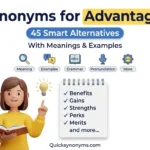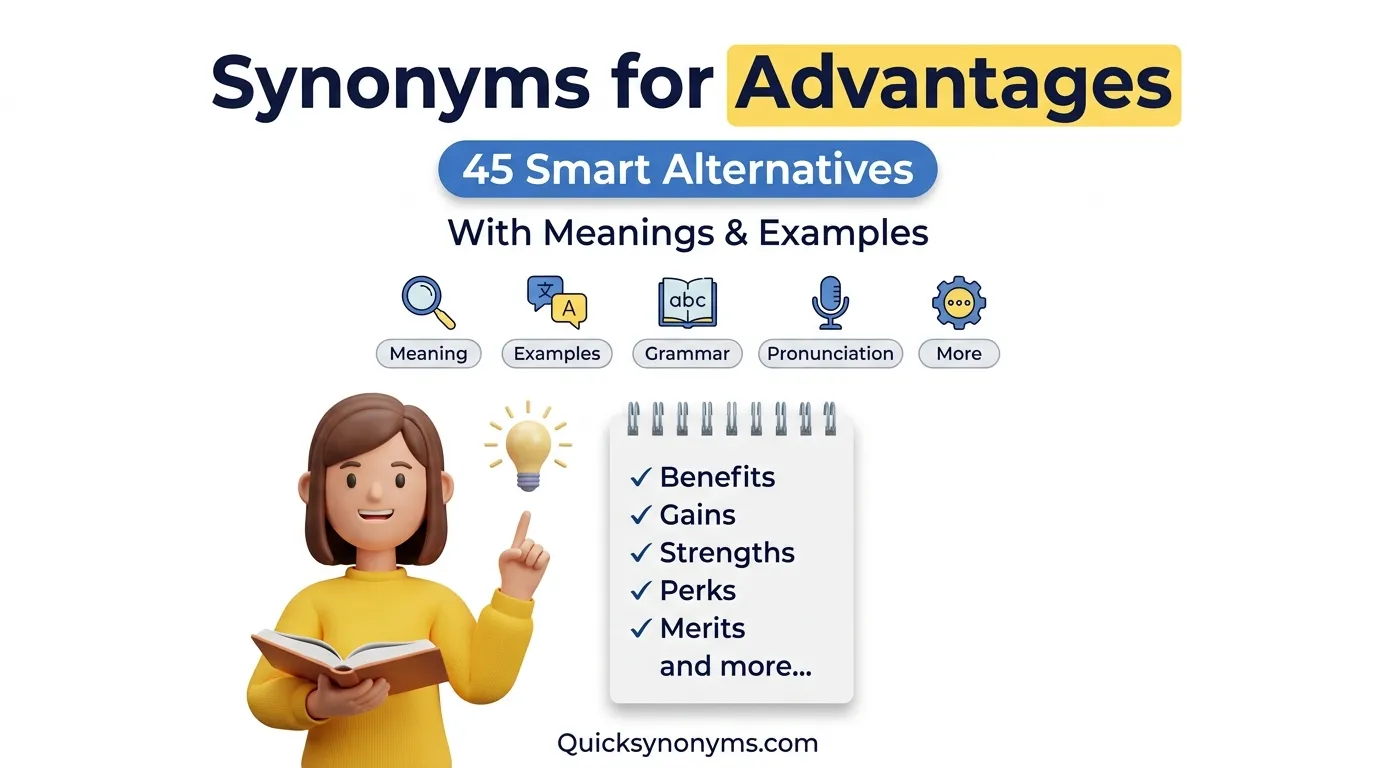
Advantages are benefits or useful things that make a situation better. For example, a student who studies every day has advantages when taking an exam. Good preparation can give the student more confidence, better knowledge, and a better chance of success.
The word “advantages” is common in school, work, business, and everyday conversations. Learning its synonyms helps English learners and content writers express ideas more clearly and avoid using the same word again and again.
In this guide, you will learn the meaning of advantages, its synonyms, examples, grammar, history, pronunciation, word forms, and semantic categories. These examples will help you choose the right word for different situations and improve your English vocabulary.
Meaning of Advantages
Definition
Advantages (Plural Noun): Benefits, useful qualities, or conditions that give someone or something a better position or result.
Examples
- Good communication skills give employees many advantages at work.
- One of the advantages of exercise is better physical fitness.
Connotative Meaning
Positive tone: Advantages usually suggest benefits, strengths, gains, or helpful conditions.
Negative tone: The word itself is not negative, but advantages can sometimes be discussed in an unfair or harmful situation.
Neutral tone: Advantages can simply describe useful features or conditions without strong emotion.
(Connotation: the feeling or idea that a word suggests beyond its basic meaning.)
Etymology
The word advantages comes from the singular noun advantage.
- Old English (450–1100): The modern word was not used in its present form in Old English. The idea of benefit or gain was expressed through other Germanic words.
- Middle English (1100–1500): Advantage entered English through Old French avantage, meaning profit, benefit, or gain. It was related to avant, meaning “before” or “in front.”
- Modern English (1500–Present): Advantage developed the meanings of benefit, favorable position, and useful condition. The plural form advantages is now widely used in everyday, academic, and professional English.
Pronunciation (IPA)
- IPA: /ədˈvæntɪdʒɪz/
- Syllables: ad-VAN-tuh-jiz
Affixation Pattern of Advantages
- Root: advant
- Prefix: None in the modern English form
- Suffix: -age forms the noun advantage; -s marks the plural form
- Word formations:
- advantage: noun and verb
- advantages: plural noun or third-person singular verb
- advantageous: adjective
- advantageously: adverb
- advantaged: adjective or past participle
- advantaging: present participle or gerund
- disadvantage: noun and verb
- disadvantages: plural noun or third-person singular verb
- disadvantaged: adjective or past participle
- disadvantageous: adjective
- disadvantageously: adverb
45 Synonyms of Advantages: With Meaning & Examples
1. Benefits (Noun)
Meaning: Helpful results or useful things gained from something.
Examples:
- Exercise has many health benefits.
- One of the benefits of reading is improved vocabulary.
2. Gains (Noun)
Meaning: Improvements or useful results received from an action.
Examples:
- The company made significant gains after changing its strategy.
- Regular practice can lead to learning gains.
3. Merits (Noun)
Meaning: Good qualities or features that make something worthy or useful.
Examples:
- The plan has several important merits.
- We discussed the merits of working from home.
4. Strengths (Noun)
Meaning: Strong or useful qualities that give someone or something an advantage.
Examples:
- Creativity is one of her greatest strengths.
- The product has several strengths compared with its competitors.
5. Perks (Noun)
Meaning: Extra benefits or advantages that come with a job, service, or situation.
Examples:
- Free meals are one of the perks of the job.
- Flexible hours are a popular perk for employees.
6. Upsides (Noun)
Meaning: The positive parts or benefits of a situation.
Examples:
- One of the upsides of remote work is flexibility.
- There are several upsides to learning another language.
7. Assets (Noun)
Meaning: Valuable qualities, resources, or people that provide benefit.
Examples:
- Her language skills are valuable assets.
- Experience can be a major asset in business.
8. Boons (Noun)
Meaning: Very helpful things that bring a benefit or improvement.
Examples:
- The new technology was a boon to small businesses.
- Better transport can be a boon for local communities.
9. Pluses (Noun)
Meaning: Positive features or good points of something.
Examples:
- Low cost is one of the main pluses of this product.
- The plan has many pluses but also some risks.
10. Pros (Noun)
Meaning: Positive points or benefits of a choice or situation.
Examples:
- We listed the pros before making a decision.
- One of the pros of the course is its flexible schedule.
11. Rewards (Noun)
Meaning: Benefits or valuable results received because of an action.
Examples:
- Hard work often brings long-term rewards.
- Learning a new skill can have many rewards.
12. Payoffs (Noun)
Meaning: Useful or valuable results gained from an action or investment.
Examples:
- Daily practice has big payoffs over time.
- The effort produced excellent payoffs for the team.
13. Returns (Noun)
Meaning: Profits, benefits, or results gained from an investment or effort.
Examples:
- The business expects strong returns from the new product.
- Education can provide valuable returns over a lifetime.
14. Profits (Noun)
Meaning: Financial gains or benefits received after costs are removed.
Examples:
- The company reported higher profits this year.
- Better planning can increase profits.
15. Bonuses (Noun)
Meaning: Extra benefits or rewards added to what is normally received.
Examples:
- Health insurance is one of the bonuses of the position.
- A free upgrade was an unexpected bonus.
16. Dividends (Noun)
Meaning: Useful or valuable results that come from an action, investment, or effort.
Examples:
- Her years of study are now paying dividends.
- Careful planning can pay dividends later.
17. Blessings (Noun)
Meaning: Things that bring happiness, help, or good fortune.
Examples:
- Good health is one of life’s greatest blessings.
- Modern technology can be a blessing for busy families.
18. Privileges (Noun)
Meaning: Special benefits or rights given to a person or group.
Examples:
- Senior members receive certain privileges.
- The position comes with several privileges.
19. Assets (Noun)
Meaning: Valuable qualities or resources that can provide an advantage.
Examples:
- Strong writing skills are useful assets for a content writer.
- Her patience is an important asset.
20. Resources (Noun)
Meaning: Useful supplies, skills, or tools that help achieve a goal.
Examples:
- Time is one of our most important resources.
- Good teachers are valuable resources for students.
21. Capabilities (Noun)
Meaning: Skills or abilities that make someone or something effective.
Examples:
- The new software has advanced capabilities.
- Strong communication capabilities can help workers succeed.
22. Capacities (Noun)
Meaning: Abilities or potential that allow someone or something to perform well.
Examples:
- The machine has a greater production capacity.
- Her leadership capacity is an advantage to the team.
23. Virtues (Noun)
Meaning: Good qualities that make a person, action, or thing valuable.
Examples:
- Patience is one of his greatest virtues.
- The virtues of the system include simplicity and speed.
24. Good Points (Noun Phrase)
Meaning: Positive qualities or features of something.
Examples:
- The low price is one of its good points.
- We discussed the good points of the proposal.
25. Positive Aspects (Noun Phrase)
Meaning: Parts or features of something that are helpful or desirable.
Examples:
- We should consider the positive aspects of the change.
- Flexibility is one of the positive aspects of the job.
26. Favorable Aspects (Noun Phrase)
Meaning: Features or conditions that create a good result.
Examples:
- The report highlights the favorable aspects of the plan.
- Low costs are a favorable aspect of the project.
27. Positive Features (Noun Phrase)
Meaning: Useful or desirable characteristics of something.
Examples:
- The phone has several positive features.
- Safety is one of the product’s positive features.
28. Strong Points (Noun Phrase)
Meaning: Qualities or features that make someone or something effective.
Examples:
- Clear communication is one of his strong points.
- Durability is a strong point of this product.
29. Winning Points (Noun Phrase)
Meaning: Qualities that help someone or something succeed or gain approval.
Examples:
- The simple design is one of the product’s winning points.
- Her friendly attitude was a winning point during the interview.
30. Competitive Edges (Noun Phrase)
Meaning: Qualities or conditions that make someone or something more successful than competitors.
Examples:
- Lower prices can give a company a competitive edge.
- Innovation gives the business several competitive edges.
31. Head Starts (Noun Phrase)
Meaning: An early benefit that puts someone ahead of others.
Examples:
- Early practice gave him a head start in the competition.
- Knowing basic vocabulary gives learners a head start.
32. Upper Hands (Noun Phrase)
Meaning: Positions of greater power, control, or advantage.
Examples:
- Better information gave the team the upper hand.
- The seller had the upper hand during the negotiation.
33. Privileged Positions (Noun Phrase)
Meaning: Situations in which someone has special benefits, rights, or opportunities.
Examples:
- Senior managers often hold privileged positions.
- The scholarship gave her a privileged position in the program.
34. Useful Qualities (Noun Phrase)
Meaning: Characteristics that provide practical help or value.
Examples:
- Patience and focus are useful qualities for a teacher.
- The tool has several useful qualities.
35. Valuable Qualities (Noun Phrase)
Meaning: Characteristics that are important, helpful, or highly useful.
Examples:
- Honesty and reliability are valuable qualities.
- Creativity is a valuable quality in many careers.
36. Desirable Qualities (Noun Phrase)
Meaning: Characteristics that people want because they are helpful or attractive.
Examples:
- Good communication is a desirable quality in a leader.
- Flexibility is a desirable quality in modern workplaces.
37. Helpful Effects (Noun Phrase)
Meaning: Positive results caused by something.
Examples:
- Exercise has many helpful effects on the body.
- Positive feedback can have helpful effects on motivation.
38. Positive Effects (Noun Phrase)
Meaning: Good or beneficial results caused by an action or condition.
Examples:
- Exercise can have positive effects on mental focus.
- The policy had several positive effects on local businesses.
39. Favorable Results (Noun Phrase)
Meaning: Results that are good, useful, or successful.
Examples:
- Careful planning can produce favorable results.
- The team achieved favorable results after months of work.
40. Beneficial Outcomes (Noun Phrase)
Meaning: Results that provide help, value, or improvement.
Examples:
- Good communication can lead to beneficial outcomes.
- The program produced beneficial outcomes for students.
41. Beneficial Conditions (Noun Phrase)
Meaning: Situations or circumstances that help someone succeed.
Examples:
- The company created beneficial conditions for new employees.
- A quiet environment provides beneficial conditions for study.
42. Positive Results (Noun Phrase)
Meaning: Good or successful outcomes from an action or situation.
Examples:
- Regular practice produces positive results.
- The new strategy delivered positive results.
43. Useful Benefits (Noun Phrase)
Meaning: Helpful gains or results that make something more valuable.
Examples:
- The program provides useful benefits for young learners.
- Online tools offer useful benefits for small businesses.
44. Leverage (Noun)
Meaning: An advantage or source of power that helps someone influence a situation.
Examples:
- Strong customer data gave the company more leverage.
- Experience gave her leverage during the negotiation.
45. Convenience (Noun)
Meaning: A feature or condition that makes something easier or more practical.
Examples:
- Online banking offers the convenience of paying bills from home.
- The convenience of digital notes is useful for busy students.
Prototype Meaning
The prototype meaning of advantages is the useful benefit that puts a person, group, product, or situation in a better position. When people hear the word, they often imagine something that helps someone succeed, save time, gain value, or perform better than another option.
Prototype Categorization
- General benefits: benefits, gains, perks, upsides, pluses, pros, boons describe useful or positive results in broad situations.
- Personal strengths: strengths, virtues, useful qualities, valuable qualities, desirable qualities focus on qualities that make a person or thing better.
- Business and competition: competitive edges, leverage, assets, returns, profits, payoffs work well in business, finance, and competitive situations.
- Positive results: positive effects, favorable results, positive results, beneficial outcomes, helpful effects focus on what happens after an action or change.
- Special rights or positions: privileges, privileged positions, upper hands, head starts describe situations where someone has a special position or greater power.
- Positive features: merits, good points, positive aspects, favorable aspects, positive features, strong points help describe why a product, plan, or idea is good.
- Practical value: resources, capabilities, capacities, convenience describe useful tools, abilities, or conditions that make something easier or more effective.
This categorization helps writers choose the most precise synonym. For example, perks works well for extra job benefits, while competitive edge fits business competition. Strengths is useful for personal qualities, while profits is better for financial gains.
Antonyms of Advantages
- Disadvantages (Noun): Conditions or features that make something less useful or successful.
- Drawbacks (Noun): Negative features or problems of something.
- Weaknesses (Noun): Areas where someone or something is less strong or effective.
- Problems (Noun): Difficulties that need attention or solutions.
- Limitations (Noun): Conditions that restrict what someone or something can do.
- Obstacles (Noun): Things that make progress or success harder.
- Deficits (Noun): Shortages or situations where something is lacking.
- Losses (Noun): Reductions in money, value, success, or resources.
- Liabilities (Noun): Things that create a burden, cost, or disadvantage.
- Hindrances (Noun): Things that delay or prevent progress.
Short Questions and Answers
What does Advantages mean?
Advantages means benefits, strengths, or useful conditions that make a person, thing, or situation better or more successful.
When should Advantages be used?
Use advantages when talking about two or more benefits, strengths, or favorable conditions. It is common in academic, professional, business, and everyday English.
Is Advantages positive or negative?
Advantages is normally positive because it describes benefits or useful qualities. However, the surrounding situation can affect the overall meaning.
How is it different from similar words?
Advantages is a broad word for benefits or favorable conditions. Benefits focuses on useful results, strengths focuses on strong qualities, perks often means extra benefits, and competitive edges focuses on benefits that help someone outperform others.
Conclusion
Learning the word advantages and its synonyms can make your English stronger and more flexible. Words such as benefits, gains, strengths, perks, merits, and upsides can help you describe positive features without repeating the same word. Choosing the right synonym also makes your writing more precise and natural.
A wider vocabulary can improve both speaking and writing. It helps you explain ideas clearly, compare choices, and express yourself with confidence. For English learners and content writers, these small vocabulary improvements can make a big difference over time.
Practice a few synonyms each day. Write simple sentences, notice how the words are used, and try them in real conversations. With regular practice, you can build a stronger vocabulary and use advantages and its alternatives with greater confidence.
Explore More: Synonyms for Customer Satisfaction: 42 Better Expressions

ESL Writing Coach
Olivia Bennett helps English learners strengthen their writing, expand their vocabulary, and communicate more naturally. Her content is designed to make everyday and professional English simple and accessible.