The word split means to divide something into parts or separate things that were once joined. You might split a pizza with friends, split a bill at a café, or split a large task into smaller steps. This common word is useful in daily talks, schoolwork, business, and writing.
Learning synonyms for split helps you choose words that match your meaning. For example, divide works well for sharing something into parts, while separate means to move things apart. English learners can use these words to build vocabulary and speak with more confidence. Content writers can also use them to avoid repetition and make their work clear.
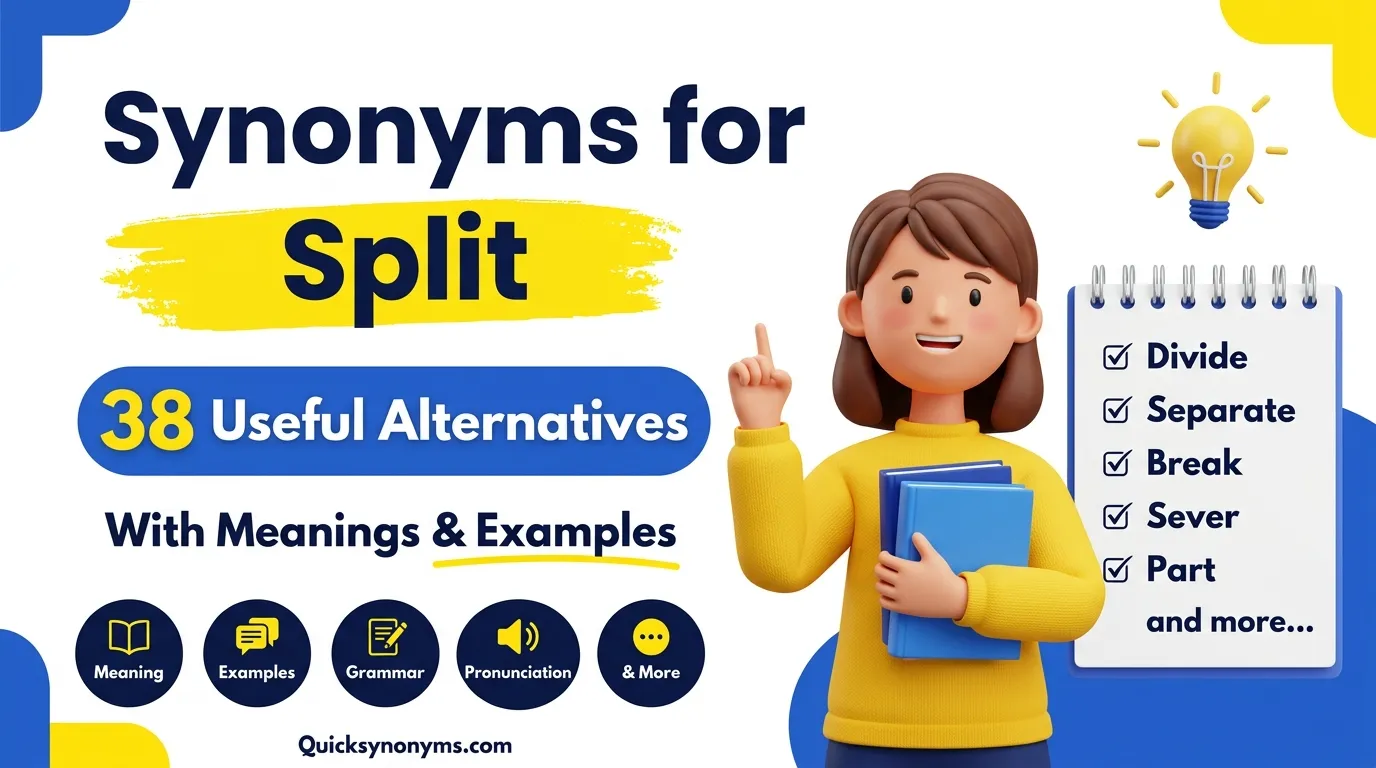
This guide covers the meaning, examples, grammar, word history, and pronunciation of split. It also explores 38 synonyms, their meanings, sample sentences, and related words, so you can choose the right word for each situation.
Meaning of Split
Definition
Split (verb): To divide something into parts or separate things that were joined together.
Examples
- We split the pizza into eight slices.
- The two friends split the cost of lunch.
Connotative Meaning
- Positive tone: Sharing fairly or dividing work to make it easier.
- Negative tone: Breaking apart a group or ending a close bond.
- Neutral tone: Dividing an object, amount, or group into parts.
(Connotation: the emotional or cultural feeling a word carries beyond its literal meaning.)
Etymology
The exact origin of split is uncertain. The word appeared in English in the 16th century and may be linked to older Germanic words.
- Old English (450 to 1100): Not clearly recorded as the source of the modern word.
- Middle English (1100 to 1500): The exact form and origin are uncertain.
- Modern English (1500 to present): Split appeared in the 16th century and came to mean dividing or breaking something into parts.
Pronunciation (IPA)
- IPA: /splɪt/
- Syllables: split, one syllable.
Affixation Pattern of Split
- Root: split
- Prefix: None in the basic word.
- Suffix: None in the basic word.
- Word formations:
- Splits (verb, third-person singular or plural noun): Divides something or refers to divided parts.
- Splitting (verb, present participle or gerund): Dividing or breaking apart.
- Split (past tense verb): Divided or broke apart.
- Split (adjective): Divided or separated.
- Splitter (noun): A person or device that splits something.
38 Synonyms of Split: With Meaning and Examples
1. Divide (verb)
Meaning: To separate something into two or more parts.
Examples:
- Please divide the cake into six pieces.
- The teacher divided the class into small groups.
2. Separate (verb)
Meaning: To move things apart or keep them from being joined.
Examples:
- Separate the clean clothes from the dirty ones.
- The fence separates the two gardens.
3. Break (verb)
Meaning: To cause something to come apart into pieces.
Examples:
- Break the chocolate into small squares.
- The heavy branch broke under the snow.
4. Sever (verb)
Meaning: To cut or break a connection completely.
Examples:
- The workers severed the old cable.
- The dispute severed their business ties.
5. Part (verb)
Meaning: To move or cause things to move away from each other.
Examples:
- The crowd parted to let the ambulance through.
- She parted the curtains to see outside.
6. Dissect (verb)
Meaning: To cut something into parts or study it in detail.
Examples:
- The students dissected a flower in science class.
- We dissected the story to understand its message.
7. Subdivide (verb)
Meaning: To divide something into smaller sections.
Examples:
- The farmer subdivided the land into small plots.
- We subdivided the project into four tasks.
8. Partition (verb)
Meaning: To divide a space or area into separate sections.
Examples:
- They partitioned the room with a wooden screen.
- The company partitioned the office into work areas.
9. Segment (verb)
Meaning: To divide something into smaller sections.
Examples:
- The team segmented the market by age group.
- We segmented the report into clear sections.
10. Distribute (verb)
Meaning: To give or spread things among people or places.
Examples:
- The teacher distributed the books among the pupils.
- Volunteers distributed food to local families.
11. Apportion (verb)
Meaning: To divide something among people in fair or planned amounts.
Examples:
- The manager apportioned the budget among three teams.
- They apportioned the work according to each person’s skills.
12. Allocate (verb)
Meaning: To assign parts of a resource for a specific purpose.
Examples:
- The school allocated funds for new computers.
- We allocated ten minutes to each speaker.
13. Disband (verb)
Meaning: To break up a group or organization.
Examples:
- The club disbanded after many members left.
- The band disbanded at the end of the tour.
14. Disperse (verb)
Meaning: To spread people or things in different directions.
Examples:
- The police dispersed the crowd.
- The seeds dispersed across the field in the wind.
15. Scatter (verb)
Meaning: To spread things over a wide area.
Examples:
- The child scattered toys across the floor.
- Strong winds scattered leaves along the road.
16. Fragment (verb)
Meaning: To break something into small pieces or parts.
Examples:
- The impact fragmented the glass.
- The conflict fragmented the political group.
17. Shatter (verb)
Meaning: To break something suddenly into many pieces.
Examples:
- The stone shattered the window.
- The dropped cup shattered on the kitchen floor.
18. Cleave (verb)
Meaning: To split or cut something apart with force.
Examples:
- The axe cleaved the log in two.
- The sharp blade cleaved the thick branch.
19. Rend (verb)
Meaning: To tear something apart with force.
Examples:
- The strong wind rent the old sail.
- The tragedy rent the family apart.
20. Disjoin (verb)
Meaning: To disconnect things that were joined together.
Examples:
- The mechanic disjoined the two metal parts.
- The repair team disjoined the pipes for cleaning.
21. Disunite (verb)
Meaning: To cause people or groups to stop being united.
Examples:
- The bitter argument disunited the team.
- The dispute disunited the members of the group.
22. Decouple (verb)
Meaning: To disconnect two things that work or move together.
Examples:
- Engineers decoupled the engine from the drive system.
- The firm decoupled its sales team from its support team.
23. Disengage (verb)
Meaning: To free or disconnect something from a connection.
Examples:
- He disengaged the gears before stopping the machine.
- She disengaged the safety lock with care.
24. Detach (verb)
Meaning: To remove something that is attached to another thing.
Examples:
- Detach the label before washing the shirt.
- The worker detached the trailer from the truck.
25. Disconnect (verb)
Meaning: To break a physical or electronic connection.
Examples:
- Disconnect the charger before cleaning the device.
- The storm disconnected several homes from the power grid.
26. Dissect (verb)
Meaning: To examine something by breaking it into parts.
Examples:
- The critic dissected the film’s main ideas.
- We dissected the problem to find its cause.
27. Slice (verb)
Meaning: To cut something into thin or flat pieces.
Examples:
- Slice the bread before serving it.
- The knife sliced through the ripe tomato.
28. Chop (verb)
Meaning: To cut something into smaller pieces with repeated blows.
Examples:
- Chop the onions before adding them to the pan.
- He chopped the wood for the fire.
29. Cut (verb)
Meaning: To divide something with a sharp tool.
Examples:
- Cut the paper into four equal squares.
- She cut the rope with a small knife.
30. Tear (verb)
Meaning: To pull or rip something apart.
Examples:
- Tear the paper along the dotted line.
- The puppy tore the cushion cover.
31. Rip (verb)
Meaning: To pull something apart quickly or forcefully.
Examples:
- He ripped the old poster off the wall.
- The sharp nail ripped a hole in her jacket.
32. Crack (verb)
Meaning: To cause a line or opening to form in something hard.
Examples:
- The cold weather cracked the paint.
- She cracked the shell with a spoon.
33. Fracture (verb)
Meaning: To break or cause a break in something hard.
Examples:
- The force fractured the stone.
- The fall fractured his wrist.
34. Cleave (verb)
Meaning: To divide something by cutting through it.
Examples:
- The blade cleaved the thick rope.
- The tool cleaved the frozen wood.
35. Branch (verb)
Meaning: To divide into separate paths or parts.
Examples:
- The road branches near the old bridge.
- The river branches into several smaller streams.
36. Diverge (verb)
Meaning: To move or develop in different directions.
Examples:
- The two paths diverge beyond the hill.
- Their opinions diverged during the meeting.
37. Discontinue (verb)
Meaning: To stop doing or providing something.
Examples:
- The store discontinued the old product line.
- The school discontinued the program after one year.
38. Break up (phrasal verb)
Meaning: To end a group, relationship, or gathering, or to divide something into parts.
Examples:
- The teacher broke up the fight between the pupils.
- The band broke up after years of touring.
Prototype Meaning
The most common meaning of split is to divide something into parts or separate things that were joined. People often picture cutting a cake, sharing a bill, or dividing a group into teams. The word can also describe a crack in a solid object or a break in a relationship. Its exact meaning depends on the context.
Prototype Categorization
- Dividing into parts: Divide, subdivide, partition, segment, dissect. Use these words when breaking a whole into smaller sections or units.
- Sharing or assigning resources: Distribute, apportion, allocate. Choose these when sharing money, work, goods, or other resources.
- Breaking or cutting: Break, sever, cleave, rend, fragment, shatter, slice, chop, cut, tear, rip, crack, fracture. Use these when something is cut, torn, or broken.
- Separating or disconnecting: Separate, part, disjoin, decouple, disengage, detach, disconnect. These words fit when things move apart or lose a connection.
- Breaking up groups: Disband, disperse, disunite, break up. Use these for groups, crowds, teams, or relationships that come apart.
- Spreading or moving apart: Scatter, branch, diverge. Choose these when things spread out or paths move in different directions.
- Stopping or ending: Discontinue. Use this when an activity, service, or product comes to an end.
Grouping synonyms helps writers choose words that match the action they want to describe. It also makes speaking and writing more clear and natural.
Antonyms of Split
- Join (verb): To bring two or more things together.
- Unite (verb): To bring people or things into one group.
- Combine (verb): To mix or bring things together.
- Merge (verb): To join two or more things into one.
- Connect (verb): To link things together.
- Integrate (verb): To bring separate parts into a whole.
- Unify (verb): To make separate parts act as one.
- Mend (verb): To repair something that is broken or torn.
Short Questions and Answers
What does split mean?
Split means to divide something into parts or separate things that were joined together. It can also mean to share a cost or end a relationship.
When should split be used?
Use split when dividing objects, sharing costs, separating groups, or describing a break. For formal writing, divide, separate, or partition may fit better in some cases.
Is split positive or negative?
Split can be positive, negative, or neutral. Sharing a bill may be fair, but a split between close friends may suggest a painful disagreement.
How is it different from similar words?
Divide focuses on making parts from a whole. Separate focuses on moving things apart or keeping them apart. Sever suggests cutting a connection completely, often in a strong or final way.
Conclusion
Learning split and its synonyms helps you express ideas with greater care. Words such as divide, separate, and partition describe different ways to make parts, while sever, detach, and disconnect focus on breaking connections. Choosing the right word helps readers understand your meaning.
These words also improve everyday speaking, schoolwork, and professional writing. They help English learners avoid repetition and build a stronger vocabulary. Content writers can use them to make articles clearer and more engaging. The best synonym depends on what you want to describe and the tone you want to create.
Practice by learning one new synonym each day. Write a sentence with it, say the sentence aloud, and look for chances to use the word in daily life. Small steps can build lasting English confidence.
Keep Reading: Synonyms for Cover: 39 Useful Alternatives

English Teacher & Linguistics Writer
Grace Whitmore creates engaging educational content on vocabulary, word usage, and effective communication. Her goal is to help learners build confidence through clear and practical English guidance.