Tolerate means to accept, allow, or endure something that you may dislike or find difficult. For example, a person may tolerate loud noise from a neighbor or tolerate a coworker’s different opinion. The word is often used when someone accepts something without trying to stop it.
Tolerate is common in everyday English, but repeating the same word can make writing less interesting. Learning synonyms gives English learners and content writers more ways to express patience, acceptance, endurance, and understanding.
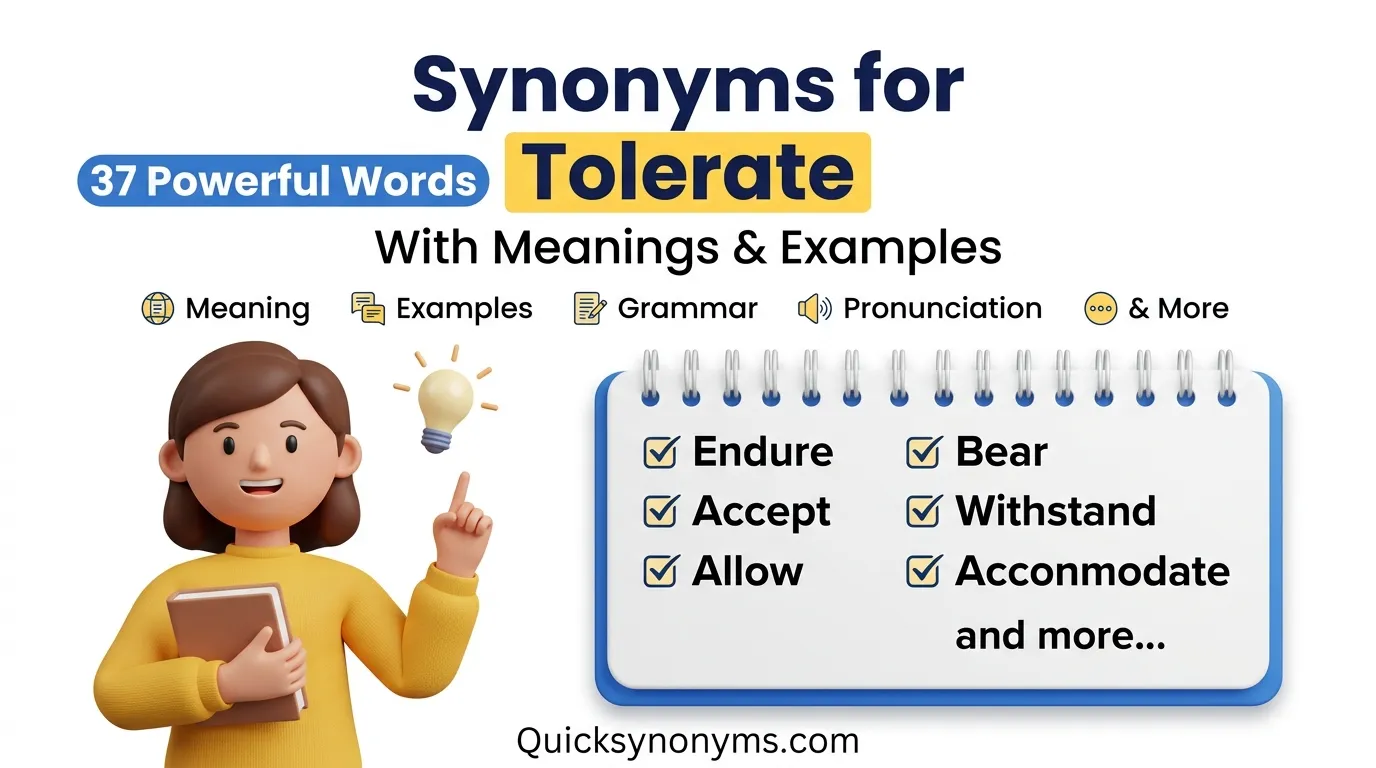
In this guide, you will learn the meaning of tolerate, its 37 useful synonyms, examples, grammar, history, pronunciation, and semantic categories. These alternatives can help you choose a more precise word for different situations.
Meaning of Tolerate
Definition
Tolerate (Verb): To accept or endure something unpleasant, difficult, or different without trying to stop it.
Examples
- I cannot tolerate rude behavior.
- She learned to tolerate the noise while working.
Connotative Meaning
Connotation means the feeling or idea that a word suggests beyond its basic meaning.
- Positive tone: May suggest patience, acceptance, or understanding.
- Negative tone: May suggest reluctantly putting up with something unpleasant.
- Neutral tone: May simply mean allowing something to exist or continue.
Etymology
The word tolerate comes from the Latin tolerare, meaning “to bear,” “to endure,” or “to support.” It entered English through French and became established in English during the 16th century.
- Old English (450–1100): The modern word tolerate was not used in Old English. Similar ideas were expressed through words connected with bearing and enduring.
- Middle English (1100–1500): French and Latin influenced English vocabulary, bringing words related to endurance and acceptance.
- Modern English (1500–Present): Tolerate developed its modern meanings of allowing, enduring, and accepting something without strong objection.
Pronunciation (IPA)
- IPA: /ˈtɒləreɪt/ British English; /ˈtɑːləreɪt/ American English
- Syllables: tol-er-ate
Affixation Pattern of Tolerate
- Root: toler
- Prefix: None
- Suffix: -ate
- Word formations:
- tolerate (verb)
- tolerated (verb)
- tolerating (verb)
- tolerance (noun)
- tolerant (adjective)
- tolerantly (adverb)
- tolerable (adjective)
- tolerability (noun)
- toleration (noun)
- intolerant (adjective)
- intolerance (noun)
- intolerable (adjective)
37 Synonyms of Tolerate: With Meaning & Examples
1. Endure (Verb)
Meaning: To experience something difficult or unpleasant without giving up.
Examples:
- She had to endure several hours of pain.
- He learned to endure the difficult conditions.
2. Bear (Verb)
Meaning: To accept or experience something unpleasant without being overwhelmed.
Examples:
- I cannot bear this constant noise.
- She could barely bear the pain.
3. Stand (Verb)
Meaning: To tolerate something that you dislike or find annoying.
Examples:
- I cannot stand his rude attitude.
- She cannot stand loud music.
4. Abide (Verb)
Meaning: To tolerate or accept something unpleasant.
Examples:
- I cannot abide dishonesty.
- She could not abide his constant complaints.
5. Accept (Verb)
Meaning: To recognize or allow something without rejecting it.
Examples:
- We should accept different opinions.
- She learned to accept the situation.
6. Allow (Verb)
Meaning: To let something happen or continue.
Examples:
- The teacher allowed extra time.
- We should not allow such behavior.
7. Permit (Verb)
Meaning: To officially or willingly allow something.
Examples:
- The rules do not permit smoking.
- The manager permitted the workers to leave early.
8. Withstand (Verb)
Meaning: To remain strong while experiencing pressure or difficulty.
Examples:
- This building can withstand strong winds.
- She withstood the pressure successfully.
9. Overlook (Verb)
Meaning: To choose not to notice or punish a small mistake.
Examples:
- The teacher overlooked his minor error.
- I can overlook one small mistake.
10. Suffer (Verb)
Meaning: To experience something painful, unpleasant, or difficult.
Examples:
- He had to suffer constant criticism.
- She suffered through a difficult period.
11. Accommodate (Verb)
Meaning: To adjust to someone’s needs or circumstances.
Examples:
- The hotel can accommodate special requests.
- We should accommodate different learning needs.
12. Respect (Verb)
Meaning: To accept another person’s views, rights, or differences.
Examples:
- We should respect different opinions.
- Good leaders respect cultural differences.
13. Forgive (Verb)
Meaning: To stop being angry about someone’s mistake or wrongdoing.
Examples:
- She decided to forgive his mistake.
- It took him time to forgive her.
14. Humor (Verb)
Meaning: To cooperate with someone or accept their wishes to avoid conflict.
Examples:
- He humored his friend by listening to the story.
- She humored the child for a few minutes.
15. Indulge (Verb)
Meaning: To allow someone’s wish or behavior even when it is unnecessary.
Examples:
- The parents indulged their child’s request.
- She indulged his harmless habit.
16. Entertain (Verb)
Meaning: To consider an idea or possibility instead of rejecting it immediately.
Examples:
- The committee entertained several proposals.
- She would not entertain the idea of leaving.
17. Acquiesce (Verb)
Meaning: To accept something without protesting.
Examples:
- He acquiesced to their demands.
- She eventually acquiesced to the decision.
18. Submit (Verb)
Meaning: To accept something difficult or unpleasant without resisting.
Examples:
- He refused to submit to unfair pressure.
- She eventually submitted to the new rules.
19. Concede (Verb)
Meaning: To admit that something is true or valid after disagreement.
Examples:
- He conceded that she had a good point.
- The manager conceded that the plan needed changes.
20. Resign (Verb)
Meaning: To accept an unpleasant situation because it cannot easily be changed.
Examples:
- He resigned himself to the long wait.
- She resigned herself to the difficult outcome.
21. Reconcile (Verb)
Meaning: To accept a difficult situation emotionally.
Examples:
- She reconciled herself to the changes.
- He eventually reconciled himself to the decision.
22. Comply (Verb)
Meaning: To accept and follow a rule, request, or order.
Examples:
- Employees must comply with safety rules.
- She agreed to comply with the policy.
23. Indulge (Verb)
Meaning: To allow or satisfy someone’s wishes or behavior.
Examples:
- He indulged her request.
- The teacher indulged the students for a few minutes.
24. Live With (Phrasal Verb)
Meaning: To accept a situation that cannot easily be changed.
Examples:
- We have to live with the decision.
- He learned to live with the inconvenience.
25. Put Up With (Phrasal Verb)
Meaning: To tolerate something annoying or unpleasant.
Examples:
- I cannot put up with this noise.
- She will not put up with rude behavior.
26. Cope With (Phrasal Verb)
Meaning: To deal successfully with a difficult situation.
Examples:
- She learned to cope with stress.
- He struggles to cope with criticism.
27. Deal With (Phrasal Verb)
Meaning: To handle a person, problem, or situation.
Examples:
- She knows how to deal with difficult customers.
- We must deal with the issue calmly.
28. Handle (Verb)
Meaning: To manage a difficult person, situation, or problem.
Examples:
- He can handle pressure well.
- She knows how to handle angry customers.
29. Manage (Verb)
Meaning: To deal with something difficult successfully.
Examples:
- She managed the stressful situation well.
- He managed to remain calm.
30. Weather (Verb)
Meaning: To survive or get through a difficult period.
Examples:
- The company weathered the economic crisis.
- She weathered many challenges.
31. Survive (Verb)
Meaning: To continue despite serious difficulty or danger.
Examples:
- The business survived several difficult years.
- He survived the stressful experience.
32. Respect Differences (Verb Phrase)
Meaning: To accept that people may have different beliefs, habits, or opinions.
Examples:
- We should respect differences in culture.
- Good teams respect differences among members.
33. Make Allowance For (Verb Phrase)
Meaning: To consider or accept a particular condition or weakness.
Examples:
- The teacher made allowance for his lack of experience.
- We should make allowance for unexpected delays.
34. Give Leeway (Verb Phrase)
Meaning: To allow someone freedom to act or make small mistakes.
Examples:
- The manager gave leeway to new employees.
- Parents often give leeway to young children.
35. Make Room For (Verb Phrase)
Meaning: To allow space or acceptance for something or someone.
Examples:
- We should make room for different opinions.
- The schedule makes room for unexpected changes.
36. Let Pass (Verb Phrase)
Meaning: To choose not to object to or punish something.
Examples:
- The teacher let the small mistake pass.
- I decided to let his comment pass.
37. Ignore (Verb)
Meaning: To deliberately choose not to notice, respond to, or deal with something.
Examples:
- The manager cannot ignore unsafe behavior.
- We should not ignore serious problems.
Prototype Meaning
The most typical meaning of tolerate is to accept something unpleasant, annoying, difficult, or different without stopping it. When people hear the word, they may imagine someone dealing with noise, rude behavior, disagreement, delays, or uncomfortable conditions.
The key idea is acceptance without strong opposition. A person who tolerates something does not always like it. They simply choose, or are able, to allow it to continue.
Prototype Categorization
Social cooperation: humor, indulge, entertain, forgive can describe accepting someone’s behavior, ideas, or mistakes.This categorization helps writers choose a more precise synonym. For example, endure works well for pain, permit for rules, overlook for mistakes, and accommodate for people’s needs.
Enduring discomfort: endure, bear, stand, suffer, withstand focus on experiencing something difficult.
Allowing something: accept, allow, permit, accommodate focus on letting something happen or exist.
Accepting differences: respect, respect differences, make room for focus on opinions, beliefs, needs, or lifestyles.
Ignoring problems: overlook, let pass, ignore focus on choosing not to react to something.
Dealing with difficulty: cope with, deal with, handle, manage, weather, survive focus on successfully handling challenging situations.
Reluctant acceptance: acquiesce, submit, resign, reconcile suggest accepting something despite disagreement or difficulty.
Giving freedom: give leeway, make allowance for suggest allowing flexibility or exceptions.
This categorization helps writers choose the most precise synonym. For example, perks works well for extra job benefits, while competitive edge fits business competition. Strengths is useful for personal qualities, while profits is better for financial gains.
Antonyms of Tolerate
- Reject (Verb): To refuse to accept something.
- Oppose (Verb): To disagree with or resist something.
- Resist (Verb): To fight against something or refuse to accept it.
- Forbid (Verb): To officially stop something from happening.
- Prohibit (Verb): To prevent something through rules or authority.
- Condemn (Verb): To strongly express disapproval of something.
- Disallow (Verb): To refuse permission for something.
- Object (Verb): To express disagreement or disapproval.
- Refuse (Verb): To say no to something or decline to accept it.
- Prevent (Verb): To stop something from happening.
Short Questions and Answers
What does tolerate mean?
Tolerate means to accept or endure something unpleasant, difficult, annoying, or different without strongly opposing it.
When should tolerate be used?
Use tolerate when someone allows something to continue even though they may dislike or disagree with it.
Is tolerate positive or negative?
It depends on the context. It can suggest patience and acceptance, but it can also suggest reluctantly putting up with something unpleasant.
How is it different from similar words?
Tolerate is a broad word. Endure focuses on difficulty, permit focuses on allowing, accept focuses on recognition or approval, and overlook focuses on ignoring a mistake or fault.
Conclusion
Learning tolerate and its synonyms gives you more ways to express acceptance, patience, endurance, and understanding. Words such as endure, accept, permit, accommodate, and withstand have related meanings, but each has its own best use.
Using different words can make your writing clearer, stronger, and more natural. It also helps you avoid repeating tolerate in essays, articles, emails, and everyday conversations. Understanding these small differences can improve both vocabulary and communication skills.
Make vocabulary practice part of your daily routine. Learn a few words, write your own examples, and use them in real conversations. With regular practice, choosing the right synonym will become easier and more natural.
Keep Reading: Synonyms for Embody: 28 Strong Words to Use

English Teacher & Linguistics Writer
Grace Whitmore creates engaging educational content on vocabulary, word usage, and effective communication. Her goal is to help learners build confidence through clear and practical English guidance.