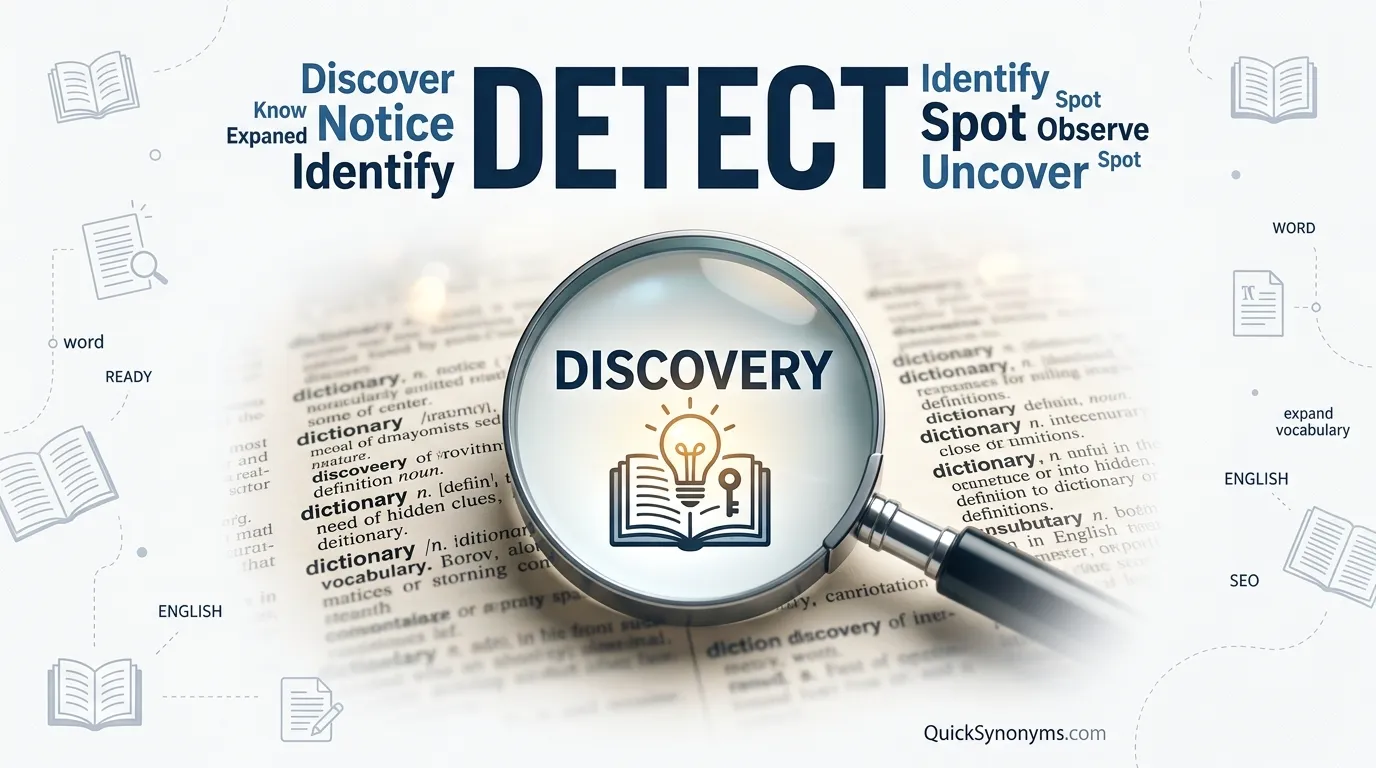
Synonyms for detect include discover, notice, identify, spot, observe, uncover, recognize, reveal, perceive, discern, expose, sense, trace, determine, diagnose, verify, ascertain, realize, investigate, catch, locate, pinpoint, distinguish, notice, witness, find out, detect, uncover, and discover.
Detect means to find or notice something that may be hidden, difficult to see, or not immediately obvious.
For example, a doctor may detect a health problem during a test. A security system can detect movement, while a teacher can detect an error in a student’s work.
The best alternative depends on the context. Notice focuses on becoming aware of something. Discover often means finding something previously unknown. Identify focuses on determining exactly what something is.
In this guide, you will learn the meaning of detect, its closest synonyms, useful alternatives, examples, pronunciation, word forms, antonyms, and differences between similar words.
Meaning of Detect
Definition
Detect (verb): To find, notice, or discover something, especially something hidden, unusual, or difficult to notice.
Examples
- The machine can detect harmful gases in the air.
- She quickly detected a mistake in the report.
Connotative Meaning
Detect usually has a neutral meaning. It often suggests careful observation, testing, checking, or investigation.
We commonly use detect when talking about:
- Problems and errors
- Diseases and health conditions
- Security threats
- Hidden objects
- Changes or unusual signals
- Suspicious activity
For example, detecting a disease early can be helpful. Detecting a security threat may indicate a serious problem.
Etymology of Detect
The word detect comes from Latin and entered English through French. It is related to the Latin verb dētegere, meaning “to uncover” or “to reveal.”
The meaning developed from the idea of uncovering something to the modern sense of finding or noticing something that may not be immediately obvious.
Pronunciation of Detect
- IPA: /dɪˈtekt/
- Syllables: de-tect
- Stress: The second syllable is stressed.
Word Forms of Detect
Here are the common forms of detect:
- Detect: verb
- Detected: past tense and past participle
- Detecting: present participle or gerund
- Detection: noun
- Detectable: adjective
- Detectably: adverb
- Detector: noun
- Detective: noun
30 Synonyms and Alternatives for Detect
Not every word below can replace detect in every sentence. Some are close synonyms, while others are useful alternatives in specific situations.
1. Discover
Meaning: To find something that was previously unknown or hidden.
Examples:
- Scientists discovered a new species.
- She discovered a mistake in the document.
Best for: Finding something new or previously unknown.
2. Notice
Meaning: To become aware of something through observation.
Examples:
- I noticed a strange sound outside.
- She noticed that the door was open.
Best for: Becoming aware of something.
3. Identify
Meaning: To recognize or determine exactly what something is.
Examples:
- The doctor identified the cause of the problem.
- Police identified the missing vehicle.
Best for: Determining the identity or nature of something.
4. Spot
Meaning: To notice or see something, often quickly.
Examples:
- Can you spot the mistake?
- She spotted a crack in the wall.
Best for: Quickly noticing something.
5. Observe
Meaning: To watch carefully and notice something.
Examples:
- The scientist observed a change in the sample.
- We observed unusual behavior.
Best for: Careful watching or examination.
6. Uncover
Meaning: To discover something hidden or secret.
Examples:
- The investigation uncovered new evidence.
- Reporters uncovered the truth.
Best for: Finding hidden information or problems.
7. Recognize
Meaning: To identify something because it is familiar or recognizable.
Examples:
- She recognized the warning signs.
- The system recognized the user’s voice.
Best for: Identifying something familiar.
8. Reveal
Meaning: To make something hidden or unknown known.
Examples:
- The test revealed a serious problem.
- The report revealed important facts.
Best for: Bringing hidden information to light.
9. Perceive
Meaning: To become aware of something through the senses or the mind.
Examples:
- She perceived a change in his voice.
- He perceived a slight difference.
Best for: Formal writing and sensory awareness.
10. Discern
Meaning: To notice or recognize something that is difficult to see or understand.
Examples:
- We could barely discern the writing.
- She discerned a pattern in the data.
Best for: Difficult-to-notice details.
11. Expose
Meaning: To reveal something hidden, especially a problem or wrongdoing.
Examples:
- The investigation exposed the fraud.
- The report exposed serious problems.
Best for: Revealing wrongdoing or hidden problems.
12. Sense
Meaning: To notice something through the senses or intuition.
Examples:
- The device can sense movement.
- She sensed that something was wrong.
Best for: Physical or intuitive awareness.
13. Catch
Meaning: To notice someone doing something or find a mistake or problem.
Examples:
- The camera caught the thief.
- The teacher caught a spelling error.
Best for: Informal situations involving mistakes or actions.
14. See
Meaning: To notice or become aware of something.
Examples:
- Did you see the error?
- I saw a strange mark on the wall.
Best for: Simple, everyday English.
15. Trace
Meaning: To find the source, path, or history of something.
Examples:
- Investigators traced the call.
- Doctors traced the problem to an infection.
Best for: Finding a source, cause, or path.
16. Determine
Meaning: To find out or establish something after examination.
Examples:
- The test determined the cause of the failure.
- Scientists determined the age of the object.
Best for: Formal and technical situations.
17. Distinguish
Meaning: To recognize a difference between two or more things.
Examples:
- The test can distinguish between two substances.
- She could distinguish the real signal from the noise.
Best for: Identifying differences.
18. Diagnose
Meaning: To identify a disease, condition, or problem through examination.
Examples:
- The doctor diagnosed the illness early.
- The technician diagnosed the computer problem.
Best for: Medical and technical problems.
19. Establish
Meaning: To determine or prove something with reasonable certainty.
Examples:
- The investigation established the cause of the accident.
- Tests established that the sample was genuine.
Best for: Formal investigations and evidence-based conclusions.
20. Verify
Meaning: To check that something is true, correct, or accurate.
Examples:
- Please verify the information before publishing it.
- The system verified the user’s identity.
Best for: Checking information or facts.
21. Ascertain
Meaning: To find out something with certainty.
Examples:
- The team tried to ascertain the cause of the failure.
- We need to ascertain the facts first.
Best for: Formal writing and careful investigation.
22. Realize
Meaning: To become aware of something or understand something.
Examples:
- She realized that she had made an error.
- He realized the door was unlocked.
Best for: Becoming aware of a fact or situation.
23. Witness
Meaning: To see or observe an event as it happens.
Examples:
- Several people witnessed the accident.
- She witnessed the unusual event.
Best for: Seeing an event happen directly.
24. Investigate
Meaning: To examine something carefully to find facts, causes, or problems.
Examples:
- Police investigated the unusual activity.
- Engineers investigated the cause of the failure.
Best for: Finding the cause or facts behind something.
25. Find Out
Meaning: To learn or discover information.
Examples:
- We need to find out what happened.
- She found out the truth later.
Best for: Everyday and conversational English.
26. Locate
Meaning: To find the exact position of something.
Examples:
- The device helped us locate the signal.
- Police located the missing car.
Best for: Finding where something is.
27. Pinpoint
Meaning: To identify something very precisely.
Examples:
- The test helped doctors pinpoint the cause.
- Engineers pinpointed the source of the problem.
Best for: Finding an exact cause, location, or detail.
28. Unmask
Meaning: To reveal the true identity or nature of someone or something.
Examples:
- The investigation unmasked the fraud.
- The evidence unmasked the real culprit.
Best for: Revealing a hidden identity or wrongdoing.
29. Detect
Meaning: To find or notice something that is not immediately obvious.
Examples:
- The sensor can detect movement.
- Doctors can detect some diseases through testing.
Best for: The original word itself when something needs to be found or noticed.
30. Uncover
Meaning: To find information, evidence, or a problem that was previously hidden.
Examples:
- The audit uncovered financial errors.
- The investigation uncovered new evidence.
Best for: Discovering hidden facts or problems.
Closest Synonyms for Detect
Some alternatives are closer to detect than others.
| Word | Best Use |
|---|---|
| Notice | Becoming aware of something |
| Spot | Quickly seeing something |
| Discover | Finding something previously unknown |
| Identify | Determining exactly what something is |
| Recognize | Identifying something familiar |
| Uncover | Finding something hidden |
| Discern | Noticing something difficult to see |
| Sense | Becoming aware through the senses |
| Pinpoint | Identifying something precisely |
| Locate | Finding the position of something |
Detect Synonyms by Context
The best synonym depends on what you want to say.
When You Mean “Notice Something”
Use:
- Notice
- Spot
- See
- Observe
- Perceive
Example:
The teacher noticed a spelling mistake.
When You Mean “Find Something Hidden”
Use:
- Discover
- Uncover
- Reveal
- Expose
- Unmask
Example:
The investigation uncovered new evidence.
When You Mean “Identify a Problem”
Use:
- Identify
- Recognize
- Diagnose
- Pinpoint
- Determine
Example:
The doctor identified the cause of the problem.
When You Mean “Find a Location or Source”
Use:
- Locate
- Trace
- Pinpoint
Example:
The police located the missing vehicle.
When You Need a Formal Alternative
Use:
- Discern
- Determine
- Ascertain
- Establish
- Verify
Example:
The researchers determined the cause of the failure.
Detect vs. Notice vs. Discover vs. Identify
These words have similar meanings, but they are not always interchangeable.
Detect usually means finding something that is hidden, unusual, or difficult to notice.
Notice means becoming aware of something through observation.
Discover often means finding something that was previously unknown.
Identify means determining exactly what something or someone is.
Compare these examples:
- The sensor detected movement.
- I noticed a strange noise.
- Scientists discovered a new species.
- Police identified the suspect.
Antonyms of Detect
The following words express ideas that are opposite or contrary to detecting something.
1. Miss
To fail to notice or recognize something.
Example:
The inspector missed the small error.
2. Overlook
To fail to notice something.
Example:
She overlooked an important detail.
3. Ignore
To deliberately pay no attention to something.
Example:
He ignored the warning signs.
4. Hide
To keep something from being seen or discovered.
Example:
The thief tried to hide the evidence.
5. Conceal
To keep something secret or prevent it from being discovered.
Example:
They tried to conceal the truth.
6. Obscure
To make something difficult to see, understand, or discover.
Example:
The fog obscured the road signs.
Short Questions and Answers
What does detect mean?
Detect means to find, notice, or discover something, especially something hidden or difficult to notice.
What is another word for detect?
Common alternatives include notice, discover, identify, spot, observe, recognize, uncover, sense, discern, and find out.
What is the closest synonym for detect?
The closest synonym depends on the context. Notice, discover, identify, spot, and recognize are often good choices.
Is detect positive or negative?
Detect is usually neutral. Its meaning depends on what is being discovered.
For example, detecting a problem may be negative, while detecting a disease early can be helpful.
When should I use detect?
Use detect when someone or something finds a problem, signal, change, disease, error, object, or other thing that may not be immediately obvious.
What is the difference between detect and notice?
Detect often suggests finding something hidden or difficult to notice. Notice simply means becoming aware of something.
What is the difference between detect and discover?
Detect often involves noticing something that already exists but may be difficult to see. Discover often suggests finding something previously unknown.
What is the difference between detect and identify?
Detect means finding or noticing something. Identify means determining exactly what that thing is.
Conclusion
The best synonym for detect depends on the situation.
Words such as notice, discover, identify, spot, recognize, uncover, discern, and sense can express similar ideas. However, each word has its own meaning and best use.
Understanding these differences can help you choose more precise words in both speaking and writing.
If you are learning English, practice one synonym at a time. Write a short sentence with it and compare it with a sentence using detect.
Regular practice can help you build a stronger vocabulary and use these words more naturally.
Explore More Word Alternatives: Synonyms for Transfer: 30 Powerful Alternatives

English Teacher & Linguistics Writer
Grace Whitmore creates engaging educational content on vocabulary, word usage, and effective communication. Her goal is to help learners build confidence through clear and practical English guidance.