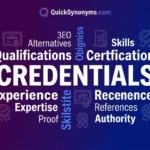
Qualifications, credentials, certifications, credentials, qualifications, proof, evidence, references, achievements, and credentials-related terms can replace credentials depending on context.
Credentials are facts, documents, or achievements that show a person is qualified, trusted, or allowed to do something. For example, when you apply for a job, an employer may check your degree, training, work history, or certificates. These are your credentials. The word is common in jobs, education, business, technology, and security. Learning synonyms for credentials helps English learners choose clearer words and helps content writers avoid repeating the same term. However, not every synonym has the same meaning. Some words describe education, while others describe proof, experience, identity, or access information. This guide explains the meaning of credentials, its synonyms, examples, grammar, history, pronunciation, word formation, and semantic categories. By understanding these differences, you can select the right word for each situation.
Meaning of Credentials
Definition
Credentials (Noun):
Credentials are qualifications, achievements, documents, or information that prove a person is suitable, trusted, or authorized for something.
Examples
- She has excellent credentials for the teaching position.
- The security officer checked his credentials before allowing him inside.
Connotative Meaning
Connotation means the feeling or idea a word suggests beyond its basic meaning.
- Positive tone: Credentials can suggest skill, trust, experience, and achievement.
- Negative tone: In some contexts, credentials may sound formal, boastful, or overly focused on status.
- Neutral tone: Credentials can simply refer to qualifications or proof of identity.
Etymology
The word credentials comes from credential, which is related to the Latin word credere, meaning “to believe” or “to trust.” The idea developed around something that gives people a reason to believe or trust a person.
- Old English (450–1100): The modern word credential was not part of Old English. Its deeper Latin root credere carried the idea of believing or trusting.
- Middle English (1100–1500): Latin and French forms related to trust, belief, and authority influenced later English vocabulary.
- Modern English (1500–Present): Credential developed as a word for evidence of authority, qualification, or trust. The plural credentials became widely used for a person’s qualifications, documents, achievements, or authorization.
Pronunciation (IPA)
- IPA: /krəˈdenʃəlz/
- Syllables: cred-en-tials
Affixation Pattern of Credentials
- Root: cred from Latin credere, meaning “to believe” or “trust”
- Prefix: None in the modern English word
- Suffix: -ential forms the adjective/noun credential; -s marks the plural
- Word formations:
- credence (noun): belief or trust
- credible (adjective): believable or trustworthy
- credibly (adverb): in a believable way
- credential (noun): proof of qualification or authority
- credentials (plural noun): qualifications, proof, or authorization
- credentialed (adjective): having recognized qualifications
- credentialing (noun): the process of checking or granting credentials
30 Synonyms of Credentials With Meaning & Examples
1. Qualifications (Noun)
Meaning: Skills, education, or experience that make someone suitable for a job or task.
Examples:
- She has the right qualifications for the position.
- His qualifications impressed the hiring manager.
2. Certifications (Noun)
Meaning: Official documents or awards that show someone has completed approved training.
Examples:
- He has several professional certifications.
- Her certifications helped her find a better job.
3. Certificates (Noun)
Meaning: Official documents that prove someone completed a course or achieved something.
Examples:
- She showed her certificates during the interview.
- The training certificates were added to his application.
4. Qualifications (Noun)
Meaning: Education, training, or experience that proves suitability.
Examples:
- His qualifications match the job requirements.
- The company reviewed her qualifications carefully.
5. Accreditations (Noun)
Meaning: Official recognition that a person, organization, or program meets certain standards.
Examples:
- The school has several professional accreditations.
- Her accreditation strengthened her professional profile.
6. Credentials (Noun)
Meaning: Proof that someone has the skills, authority, or background needed for a role.
Examples:
- The doctor has impressive credentials.
- Please submit your credentials with the application.
7. Achievements (Noun)
Meaning: Successful things a person has done or accomplished.
Examples:
- Her achievements made her a strong candidate.
- His academic achievements were impressive.
8. Accomplishments (Noun)
Meaning: Important things someone has successfully completed.
Examples:
- His accomplishments earned him a promotion.
- She listed her major accomplishments on her resume.
9. Experience (Noun)
Meaning: Knowledge or skill gained by doing something over time.
Examples:
- She has ten years of experience in marketing.
- His experience makes him suitable for the role.
10. Expertise (Noun)
Meaning: High-level knowledge or skill in a particular area.
Examples:
- Her expertise is valuable to the company.
- He has expertise in software development.
11. Background (Noun)
Meaning: A person’s education, experience, and past work or activities.
Examples:
- She has a strong academic background.
- His technical background fits the position well.
12. Track Record (Noun)
Meaning: A history of past actions, results, or successes.
Examples:
- The manager has a strong track record.
- Her track record shows years of successful work.
13. References (Noun)
Meaning: People or information that can confirm someone’s character, skills, or work history.
Examples:
- The employer asked for three references.
- His references spoke highly of his work.
14. Recommendations (Noun)
Meaning: Statements that support a person’s ability, character, or suitability.
Examples:
- She received strong recommendations from her professors.
- His recommendations helped him secure the position.
15. Endorsements (Noun)
Meaning: Public or official statements showing support for someone or something.
Examples:
- The candidate received several professional endorsements.
- Her endorsements increased her credibility.
16. Proof (Noun)
Meaning: Information or evidence that shows something is true.
Examples:
- You may need proof of your qualifications.
- The document provided proof of his identity.
17. Evidence (Noun)
Meaning: Facts or information that support a claim or show that something is true.
Examples:
- Her experience is evidence of her ability.
- The documents provided evidence of his training.
18. Documentation (Noun)
Meaning: Official papers or records that provide information or proof.
Examples:
- Please provide documentation of your training.
- The company requested additional documentation.
19. Records (Noun)
Meaning: Stored information that provides evidence of a person’s history or activities.
Examples:
- The university checked his academic records.
- Her employment records were reviewed.
20. Identification (Noun)
Meaning: Information or documents that prove who a person is.
Examples:
- You must show identification at the entrance.
- The officer requested identification.
21. Credentials Information (Noun)
Meaning: Details used to prove identity, authority, or access.
Examples:
- The employee updated his credentials information.
- Keep your credentials information secure.
22. Login Details (Noun)
Meaning: Information such as a username and password used to access an account.
Examples:
- Never share your login details with strangers.
- She forgot her login details.
23. Access Details (Noun)
Meaning: Information needed to enter or use a system, account, or service.
Examples:
- The administrator sent me the access details.
- Keep your access details private.
24. Authorization (Noun)
Meaning: Official permission to do something or access something.
Examples:
- The employee received authorization to enter the room.
- You need authorization to access these files.
25. Permission (Noun)
Meaning: Approval that allows someone to do something.
Examples:
- She received permission to use the equipment.
- You need permission to enter the restricted area.
26. Authority (Noun)
Meaning: Official power or the right to control, decide, or act.
Examples:
- He has the authority to approve the request.
- The manager gave her authority to make the decision.
27. Status (Noun)
Meaning: A person’s position, standing, or recognized level in a group or field.
Examples:
- Her professional status helped build trust.
- His status as an expert attracted attention.
28. Merit (Noun)
Meaning: The quality or ability that makes someone deserving of recognition.
Examples:
- The candidate was selected on merit.
- Her work showed great merit.
29. Standing (Noun)
Meaning: A person’s reputation or position within a professional or social group.
Examples:
- He has a strong standing in the industry.
- Her professional standing grew over the years.
30. Credentials or Qualifications (Noun)
Meaning: A general phrase for the education, skills, experience, or proof that supports someone’s suitability.
Examples:
- The employer reviewed his credentials and qualifications.
- Her credentials and qualifications made her a strong applicant.
Prototype Meaning
The most typical meaning of credentials is proof that a person is qualified, experienced, trusted, or authorized. When people hear the word, they often imagine a resume, degree, certificate, professional license, work history, or other official proof. In technology, however, credentials can also mean information such as a username and password used to access an account.
Prototype Categorization
The 30 terms can be grouped into useful semantic categories:
- Education and Training: qualifications, certifications, certificates, accreditations. These work best when discussing formal learning or professional training.
- Skills and Experience: experience, expertise, background, achievements, accomplishments, track record. These focus on what a person knows or has done.
- Proof and Records: proof, evidence, documentation, records, identification. These emphasize information that verifies something.
- Professional Reputation: references, recommendations, endorsements, status, standing, merit. These focus on how others view a person’s ability or reputation.
- Permission and Access: authorization, permission, authority, login details, access details. These are useful when credentials refers to access, control, or official permission.
- General Professional Terms: credentials, credentials information, credentials or qualifications. These broader expressions work when the exact type of proof is not specified.
This categorization helps writers choose a synonym based on context instead of replacing credentials with a word that does not fully match the intended meaning.
Antonyms of Credentials
Unqualified (Adjective)
Meaning: Not having the required skills, training, or experience.
Inexperience (Noun)
Meaning: A lack of practical knowledge gained from previous work.
Disqualification (Noun)
Meaning: A condition that prevents someone from being accepted or considered.
Unauthorized (Adjective)
Meaning: Not having official permission or approval.
Incompetence (Noun)
Meaning: A lack of ability or skill needed to perform a task properly.
Ignorance (Noun)
Meaning: Lack of knowledge or information about something.
Short Questions and Answers
What does credentials mean?
Credentials means qualifications, achievements, documents, or information that prove a person’s ability, identity, authority, or access.
When should credentials be used?
Use credentials when talking about qualifications, professional achievements, proof of identity, authorization, or account access information.
Is credentials positive or negative?
Credentials is usually neutral or positive. It often suggests that someone is qualified, experienced, trustworthy, or authorized. The tone depends on the context.
How is it different from similar words?
Credentials is a broad term. Qualifications usually focus on education and skills, certifications focus on official training, references focus on recommendations from others, and authorization focuses on permission.
Conclusion
Learning credentials and its synonyms can make your English more precise and flexible. Words such as qualifications, certifications, experience, expertise, references, proof, authority, and authorization can express different parts of the idea. Choosing the right synonym helps you avoid repetition and makes your writing easier to understand. It also helps you speak with more confidence in work, school, business, and everyday situations. Remember that synonyms are not always exact replacements. The best word depends on what you want to describe. Practice using these words in short sentences each day. Read them in articles, write your own examples, and notice how native speakers use them. With regular practice, your vocabulary, writing, and speaking skills will become stronger.
Learn More Synonyms: Synonyms for industrialization: 30 Powerful Alternatives

ESL Writing Coach
Olivia Bennett helps English learners strengthen their writing, expand their vocabulary, and communicate more naturally. Her content is designed to make everyday and professional English simple and accessible.