Synonyms for ironically include paradoxically, unexpectedly, sarcastically, amusingly, strangely, humorously, incongruously, wryly, unexpectedly, and surprisingly.
Ironically means that something happens in a way that is opposite to what people expect. Imagine a person who spends years telling others to save money, then suddenly buys an expensive car on impulse. That situation can be described as ironically. The word is common in daily speech, stories, news, and online writing because it helps describe surprising or opposite results. Learning synonyms for ironically helps English learners express ideas with greater accuracy and variety. It also helps content writers avoid using the same word again and again. In this guide, you will learn the meaning of ironically, its synonyms, examples, grammar, pronunciation, word history, and semantic categories. You will also see how related words differ in tone and meaning, so you can choose the right word for each situation.
Meaning of Ironically
Definition
Ironically (Adverb):
In a way that is surprising because it is different from, or opposite to, what people expect.
Examples
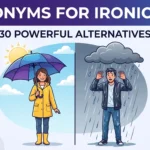
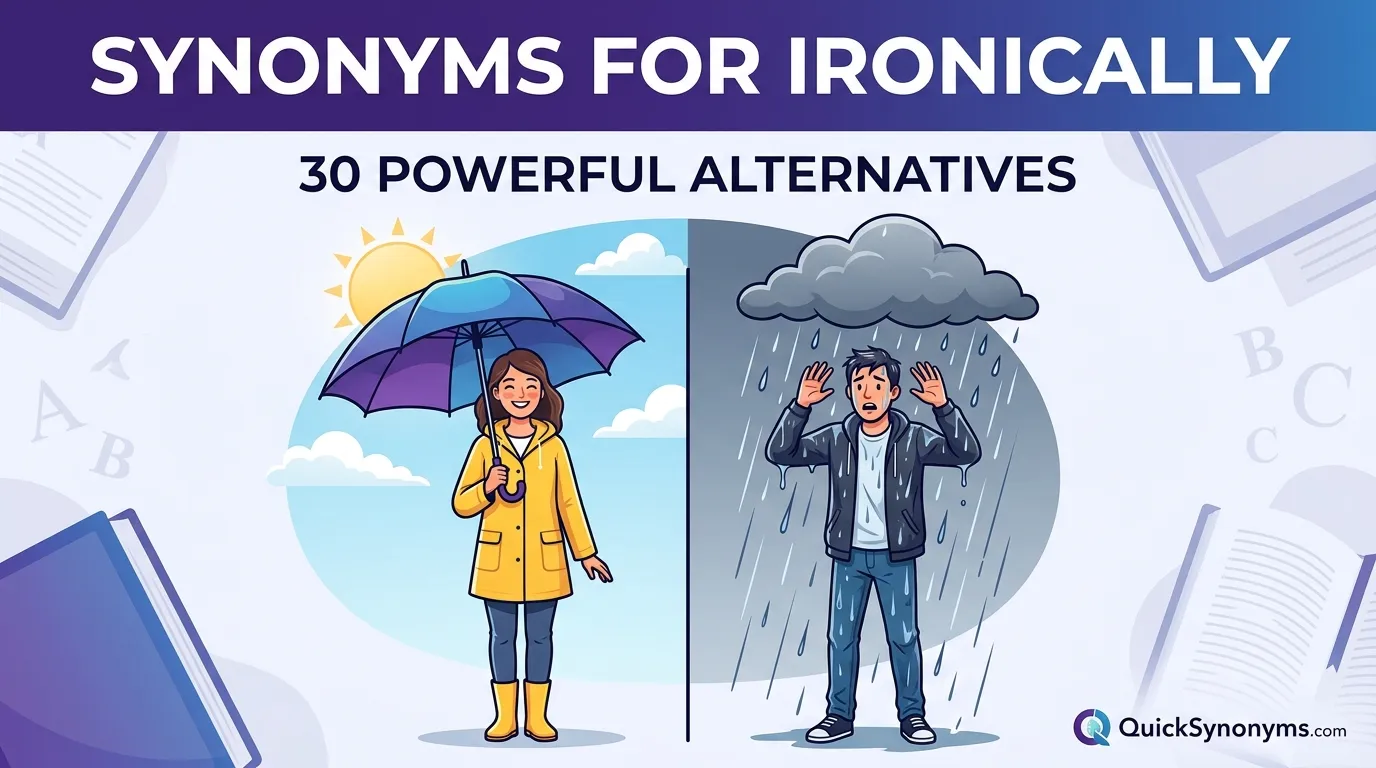
- Ironically, the man who hated rain forgot his umbrella.
- She trained for months, but ironically, she missed the final race.
Connotative Meaning
Connotation: The feeling or idea that a word suggests beyond its basic meaning.
- Positive tone: Can suggest clever humor, wit, or an amusing contrast.
- Negative tone: Can suggest sarcasm, criticism, or an unpleasant contradiction.
- Neutral tone: Can simply describe an unexpected result or contrast.
Etymology
The word ironically comes from ironic, which comes from irony. The history of the word is connected to the Greek word eirōneia, meaning dissimulation or feigned ignorance.
- Old English (450 to 1100): The modern word ironically was not part of Old English. The concept later developed through the classical tradition of irony.
- Middle English (1100 to 1500): English writers increasingly encountered classical rhetorical ideas through French and Latin.
- Modern English (1500 to Present): Irony, ironic, and ironically became established in English. The words developed from literary and rhetorical uses to common everyday descriptions of unexpected or opposite situations.
Pronunciation (IPA)
- IPA: /aɪˈrɒnɪkli/ in British English, /aɪˈrɑːnɪkli/ in American English
- Syllables: i-ron-i-cal-ly
Affixation Pattern of Ironically
- Root: iron
- Prefix: None in the modern word
- Suffix: -ic and -ally
- Word formations:
- Irony: noun
- Ironic: adjective
- Ironically: adverb
- Ironist: noun
- Ironical: adjective
- Ironize: verb
- Ironicalness: noun
30 Synonyms of Ironically With Meaning & Examples
1. Paradoxically (Adverb)
Meaning: In a way that seems opposite to what is expected but may still be true.
Examples:
- Paradoxically, working less helped her become more productive.
- The treatment paradoxically made the problem worse.
2. Unexpectedly (Adverb)
Meaning: In a way that was not expected.
Examples:
- Unexpectedly, the quiet student won the competition.
- The meeting ended unexpectedly early.
3. Surprisingly (Adverb)
Meaning: In a way that causes surprise.
Examples:
- Surprisingly, everyone agreed with the proposal.
- The old computer surprisingly still worked.
4. Contrarily (Adverb)
Meaning: In a way that is opposite to what was expected or stated.
Examples:
- Contrarily, the new system created more problems.
- He acted contrarily to the team’s advice.
5. Incongruously (Adverb)
Meaning: In a way that does not fit the situation or expectation.
Examples:
- He smiled incongruously during the serious discussion.
- The bright sign looked incongruously placed in the dark room.
6. Sarcastically (Adverb)
Meaning: In a way that uses mocking or cutting humor.
Examples:
- She sarcastically thanked him for being late.
- He sarcastically called the broken machine a masterpiece.
7. Wryly (Adverb)
Meaning: In a dry and slightly humorous way.
Examples:
- He wryly admitted that his plan had failed.
- She wryly observed that nothing had gone as planned.
8. Amusingly (Adverb)
Meaning: In a way that is funny or entertaining.
Examples:
- Amusingly, the teacher forgot her own homework.
- The story ended amusingly.
9. Humorously (Adverb)
Meaning: In a funny or playful way.
Examples:
- He humorously described his cooking disaster.
- She humorously compared the office to a circus.
10. Strangely (Adverb)
Meaning: In an unusual or unexpected way.
Examples:
- Strangely, nobody noticed the mistake.
- The room was strangely quiet.
11. Oddly (Adverb)
Meaning: In an unusual or unexpected manner.
Examples:
- Oddly, he seemed happy about the failure.
- The dog behaved oddly that morning.
12. Unusually (Adverb)
Meaning: In a way that is different from what is normal.
Examples:
- Unusually, the store was empty.
- She was unusually quiet during lunch.
13. Remarkably (Adverb)
Meaning: In a way that is surprising or worthy of attention.
Examples:
- Remarkably, he finished the work in one day.
- The small team performed remarkably well.
14. Curiously (Adverb)
Meaning: In a strange or interesting way.
Examples:
- Curiously, the answer was already on the board.
- Curiously, she refused the offer.
15. Coincidentally (Adverb)
Meaning: By chance at the same time or in connection with something else.
Examples:
- Coincidentally, we chose the same restaurant.
- Coincidentally, her brother was visiting the same city.
16. Counterintuitively (Adverb)
Meaning: In a way that goes against normal expectations or intuition.
Examples:
- Counterintuitively, the simpler design performed better.
- Counterintuitively, adding more features made the app less useful.
17. Oppositely (Adverb)
Meaning: In an opposite way or direction.
Examples:
- The two groups reacted oppositely to the news.
- The results moved oppositely from what analysts expected.
18. Atypically (Adverb)
Meaning: In a way that is not typical or usual.
Examples:
- Atypically, the usually calm manager became angry.
- The weather behaved atypically for that season.
19. Unexpectedly Humorously (Adverbial Phrase)
Meaning: In a way that is both surprising and funny.
Examples:
- Unexpectedly humorously, the serious speech ended with a joke.
- The mistake was unexpectedly humorously received by the audience.
20. Dryly (Adverb)
Meaning: In a calm, understated, and often humorous way.
Examples:
- He dryly commented on the failed experiment.
- She dryly noted that the plan had some problems.
21. Satirically (Adverb)
Meaning: In a way that uses humor to criticize people, ideas, or society.
Examples:
- The writer satirically described modern office life.
- The cartoon satirically criticized political advertising.
22. Mockingly (Adverb)
Meaning: In a way that makes fun of someone or something.
Examples:
- He mockingly repeated the strange excuse.
- She spoke mockingly about the failed plan.
23. Humorously Contradictory (Adverbial Phrase)
Meaning: In a way that creates humor through an unexpected contradiction.
Examples:
- The situation was humorously contradictory.
- His advice was humorously contradictory to his own actions.
24. Against Expectation (Adverbial Phrase)
Meaning: In a way that does not match what people expected.
Examples:
- Against expectation, the smallest team won.
- Against expectation, the difficult task became easy.
25. Against the Odds (Adverbial Phrase)
Meaning: In a way that succeeds despite an unlikely outcome.
Examples:
- Against the odds, she won the final match.
- Against the odds, the old building survived the storm.
26. Contrary to Expectation (Adverbial Phrase)
Meaning: In a way that is different from what was expected.
Examples:
- Contrary to expectation, the project finished early.
- Contrary to expectation, the audience loved the unusual idea.
27. Funnily Enough (Adverbial Phrase)
Meaning: Used when something surprising is also amusing.
Examples:
- Funnily enough, the person who warned us got lost.
- Funnily enough, I had the same idea yesterday.
28. By a Strange Twist (Adverbial Phrase)
Meaning: Because of an unusual change or unexpected event.
Examples:
- By a strange twist, the rival teams became friends.
- By a strange twist, the mistake led to a better result.
29. In a Twist of Fate (Adverbial Phrase)
Meaning: In an unexpected way caused by circumstances.
Examples:
- In a twist of fate, the student became the teacher.
- In a twist of fate, his old rival became his business partner.
30. Unexpectedly Amusingly (Adverb)
Meaning: In a way that is both unexpected and amusing.
Examples:
- The serious event ended unexpectedly amusingly.
- The mistake turned out unexpectedly amusingly.
Prototype Meaning
The prototype meaning of ironically is an unexpected situation where the result is very different from what people would normally expect. When people hear ironically, they often imagine a contrast between an action, belief, or situation and its surprising outcome. For example, a person who teaches road safety getting a speeding ticket creates an ironic situation.
Prototype Categorization
The 30 synonyms can be grouped into several semantic categories:
- Unexpectedness: unexpectedly, surprisingly, strangely, oddly, unusually, remarkably. These are useful when the main idea is surprise.
- Contradiction: paradoxically, contrarily, oppositely, counterintuitively, contrary to expectation. These work best when the outcome conflicts with expectations.
- Humor and Wit: amusingly, humorously, wryly, dryly, funnily enough. These emphasize a funny or clever contrast.
- Sarcasm and Mockery: sarcastically, satirically, mockingly. These are best when the speaker intends humor, criticism, or ridicule.
- Chance and Fate: coincidentally, by a strange twist, in a twist of fate. These describe surprising events caused by chance or circumstances.
- Unusual Behavior: incongruously, curiously, atypically. These highlight something that does not fit the normal pattern.
This categorization helps writers choose a synonym based on the exact situation. Not every synonym of ironically has the same meaning. For example, sarcastically focuses on mocking speech, while paradoxically focuses on an apparent contradiction.
Antonyms of Ironically
1. Expectedly (Adverb)
Meaning: In a way that happens as expected.
2. Predictably (Adverb)
Meaning: In a way that could be expected or predicted.
3. Normally (Adverb)
Meaning: In the usual or ordinary way.
4. Straightforwardly (Adverb)
Meaning: In a direct and clear way without hidden contrast.
5. Consistently (Adverb)
Meaning: In a way that stays the same or follows an expected pattern.
6. Literally (Adverb)
Meaning: In the exact or direct sense of the words.
7. Sincerely (Adverb)
Meaning: In a genuine and honest way rather than sarcastically.
Short Questions and Answers
What does ironically mean?
Ironically means in a way that is surprising because it is different from or opposite to what people expect.
When should ironically be used?
Use ironically when an event, result, or situation creates an unexpected contrast with what people normally expect.
Is ironically positive or negative?
It can be positive, negative, or neutral. Its tone depends on the situation and the speaker’s intention.
How is it different from similar words?
Ironically usually highlights an unexpected contrast. Sarcastically focuses on mocking language, while surprisingly simply describes something unexpected. Paradoxically focuses on an apparent contradiction.
Conclusion
Learning ironically and its synonyms can make your English stronger and more flexible. The word is useful when you want to describe an unexpected contrast or result. Related words such as paradoxically, surprisingly, wryly, sarcastically, and counterintuitively can help you express more specific ideas. Knowing these differences also helps you avoid repetition in essays, articles, conversations, and creative writing. English learners can build confidence by studying each word with a simple meaning and example sentence. Content writers can use semantic categories to select words that match the exact tone of their message. Practice one or two new synonyms each day. Over time, this small habit can improve your vocabulary, writing, speaking, and overall command of English.
Explore More Synonyms: Synonyms For Appreciate Your Help: 30 Powerful Alternatives

Senior English Language Expert
Eleanor Brooks specializes in English grammar, vocabulary, and word usage. She enjoys simplifying complex language concepts and creating practical resources that help learners write and speak with confidence.