Emotional intelligence means understanding feelings and using that understanding to respond well.
Imagine a coworker gives you a hard comment. Instead of getting angry, you listen, understand your feelings, and answer calmly. That is emotional intelligence. It helps people handle emotions, understand others, and make better choices.
This phrase is common in school, work, leadership, and daily life. Learning synonyms helps English learners and content writers express ideas in fresh and clear ways.
In this guide, you will learn the meaning of emotional intelligence, its synonyms, examples, grammar, history, pronunciation, and useful semantic groups.
Meaning of Emotional Intelligence
Definition
Emotional intelligence (Noun): The ability to understand, manage, and use emotions in yourself and in your interactions with other people.
Examples
- Her emotional intelligence helps her stay calm during difficult talks.
- Good emotional intelligence can help people understand their coworkers better.
Connotative Meaning
(Connotation: the feeling or idea that a word suggests beyond its basic meaning.)
- Positive tone: It often suggests empathy, self-control, awareness, and good communication.
- Negative tone: In some contexts, it may suggest that someone lacks emotional awareness or control.
- Neutral tone: It can simply describe a person’s ability to understand and manage emotions.
Etymology
The phrase emotional intelligence is a modern English term. Its history is different from the history of the individual words.
- Old English (450–1100): The modern phrase did not exist. The ideas behind it were expressed through older words related to feeling, mind, wisdom, and understanding.
- Middle English (1100–1500): English continued to develop words for emotion, thought, knowledge, and understanding through French and Latin influence.
- Modern English (1500–Present): The phrase emotional intelligence developed as a modern psychological term. Peter Salovey and John Mayer published an influential framework for the concept in 1990. The idea later became widely known through popular writing on emotional intelligence.
Pronunciation (IPA)
- IPA: /ɪˌmoʊ.ʃə.nəl ɪnˈtel.ə.dʒəns/
- Syllables: e-mo-tion-al in-tel-li-gence
Affixation Pattern of Emotional Intelligence
Because emotional intelligence is a two-word noun phrase, it does not have one single root or affix pattern.
- Root 1: emotion
- Prefix: None in the full phrase
- Suffix: -al in emotional
- Root 2: intelligent
- Suffix: -ence in intelligence
Word formations
- Emotion: Noun
- Emotional: Adjective
- Emotionally: Adverb
- Intelligent: Adjective
- Intelligence: Noun
- Intelligently: Adverb
- Unintelligent: Adjective
- Emotional intelligence: Noun phrase
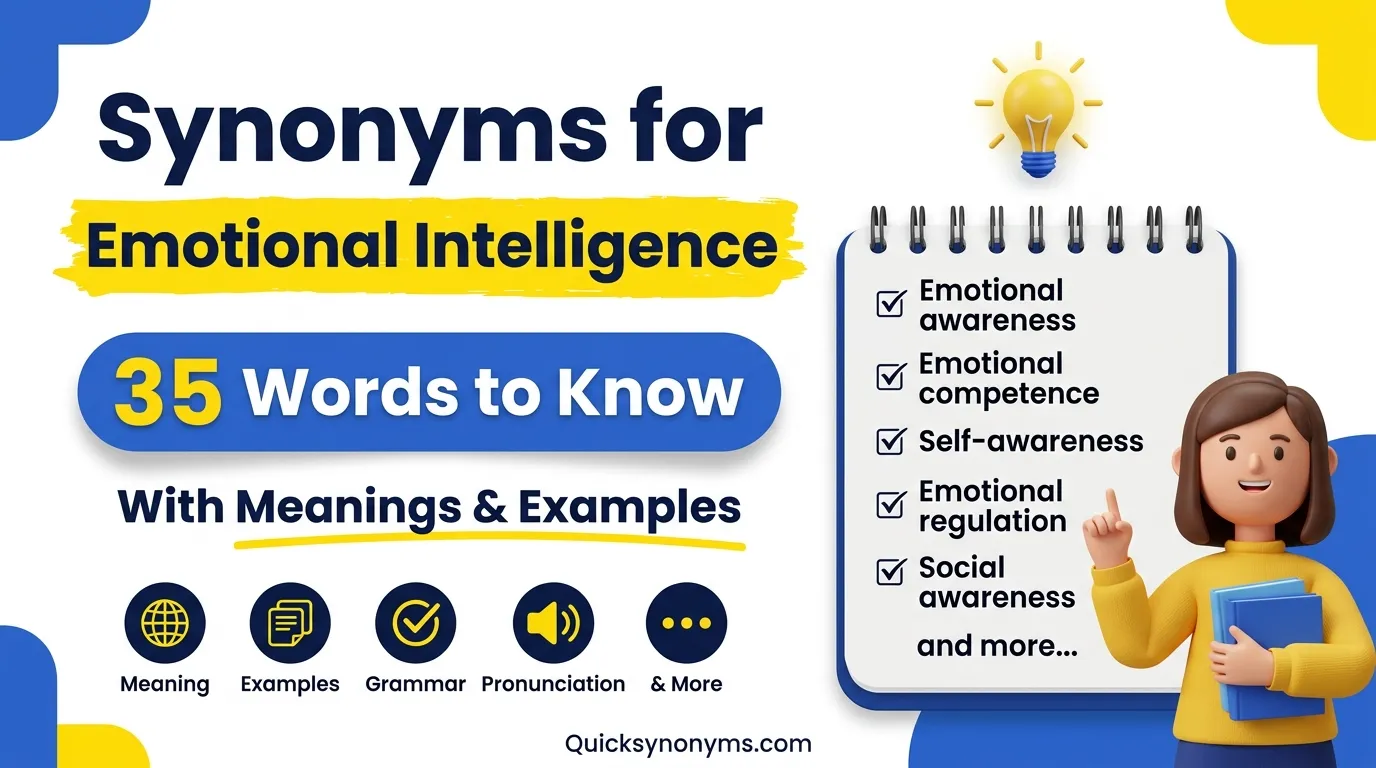
35 Synonyms of Emotional Intelligence, With Meaning & Examples
1. Emotional awareness (Noun)
Meaning: The ability to notice and understand emotions.
Examples:
- Emotional awareness helped her understand why she felt upset.
- Strong emotional awareness can improve communication.
2. Emotional competence (Noun)
Meaning: The ability to handle emotions and emotional situations effectively.
Examples:
- Emotional competence is useful in leadership.
- His emotional competence helps him manage difficult conversations.
3. Emotional literacy (Noun)
Meaning: The ability to recognize, name, and talk about emotions.
Examples:
- Schools can help children build emotional literacy.
- Emotional literacy makes it easier to explain how you feel.
4. Emotional understanding (Noun)
Meaning: The ability to understand your own feelings and the feelings of others.
Examples:
- Emotional understanding helped them solve the disagreement.
- Good emotional understanding can strengthen relationships.
5. Emotional sensitivity (Noun)
Meaning: The ability to notice and respond to emotional changes.
Examples:
- Her emotional sensitivity helps her support others.
- Emotional sensitivity can improve teamwork.
6. Self-awareness (Noun)
Meaning: The ability to understand your own feelings, thoughts, and behavior.
Examples:
- Self-awareness helped him notice his anger.
- Good leaders often develop strong self-awareness.
7. Self-understanding (Noun)
Meaning: A clear understanding of your own emotions, needs, and behavior.
Examples:
- Self-understanding can help you make better choices.
- She gained more self-understanding after reflecting on the problem.
8. Self-regulation (Noun)
Meaning: The ability to control and manage your emotional reactions.
Examples:
- Self-regulation helped him stay calm.
- Children can learn self-regulation with practice.
9. Emotional regulation (Noun)
Meaning: The ability to manage emotional responses in a healthy way.
Examples:
- Emotional regulation is useful during stressful situations.
- She used emotional regulation to avoid an angry response.
10. Self-control (Noun)
Meaning: The ability to control your feelings and actions.
Examples:
- He showed self-control during the argument.
- Self-control helped her think before speaking.
11. Empathy (Noun)
Meaning: The ability to understand and share another person’s feelings.
Examples:
- Her empathy helped the new student feel welcome.
- Empathy is important when someone is going through a hard time.
12. Compassion (Noun)
Meaning: A caring response to another person’s pain or difficulty.
Examples:
- He showed compassion toward the injured worker.
- Compassion can make difficult conversations kinder.
13. Social awareness (Noun)
Meaning: The ability to understand other people’s feelings and social situations.
Examples:
- Social awareness helped her notice that the team was worried.
- Strong social awareness can improve group communication.
14. Social intelligence (Noun)
Meaning: The ability to understand people and handle social situations well.
Examples:
- His social intelligence makes him easy to work with.
- Social intelligence can help people build strong relationships.
15. Interpersonal skills (Noun)
Meaning: Skills used to communicate and interact effectively with other people.
Examples:
- Good interpersonal skills are useful in every workplace.
- Her interpersonal skills help her solve conflicts.
16. People skills (Noun)
Meaning: The ability to communicate and work well with people.
Examples:
- She has excellent people skills.
- People skills are useful for managers and teachers.
17. Interpersonal effectiveness (Noun)
Meaning: The ability to communicate and build relationships successfully.
Examples:
- Interpersonal effectiveness helped him lead the meeting.
- Training improved her interpersonal effectiveness.
18. Relationship skills (Noun)
Meaning: Skills that help people create and maintain healthy relationships.
Examples:
- Relationship skills are important in teamwork.
- Good relationship skills can prevent many conflicts.
19. Relationship management (Noun)
Meaning: The ability to maintain positive and productive relationships.
Examples:
- Relationship management is important for team leaders.
- Her relationship management skills helped calm the disagreement.
20. Communication skills (Noun)
Meaning: The ability to share ideas and feelings clearly and effectively.
Examples:
- Strong communication skills can reduce misunderstandings.
- His communication skills helped the team work together.
21. Listening skills (Noun)
Meaning: The ability to listen carefully and understand what another person means.
Examples:
- Good listening skills make people feel respected.
- Her listening skills helped resolve the problem.
22. Perspective-taking (Noun)
Meaning: The ability to understand a situation from another person’s point of view.
Examples:
- Perspective-taking helped him understand his friend’s reaction.
- Good leaders use perspective-taking during conflicts.
23. Emotional insight (Noun)
Meaning: A clear understanding of emotions and their causes.
Examples:
- Her emotional insight helped her understand the disagreement.
- Emotional insight can help people respond with care.
24. Emotional maturity (Noun)
Meaning: The ability to handle feelings and difficult situations in a calm and responsible way.
Examples:
- He showed emotional maturity during the debate.
- Emotional maturity can improve personal relationships.
25. Emotional balance (Noun)
Meaning: The ability to keep emotions steady and manageable.
Examples:
- Emotional balance helped her stay calm under pressure.
- Meditation can support a sense of emotional balance.
26. Emotional self-management (Noun)
Meaning: The ability to manage your own emotions and reactions.
Examples:
- Emotional self-management helped him deal with criticism.
- Good emotional self-management can prevent rushed decisions.
27. Social sensitivity (Noun)
Meaning: The ability to notice and understand emotional and social signals.
Examples:
- Social sensitivity helped her notice that he felt uncomfortable.
- Social sensitivity is useful in group discussions.
28. Empathetic understanding (Noun)
Meaning: Understanding another person’s feelings from their point of view.
Examples:
- Empathetic understanding helped the teacher support the student.
- Good leaders often use empathetic understanding.
29. Emotional judgment (Noun)
Meaning: The ability to use emotional information when making decisions.
Examples:
- Emotional judgment helped her choose a calm response.
- Good emotional judgment can prevent unnecessary conflict.
30. Emotional awareness skills (Noun)
Meaning: Skills used to notice and understand emotions.
Examples:
- Children can develop emotional awareness skills over time.
- Emotional awareness skills can improve classroom communication.
31. Social-emotional skills (Noun)
Meaning: Skills used to understand emotions, manage behavior, and interact with others.
Examples:
- Schools often teach social-emotional skills.
- Social-emotional skills help children work with classmates.
32. Emotional reasoning (Noun)
Meaning: The use of emotional information when thinking about a situation.
Examples:
- Emotional reasoning helped her understand why the issue mattered.
- Good emotional reasoning can add another view to a problem.
33. People awareness (Noun)
Meaning: The ability to notice and understand what other people may be feeling.
Examples:
- His people awareness helped him support the team.
- People awareness is useful during difficult meetings.
34. Social understanding (Noun)
Meaning: The ability to understand people, relationships, and social situations.
Examples:
- Social understanding helped her handle the disagreement.
- Children develop social understanding through interaction.
35. People smarts (Noun)
Meaning: A casual way to describe skill in understanding and dealing with people.
Examples:
- Her people smarts make her a natural team leader.
- You need people smarts to handle tricky conversations.
Prototype Meaning
The most typical meaning of emotional intelligence is the ability to understand emotions and use that understanding to respond wisely. People usually imagine someone who knows how they feel, notices how others feel, stays in control, listens well, and handles social situations with care.
Prototype Categorization
- Self-awareness: Self-awareness, self-understanding, emotional awareness, and emotional insight focus on understanding your own feelings.
- Emotional control: Self-regulation, emotional regulation, self-control, emotional balance, and emotional self-management focus on managing reactions.
- Understanding others: Empathy, empathetic understanding, compassion, social awareness, and people awareness focus on understanding other people.
- Communication and relationships: Interpersonal skills, communication skills, listening skills, relationship skills, and relationship management focus on working well with others.
- Social understanding: Social intelligence, social sensitivity, social understanding, and perspective-taking focus on reading people and situations.
- Professional alternatives: Emotional competence, interpersonal effectiveness, emotional maturity, and social-emotional skills work well in formal or professional writing.
- Casual alternatives: People skills and people smarts sound more natural in everyday conversation.
This grouping helps writers choose a word that matches the exact idea. For example, use empathy when you mean understanding another person’s feelings, but use self-regulation when you mean controlling your own reaction.
Antonyms of Emotional Intelligence
- Low self-awareness (Noun phrase): Limited understanding of your own emotions and behavior.
- Poor emotional regulation (Noun phrase): Difficulty managing emotional reactions.
- Limited empathy (Noun phrase): Difficulty understanding another person’s feelings.
- Weak social awareness (Noun phrase): Difficulty noticing emotional or social signals.
- Poor interpersonal skills (Noun phrase): Difficulty communicating or working effectively with others.
- Emotional unawareness (Noun): A lack of awareness about emotions.
- Social insensitivity (Noun): A lack of awareness of other people’s feelings or social signals.
Short Questions and Answers
What does emotional intelligence mean?
Emotional intelligence means understanding emotions, managing your reactions, and using emotional information to communicate and respond effectively.
When should emotional intelligence be used?
Use it when discussing emotional awareness, self-control, empathy, communication, or social behavior. It is common in education, workplaces, leadership, and personal development.
Is emotional intelligence positive or negative?
It is usually positive because it describes useful emotional and social abilities. However, the phrase can be used neutrally when discussing someone’s strengths or areas for improvement.
How is it different from similar words?
Emotional intelligence is a broad concept. Empathy focuses on understanding others, while self-awareness focuses on understanding yourself. Self-regulation focuses on managing your reactions, and interpersonal skills focus on interacting effectively with others.
Conclusion
Learning emotional intelligence and its synonyms gives you more ways to talk about feelings, communication, and relationships. Instead of repeating the same phrase, you can choose a more exact word. For example, use empathy for understanding others, self-awareness for understanding yourself, and emotional regulation for managing your reactions.
These words can strengthen both writing and speaking. They can also help English learners understand small differences between related ideas. Writers can use them to make sentences clearer and more natural.
Try learning two or three new words each day. Write a sentence with each one and use them in real conversations when possible. With regular practice, your vocabulary will grow, your writing will become more varied, and your confidence in English will improve.
Explore More: Synonyms for Thought Provoking: 28 Ideas That Spark Thought

Senior English Language Expert
Eleanor Brooks specializes in English grammar, vocabulary, and word usage. She enjoys simplifying complex language concepts and creating practical resources that help learners write and speak with confidence.