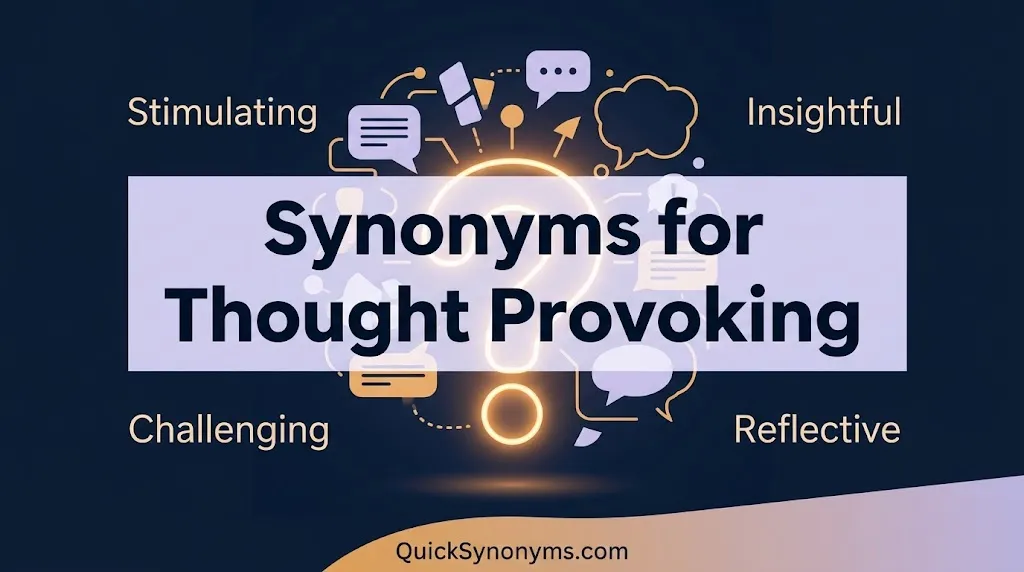
The best synonyms for thought provoking include stimulating, insightful, challenging, reflective, and provocative. These words describe ideas, questions, books, films, or conversations that make people think deeply, question assumptions, or consider a subject from a new angle.
A documentary ends, the screen goes dark, and you keep thinking about its final question. That experience is thought provoking because it pushes you beyond simply watching and makes you examine an idea, belief, or problem more deeply.
Learning synonyms for thought provoking helps you describe this effect with greater accuracy. You might call an article insightful, a question challenging, a film reflective, or an argument provocative, depending on what kind of thinking it creates.
This guide covers 28 useful alternatives, their meanings, examples, tone, and best contexts. It also explains how these words differ so you can choose the right one instead of repeating thought provoking.
Meaning of Thought provoking
Definition
Thought provoking (adjective): Causing someone to think deeply, question ideas, or consider something in a new way.
Example
- The speaker gave a thought provoking talk about the future of artificial intelligence.
Connotative Meaning
Connotation means the feeling or idea a word suggests beyond its basic meaning.
- Positive tone: Suggests valuable, deep, or meaningful thinking.
- Negative tone: Can suggest an unsettling idea that creates doubt or discomfort.
- Neutral tone: Simply describes something that encourages serious thought.
Formal vs Informal Usage
Thought provoking is neutral and widely used in both formal and informal English. It commonly describes books, films, speeches, questions, essays, discussions, art, and ideas.
In polished writing, alternatives such as insightful, reflective, or analytical can provide more precise meaning.
Etymology
The expression combines the noun thought with provoking, creating the literal idea of something that provokes or causes thought.
- Old English (450-1100): Thought developed from Old English forms related to thinking and mental consideration. The verb provoke has a different origin.
- Middle English (1100-1500): Related forms of thought and provoke continued to develop through Middle English usage.
- Modern English (1500-Present): Thought provoking emerged as a descriptive compound for something that encourages serious or unusual thinking. The hyphenated form thought-provoking is also common when it appears before a noun.
Pronunciation (IPA)
- IPA: /ˈθɔːt prəˌvoʊ.kɪŋ/ (common American English approximation)
- Syllables: thought-pro-vok-ing
- UK English may use a slightly different vowel in thought and provoking, but the overall pronunciation pattern remains similar.
Affixation Pattern of Thought provoking
- Root: thought and provoke
- Prefix: pro- occurs historically within provoke, but it is not a productive prefix added to thought provoking.
- Suffix: -ing in provoking
- Word formations:
- thought (noun)
- think (verb)
- thinking (noun/adjective)
- thoughtful (adjective)
- thoughtfulness (noun)
- provoke (verb)
- provocation (noun)
- provocative (adjective)
28 Synonyms of Thought Provoking With Meaning & Examples
1. Stimulating (Adjective)
Meaning: Encouraging mental activity, interest, or new ideas.
Examples:
- The professor led a stimulating discussion about climate policy.
- We had a stimulating conversation about the future of work.
Best for: Discussions and ideas
2. Insightful (Adjective)
Meaning: Showing or providing a deep understanding of a subject.
Examples:
- Her insightful article changed how I viewed the problem.
- The interview offered several insightful observations about modern life.
Best for: Analysis and commentary
3. Challenging (Adjective)
Meaning: Making someone question, examine, or reconsider an idea.
Examples:
- The novel presents a challenging view of human nature.
- His challenging question made the entire class reconsider its assumptions.
Best for: Questions and arguments
4. Reflective (Adjective)
Meaning: Encouraging careful thought about experiences, ideas, or feelings.
Examples:
- The memoir is reflective and deeply personal.
- She wrote a reflective essay about growing up.
Best for: Personal writing
5. Provocative (Adjective)
Meaning: Deliberately causing strong thought, discussion, or reaction.
Examples:
- The artist created a provocative piece about social inequality.
- His provocative argument sparked a long debate.
Best for: Controversial ideas
6. Contemplative (Adjective)
Meaning: Encouraging deep, quiet, and serious thought.
Examples:
- The film has a slow, contemplative mood.
- The poem offers a contemplative look at aging.
Best for: Art and literature
7. Intriguing (Adjective)
Meaning: Creating curiosity and making someone want to think or learn more.
Examples:
- The scientist proposed an intriguing explanation.
- The ending raised several intriguing questions.
Best for: Questions and mysteries
8. Engaging (Adjective)
Meaning: Holding attention while encouraging interest and mental involvement.
Examples:
- The teacher created an engaging discussion about history.
- The book presents an engaging look at human behavior.
Best for: Teaching and writing
9. Insight-generating (Adjective)
Meaning: Likely to produce useful understanding or new ideas.
Examples:
- The workshop included several insight-generating exercises.
- Their insight-generating questions improved the research process.
Best for: Research and workshops
10. Illuminating (Adjective)
Meaning: Making a difficult or unclear subject easier to understand.
Examples:
- The interview was illuminating and changed my view of the issue.
- Her explanation gave us an illuminating perspective on the conflict.
Best for: Explanations
11. Enlightening (Adjective)
Meaning: Giving someone new knowledge or a better understanding.
Examples:
- The lecture was enlightening and easy to follow.
- Talking with local residents was an enlightening experience.
Best for: Learning experiences
12. Evocative (Adjective)
Meaning: Bringing strong ideas, memories, or feelings to mind.
Examples:
- The novel contains evocative descriptions of childhood.
- The photograph is evocative of a very different era.
Best for: Art and description
13. Suggestive (Adjective)
Meaning: Indirectly bringing an idea or possibility to mind.
Examples:
- The painting is suggestive of loneliness and change.
- Her suggestive question made us consider another explanation.
Best for: Art and indirect ideas
14. Intellectual (Adjective)
Meaning: Related to serious thinking, reasoning, or the use of the mind.
Examples:
- The conference provided an intellectual challenge.
- They enjoyed an intellectual discussion about ethics.
Best for: Academic subjects
15. Analytical (Adjective)
Meaning: Encouraging careful examination of facts, ideas, or relationships.
Examples:
- The report offers an analytical view of the economy.
- Her analytical approach revealed a problem in the original argument.
Best for: Reports and arguments
16. Incisive (Adjective)
Meaning: Showing clear and sharp understanding of a complicated issue.
Examples:
- The journalist asked an incisive question.
- His incisive comments exposed a weakness in the proposal.
Best for: Questions and criticism
17. Penetrating (Adjective)
Meaning: Showing a deep ability to understand something that is not obvious.
Examples:
- The writer gives a penetrating analysis of power.
- She offered a penetrating observation about human behavior.
Best for: Deep analysis
18. Profound (Adjective)
Meaning: Having great depth of meaning or thought.
Examples:
- The film raises profound questions about freedom.
- His speech had a profound effect on the audience.
Best for: Deep ideas
19. Meaningful (Adjective)
Meaning: Having important value, purpose, or significance.
Examples:
- The discussion led to a meaningful conversation about identity.
- She asked a meaningful question about success.
Best for: Personal topics
20. Revealing (Adjective)
Meaning: Showing something important that was previously hidden or unclear.
Examples:
- The interview was revealing about the company’s culture.
- His answer was revealing and made us reconsider his motives.
Best for: Interviews and discoveries
21. Absorbing (Adjective)
Meaning: Holding attention strongly enough to encourage continued interest.
Examples:
- The book provides an absorbing account of the investigation.
- We watched an absorbing documentary about human memory.
Best for: Books and documentaries
22. Compelling (Adjective)
Meaning: So convincing or interesting that it strongly holds attention.
Examples:
- The speaker presented a compelling argument.
- The documentary makes a compelling case for reform.
Best for: Arguments and evidence
23. Searching (Adjective)
Meaning: Examining a subject deeply and honestly.
Examples:
- The author asks searching questions about modern society.
- The interview included several searching questions about leadership.
Best for: Serious questions
24. Deep (Adjective)
Meaning: Showing serious or substantial intellectual or emotional thought.
Examples:
- The movie raises some deep questions about morality.
- We had a deep conversation about what makes life meaningful.
Best for: Everyday conversation
25. Reflecting (Adjective)
Meaning: Involving careful consideration of an idea or experience.
Examples:
- The essay is reflecting on the effects of technology.
- His writing is reflecting on the meaning of success.
Best for: Reflective writing
26. Questioning (Adjective)
Meaning: Examining accepted ideas rather than accepting them without thought.
Examples:
- Her questioning approach challenged the traditional theory.
- The novel has a questioning attitude toward social rules.
Best for: Critical discussion
27. Stimulative (Adjective)
Meaning: Causing mental interest, activity, or intellectual response.
Examples:
- The course provides a stimulative environment for discussion.
- The debate was stimulative and encouraged new ideas.
Best for: Formal or academic contexts
28. Mind-expanding (Adjective)
Meaning: Broadening someone’s understanding by introducing new ideas or perspectives.
Examples:
- Traveling abroad can be a mind-expanding experience.
- The book offers a mind-expanding look at consciousness.
Best for: New perspectives
Thought provoking vs Its Closest Synonym
Unlike stimulating, thought provoking specifically emphasizes an idea that makes someone stop and think deeply or reconsider something. Stimulating is broader and can describe anything that creates mental interest or activity.
Unlike insightful, thought provoking focuses on the effect an idea has on the reader or listener. Insightful focuses more on the quality of understanding contained in the idea itself.
Prototype Meaning
The most typical meaning of thought provoking is something that makes you pause and think beyond the obvious. People often imagine a powerful question, unusual idea, serious film, challenging book, or conversation that stays in the mind long after it ends.
The key feature is mental engagement. A thought-provoking idea does not simply give information; it encourages the person receiving it to question, connect, reflect, or see an issue differently.
Prototype Categorization
- Mental stimulation: stimulating, engaging, intriguing, absorbing
- Deep understanding: insightful, illuminating, enlightening, penetrating
- Critical thinking: challenging, analytical, incisive, questioning
- Reflection: reflective, contemplative, searching, deep
- Strong intellectual impact: profound, compelling, meaningful
- New perspectives: mind-expanding, revealing, suggestive
- Artistic effect: evocative, provocative
These categories help writers choose a word based on how the thinking happens, rather than treating every synonym as interchangeable.
Antonyms of Thought provoking
There is no single perfect opposite of thought provoking in every context. The closest contextual opposites include:
- Uninspiring (adjective): Failing to create interest or new ideas.
- Boring (adjective): Causing little interest or mental engagement.
- Uninteresting (adjective): Not attracting attention or curiosity.
- Mindless (adjective): Requiring little thought or reflection.
- Trivial (adjective): Lacking serious importance or depth.
- Superficial (adjective): Lacking depth of thought or understanding.
- Predictable (adjective): Offering little that is surprising or intellectually challenging.
Short Questions and Answers
What does thought provoking mean?
Thought provoking describes something that makes people think carefully, question assumptions, or consider an idea more deeply.
Is thought provoking positive or negative?
It is usually positive or neutral because it suggests intellectual value. However, something can be thought provoking because it creates discomfort, doubt, or controversy.
What is another word for thought provoking?
Common alternatives include stimulating, insightful, challenging, reflective, and provocative. The best choice depends on the exact effect you want to describe.
Is insightful the same as thought provoking?
Not exactly. Insightful describes something that shows deep understanding, while thought provoking describes something that causes deeper thinking.
What is a formal synonym for thought provoking?
Illuminating, incisive, analytical, and profound can work well in formal writing, depending on the context.
What is the opposite of thought provoking?
Common contextual opposites include boring, uninteresting, superficial, mindless, and trivial.
Can thought provoking describe a person?
It can describe a person’s ideas, questions, comments, or conversation, but it is more natural to say that the person’s ideas or comments are thought provoking.
Conclusion
Learning synonyms for thought provoking gives you more precise ways to describe ideas that stay with the reader or listener. Instead of using the same phrase repeatedly, you can choose insightful for deep understanding, challenging for difficult ideas, reflective for quiet consideration, or provocative for ideas that create strong debate.
The right word depends on the effect you want to show. Practice replacing thought provoking in sentences and notice how each alternative changes the meaning slightly. This builds stronger vocabulary and makes your writing more natural, specific, and confident.
When you read a book, watch a film, or join a serious discussion, try to identify what makes the experience memorable. Then choose the synonym that describes that effect most accurately.
Explore More: Synonyms for Deprived: 27 Words for Lacking and Loss.

Senior English Language Expert
Eleanor Brooks specializes in English grammar, vocabulary, and word usage. She enjoys simplifying complex language concepts and creating practical resources that help learners write and speak with confidence.








1 thought on “Synonyms for Thought Provoking: 28 Ideas That Spark Thought”