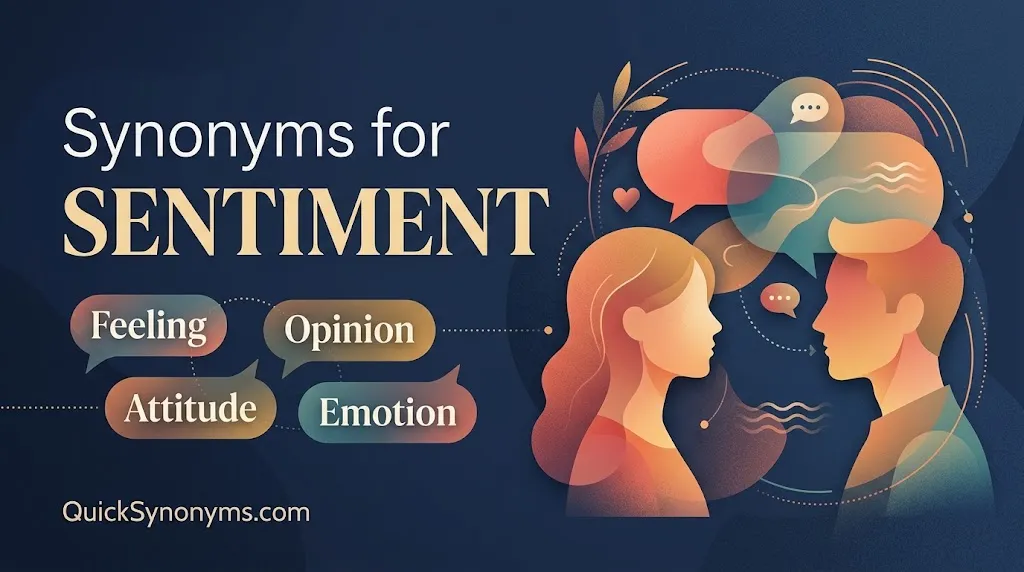
Common synonyms for sentiment include feeling, opinion, attitude, view, and emotion. The best choice depends on whether you mean a personal feeling, a belief, or a general attitude toward something.
Sentiment means a feeling, opinion, or attitude about something. Imagine a group of people discussing a new school rule. Some may support it, while others may dislike it. Their shared feelings and opinions are their sentiments. The word is common in everyday writing, news, business, politics, and discussions about public opinion.
Learning synonyms for sentiment helps English learners choose more exact words. It also helps writers avoid repeating the same word in essays, articles, stories, and professional writing.
In this guide, you will learn the meaning, examples, pronunciation, history, word forms, and useful synonyms of sentiment. You will also see how related words differ by meaning and context.
Meaning of Sentiment
Definition
Sentiment (noun): A feeling, opinion, or attitude that is influenced by emotion or personal thought.
Examples
- Public sentiment changed after the announcement.
- She expressed her sentiment about the new policy.
Connotative Meaning
Connotation: The feeling or idea that a word suggests beyond its basic meaning.
- Positive tone: A warm, caring, supportive, or hopeful feeling.
- Negative tone: An emotional, biased, excessive, or overly sentimental feeling.
- Neutral tone: A general opinion, attitude, or feeling about an issue.
Etymology
The word sentiment entered English through Old French and Medieval Latin. It is connected to the Latin verb sentire, meaning “to feel” or “to sense.”
- Old English (450–1100): There was no direct Old English form of modern sentiment. Its Latin root sentire developed outside Old English.
- Middle English (1100–1500): English used forms such as sentement, borrowed through Old French and Medieval Latin, with meanings connected to feeling and personal experience.
- Modern English (1500–Present): Sentiment developed meanings involving opinions, attitudes, emotional thoughts, and expressed feelings.
Pronunciation (IPA)
- IPA: /ˈsentɪmənt/
- Syllables: sen-ti-ment
Affixation Pattern of Sentiment
- Root: Latin sentire, meaning “to feel” or “to sense”
- Prefix: None
- Suffix: -ment, forming a noun related to a state, result, or condition
Word Formations
- Sentiment: noun
- Sentiments: plural noun
- Sentimental: adjective
- Sentimentally: adverb
- Sentimentality: noun
- Sentimentalize: verb
- Sentimentalized: verb/adjective form
- Sentimentalizing: verb form
- Sentimentalist: noun
20 Synonyms of Sentiment: Words for Feelings and Opinions
1. Feeling (Noun)
Meaning: An emotion, reaction, or personal sense about someone or something.
Examples:
- She had a strong feeling about the decision.
- His feelings changed after the conversation.
2. Opinion (Noun)
Meaning: A belief or judgment about something.
Examples:
- What is your opinion of the new plan?
- Her opinion was different from mine.
3. Attitude (Noun)
Meaning: The way someone thinks or feels about a person, situation, or idea.
Examples:
- His attitude toward work has improved.
- The team has a positive attitude.
4. View (Noun)
Meaning: A particular opinion or way of thinking about something.
Examples:
- I respect your view on the matter.
- Her view of the problem was practical.
5. Emotion (Noun)
Meaning: A strong feeling such as love, anger, fear, or happiness.
Examples:
- The speech was full of emotion.
- She struggled to control her emotions.
6. Thought (Noun)
Meaning: An idea or opinion formed in the mind.
Examples:
- That thought stayed with him all day.
- She shared her thoughts about the proposal.
7. Idea (Noun)
Meaning: A thought, belief, or concept about something.
Examples:
- I understand your idea.
- The article presents an interesting idea.
8. Notion (Noun)
Meaning: An idea or belief about something.
Examples:
- He rejected the notion that success is easy.
- She had a strange notion about the situation.
9. Viewpoint (Noun)
Meaning: A particular way of considering or understanding an issue.
Examples:
- We need to consider the customer’s viewpoint.
- His viewpoint was shaped by experience.
10. Perspective (Noun)
Meaning: A particular way of seeing or understanding something.
Examples:
- Travel can change your perspective.
- She offered a different perspective on the issue.
11. Stance (Noun)
Meaning: A clear position or attitude toward an issue.
Examples:
- The company changed its stance on the policy.
- He made his stance clear.
12. Position (Noun)
Meaning: A person’s stated opinion or attitude about an issue.
Examples:
- She explained her position clearly.
- The group has a strong position on the matter.
13. Outlook (Noun)
Meaning: A person’s general attitude or view about life or a situation.
Examples:
- She has a positive outlook on life.
- His outlook changed after the experience.
14. Impression (Noun)
Meaning: An idea or feeling formed about someone or something.
Examples:
- My first impression was positive.
- The speech left a strong impression on the audience.
15. Response (Noun)
Meaning: A reaction or feeling expressed in answer to something.
Examples:
- The proposal received a mixed response.
- Her response showed strong support.
16. Mood (Noun)
Meaning: A temporary emotional state or general feeling.
Examples:
- The mood of the crowd was cheerful.
- The news changed the public mood.
17. Sensibility (Noun)
Meaning: The ability to understand and respond to emotions or delicate feelings.
Examples:
- The poem shows great emotional sensibility.
- Her artistic sensibility is easy to recognize.
18. Sympathy (Noun)
Meaning: Feelings of care or concern for someone who is suffering.
Examples:
- She expressed sympathy for the family.
- His story gained public sympathy.
19. Tenderness (Noun)
Meaning: Gentle feelings of kindness, affection, or care.
Examples:
- The letter was filled with tenderness.
- He spoke about his childhood with tenderness.
20. Sentimentality (Noun)
Meaning: Strong or excessive emotion, especially about love, memories, or sadness.
Examples:
- The film avoids unnecessary sentimentality.
- She kept the old gift out of sentimentality.
Prototype Meaning
The most typical meaning of sentiment is a feeling or opinion about something, especially when emotion influences that feeling. When people hear the word, they often imagine a personal or public attitude that can be expressed through words, actions, or behavior.
Prototype Categorization
- Opinion and belief: opinion, view, thought, idea, notion are useful when sentiment means what someone thinks.
- Attitude and position: attitude, stance, position, outlook work well when describing a person’s approach to an issue.
- Emotion and feeling: feeling, emotion, mood, response are useful when the focus is on emotional reactions.
- Personal viewpoint: viewpoint, perspective, impression help describe how someone understands or sees something.
- Warm or emotional feeling: sympathy, tenderness, sensibility, sentimentality fit situations involving affection, care, or strong emotion.
This categorization helps writers choose a synonym that matches the exact meaning instead of replacing sentiment with a word that only seems similar.
Antonyms of Sentiment
Indifference (Noun)
A lack of interest, concern, or feeling.
Apathy (Noun)
A lack of interest or emotional response.
Disinterest (Noun)
A lack of personal concern or involvement.
Detachment (Noun)
A state of being emotionally separate from something.
Objectivity (Noun)
The quality of judging something without personal feelings or bias.
Reason (Noun)
The use of logical thinking rather than emotion.
Short Questions and Answers
What does sentiment mean?
Sentiment means a feeling, opinion, or attitude about something, often influenced by emotion.
When should sentiment be used?
Use sentiment when describing a personal or group feeling, opinion, or attitude, especially when emotion plays a role.
Is sentiment positive or negative?
Sentiment can be positive, negative, or neutral. Its meaning depends on the context.
How is it different from similar words?
Sentiment can combine feeling and opinion. Opinion usually focuses more on what someone thinks, while emotion focuses more strongly on what someone feels.
Conclusion
Learning sentiment and its synonyms can make your English clearer and more flexible. Words such as feeling, opinion, attitude, view, and emotion help you express different shades of meaning without repeating the same word.
More specific choices such as stance, perspective, sympathy, or tenderness can make your writing more precise.
Understanding these differences is useful in essays, conversations, professional writing, news articles, and creative work. Instead of choosing a synonym only because it looks similar, think about the exact meaning you want to express.
Daily vocabulary practice can help you build a stronger word bank, improve your speaking and writing, avoid repetition, and communicate with greater confidence.
Learn more with these synonyms for morale.

Senior English Language Expert
Eleanor Brooks specializes in English grammar, vocabulary, and word usage. She enjoys simplifying complex language concepts and creating practical resources that help learners write and speak with confidence.











1 thought on “Synonyms for Sentiment: 20 Words to Express Feelings”