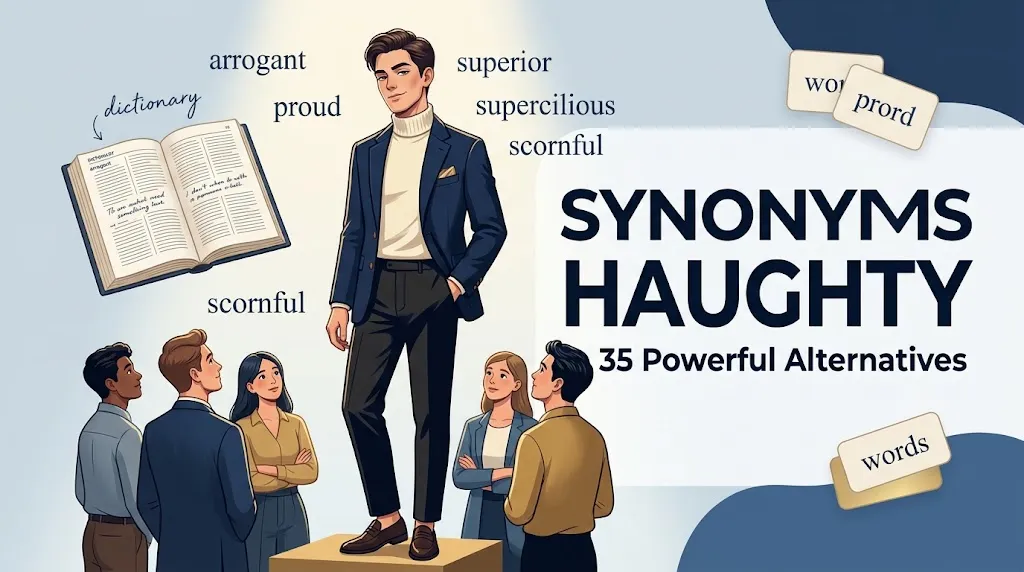
Haughty means acting as if you are better, smarter, or more important than other people.
If you are looking for a haughty synonym, common choices include arrogant, conceited, supercilious, disdainful, and condescending. The best synonym depends on the exact attitude or behavior you want to describe.
Imagine a manager who ignores junior workers, speaks with a cold tone, and expects everyone to admire him. His behavior may seem haughty. The word is often used when describing proud or superior behavior, especially when that behavior feels unpleasant or rude.
Learning synonyms for haughty helps English learners express shades of meaning more clearly. It also helps content writers avoid repeating the same word in articles, stories, essays, and professional writing. A good synonym can show whether someone is simply proud, openly arrogant, or quietly superior.
In this article, we explore the meaning of haughty, its synonyms, examples, grammar, history, pronunciation, word formation, and semantic categories. These examples will help you choose the right word for each situation.
Meaning of Haughty
Definition
Haughty (Adjective):
Showing that you think you are better, more important, or more deserving than other people.
Examples
- The haughty woman refused to speak to the hotel staff.
- His haughty attitude made his classmates uncomfortable.
Connotative Meaning
Connotation: The feeling or idea that a word suggests beyond its basic meaning.
- Positive tone: Haughty is rarely positive, but in some literary contexts it may suggest dignity or proud self-confidence.
- Negative tone: It usually suggests arrogance, superiority, pride, or disrespect.
- Neutral tone: In rare descriptive contexts, it can simply describe a proud or elevated manner without strong judgment.
Etymology
The word haughty comes from an Old French word related to haut, meaning “high.” Its history reflects the idea of being physically or socially “high” above others.
- Old English (450–1100): There was no direct Old English form of haughty. The idea was expressed through words connected with pride, height, or superiority.
- Middle English (1100–1500): Forms related to Old French haut entered English and developed meanings connected with being high, proud, or elevated.
- Modern English (1500–Present): Haughty developed its modern sense of behaving proudly or arrogantly toward others.
Pronunciation (IPA)
- IPA: /ˈhɔːti/
- Syllables: haugh-ty
Affixation Pattern of Haughty
- Root: haught-, historically connected with Old French haut, meaning “high”
- Prefix: None
- Suffix: -y, forming an adjective that describes a quality
- Word formations:
- Haughty — adjective: showing arrogant superiority
- Haughtily — adverb: in a haughty manner
- Haughtiness — noun: the quality of being haughty
Best Synonym for Haughty
Arrogant is one of the closest and most common synonyms for haughty. Other strong alternatives include supercilious, disdainful, condescending, snobbish, pompous, and self-important. The right choice depends on the context and the type of superior behavior you want to describe.
35 Synonyms of Haughty With Meaning & Examples
1. Arrogant (Adjective)
Meaning: Believing that you are better or more important than others.
Examples:
- The arrogant student never listened to his classmates.
- His arrogant behavior upset the whole team.
2. Conceited (Adjective)
Meaning: Having too much pride in your abilities, appearance, or qualities.
Examples:
- She is too conceited to accept advice.
- His conceited manner annoyed his friends.
3. Proud (Adjective)
Meaning: Feeling that you are better or more important, sometimes in an unpleasant way.
Examples:
- He was too proud to admit his mistake.
- Her proud attitude made cooperation difficult.
4. Snobbish (Adjective)
Meaning: Acting as if people from a higher social group are better than others.
Examples:
- The snobbish guest refused to sit with the other visitors.
- His snobbish comments offended the workers.
5. Supercilious (Adjective)
Meaning: Behaving as if other people are less intelligent or important.
Examples:
- The lawyer gave a supercilious smile.
- Her supercilious tone irritated everyone.
6. Disdainful (Adjective)
Meaning: Showing that you do not respect or value someone.
Examples:
- He gave me a disdainful look.
- Her disdainful reply ended the conversation.
7. Imperious (Adjective)
Meaning: Expecting others to obey you because you believe you have authority.
Examples:
- The imperious manager ordered everyone to leave.
- Her imperious voice silenced the room.
8. Domineering (Adjective)
Meaning: Trying to control other people in an aggressive way.
Examples:
- His domineering personality caused many arguments.
- The domineering leader made every decision alone.
9. Overbearing (Adjective)
Meaning: Trying to control people too much and ignoring their wishes.
Examples:
- Her overbearing father chose her career for her.
- The boss became overbearing during the project.
10. Snobby (Adjective)
Meaning: Believing that people or things from a higher social level are better.
Examples:
- His snobby attitude made him unpopular.
- She sounded snobby when discussing expensive brands.
11. Self-important (Adjective)
Meaning: Thinking that you are more important than you really are.
Examples:
- The self-important speaker talked for an hour.
- His self-important attitude frustrated the team.
12. Pompous (Adjective)
Meaning: Acting overly important and using an overly serious manner.
Examples:
- The pompous official gave a long speech.
- His pompous style made a simple idea sound complex.
13. Pretentious (Adjective)
Meaning: Trying to appear more intelligent, cultured, or important than you really are.
Examples:
- His pretentious speech confused the audience.
- The restaurant’s pretentious name made us laugh.
14. Lofty (Adjective)
Meaning: Showing an attitude of superiority or great self-importance.
Examples:
- She spoke in a lofty manner.
- His lofty attitude kept him away from others.
15. Snooty (Adjective)
Meaning: Unfriendly and superior toward people considered less important.
Examples:
- The snooty receptionist ignored the customer.
- Her snooty behavior surprised her old friends.
16. Uppity (Adjective)
Meaning: Behaving as if you are more important than people expect you to be.
Examples:
- The character was criticized for his uppity behavior.
- His uppity manner annoyed his neighbors.
17. Haughty-minded (Adjective)
Meaning: Having a proud and superior attitude toward others.
Examples:
- The haughty-minded ruler trusted very few people.
- His haughty-minded behavior created distance.
18. Contemptuous (Adjective)
Meaning: Showing that you think someone is worthless or beneath you.
Examples:
- She gave him a contemptuous glance.
- His contemptuous remarks hurt the new employee.
19. Scornful (Adjective)
Meaning: Showing strong disrespect or dislike for someone or something.
Examples:
- He made a scornful comment about the proposal.
- Her scornful laugh embarrassed the speaker.
20. Patronizing (Adjective)
Meaning: Speaking or behaving as if another person is less intelligent or capable.
Examples:
- His patronizing tone upset his coworker.
- She disliked the doctor’s patronizing manner.
21. Condescending (Adjective)
Meaning: Acting as if you are superior to someone who needs your help or attention.
Examples:
- The teacher’s condescending tone discouraged the student.
- He sounded condescending during the discussion.
22. Superiority-minded (Adjective)
Meaning: Having a strong belief that you are better than other people.
Examples:
- His superiority-minded attitude damaged his friendships.
- The character is written as superiority-minded and cold.
23. High-handed (Adjective)
Meaning: Using authority in a forceful way without caring about others’ opinions.
Examples:
- The director took a high-handed approach.
- Employees disliked his high-handed decisions.
24. Imperious-looking (Adjective)
Meaning: Appearing proud, commanding, or superior.
Examples:
- The queen had an imperious-looking expression.
- His imperious-looking face made him seem unapproachable.
25. Snobbish-minded (Adjective)
Meaning: Having a strong tendency to judge people by social status or wealth.
Examples:
- His snobbish-minded views caused tension.
- The character is wealthy but not snobbish-minded.
26. Arrogant-looking (Adjective)
Meaning: Appearing overly confident or superior.
Examples:
- His arrogant-looking smile annoyed the audience.
- The actor played an arrogant-looking businessman.
27. Disdainful (Adjective)
Meaning: Showing that you consider someone or something unworthy of respect.
Examples:
- She was disdainful of their simple lifestyle.
- He gave a disdainful shrug.
28. Egotistical (Adjective)
Meaning: Thinking and talking too much about yourself and your importance.
Examples:
- The egotistical actor talked only about himself.
- His egotistical behavior drove his colleagues away.
29. Narcissistic (Adjective)
Meaning: Showing extreme self-focus and an excessive sense of personal importance.
Examples:
- His narcissistic behavior made teamwork difficult.
- The novel features a narcissistic businessman.
30. Vainglorious (Adjective)
Meaning: Excessively proud of your own achievements or qualities.
Examples:
- The vainglorious ruler wanted constant praise.
- His vainglorious speech focused on his own success.
31. Grandiose (Adjective)
Meaning: Having an exaggerated sense of importance or greatness.
Examples:
- He had grandiose ideas about his future.
- Her grandiose claims were difficult to believe.
32. Cocky (Adjective)
Meaning: Too confident in yourself, often in an annoying way.
Examples:
- The cocky player underestimated his opponent.
- His cocky attitude disappeared after the defeat.
33. Overconfident (Adjective)
Meaning: Too confident because you believe you cannot fail.
Examples:
- The overconfident driver ignored the warning signs.
- She became overconfident after one successful test.
34. Self-satisfied (Adjective)
Meaning: Too pleased with yourself and your achievements.
Examples:
- His self-satisfied smile was easy to notice.
- The winner looked self-satisfied after the competition.
35. Lordly (Adjective)
Meaning: Behaving in a proud, commanding, or superior way.
Examples:
- He walked into the room with a lordly manner.
- Her lordly behavior made the staff uncomfortable.
Prototype Meaning
The most typical meaning of haughty is arrogantly superior behavior. When people hear this word, they often imagine someone who looks down on others, speaks with a cold or proud tone, and believes they deserve special treatment. A haughty person does not simply feel proud; they often show that pride in a way that makes other people feel unimportant.
Prototype Categorization
The 35 synonyms can be grouped into semantic categories. This helps writers choose a word that matches the exact kind of superiority they want to describe.
- General arrogance: arrogant, conceited, proud, egotistical, overconfident — useful when someone has an excessive belief in their own importance or abilities.
- Social superiority: snobbish, snobby, snooty, uppity, snobbish-minded — best for people who judge others by class, wealth, status, or social position.
- Disrespect and contempt: disdainful, contemptuous, scornful, patronizing, condescending — useful when superior behavior is shown through speech, looks, or treatment of others.
- Power and control: imperious, domineering, overbearing, high-handed, lordly — best when a person expects obedience or tries to control others.
- Self-importance: self-important, pompous, pretentious, lofty, grandiose, vainglorious — useful when someone exaggerates their importance, knowledge, status, or achievements.
- Strong self-focus: narcissistic, self-satisfied, superiority-minded — useful when excessive focus on the self is central to the description.
- Appearance or manner: imperious-looking, arrogant-looking — useful when describing how someone’s face, expression, or appearance suggests superiority.
- High pride: haughty-minded, cocky — useful for characters or people whose confidence becomes unpleasant or excessive.
This categorization helps writers avoid choosing synonyms only because they look similar in a dictionary. The best synonym should match the person’s behavior, attitude, social setting, and emotional tone.
Antonyms of Haughty
1. Humble (Adjective)
Not believing that you are better or more important than others.
2. Modest (Adjective)
Not boasting about your abilities or achievements.
3. Humble-minded (Adjective)
Having a modest and respectful attitude toward others.
4. Unassuming (Adjective)
Not trying to attract attention or appear important.
5. Respectful (Adjective)
Showing proper respect and consideration for other people.
6. Friendly (Adjective)
Kind, pleasant, and open toward others.
7. Approachable (Adjective)
Easy to talk to and comfortable to be around.
8. Courteous (Adjective)
Polite and respectful in behavior.
Short Questions and Answers
What is a synonym for haughty?
A common synonym for haughty is arrogant. Other alternatives include supercilious, disdainful, condescending, snobbish, pompous, and self-important. The best choice depends on the context.
What does haughty mean?
Haughty means behaving as if you are better, more important, or more deserving than other people.
When should haughty be used?
Use haughty when describing proud or superior behavior that often makes other people feel ignored, disrespected, or unimportant.
Is haughty positive or negative?
Haughty is usually negative because it suggests arrogance and an unpleasant sense of superiority. Context can slightly change its tone in literary writing.
How is it different from similar words?
Haughty is a broad word for proud and superior behavior. Arrogant focuses on excessive self-confidence, snobbish often relates to social status, condescending describes treating others as less intelligent, and imperious emphasizes commanding behavior.
Conclusion
Learning haughty and its synonyms gives English learners more ways to describe pride, arrogance, superiority, and social behavior. Words such as arrogant, conceited, snobbish, and condescending may look similar, but each carries a slightly different meaning. Knowing these differences improves vocabulary and helps writers create clearer descriptions.
If you need a haughty synonym, choose a word that matches the exact tone and situation. Arrogant, supercilious, condescending, and snobbish can all describe similar behavior, but each has its own shade of meaning.
It also makes speaking and writing more natural by reducing repeated words. Instead of using haughty in every sentence, you can choose a synonym that shows the exact attitude you mean.
Regular vocabulary practice builds confidence over time. Try learning a few synonyms each day, write your own example sentences, and notice how native speakers use these words in books, articles, films, and conversations.
Explore More Synonyms: Synonyms for Despise: 40 Powerful Alternatives

Senior English Language Expert
Eleanor Brooks specializes in English grammar, vocabulary, and word usage. She enjoys simplifying complex language concepts and creating practical resources that help learners write and speak with confidence.



1 thought on “Synonyms for Haughty: 35 Powerful Alternatives”