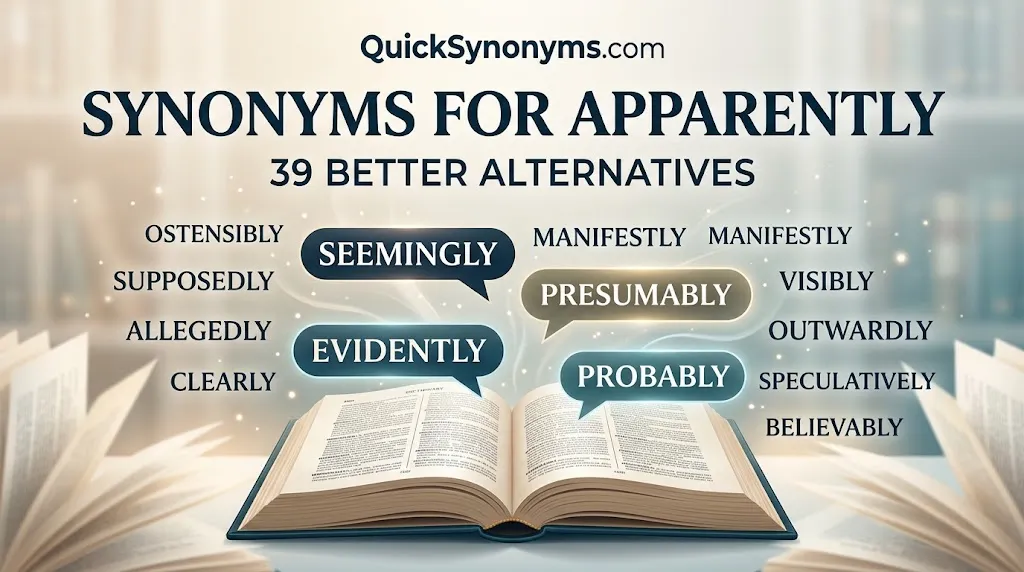
Apparently means something seems to be true based on what you can see, hear, or know. For example, if a coworker is not at work, you might say, “Apparently, she is working from home.” You may not know every detail, but the information makes the situation seem clear. The word is common in everyday English because it helps speakers share information without claiming complete certainty.
Learning synonyms for apparently helps English learners and content writers express ideas with more accuracy. Some alternatives sound formal, while others suggest uncertainty, evidence, or reported information. In this guide, you will learn the meaning of apparently, its synonyms, examples, grammar, history, pronunciation, and semantic categories. These useful alternatives can help make your English more natural, varied, and precise.
Meaning of Apparently
Definition
Apparently (Adverb):
Apparently means something seems to be true based on available information or evidence.
Examples
- Apparently, the store is closed today.
- She apparently forgot about the meeting.
Connotative Meaning
Connotation means the feeling or idea that a word suggests beyond its basic meaning.
- Positive tone: Apparently can sound positive when it introduces good news or an encouraging discovery.
- Negative tone: It can sound negative when it introduces an unexpected or disappointing fact.
- Neutral tone: Most often, apparently has a neutral tone and simply shows that something seems true.
Etymology
The word apparently comes from apparent, which comes through Old French from Latin apparere, meaning “to appear” or “to come into view.”
- Old English (450–1100): The modern word was not part of Old English vocabulary. Its Latin-based root developed outside the Old English system.
- Middle English (1100–1500): Forms related to apparent entered English through Anglo-French and Old French. The word was connected with ideas of being visible or clear.
- Modern English (1500–Present): Apparent developed meanings related to something that seems true or is clearly visible. The adverb apparently came to mean “as it appears” or “seemingly.”
Pronunciation (IPA)
- IPA: /əˈpærəntli/
- Syllables: ap-par-ent-ly
Affixation Pattern of Apparently
- Root: appear
- Prefix: None in apparently
- Suffix: -ly
- Word formations:
- Appear (verb): to become visible or seem to be present
- Appearance (noun): the way someone or something looks
- Apparent (adjective): seeming to be true or clearly visible
- Apparently (adverb): as it seems or according to available information
- Apparentness (noun): the quality of being apparent
39 Synonyms of Apparently With Meaning & Examples
1. Seemingly (Adverb)
Meaning: In a way that makes something appear to be true.
Examples:
- Seemingly, everything went according to plan.
- He was seemingly unaware of the problem.
2. Evidently (Adverb)
Meaning: In a way that shows something is probably true from evidence.
Examples:
- Evidently, the machine needs repair.
- She evidently knew the answer.
3. Clearly (Adverb)
Meaning: In a way that is easy to see or understand.
Examples:
- Clearly, they need more time.
- He clearly understood the instructions.
4. Obviously (Adverb)
Meaning: In a way that seems very easy to recognize or understand.
Examples:
- Obviously, something went wrong.
- She obviously wanted to leave early.
5. Ostensibly (Adverb)
Meaning: According to what appears to be the reason or purpose.
Examples:
- He went there ostensibly to study.
- The meeting was ostensibly about the budget.
6. Presumably (Adverb)
Meaning: Used when something is believed to be true based on reasonable assumptions.
Examples:
- Presumably, they have already arrived.
- She is presumably still at work.
7. Reportedly (Adverb)
Meaning: According to information that has been reported by others.
Examples:
- The company reportedly plans to expand.
- He reportedly left the country last week.
8. Allegedly (Adverb)
Meaning: According to a claim that has not been proven.
Examples:
- He allegedly broke the rules.
- The company allegedly ignored several complaints.
9. Apparently So (Phrase)
Meaning: Used to say that something seems to be true.
Examples:
- Is the meeting canceled? Apparently so.
- Did they win? Apparently so.
10. It Seems (Phrase)
Meaning: Used to say that something appears to be true.
Examples:
- It seems that we made a mistake.
- It seems she already knows.
11. As It Seems (Phrase)
Meaning: Based on how something currently appears.
Examples:
- As it seems, the plan has changed.
- As it seems, nobody objected.
12. As It Appears (Phrase)
Meaning: According to the way something looks or appears.
Examples:
- As it appears, the project is nearly finished.
- As it appears, they need additional help.
13. By All Appearances (Phrase)
Meaning: Based on everything that can currently be observed.
Examples:
- By all appearances, the event was successful.
- By all appearances, he was telling the truth.
14. To All Appearances (Phrase)
Meaning: As far as can be judged from what is visible.
Examples:
- To all appearances, the building was empty.
- To all appearances, she had solved the problem.
15. On the Face of It (Phrase)
Meaning: Based only on what seems true at first.
Examples:
- On the face of it, the plan seems reasonable.
- On the face of it, there is no serious problem.
16. At First Sight (Phrase)
Meaning: Based on an initial impression.
Examples:
- At first sight, the answer appears correct.
- At first sight, the task looked simple.
17. From All Indications (Phrase)
Meaning: Based on all available signs or evidence.
Examples:
- From all indications, the team is ready.
- From all indications, the storm is moving away.
18. By the Look of Things (Phrase)
Meaning: Judging from the current appearance or situation.
Examples:
- By the look of things, we should leave soon.
- By the look of things, they have finished the work.
19. From the Looks of It (Phrase)
Meaning: Based on what something currently looks like.
Examples:
- From the looks of it, they are busy.
- From the looks of it, the car needs repairs.
20. Judging by Appearances (Phrase)
Meaning: Making a conclusion from what something looks like.
Examples:
- Judging by appearances, everything is fine.
- Judging by appearances, he seems confident.
21. Apparently Enough (Phrase)
Meaning: Used to emphasize that something seems to be the case.
Examples:
- Apparently enough, nobody knew the answer.
- Apparently enough, the issue was already solved.
22. In All Likelihood (Phrase)
Meaning: Very probably or most likely.
Examples:
- In all likelihood, they will accept the offer.
- In all likelihood, the event will be postponed.
23. Most Likely (Adverbial Phrase)
Meaning: Probably or with a high chance of being true.
Examples:
- She will most likely arrive tomorrow.
- Most likely, the shop is already closed.
24. Probably (Adverb)
Meaning: Very likely but not completely certain.
Examples:
- He will probably call later.
- They probably missed the train.
25. Likely (Adverb)
Meaning: Probably or very possibly.
Examples:
- She will likely join us later.
- The price will likely increase.
26. Presumably So (Phrase)
Meaning: Used when something is assumed to be true.
Examples:
- Is he coming? Presumably so.
- Did they approve it? Presumably so.
27. Seemingly So (Phrase)
Meaning: Apparently true based on what can be observed.
Examples:
- Was the problem solved? Seemingly so.
- Did she agree? Seemingly so.
28. In Appearance (Phrase)
Meaning: In the way something looks rather than necessarily how it really is.
Examples:
- In appearance, the two houses were identical.
- In appearance, the plan seemed perfect.
29. On the Surface (Phrase)
Meaning: Based only on what is immediately visible or obvious.
Examples:
- On the surface, the problem looks simple.
- On the surface, everything appears normal.
30. Superficially (Adverb)
Meaning: Based only on outward appearance and not deeper facts.
Examples:
- Superficially, the two ideas seem similar.
- The plans are superficially alike.
31. To All Indications (Phrase)
Meaning: According to all available signs or evidence.
Examples:
- To all indications, the business is growing.
- To all indications, the issue has been resolved.
32. As Far as One Can Tell (Phrase)
Meaning: Based on the information currently available.
Examples:
- As far as one can tell, the system is working.
- As far as one can tell, nobody was injured.
33. As Far as It Appears (Phrase)
Meaning: Based on what can currently be seen or understood.
Examples:
- As far as it appears, the work is complete.
- As far as it appears, there is no danger.
34. For All Appearances (Phrase)
Meaning: Based on everything that can be observed.
Examples:
- For all appearances, the meeting was successful.
- For all appearances, they were ready to leave.
35. Apparently Speaking (Adverbial Phrase)
Meaning: Used informally to introduce something that seems true from available information.
Examples:
- Apparently speaking, the store has changed owners.
- Apparently speaking, the rules were updated.
36. By the Evidence (Phrase)
Meaning: Based on the evidence that is available.
Examples:
- By the evidence, the plan was successful.
- By the evidence, they made the right choice.
37. According to Reports (Phrase)
Meaning: Based on information given by reports or other sources.
Examples:
- According to reports, the road is closed.
- According to reports, the company will hire more workers.
38. It Would Seem (Phrase)
Meaning: Used to suggest that something appears to be true.
Examples:
- It would seem that we need another solution.
- It would seem that he misunderstood the question.
39. So It Seems (Phrase)
Meaning: Used to say that something appears to be true.
Examples:
- Is the store closed? So it seems.
- Did they cancel the event? So it seems.
Prototype Meaning
The prototype meaning of apparently is “as it seems from the information available.” When people hear this word, they usually imagine a speaker who has some evidence but may not know the full truth. It often creates a small distance between the speaker and the statement. For example, “Apparently, John moved to London” suggests that the speaker has heard or discovered this information but may not have confirmed every detail.
Prototype Categorization
The 39 alternatives can be divided into useful semantic groups. This helps writers choose a synonym based on the exact meaning they want.
- Appearance-Based Alternatives: seemingly, on the surface, superficially, in appearance, by the look of things, from the looks of it.
- Evidence-Based Alternatives: evidently, clearly, obviously, from all indications, to all indications, by the evidence.
- Probability Alternatives: presumably, probably, likely, most likely, in all likelihood, presumably so.
- Reported Information: reportedly, allegedly, according to reports.
- Observation Phrases: as it seems, as it appears, as far as it appears, as far as one can tell.
- Initial-Impression Alternatives: at first sight, on the face of it, judging by appearances.
- Appearance Expressions: by all appearances, to all appearances, for all appearances.
- Conversational Alternatives: apparently so, seemingly so, it would seem, so it seems.
This grouping helps writers avoid choosing a synonym that changes the meaning. For example, reportedly focuses on information from other people, while evidently focuses more on evidence. Probably expresses likelihood, while seemingly focuses on appearance.
Antonyms of Apparently
1. Certainly (Adverb)
Meaning: In a way that shows something is definitely true.
2. Definitely (Adverb)
Meaning: Without doubt or uncertainty.
3. Actually (Adverb)
Meaning: Used to state what is really true.
4. Truly (Adverb)
Meaning: In a way that is genuinely or factually true.
5. Surely (Adverb)
Meaning: Used to show strong confidence that something is true.
6. Certainly Not (Phrase)
Meaning: Used to clearly reject something as true.
Short Questions and Answers
What does Apparently mean?
Apparently means that something seems to be true based on available information, evidence, or appearances.
When should Apparently be used?
Use apparently when you want to share information that seems true but has not been completely confirmed. It is useful in both everyday speech and writing.
Is Apparently positive or negative?
Apparently is usually neutral. Its emotional meaning depends on the information that follows it.
How is Apparently different from similar words?
Apparently focuses on how something seems based on available information. Evidently often suggests stronger evidence, while probably focuses more directly on likelihood. Reportedly shows that information comes from another source, and allegedly indicates an unproven claim.
Conclusion
Learning apparently and its synonyms gives English learners more ways to express uncertainty, evidence, appearance, and reported information. Instead of repeating the same word, you can choose a more precise alternative. Words such as seemingly, evidently, presumably, reportedly, and probably each add a slightly different meaning. Understanding these differences can make your writing clearer and your conversations more natural. It can also help content writers create varied sentences without changing the main idea.
Daily vocabulary practice is one of the best ways to build English confidence. Try learning two or three alternatives at a time and use them in your own sentences. Pay attention to context because a synonym may not always have exactly the same meaning. With regular practice, you will become better at choosing the right word for speaking, writing, and professional communication.
Learn More Synonyms: Synonyms for Bed: 38 Fresh Alternatives Explained

Lexicographer & Vocabulary Specialist
Nathan Carter focuses on English vocabulary, synonyms, antonyms, and word meanings. He is passionate about producing clear, accurate, and easy-to-understand language guides for readers of all levels.



1 thought on “Synonyms for Apparently: 39 Better Alternatives”