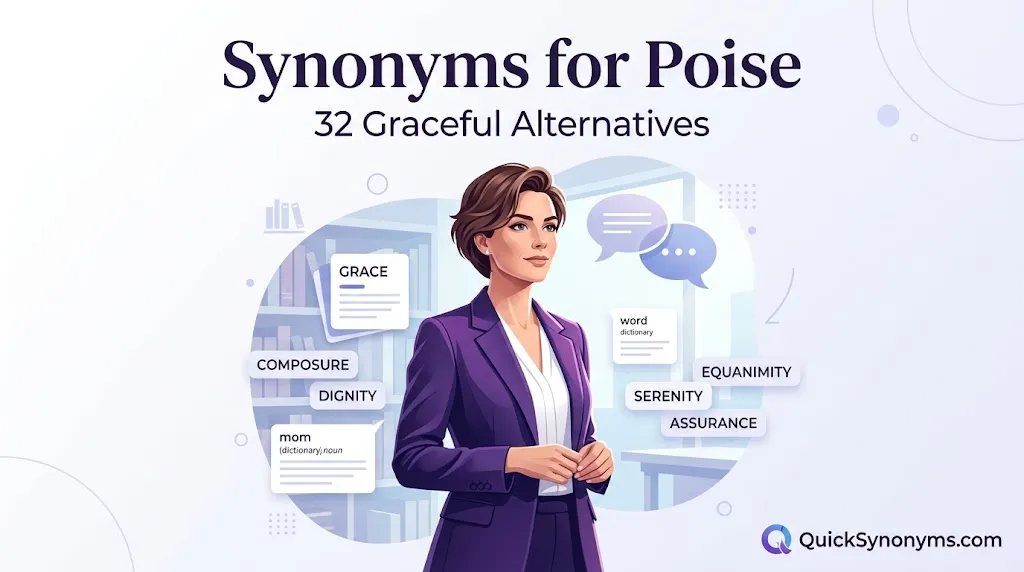
Poise means calm confidence, self-control, and graceful behavior.
Imagine a student giving a speech after forgetting one line. Instead of panicking, she pauses, smiles, and continues with confidence.
We can say that she handled the moment with poise.
The word is common when we describe someone who stays calm under pressure or moves with grace and control.
Learning synonyms for poise helps English learners express ideas more clearly.
It also helps content writers avoid repeating the same word in essays, articles, speeches, and professional writing.
In this guide, we explore the meaning of poise and 32 useful synonyms.
You will also learn their examples, grammar, history, pronunciation, word formation, and semantic categories.
This makes it easier to choose the right alternative for each situation.
Meaning of Poise
Definition
Poise (Noun):
Poise means a calm, confident, and controlled way of behaving.
It can also mean graceful balance in the way someone stands or moves.
Poise (Verb):
As a verb, poise means to balance or hold something steadily.
It can also mean being ready for an action.
Examples
- She answered the difficult questions with poise.
- The dancer moved across the stage with natural poise.
Connotative Meaning
(Connotation: the feeling or idea that a word suggests beyond its basic meaning.)
- Positive tone: Poise usually suggests confidence, maturity, grace, dignity, and self-control.
- Negative tone: In some contexts, excessive poise may suggest stiffness or emotional distance.
- Neutral tone: It can simply describe physical balance or controlled movement.
Etymology
The history of poise is linked to ideas of weight and balance.
The word entered English through French and later developed several related meanings.
Old English (450–1100)
There was no direct English form of poise in Old English.
The word entered English at a later period through French.
Middle English (1100–1500)
Poise developed from Middle English forms related to words meaning “weight.”
These forms came through Old French and were connected to the Latin word pensum, meaning “weight” or “something weighed.”
Modern English (1500–Present)
The meaning gradually expanded.
It moved from physical weight and balance to ideas such as calmness, confidence, self-control, and graceful behavior.
The verb also developed meanings related to balancing something and being ready for action.
Pronunciation (IPA)
- IPA: /pɔɪz/
- Syllables: poise
The word has one syllable.
It has the same common pronunciation in British and American English.
Affixation Pattern of Poise
- Root: poise
- Prefix: None
- Suffix: None
Word Formations
- poise: noun, verb
- poised: adjective, past participle
- poising: present participle, gerund
- poises: third-person singular verb form
These are mainly grammatical forms of the same word.
32 Synonyms of Poise With Meaning & Examples
1. Composure (Noun)
Meaning: A calm state of mind, especially during a difficult situation.
Examples:
- She maintained her composure during the interview.
- He lost his composure during the argument.
2. Self-Possession (Noun)
Meaning: The ability to remain calm and in control of yourself.
Examples:
- Her self-possession impressed the entire team.
- He showed remarkable self-possession under pressure.
3. Self-Control (Noun)
Meaning: The ability to control your emotions and actions.
Examples:
- Good self-control helped him stay calm.
- She showed great self-control during the debate.
4. Self-Command (Noun)
Meaning: Strong control over your feelings and behavior.
Examples:
- His self-command was impressive during the crisis.
- She answered with complete self-command.
5. Equanimity (Noun)
Meaning: A calm and balanced state of mind.
Examples:
- She accepted the criticism with equanimity.
- He faced the loss with equanimity.
6. Aplomb (Noun)
Meaning: Great confidence and calmness in a difficult situation.
Examples:
- She handled the presentation with aplomb.
- He dealt with the complaint with professional aplomb.
7. Assurance (Noun)
Meaning: Confident behavior that shows trust in your abilities.
Examples:
- She spoke with great assurance.
- His assurance made the audience comfortable.
8. Self-Assurance (Noun)
Meaning: Strong confidence in your own abilities and judgment.
Examples:
- Her self-assurance grew with experience.
- He answered with quiet self-assurance.
9. Confidence (Noun)
Meaning: A strong belief in your abilities or decisions.
Examples:
- She spoke with confidence during the meeting.
- His confidence helped him perform well.
10. Calmness (Noun)
Meaning: The quality of being peaceful and not easily upset.
Examples:
- Her calmness helped everyone relax.
- He showed remarkable calmness during the emergency.
11. Serenity (Noun)
Meaning: A peaceful and calm state of mind.
Examples:
- She faced the challenge with serenity.
- His serenity was noticeable during stressful moments.
12. Sang-Froid (Noun)
Meaning: Calm self-control during an exciting or stressful situation.
Examples:
- The pilot showed impressive sang-froid.
- She handled the crisis with remarkable sang-froid.
13. Coolness (Noun)
Meaning: Calm control when facing pressure or danger.
Examples:
- His coolness impressed his teammates.
- She kept her coolness during the argument.
14. Presence of Mind (Noun Phrase)
Meaning: The ability to think clearly during a sudden problem.
Examples:
- His presence of mind prevented an accident.
- She showed great presence of mind during the emergency.
15. Dignity (Noun)
Meaning: A calm and respectable manner that shows self-respect.
Examples:
- She accepted the decision with dignity.
- He maintained his dignity throughout the dispute.
16. Bearing (Noun)
Meaning: The way a person carries themselves with confidence or grace.
Examples:
- Her confident bearing attracted attention.
- The officer had a professional bearing.
17. Grace (Noun)
Meaning: Smooth, attractive, and controlled movement or behavior.
Examples:
- The dancer moved with grace.
- She accepted the criticism with grace.
18. Elegance (Noun)
Meaning: A refined and attractive quality in appearance or behavior.
Examples:
- She walked with natural elegance.
- His speech had simplicity and elegance.
19. Refinement (Noun)
Meaning: A polished and sophisticated quality in behavior or appearance.
Examples:
- Her manners showed great refinement.
- The speaker presented his ideas with refinement.
20. Polish (Noun)
Meaning: A smooth, practiced, and professional quality.
Examples:
- Her presentation had impressive polish.
- Practice gave his performance professional polish.
21. Carriage (Noun)
Meaning: The way someone holds and moves their body.
Examples:
- Her upright carriage gave her a graceful appearance.
- The dancer had excellent carriage.
22. Balance (Noun)
Meaning: A stable and controlled physical or mental state.
Examples:
- The gymnast showed excellent balance.
- She maintained emotional balance during the crisis.
23. Equilibrium (Noun)
Meaning: A state of physical or emotional balance and stability.
Examples:
- He worked to regain his emotional equilibrium.
- Meditation helped her maintain equilibrium.
24. Stability (Noun)
Meaning: The quality of remaining steady, calm, or controlled.
Examples:
- His emotional stability helped him manage stress.
- The team needed mental stability to succeed.
25. Steadiness (Noun)
Meaning: The quality of being firm, calm, and consistent.
Examples:
- Her steadiness gave the team confidence.
- He showed great steadiness under pressure.
26. Self-Mastery (Noun)
Meaning: Strong control over your emotions, thoughts, and behavior.
Examples:
- Meditation can improve self-mastery.
- His self-mastery helped him remain calm.
27. Level-Headedness (Noun)
Meaning: The ability to think calmly and sensibly.
Examples:
- Her level-headedness helped solve the problem.
- His level-headedness was valuable during the crisis.
28. Tranquility (Noun)
Meaning: A peaceful and undisturbed state.
Examples:
- The quiet setting gave her a sense of tranquility.
- He maintained inner tranquility during the difficult period.
29. Control (Noun)
Meaning: The ability to manage your feelings, actions, or reactions.
Examples:
- She kept control of her emotions.
- His control during the match was impressive.
30. Decorum (Noun)
Meaning: Proper and respectful behavior in a social or formal setting.
Examples:
- The guests maintained decorum during the ceremony.
- Professional decorum is important in the workplace.
31. Assuredness (Noun)
Meaning: A strong and confident manner.
Examples:
- Her assuredness made her speech convincing.
- He answered with quiet assuredness.
32. Self-Confidence (Noun)
Meaning: Belief in your own abilities and worth.
Examples:
- Practice helped build her self-confidence.
- His self-confidence was clear during the presentation.
Prototype Meaning
The most typical meaning of poise is calm confidence and self-control.
When people hear this word, they often imagine someone who remains relaxed and confident under pressure.
A poised person does not easily panic or lose control.
The word can also describe graceful physical movement and balance.
Prototype Categorization
- Calmness and Composure: Composure, calmness, serenity, tranquility, sang-froid, and coolness describe emotional calm.
- Confidence and Assurance: Confidence, assurance, self-assurance, self-confidence, assuredness, and aplomb focus on confidence.
- Self-Control: Self-possession, self-control, self-command, self-mastery, level-headedness, and control emphasize emotional control.
- Balance and Stability: Balance, equilibrium, stability, and steadiness describe mental, emotional, or physical stability.
- Graceful Bearing: Bearing, grace, elegance, refinement, polish, and carriage focus on movement and appearance.
- Dignified Behavior: Dignity, decorum, and presence of mind describe respectable and sensible behavior.
This categorization helps writers choose the closest synonym for each situation.
For example, confidence focuses on belief in yourself.
Composure is better when the main idea is staying calm under pressure.
Grace works well when attractive movement or behavior is important.
Antonyms of Poise
- Agitation (Noun): A state of nervousness or emotional disturbance.
- Anxiety (Noun): A feeling of worry or nervousness.
- Nervousness (Noun): A state of fear or uneasiness.
- Insecurity (Noun): Lack of confidence in yourself or your abilities.
- Instability (Noun): Lack of emotional, mental, or physical steadiness.
- Panic (Noun): Sudden and extreme fear that makes clear thinking difficult.
- Awkwardness (Noun): Lack of ease or confidence in behavior or movement.
- Impulsiveness (Noun): Acting quickly without enough thought or control.
- Discomposure (Noun): Loss of calmness or self-control.
Short Questions and Answers
What does poise mean?
Poise means calm confidence, self-control, and graceful behavior.
It can also describe physical balance and controlled movement.
When should poise be used?
Use poise when describing someone who stays calm and confident under pressure.
It can also describe graceful posture, movement, or bearing.
Is poise positive or negative?
Poise is usually positive.
It often suggests confidence, maturity, dignity, calmness, and grace.
However, context can make it sound slightly negative if someone appears overly controlled or distant.
How is it different from similar words?
Poise combines calmness, confidence, and controlled behavior.
Confidence focuses more on belief in oneself.
Composure focuses more on staying calm.
Grace often focuses on attractive movement or behavior.
Conclusion
Learning poise and its synonyms gives English learners more ways to describe confidence, calmness, balance, and graceful behavior.
Instead of using the same word repeatedly, you can choose a more exact term for each situation.
For example, composure works well for calmness under pressure.
Confidence highlights belief in ability.
Grace emphasizes attractive movement or behavior.
Words such as aplomb, equanimity, self-possession, dignity, and self-control can make your writing more precise.
Regular vocabulary practice is an easy way to improve English confidence.
Try learning a few synonyms each day and use them in your own sentences.
Read articles and listen to English conversations to see how words change across different situations.
Keep a small vocabulary list and review it often.
Over time, your vocabulary will become richer and more flexible.
You will speak more naturally, write with less repetition, and choose stronger words with confidence.
More Useful Words: Synonyms for Dark brown: 32 Rich Color Alternatives

Content Editor & Language Researcher
Daniel Foster specializes in editing educational content and researching English language topics. He is committed to creating well-structured, reader-friendly articles that make learning easier.









1 thought on “Synonyms for Poise: 32 Graceful Alternatives”