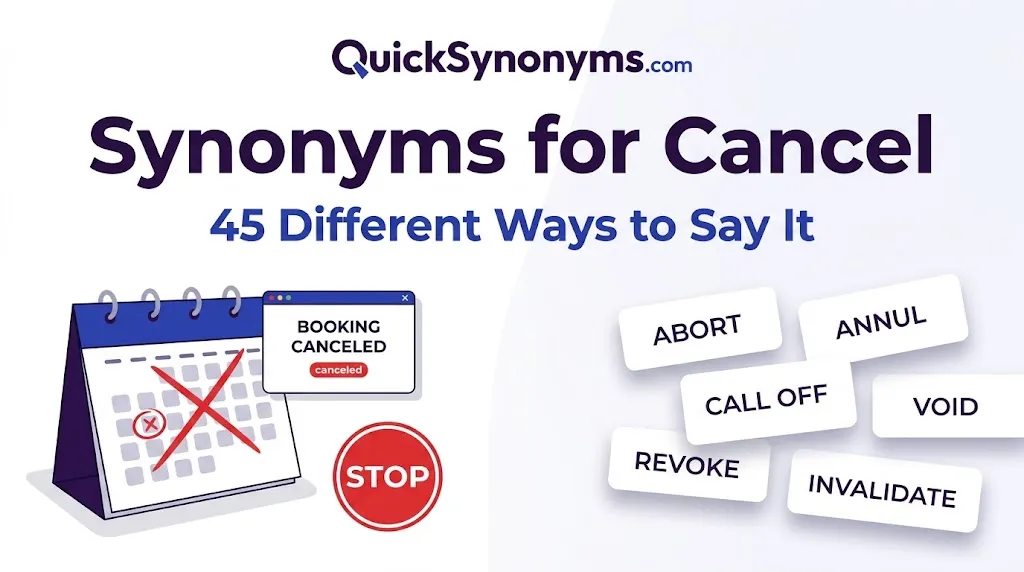
Cancel means to stop something that was planned, arranged, or expected to happen. For example, imagine you planned dinner with a friend, but an urgent task comes up. You may call your friend and say, “I need to cancel our dinner.” The word is common in daily English because plans, events, orders, subscriptions, and appointments can all be canceled.
Learning synonyms for cancel helps English learners use more precise words. It also helps writers avoid repeating the same word in every sentence. Some alternatives sound formal, while others are better for business, travel, events, or casual speech. In this guide, you will learn the meaning, examples, pronunciation, history, grammar, and semantic categories of 45 useful alternatives to cancel.
Meaning of Cancel
Definition
Cancel (Verb):
To decide that something planned, arranged, or scheduled will not happen.
Examples
- We had to cancel the meeting because of bad weather.
- She decided to cancel her hotel reservation.
Connotative Meaning
Connotation: The feeling or idea a word suggests beyond its basic meaning.
- Positive tone: Can suggest avoiding something unwanted or stopping a bad plan.
- Negative tone: May suggest disappointment, loss, or inconvenience.
- Neutral tone: Simply means stopping or ending a planned action.
Etymology
The word cancel comes from Latin cancellare, meaning “to make like a lattice” or “to cross out.” It developed through Old French and entered English in the Middle Ages.
- Old English (450–1100): The modern word was not commonly used in English during this period.
- Middle English (1100–1500): Cancel entered English through Anglo-French and Old French, with the sense of crossing out or annulling.
- Modern English (1500–Present): The word developed its current meanings, including stopping plans, agreements, orders, events, and services.
Pronunciation (IPA)
- IPA: /ˈkæn.səl/
- Syllables: can-cel
Affixation Pattern of Cancel
- Root: cancel
- Prefix: None
- Suffix: None in the basic word
- Word formations:
- cancel – verb
- cancels – verb
- canceled – verb/adjective
- cancelled – verb/adjective
- canceling – verb
- cancelling – verb
- cancellation – noun
- cancellable – adjective
- cancellation fee – noun phrase
45 Synonyms of Cancel With Meaning & Examples
1. Abandon (Verb)
Meaning: To stop a planned activity or decision completely.
Examples:
- They decided to abandon the project.
- The team abandoned its original plan.
2. Call off (Phrasal Verb)
Meaning: To stop or cancel something that was planned.
Examples:
- They called off the wedding.
- We called off the meeting.
3. Annul (Verb)
Meaning: To officially declare an agreement or legal arrangement invalid.
Examples:
- The court annulled the contract.
- The marriage was annulled by the court.
4. Revoke (Verb)
Meaning: To officially take back permission, an offer, or a decision.
Examples:
- The company revoked his membership.
- His license was revoked.
5. Rescind (Verb)
Meaning: To officially cancel or withdraw a decision or agreement.
Examples:
- The company rescinded the offer.
- They decided to rescind the agreement.
6. Withdraw (Verb)
Meaning: To remove or take back something previously offered or planned.
Examples:
- She withdrew her application.
- The company withdrew its proposal.
7. Repeal (Verb)
Meaning: To officially cancel a law or rule.
Examples:
- Parliament repealed the old law.
- The government plans to repeal the regulation.
8. Abrogate (Verb)
Meaning: To officially end or cancel a law, agreement, or duty.
Examples:
- The country abrogated the treaty.
- The agreement was abrogated after the dispute.
9. Invalidate (Verb)
Meaning: To make something no longer legally or officially valid.
Examples:
- The error invalidated the contract.
- The court invalidated the agreement.
10. Void (Verb)
Meaning: To make an agreement or transaction legally ineffective.
Examples:
- The court voided the contract.
- The company voided the transaction.
11. Nullify (Verb)
Meaning: To make something have no legal or practical effect.
Examples:
- The ruling nullified the agreement.
- The new rule nullified the previous decision.
12. Terminate (Verb)
Meaning: To officially end something.
Examples:
- The company terminated the contract.
- They terminated the service.
13. Discontinue (Verb)
Meaning: To stop providing, producing, or doing something.
Examples:
- The store discontinued the product.
- They discontinued the service.
14. Suspend (Verb)
Meaning: To temporarily stop something.
Examples:
- The school suspended the event.
- The company suspended the service.
15. Halt (Verb)
Meaning: To stop something from continuing.
Examples:
- The storm halted the flight.
- They halted production.
16. Stop (Verb)
Meaning: To prevent an activity from continuing or happening.
Examples:
- Please stop the delivery.
- They stopped the event.
17. End (Verb)
Meaning: To bring something to a finish.
Examples:
- They decided to end the agreement.
- The company ended the program.
18. Cease (Verb)
Meaning: To stop doing something.
Examples:
- The factory ceased operations.
- They ceased negotiations.
19. Drop (Verb)
Meaning: To stop pursuing an idea, plan, or activity.
Examples:
- She dropped the plan.
- The team dropped the proposal.
20. Scrap (Verb)
Meaning: To abandon or get rid of a plan or project.
Examples:
- They scrapped the old design.
- The company scrapped the project.
21. Abolish (Verb)
Meaning: To officially end a system, practice, or institution.
Examples:
- The government abolished the tax.
- The country abolished the old system.
22. Eliminate (Verb)
Meaning: To remove or get rid of something completely.
Examples:
- They eliminated unnecessary steps.
- The company eliminated the extra fee.
23. Remove (Verb)
Meaning: To take something away from a plan, list, or arrangement.
Examples:
- Please remove my name from the list.
- They removed the event from the schedule.
24. Retract (Verb)
Meaning: To take back a statement, offer, or claim.
Examples:
- He retracted his statement.
- The company retracted the offer.
25. Reverse (Verb)
Meaning: To change a decision or action back to an earlier state.
Examples:
- The manager reversed the decision.
- They reversed the policy.
26. Countermand (Verb)
Meaning: To officially cancel an earlier order or instruction.
Examples:
- The officer countermanded the order.
- The manager countermanded the previous instruction.
27. Override (Verb)
Meaning: To reject or cancel a previous decision or instruction.
Examples:
- The manager overrode the original decision.
- The new rule overrides the old one.
28. Break off (Phrasal Verb)
Meaning: To end an activity, relationship, or discussion suddenly.
Examples:
- They broke off the negotiations.
- She broke off the engagement.
29. Call in (Phrasal Verb)
Meaning: To officially withdraw or cancel something previously issued.
Examples:
- The company called in the old notices.
- The manufacturer called in the defective products.
30. Renounce (Verb)
Meaning: To formally give up or reject something.
Examples:
- He renounced his claim.
- She renounced her membership.
31. Relinquish (Verb)
Meaning: To voluntarily give up a right, claim, or position.
Examples:
- He relinquished his position.
- The owner relinquished control of the company.
32. Forego (Verb)
Meaning: To choose not to have or do something.
Examples:
- We decided to forego the trip.
- She forewent the planned celebration.
33. Forfeit (Verb)
Meaning: To lose or give up something because of an action or condition.
Examples:
- He forfeited his reservation.
- They forfeited their right to participate.
34. Abjure (Verb)
Meaning: To formally reject or give up something.
Examples:
- He abjured his former beliefs.
- The leader abjured the agreement.
35. Disavow (Verb)
Meaning: To reject or deny responsibility for something.
Examples:
- The group disavowed the statement.
- She disavowed the decision.
36. Disown (Verb)
Meaning: To reject or refuse to accept something as one’s own.
Examples:
- The organization disowned the proposal.
- He disowned the controversial plan.
37. Discharge (Verb)
Meaning: To release someone from an obligation or duty.
Examples:
- The court discharged him from the agreement.
- The payment discharged the debt.
38. Dissolve (Verb)
Meaning: To officially end an organization, partnership, or agreement.
Examples:
- They dissolved the partnership.
- The board dissolved the committee.
39. Invalidate (Verb)
Meaning: To make something officially ineffective or unusable.
Examples:
- The mistake invalidated the ticket.
- The court invalidated the claim.
40. Negate (Verb)
Meaning: To cancel the effect of something.
Examples:
- The new evidence negated his argument.
- The mistake negated the benefits.
41. Neutralize (Verb)
Meaning: To make something ineffective or unable to produce an effect.
Examples:
- The new measure neutralized the threat.
- The changes neutralized the earlier advantage.
42. Deactivate (Verb)
Meaning: To stop a service, account, device, or feature from operating.
Examples:
- She deactivated her account.
- The company deactivated the old system.
43. Unsubscribe (Verb)
Meaning: To stop receiving a service, newsletter, or subscription.
Examples:
- I decided to unsubscribe from the newsletter.
- She unsubscribed from the service.
44. Withdraw from (Phrasal Verb)
Meaning: To stop participating in an activity, agreement, or event.
Examples:
- The team withdrew from the competition.
- He withdrew from the agreement.
45. Call a halt to (Phrase)
Meaning: To officially or firmly stop an activity.
Examples:
- The manager called a halt to the project.
- Officials called a halt to the construction.
Prototype Meaning
The most typical meaning of cancel is to stop something that was planned or arranged before it happens. When people hear cancel, they often imagine an appointment, meeting, trip, event, order, or reservation that will no longer take place. The word can also mean ending a service or agreement.
Prototype Categorization
The 45 alternatives can be grouped by their most common meanings:
- Plans and Events: call off, abandon, drop, scrap, stop, end, halt, call a halt to
- Contracts and Legal Decisions: annul, rescind, revoke, repeal, abrogate, invalidate, void, nullify, terminate, dissolve
- Services and Subscriptions: discontinue, deactivate, unsubscribe, suspend
- Offers and Statements: withdraw, retract, renounce, disavow
- Rules and Official Decisions: repeal, override, countermand, abolish, reverse
- Giving Something Up: relinquish, forego, forfeit, abjure, withdraw from
- Making Something Ineffective: negate, neutralize, eliminate, invalidate
This grouping helps writers choose the right word. For example, call off works well for events, while revoke is better for official permissions. Rescind suits formal agreements, and unsubscribe is specific to subscriptions.
Antonyms of Cancel
1. Continue (Verb)
Meaning: To keep doing something without stopping.
2. Confirm (Verb)
Meaning: To say that an arrangement or plan will happen.
3. Approve (Verb)
Meaning: To officially accept or agree to something.
4. Authorize (Verb)
Meaning: To give official permission for something.
5. Schedule (Verb)
Meaning: To arrange something for a particular time.
6. Arrange (Verb)
Meaning: To organize something so it can happen.
7. Maintain (Verb)
Meaning: To keep something in its existing state.
8. Renew (Verb)
Meaning: To continue an agreement, service, or arrangement for another period.
Short Questions and Answers
What does cancel mean?
Cancel means to stop something planned, scheduled, arranged, or expected to happen.
When should cancel be used?
Use cancel when you decide that a planned event, appointment, order, trip, service, or arrangement will not happen.
Is cancel positive or negative?
Cancel is usually neutral, but it can have a negative feeling when it causes disappointment or inconvenience.
How is it different from similar words?
Cancel is a general word. More specific alternatives include revoke for permission, repeal for laws, rescind for agreements, and unsubscribe for subscriptions.
Conclusion
Learning synonyms for cancel can make your English clearer and more flexible. Instead of using the same word repeatedly, you can choose alternatives that match the exact situation. For example, you can call off a meeting, revoke a license, rescind an agreement, or unsubscribe from a newsletter. These small differences can make your writing sound more natural and precise.
Regular vocabulary practice also improves speaking and writing confidence. Try learning a few alternatives each day and use them in your own sentences. Understanding their meanings and contexts is more useful than simply memorizing a long list. With practice, you will know when to use cancel and when a stronger or more specific alternative is better.
More Useful Words: Synonyms for Resulted: 46 Powerful Alternatives

English Teacher & Linguistics Writer
Grace Whitmore creates engaging educational content on vocabulary, word usage, and effective communication. Her goal is to help learners build confidence through clear and practical English guidance.






1 thought on “Synonyms for Cancel: 45 Different Ways to Say It”