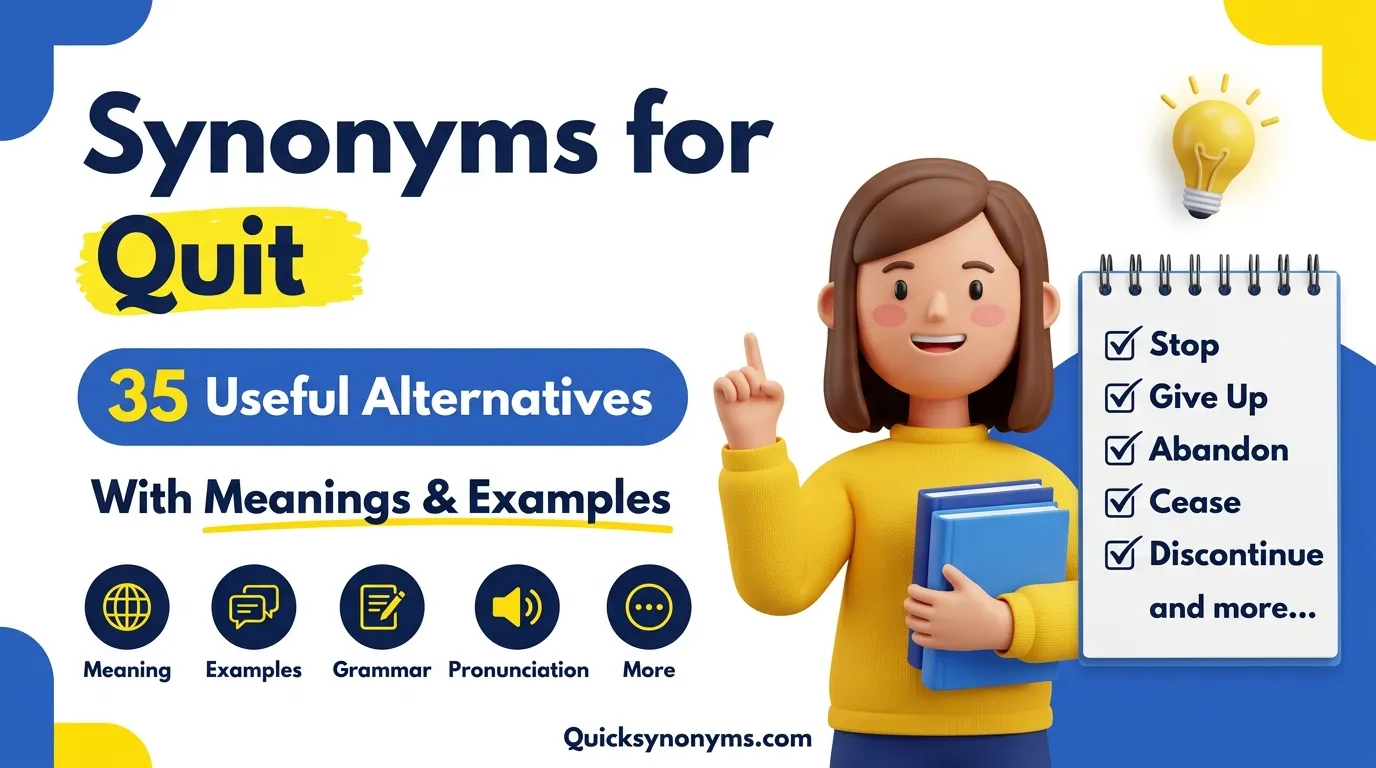
Quit means to stop doing something, leave a place, or give up a job or activity. For example, you may quit a job, quit smoking, or quit a game when you decide to stop. The word is common because it works in many everyday situations.
Learning synonyms for quit helps English learners choose words that match the exact situation. Writers can also use these words to make essays, emails, reports, and conversations clearer.
This guide covers the meaning of quit, examples, grammar, history, pronunciation, and 35 useful synonyms. It also groups the words by meaning so you can understand their small differences.
Meaning of Quit
Definition
Quit (verb): to stop doing something or leave a job, place, or activity.
Examples
- She decided to quit her job.
- He quit smoking last year.
Connotative Meaning
- Positive tone: can suggest making a healthy or useful change.
- Negative tone: can suggest giving up too soon or failing to continue.
- Neutral tone: simply means stopping or leaving something.
Etymology
The word quit came into English from Anglo-French and Old French forms related to being free, released, or discharged. Its meaning later developed to include leaving, stopping, or giving up.
- Old English (450 to 1100): Not applicable.
- Middle English (1100 to 1500): Quit entered English through Anglo-French and Old French forms such as quiter and quitter, linked to the idea of freeing or releasing.
- Modern English (1500 to present): The word developed its common meanings of leaving, stopping, and giving up.
Pronunciation (IPA)
- IPA: /kwɪt/
- Syllables: quit
Affixation Pattern of Quit
- Root: quit
- Prefix: None
- Suffix: None
- Word formations:
- Quit: verb
- Quits: verb
- Quit: past tense and past participle
- Quitting: present participle
- Quitter: noun
35 Synonyms of Quit: With Meaning and Examples
1. Stop (verb)
Meaning: To end an action or activity.
Examples:
- Please stop talking during the test.
- He stopped working late at night.
2. Give up (verb)
Meaning: To stop trying or stop doing something.
Examples:
- She gave up smoking.
- Never give up on your goals.
3. Abandon (verb)
Meaning: To leave something or stop supporting it completely.
Examples:
- They abandoned the old plan.
- He abandoned his search after several hours.
4. Cease (verb)
Meaning: To stop something completely.
Examples:
- The noise finally ceased.
- The company ceased production last year.
5. Discontinue (verb)
Meaning: To stop doing or providing something.
Examples:
- The store discontinued the product.
- She discontinued the treatment after speaking with her doctor.
6. Desist (verb)
Meaning: To stop doing something, especially after being asked.
Examples:
- The officer told them to desist.
- Please desist from making false claims.
7. Halt (verb)
Meaning: To stop something, often suddenly.
Examples:
- The company halted construction.
- Heavy rain halted the match.
8. End (verb)
Meaning: To bring something to a stop.
Examples:
- They ended the meeting early.
- She ended the discussion politely.
9. Terminate (verb)
Meaning: To officially end something.
Examples:
- The company terminated the contract.
- They terminated the agreement last month.
10. Resign (verb)
Meaning: To officially leave a job or position.
Examples:
- She resigned from her position.
- He resigned after five years with the company.
11. Leave (verb)
Meaning: To go away from a place, job, or activity.
Examples:
- She left her job in June.
- He left the team after the season.
12. Depart (verb)
Meaning: To leave a place or situation.
Examples:
- The guests departed early.
- She departed from the company after ten years.
13. Withdraw (verb)
Meaning: To remove yourself from an activity, group, or situation.
Examples:
- He withdrew from the competition.
- She withdrew from the course.
14. Retire (verb)
Meaning: To stop working permanently, usually because of age or choice.
Examples:
- My father retired at sixty-five.
- She retired from teaching last year.
15. Surrender (verb)
Meaning: To stop resisting or trying to continue.
Examples:
- He surrendered after hours of fighting.
- She surrendered her claim to the property.
16. Relinquish (verb)
Meaning: To voluntarily give up something you have or control.
Examples:
- He relinquished control of the company.
- She relinquished her position on the board.
17. Renounce (verb)
Meaning: To formally give up a belief, claim, or right.
Examples:
- He renounced his claim to the title.
- She renounced her former position.
18. Forsake (verb)
Meaning: To leave or give up something completely.
Examples:
- He forsook his old habits.
- She refused to forsake her principles.
19. Forgo (verb)
Meaning: To choose not to have or do something.
Examples:
- She decided to forgo dessert.
- He chose to forgo the trip.
20. Drop (verb)
Meaning: To stop doing something or leave an activity.
Examples:
- He dropped the course.
- She dropped the project after several problems.
21. Scrap (verb)
Meaning: To stop using or planning something.
Examples:
- They scrapped the old design.
- The team scrapped its original plan.
22. Cancel (verb)
Meaning: To stop something that was planned or arranged.
Examples:
- They canceled the event.
- She canceled her membership.
23. Suspend (verb)
Meaning: To stop something for a time.
Examples:
- The school suspended the program.
- They suspended the service during repairs.
24. Break off (verb)
Meaning: To suddenly end an activity or relationship.
Examples:
- They broke off the discussion.
- She broke off negotiations.
25. Walk away (verb)
Meaning: To leave a situation or stop trying to deal with it.
Examples:
- He walked away from the deal.
- She decided to walk away from the argument.
26. Pull out (verb)
Meaning: To leave or withdraw from an activity or agreement.
Examples:
- The company pulled out of the project.
- He pulled out of the race.
27. Bow out (verb)
Meaning: To leave an activity, position, or competition willingly.
Examples:
- The actor decided to bow out of the show.
- She bowed out of the competition.
28. Back out (verb)
Meaning: To decide not to do something you previously agreed to do.
Examples:
- He backed out of the agreement.
- She backed out at the last minute.
29. Yield (verb)
Meaning: To stop resisting or give way.
Examples:
- The team finally yielded to pressure.
- He refused to yield during the debate.
30. Vacate (verb)
Meaning: To leave a place, position, or property.
Examples:
- The tenants must vacate the building.
- She vacated her position as manager.
31. Desert (verb)
Meaning: To leave someone or something when you should stay.
Examples:
- The soldier deserted his post.
- He deserted his responsibilities.
32. Relinquish (verb)
Meaning: To give up control, possession, or responsibility.
Examples:
- She relinquished control of the project.
- He relinquished his rights to the property.
33. Abdicate (verb)
Meaning: To give up an important position or responsibility.
Examples:
- The king abdicated the throne.
- He refused to abdicate his responsibilities.
34. Refrain (verb)
Meaning: To deliberately stop yourself from doing something.
Examples:
- Please refrain from using your phone.
- She refrained from making a comment.
35. Conclude (verb)
Meaning: To bring an activity, event, or process to an end.
Examples:
- The speaker concluded the meeting.
- They concluded the discussion after an hour.
Prototype Meaning
The most typical meaning of quit is to stop doing something or to leave something behind. People often use it when talking about jobs, habits, activities, sports, or efforts they no longer want to continue.
Prototype Categorization
- General stopping: stop, cease, discontinue, desist, halt, end, terminate. Use these when an action, process, or activity comes to an end.
- Giving up: give up, abandon, forsake, forgo, drop, relinquish, renounce. Use these when someone decides not to continue or gives something up.
- Leaving a job or position: resign, leave, depart, retire, vacate, abdicate. Use these when someone leaves work, a position, or an important role.
- Leaving an activity: withdraw, pull out, bow out, back out, walk away, desert. Use these when someone leaves a competition, plan, agreement, or situation.
- Ending plans or arrangements: scrap, cancel, suspend, break off, conclude. Use these when plans, services, discussions, or activities are ended.
- Stopping resistance: surrender, yield. Use these when someone stops resisting or accepts that they cannot continue.
Grouping synonyms helps you choose a word that fits the exact situation. It also makes it easier to remember the differences between similar words.
Antonyms of Quit
- Continue (verb): to keep doing something.
- Persist (verb): to continue despite difficulty.
- Remain (verb): to stay in a place or situation.
- Maintain (verb): to keep something going.
- Resume (verb): to start again after stopping.
- Begin (verb): to start doing something.
- Persevere (verb): to keep trying despite problems.
- Stay (verb): to continue being in a place or situation.
Short Questions and Answers
What does Quit mean?
Quit means to stop doing something, leave a place or job, or give up an activity.
When should Quit be used?
Use quit in everyday English when someone stops an activity, leaves a job, or gives up a habit or effort.
Is Quit positive or negative?
Quit can be positive or negative depending on the situation. Quitting a harmful habit can be positive, while quitting a goal too early may be viewed negatively.
How is it different from similar words?
Stop is the most general word for ending an action. Resign is mainly used for leaving a job or position. Abandon suggests leaving something completely and often has a stronger negative feeling.
Conclusion
Learning quit and its synonyms gives you more ways to describe stopping, leaving, or giving something up. Words such as cease, resign, withdraw, and abandon have different uses and can make your meaning more exact.
These synonyms are useful in everyday speech, essays, work emails, and professional writing. Choosing the right word can make your English clearer and help you avoid repeating quit too often.
Try learning one new synonym each day. Write a simple sentence with it and use it in real conversations or writing. Regular practice can build stronger vocabulary and greater English confidence.
Keep Reading: Synonyms for Belittle: 40 Powerful Words

English Teacher & Linguistics Writer
Grace Whitmore creates engaging educational content on vocabulary, word usage, and effective communication. Her goal is to help learners build confidence through clear and practical English guidance.