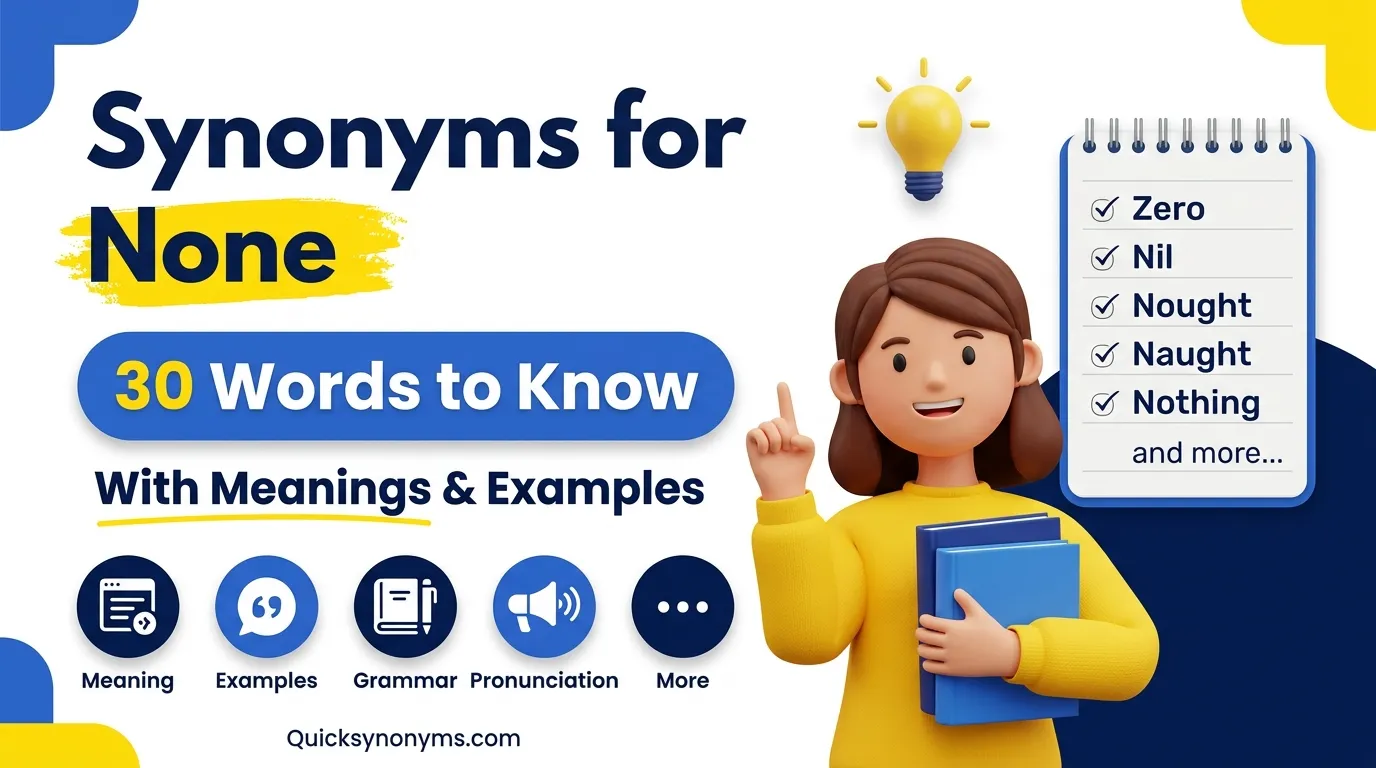
None means not one or not any of a group. You may use it when someone asks how many items are left and there are no items left. It is common in everyday English because it gives a short, clear answer.
For example, a teacher may ask, “How many students are absent?” A student may answer, “None.” Learning synonyms for none helps English learners understand small differences in meaning, tone, and context.
Writers can also use related words to avoid repeating the same expression. This article covers the meaning, examples, grammar, history, pronunciation, and semantic groups of words related to none.
Meaning of None
Definition
None (pronoun): not one or not any of a group.
Examples
- None of the students were late.
- I asked for cookies, but there were none left.
Connotative Meaning
- Positive tone: Can suggest that nothing is missing or unwanted.
- Negative tone: Can suggest a complete lack or absence.
- Neutral tone: Simply means not one or not any.
Etymology
The word none comes from Old English nān, meaning “not one” or “not any.” It developed from the combination of a negative element and ān, meaning “one.”
- Old English (450 to 1100): Nān meant “not one” or “not any.”
- Middle English (1100 to 1500): The form developed into non and none.
- Modern English (1500 to present): None became the common modern form meaning “not one” or “not any.”
Pronunciation (IPA)
- IPA: /nʌn/
- Syllables: none
Affixation Pattern of None
- Root: one
- Prefix: no or negative element from the historical form
- Suffix: None
- Word formations:
- none: pronoun
- none: determiner in phrases such as “none of them”
- none: adverb in expressions such as “none too happy”
30 Synonyms of None: With Meaning and Examples
1. Zero (noun)
Meaning: A quantity of nothing.
Examples:
- The final score was zero.
- We have zero tickets left.
2. Nil (noun)
Meaning: Nothing or zero, especially in numbers or scores.
Examples:
- The team won two nil.
- The number of errors was nil.
3. Nought (noun)
Meaning: The number zero, mainly in British English.
Examples:
- The temperature fell to nought.
- He scored nought points.
4. Naught (noun)
Meaning: Nothing or zero.
Examples:
- The effort came to naught.
- He had naught to show for his work.
5. Nothing (pronoun)
Meaning: Not anything.
Examples:
- Nothing was found in the box.
- There was nothing on the table.
6. Nobody (pronoun)
Meaning: No person.
Examples:
- Nobody answered the door.
- Nobody knew the answer.
7. Neither (pronoun)
Meaning: Not one of two people or things.
Examples:
- Neither was ready to leave.
- Neither of the answers was correct.
8. No (determiner)
Meaning: Not any or not one.
Examples:
- No students were absent.
- There were no tickets left.
9. Not any (determiner phrase)
Meaning: Zero of a group or amount.
Examples:
- There were not any chairs left.
- I have not any money with me.
10. Not one (pronoun phrase)
Meaning: Zero people or things from a group.
Examples:
- Not one person complained.
- Not one answer was correct.
11. Nada (noun)
Meaning: Nothing, used informally.
Examples:
- We found nada in the old room.
- He knew nada about the topic.
12. Zilch (noun)
Meaning: Nothing or zero, used informally.
Examples:
- I earned zilch from the deal.
- She had zilch to say.
13. Zip (noun)
Meaning: Nothing or zero, used informally.
Examples:
- We received zip in donations.
- He knows zip about cars.
14. Nary (determiner)
Meaning: Not one or not any, usually in formal or old-fashioned English.
Examples:
- There was nary a sound.
- He had nary a complaint.
15. Nowt (pronoun)
Meaning: Nothing, mainly in some British dialects.
Examples:
- There was nowt in the cupboard.
- He said nowt about the problem.
16. Diddly (noun)
Meaning: Nothing or very little, in informal speech.
Examples:
- The plan earned diddly.
- He knows diddly about the subject.
17. Zilch (pronoun)
Meaning: Nothing at all, in informal English.
Examples:
- Zilch was left after lunch.
- Zilch came from the search.
18. Zero (pronoun)
Meaning: Not even one.
Examples:
- Zero were available at the time.
- Zero remained after the sale.
19. Nil (pronoun)
Meaning: Nothing or no amount.
Examples:
- Nil was found during the search.
- Nil remained after the storm.
20. Naught (pronoun)
Meaning: Nothing.
Examples:
- Naught was gained from the attempt.
- Naught remained after the fire.
21. Nought (pronoun)
Meaning: Nothing or zero.
Examples:
- Nought remained in the account.
- Nought was recorded that day.
22. Empty (adjective)
Meaning: Containing nothing.
Examples:
- The room was empty.
- The box was empty after the move.
23. Vacant (adjective)
Meaning: Empty or not occupied.
Examples:
- The seat was vacant.
- Several rooms were vacant.
24. Absent (adjective)
Meaning: Not present.
Examples:
- Two workers were absent.
- His name was absent from the list.
25. Missing (adjective)
Meaning: Not present or not found.
Examples:
- Three pages were missing.
- Several files were missing.
26. Lacking (adjective)
Meaning: Not having enough or any of something needed.
Examples:
- The plan was lacking detail.
- The room was lacking furniture.
27. Devoid (adjective)
Meaning: Completely without something.
Examples:
- The street was devoid of people.
- The box was devoid of useful items.
28. Scarce (adjective)
Meaning: Available in very small amounts.
Examples:
- Fresh water was scarce.
- Jobs were scarce that year.
29. Absentness (noun)
Meaning: The state of being absent or not present.
Examples:
- His absentness was noticed quickly.
- The absentness of noise felt strange.
30. Lack (noun)
Meaning: The absence or shortage of something.
Examples:
- There was a lack of evidence.
- The lack of food worried everyone.
Prototype Meaning
The most typical meaning of none is “not one” or “not any.” When people hear none, they usually imagine a group where the number available, present, or remaining is zero.
Prototype Categorization
- Zero or no amount: zero, nil, nought, naught, zip, zilch, nada. Use these when talking about an amount, score, or total of zero.
- No person or thing: nothing, nobody, neither, no, not any, not one. Use these when saying that no person or thing exists or applies.
- Complete absence: empty, vacant, absent, missing, lacking, devoid. Use these when something is not present or has nothing inside it.
- Very small or limited amount: scarce, lack. Use these when the meaning is closer to a shortage than a complete absence.
- Informal or dialect forms: nowt, diddly, zip, zilch, nada. Use these mainly in casual speech or informal writing.
- Formal or old-fashioned forms: nary, naught, nought. Use these when the style or context suits older or formal English.
Grouping helps writers see which words can replace none directly and which only work in certain contexts. The best choice depends on the person, amount, grammar, and tone.
Antonyms of None
- All (pronoun): Every person or thing in a group.
- Some (pronoun): An unspecified amount or number.
- Many (determiner): A large number.
- Several (determiner): More than two but not many.
- Everyone (pronoun): Every person.
- Everything (pronoun): All things.
- Each (pronoun): Every individual one in a group.
- Any (determiner): One or more from a group.
Short Questions and Answers
What does None mean?
None means not one or not any of a group.
When should None be used?
Use none when you want to say that zero people or things from a known group are involved, present, available, or remaining.
Is None positive or negative?
None is usually neutral. Its feeling depends on the situation.
How is it different from similar words?
Zero is mainly used for an amount or number. Nothing refers to no thing, while neither refers to not one of two choices.
Conclusion
Learning none and its related words helps you express absence and zero amounts more clearly. Words such as zero, nothing, nil, and neither can fit different situations and grammar patterns.
These alternatives also help writers avoid repetition and choose words that match the right tone. English learners can improve both speaking and writing by noticing how each word works in real sentences.
With regular practice, these small differences become easier to understand. Try learning a few new vocabulary words each day and use them in your own sentences to build stronger English confidence.
Explore More: Synonyms for Pristine: 30 Words to Know

Content Editor & Language Researcher
Daniel Foster specializes in editing educational content and researching English language topics. He is committed to creating well-structured, reader-friendly articles that make learning easier.