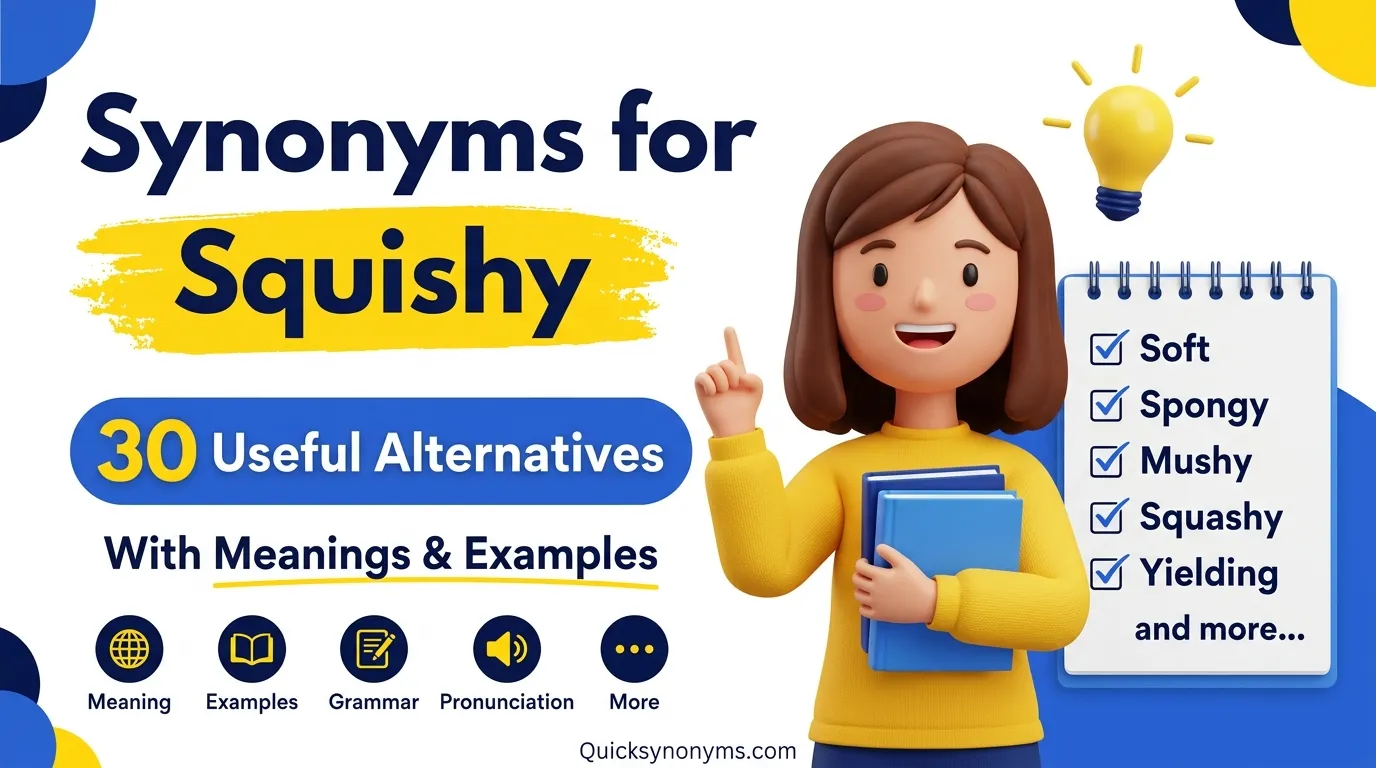
Squishy describes something soft that gives way when you press it. Think of a soft pillow, an overripe banana, or a toy that slowly returns to its shape after you squeeze it. The word is common because it makes a texture easy to picture.
Learning synonyms for squishy helps English learners describe things with more detail. It also helps writers avoid using the same word again and again. In this guide, you will learn the meaning of squishy and 30 useful synonyms. You will also see examples, grammar, word history, pronunciation, word forms, and semantic groups. This makes it easier to choose the right word for each situation.
Meaning of Squishy
Definition
Squishy (Adjective): Soft and easy to press, squeeze, crush, or shape.
It can also describe something that is unclear or not exact in some informal American uses.
Examples
- The pillow is soft and squishy.
- The banana became squishy after sitting on the counter for several days.
Connotative Meaning
Connotation: The feeling or idea a word suggests beyond its basic meaning.
- Positive tone: Soft, cozy, comfortable, or fun, such as a squishy cushion or toy.
- Negative tone: Too soft, messy, wet, or unpleasant, such as squishy fruit.
- Neutral tone: Simply describes a soft texture without showing a strong feeling.
Etymology
The word squishy is much newer than many common English words.
- Old English (450–1100): Squishy was not used in Old English.
- Middle English (1100–1500): The word was not yet part of common English. Its base is linked to later words related to squeezing and crushing.
- Modern English (1500–Present): Squishy appeared in English around the mid-1800s. It developed from squish, with the suffix -y, meaning characterized by or having the quality of something.
Pronunciation (IPA)
- IPA: /ˈskwɪʃ.i/
- Syllables: squish-y
Affixation Pattern of Squishy
- Root: squish
- Prefix: None
- Suffix: -y
Word formations
- Squish (verb): to press or squeeze something.
- Squished (verb/adjective): pressed or crushed.
- Squishing (verb): pressing or squeezing.
- Squishy (adjective): soft and easy to press.
- Squishily (adverb): in a squishy way.
- Squishiness (noun): the quality of being squishy.
30 Synonyms of Squishy, With Meaning & Examples
1. Soft (Adjective)
Meaning: Easy to press or touch because it is not hard.
Examples:
- The bread was soft and fresh.
- She bought a soft cushion for the chair.
2. Spongy (Adjective)
Meaning: Soft and springy like a sponge.
Examples:
- The mattress feels spongy.
- The cake has a light, spongy texture.
3. Mushy (Adjective)
Meaning: Very soft and often partly broken down.
Examples:
- The cooked potatoes became mushy.
- The old fruit was mushy inside.
4. Squashy (Adjective)
Meaning: Soft and easily pressed or crushed.
Examples:
- The sofa has a squashy seat.
- The ripe peach felt squashy.
5. Yielding (Adjective)
Meaning: Giving way easily when pressure is applied.
Examples:
- The soil was soft and yielding.
- The cushion has a yielding surface.
6. Compressible (Adjective)
Meaning: Able to become smaller when pressed.
Examples:
- Foam is light and compressible.
- The material is soft and compressible.
7. Pliable (Adjective)
Meaning: Easy to bend, shape, or press.
Examples:
- The clay is soft and pliable.
- The leather becomes pliable when warm.
8. Flexible (Adjective)
Meaning: Able to bend or change shape without breaking.
Examples:
- The rubber is flexible and soft.
- This material is flexible enough to bend.
9. Malleable (Adjective)
Meaning: Easy to shape or change when pressure is used.
Examples:
- Warm wax is soft and malleable.
- The clay becomes malleable with water.
10. Supple (Adjective)
Meaning: Soft and flexible rather than stiff.
Examples:
- The leather feels supple.
- The material stays soft and supple.
11. Doughy (Adjective)
Meaning: Soft and thick like uncooked dough.
Examples:
- The bread was still doughy inside.
- The mixture had a doughy texture.
12. Pulpy (Adjective)
Meaning: Soft and full of pulp or crushed material.
Examples:
- The orange became pulpy.
- The fruit had a soft, pulpy center.
13. Flabby (Adjective)
Meaning: Soft and loose rather than firm.
Examples:
- The old cushion became flabby.
- The material felt loose and flabby.
14. Limp (Adjective)
Meaning: Soft and lacking firmness or strength.
Examples:
- The wet cloth became limp.
- The leaves looked limp after the heat.
15. Floppy (Adjective)
Meaning: Soft and loose, with little stiffness.
Examples:
- The hat has a floppy brim.
- The soft toy has floppy ears.
16. Flaccid (Adjective)
Meaning: Soft and lacking firmness or tension.
Examples:
- The balloon became flaccid after losing air.
- The material felt loose and flaccid.
17. Elastic (Adjective)
Meaning: Able to stretch and return to its original shape.
Examples:
- The band is soft and elastic.
- This fabric is elastic and comfortable.
18. Springy (Adjective)
Meaning: Soft and able to bounce back after being pressed.
Examples:
- The mattress feels springy.
- The ground was soft and springy.
19. Cushiony (Adjective)
Meaning: Soft and comfortable like a cushion.
Examples:
- The chair has a cushiony seat.
- We walked across a cushiony carpet.
20. Gelatinous (Adjective)
Meaning: Soft and jelly-like.
Examples:
- The mixture became gelatinous.
- The dessert has a soft, gelatinous texture.
21. Paste-like (Adjective)
Meaning: Soft and thick like paste.
Examples:
- The mixture became paste-like.
- Add water until it has a paste-like texture.
22. Semi-solid (Adjective)
Meaning: Partly solid but still soft and able to change shape.
Examples:
- The cream becomes semi-solid when cool.
- The substance has a semi-solid texture.
23. Slushy (Adjective)
Meaning: Soft and partly liquid, often like melting ice.
Examples:
- The snow became slushy in the sun.
- The drink had a cold, slushy texture.
24. Soggy (Adjective)
Meaning: Very wet and soft because it has absorbed water.
Examples:
- The bread became soggy in the rain.
- The ground was soggy after the storm.
25. Sloppy (Adjective)
Meaning: Wet, soft, or loose in texture.
Examples:
- The mud was sloppy after the rain.
- The wet mixture became sloppy.
26. Squelchy (Adjective)
Meaning: Soft and wet, often making a sucking sound when pressed.
Examples:
- The muddy path felt squelchy.
- My shoes made a squelchy sound in the wet soil.
27. Squidgy (Adjective)
Meaning: Soft and slightly wet or easily pressed.
Examples:
- The cake felt squidgy in the middle.
- The wet ground was squidgy under my feet.
28. Pappy (Adjective)
Meaning: Soft and lacking firmness, often like pulp.
Examples:
- The overripe fruit was pappy.
- The cooked vegetables became pappy.
29. Fleshy (Adjective)
Meaning: Soft and thick like flesh.
Examples:
- The fruit has a fleshy center.
- The plant has thick, fleshy leaves.
30. Crushable (Adjective)
Meaning: Easy to crush or press into a smaller shape.
Examples:
- The soft container is crushable.
- The packaging is light and crushable.
Prototype Meaning
The most typical meaning of squishy is soft and easy to press or squeeze. When people hear the word, they often imagine something like a soft toy, cushion, ripe fruit, foam, or another object that changes shape when pressure is applied.
The word can also describe wet ground or food that has become too soft. In some American uses, squishy can describe an idea, rule, or estimate that is unclear or not exact.
Prototype Categorization
- Soft and compressible: soft, spongy, squashy, yielding, compressible describe things that give way under pressure.
- Soft and flexible: pliable, flexible, malleable, supple, elastic focus on bending, shaping, or changing form.
- Food and thick textures: mushy, doughy, pulpy, pappy, gelatinous work well for soft foods and mixtures.
- Wet and messy textures: soggy, slushy, sloppy, squelchy, squidgy are useful when water or moisture is part of the texture.
- Loose or lacking firmness: flabby, limp, floppy, flaccid describe things that do not hold a firm shape.
- Comfort and cushioning: springy, cushiony, spongy fit pillows, mattresses, seats, foam, and similar materials.
This grouping helps writers choose a word based on the exact texture they want to describe instead of using squishy for every situation.
Antonyms of Squishy
- Hard (Adjective): Not soft and difficult to press.
- Firm (Adjective): Solid and resistant to pressure.
- Rigid (Adjective): Very stiff and unable to bend easily.
- Solid (Adjective): Firm and not soft or liquid.
- Stiff (Adjective): Not flexible or easy to bend.
- Unyielding (Adjective): Not giving way under pressure.
Short Questions and Answers
What does squishy mean?
Squishy means soft and easy to press, squeeze, or crush. It often describes cushions, toys, fruit, foam, and soft materials.
When should squishy be used?
Use squishy when you want to describe something that feels soft and gives way under pressure. It is an informal word and works well in everyday English.
Is squishy positive or negative?
It depends on the context. A squishy cushion can sound comfortable and pleasant, while squishy fruit can suggest that it is too soft or overripe.
How is it different from similar words?
Each synonym focuses on a slightly different quality. Spongy suggests springiness, mushy suggests very soft food, soggy suggests water, and pliable focuses on being easy to bend or shape.
Conclusion
Learning squishy and its synonyms gives you more ways to describe texture and softness. Words such as soft, spongy, mushy, squashy, yielding, and pliable can make your writing more clear and exact.
Using the right synonym also helps you avoid repetition. Instead of using squishy in every sentence, you can choose a word that shows the exact texture you mean. This makes both speaking and writing stronger.
English learners can build confidence by learning a few new words each day. Try using these synonyms in short sentences, conversations, notes, or creative writing. With regular practice, your vocabulary will grow, your descriptions will become clearer, and choosing the right word will feel much easier.
Explore More: Synonyms for Show: 29 Useful Alternatives

Content Editor & Language Researcher
Daniel Foster specializes in editing educational content and researching English language topics. He is committed to creating well-structured, reader-friendly articles that make learning easier.









1 thought on “Synonyms for Squishy: 30 Useful Alternatives”