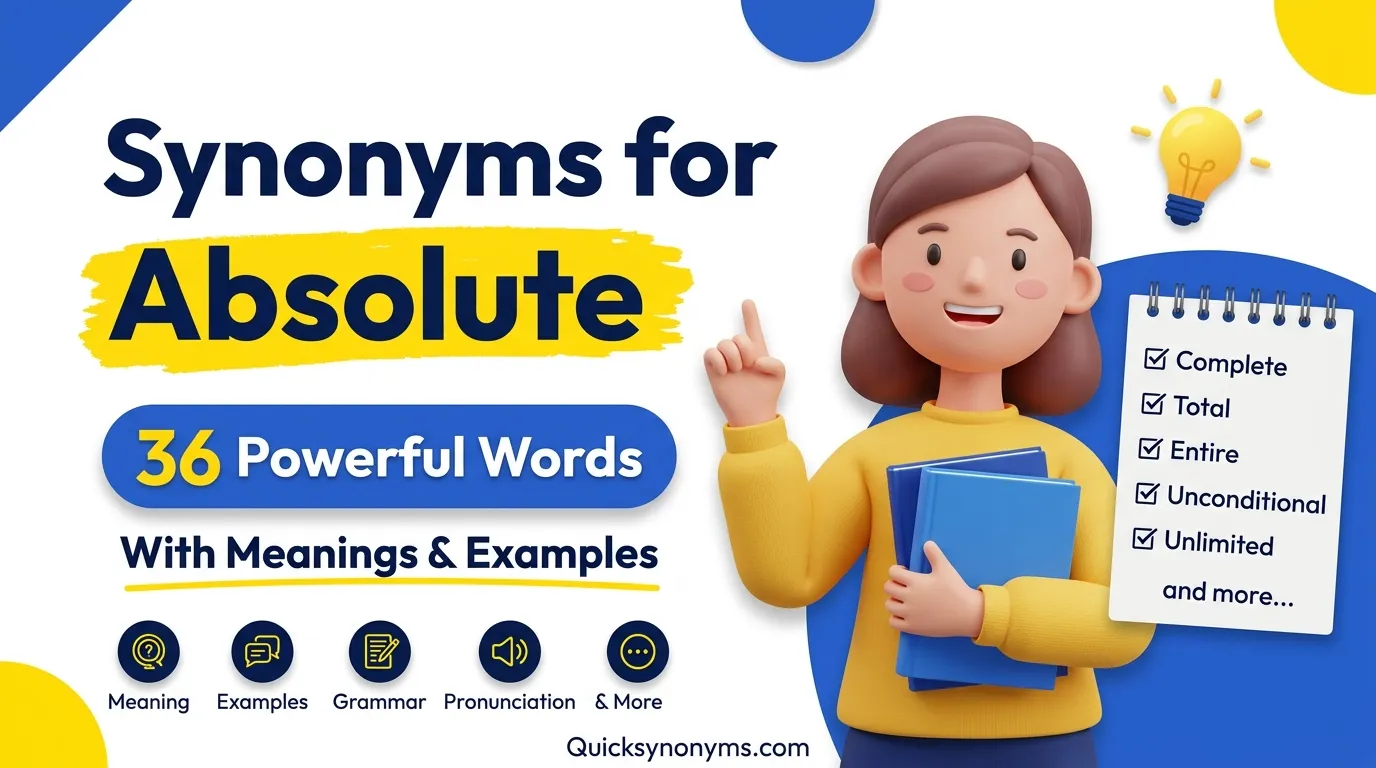
Absolute means complete, total, or not limited by any condition. Imagine a manager saying, “You have absolute freedom to choose.” This means there are no limits on the choice. The word is common in writing and speech because it can describe strong ideas such as absolute power, absolute truth, or absolute certainty.
Learning synonyms for absolute helps English learners express ideas with more detail and avoid repeating the same word. It also helps writers choose a word that fits the exact meaning and tone they want. In this guide, you will learn the meaning of absolute, its synonyms, examples, grammar, history, pronunciation, and semantic categories. These useful alternatives can make everyday English, academic writing, and professional content clearer.
Meaning of Absolute
Definition
Absolute (Adjective/Noun): Complete, total, or not limited or changed by any condition.
As a noun, absolute can mean something that is complete, certain, or independent of other things.
Examples
- She has absolute control over the project.
- There is no absolute guarantee of success.
Connotative Meaning
Connotation means the feeling or idea a word suggests beyond its basic meaning.
- Positive tone: Can suggest complete freedom, certainty, purity, or confidence.
- Negative tone: Can suggest extreme control, rigid thinking, or excessive power.
- Neutral tone: Can simply mean complete, total, or unlimited.
Etymology
The word absolute comes from Latin absolutus, meaning “set free,” “completed,” or “finished.” It comes from absolvere, meaning “to release,” “complete,” or “set free.”
- Old English (450–1100): The modern form absolute was not commonly used in Old English. Related Latin ideas entered English later through French and Latin.
- Middle English (1100–1500): The word entered English through Anglo-French and Latin forms. It developed meanings linked to being complete, free from conditions, or independent.
- Modern English (1500–Present): Absolute gained its modern meanings of complete, total, certain, unlimited, and independent.
Pronunciation (IPA)
- IPA: /ˈæbsəluːt/
- Syllables: ab-so-lute
Affixation Pattern of Absolute
- Root: The word traces back to Latin solvere, meaning “to loosen,” “release,” or “free.”
- Prefix: ab-, meaning “away from.”
- Suffix: -ute is part of the historical Latin-derived form rather than a productive English suffix in this word.
- Word formations:
- absolute adjective/noun
- absolutely adverb
- absoluteness noun
- absolution noun, historically related through the Latin root
- absolve verb, historically related through the same Latin root
36 Synonyms of Absolute: With Meaning & Examples
1. Complete (Adjective)
Meaning: Having all parts or being fully finished.
Examples:
- The project is now complete.
- We need a complete report before Friday.
2. Total (Adjective)
Meaning: Including everything or the whole amount.
Examples:
- The total cost was higher than expected.
- They showed total support for the plan.
3. Entire (Adjective)
Meaning: Including every part of something.
Examples:
- She spent the entire day at home.
- I read the entire book.
4. Utter (Adjective)
Meaning: Complete or extreme in degree.
Examples:
- His claim was utter nonsense.
- The room was in utter silence.
5. Outright (Adjective/Adverb)
Meaning: Complete, direct, or without any conditions.
Examples:
- The company made an outright rejection.
- She outright refused the offer.
6. Full (Adjective)
Meaning: Containing or including everything possible.
Examples:
- We have full control of the system.
- He gave a full explanation.
7. Whole (Adjective/Noun)
Meaning: Complete and including all parts.
Examples:
- She spent the whole afternoon studying.
- The whole process took two hours.
8. Perfect (Adjective)
Meaning: Complete and without any fault or weakness.
Examples:
- The machine is in perfect condition.
- We need a perfect balance between the two parts.
9. Pure (Adjective)
Meaning: Not mixed with anything else; complete in its kind.
Examples:
- The bottle contains pure water.
- His reaction was pure joy.
10. Sheer (Adjective)
Meaning: Complete or very strong in degree.
Examples:
- They succeeded through sheer determination.
- The size of the building was sheer amazement.
11. Unconditional (Adjective)
Meaning: Given or accepted without any conditions.
Examples:
- She gave him unconditional support.
- The offer came with unconditional approval.
12. Unqualified (Adjective)
Meaning: Complete and without limits, conditions, or exceptions.
Examples:
- He gave his unqualified support.
- The leader offered unqualified praise.
13. Unrestricted (Adjective)
Meaning: Not limited by rules, conditions, or controls.
Examples:
- Members have unrestricted access to the library.
- The program allows unrestricted use of the service.
14. Unlimited (Adjective)
Meaning: Having no set limit or maximum.
Examples:
- The plan offers unlimited data.
- Students have unlimited access to the materials.
15. Boundless (Adjective)
Meaning: Having no limits or boundaries.
Examples:
- She has boundless energy.
- His boundless curiosity helped him learn quickly.
16. Infinite (Adjective)
Meaning: Without an end, limit, or boundary.
Examples:
- Space appears infinite.
- The possibilities seem infinite.
17. Universal (Adjective)
Meaning: Applying to everyone or everything in a particular group.
Examples:
- The rule has universal support.
- Clean water is a universal human need.
18. Supreme (Adjective)
Meaning: Highest in power, rank, or authority.
Examples:
- The court has supreme authority in this matter.
- The king held supreme power.
19. Sovereign (Adjective)
Meaning: Having complete power or authority over a country or territory.
Examples:
- The country is a sovereign state.
- The ruler claimed sovereign authority.
20. Independent (Adjective)
Meaning: Free from control, influence, or dependence on others.
Examples:
- The group is independent of the government.
- She wants to make an independent decision.
21. Ultimate (Adjective)
Meaning: Greatest, highest, or final in a particular situation.
Examples:
- Safety is our ultimate goal.
- The manager has the ultimate responsibility.
22. Final (Adjective)
Meaning: Last and not normally open to change.
Examples:
- The judge made the final decision.
- This is the final version of the document.
23. Definite (Adjective)
Meaning: Clear, certain, or fixed.
Examples:
- We need a definite answer today.
- She made a definite promise.
24. Certain (Adjective)
Meaning: Known to be true or sure to happen.
Examples:
- I am certain that he is right.
- There is no certain answer yet.
25. Indisputable (Adjective)
Meaning: Impossible to reasonably deny or question.
Examples:
- The evidence is indisputable.
- Her talent is indisputable.
26. Unquestionable (Adjective)
Meaning: So clear or certain that it cannot reasonably be doubted.
Examples:
- His honesty is unquestionable.
- The team’s success is unquestionable.
27. Incontrovertible (Adjective)
Meaning: Impossible to prove wrong or argue against.
Examples:
- The facts provide incontrovertible evidence.
- There is incontrovertible proof of the event.
28. Undeniable (Adjective)
Meaning: Clearly true and impossible to deny.
Examples:
- She has undeniable talent.
- There is an undeniable link between the two events.
29. Unequivocal (Adjective)
Meaning: Clear and leaving no room for doubt.
Examples:
- He gave an unequivocal answer.
- The message was unequivocal.
30. Categorical (Adjective)
Meaning: Completely clear, firm, and without exceptions.
Examples:
- She gave a categorical refusal.
- The manager made a categorical statement.
31. Conclusive (Adjective)
Meaning: Providing a final answer or proof.
Examples:
- The test gave conclusive results.
- We need conclusive evidence before acting.
32. Decisive (Adjective)
Meaning: Settling an issue clearly or finally.
Examples:
- The final goal was decisive.
- Her argument was decisive in the discussion.
33. Fixed (Adjective)
Meaning: Set and not intended to change.
Examples:
- The meeting has a fixed date.
- The price is fixed for the whole year.
34. Firm (Adjective)
Meaning: Strong, definite, and not likely to change.
Examples:
- He gave a firm answer.
- She took a firm position on the issue.
35. Thoroughgoing (Adjective)
Meaning: Complete and covering every important part.
Examples:
- The team carried out a thoroughgoing review.
- The policy needs a thoroughgoing change.
36. Unmitigated (Adjective)
Meaning: Complete and not reduced or made less severe.
Examples:
- The plan was an unmitigated success.
- The decision caused unmitigated damage.
Prototype Meaning
The most typical meaning of absolute is complete, total, or without limits or conditions. When people hear the word, they often think of something that is at the highest or strongest level, such as absolute certainty, absolute control, or absolute freedom. The exact synonym depends on the context.
Prototype Categorization
The synonyms of absolute can be grouped by their main meaning:
- Complete or total: Complete, total, entire, utter, full, whole, and thoroughgoing describe something that includes all parts.
- Without limits: Unrestricted, unlimited, boundless, infinite, unconditional, and unqualified describe something that has few or no limits or conditions.
- Highest level: Supreme, sovereign, ultimate, and perfect describe something at the highest or strongest level.
- Certain or unquestionable: Certain, definite, indisputable, unquestionable, incontrovertible, undeniable, and unequivocal describe ideas that are clear or difficult to doubt.
- Firm or final: Categorical, conclusive, decisive, final, fixed, and firm describe decisions, statements, or positions that are settled.
- Strong or complete in degree: Outright, sheer, pure, and unmitigated emphasize a strong or complete quality.
- Independent or widely applicable: Independent and universal can express ideas related to freedom from control or broad application.
This grouping helps writers choose the synonym that matches the exact meaning they want instead of replacing absolute with a word that only partly fits.
Antonyms of Absolute
- Limited (Adjective): Restricted by a boundary, rule, or condition.
- Conditional (Adjective): Dependent on a particular condition.
- Partial (Adjective): Involving only part of something.
- Incomplete (Adjective): Missing some parts or details.
- Restricted (Adjective): Limited by rules or controls.
- Uncertain (Adjective): Not known or guaranteed to be true.
- Relative (Adjective): Dependent on comparison, conditions, or circumstances.
- Changeable (Adjective): Able or likely to change.
Short Questions and Answers
What does absolute mean?
Absolute means complete, total, certain, or without limits or conditions.
When should absolute be used?
Use absolute when you want to show that something is complete, total, certain, or free from limits. The exact meaning depends on the sentence.
Is absolute positive or negative?
Absolute can be positive, negative, or neutral. It can suggest complete freedom or certainty, but it can also describe extreme power or strict control.
How is it different from similar words?
Absolute is a broad word. Complete focuses on having all parts, unlimited focuses on having no limits, certain focuses on confidence or truth, and supreme focuses on the highest level of power or rank.
Conclusion
Learning absolute and its synonyms gives English learners more ways to express complete, certain, strong, and unlimited ideas. Words such as total, complete, unconditional, unlimited, and unequivocal may look similar, but each has its own best use. Knowing these small differences can make your English more precise.
Synonyms also help writers avoid repeating the same word in every sentence. They can make articles, essays, emails, and conversations sound more natural and clear. Regular vocabulary practice can build stronger writing and speaking skills over time. Try learning a few synonyms each day and use them in your own sentences. With practice, you will become more confident in choosing the right word for each situation.
Learn More: Synonyms for Remains: 35 Useful Alternatives

Lexicographer & Vocabulary Specialist
Nathan Carter focuses on English vocabulary, synonyms, antonyms, and word meanings. He is passionate about producing clear, accurate, and easy-to-understand language guides for readers of all levels.