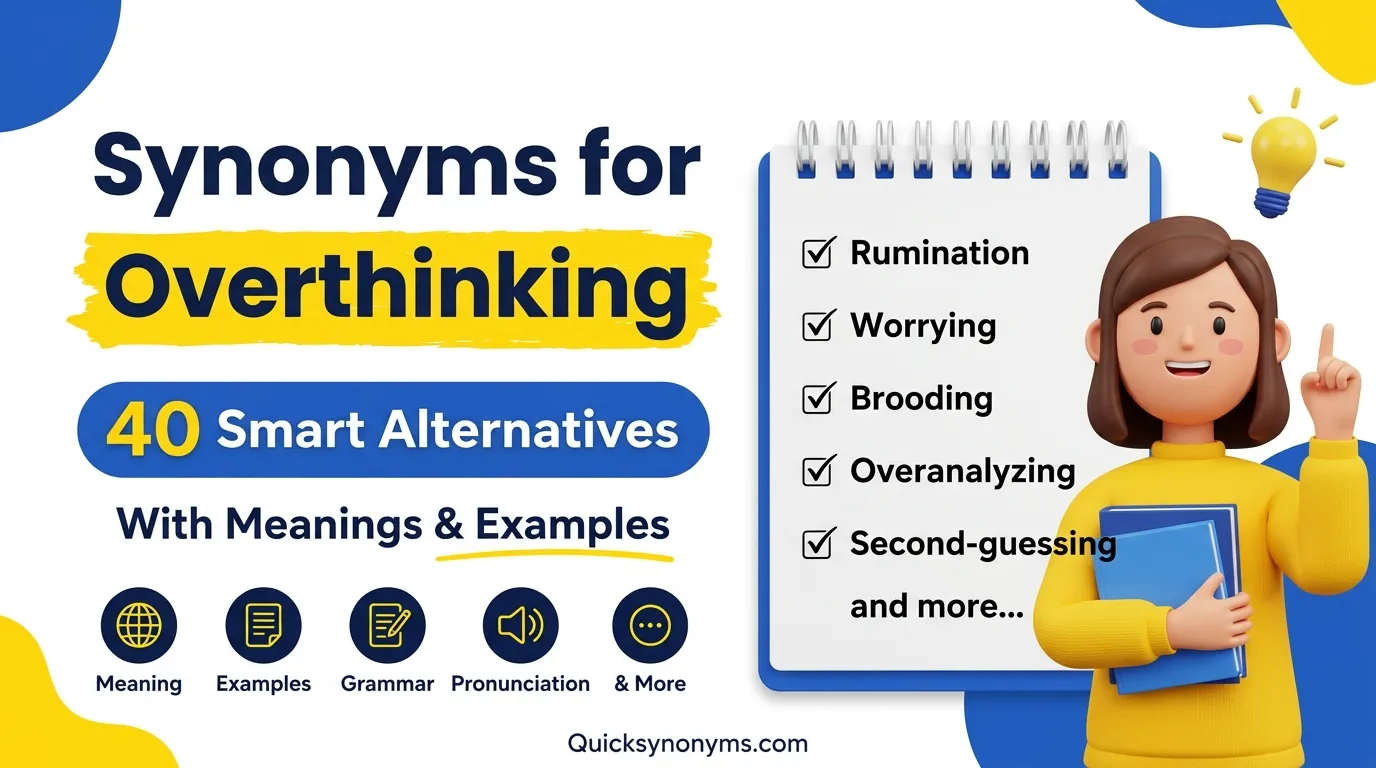
Overthinking means thinking about something too much, often without reaching a clear answer. For example, you may send a short text to a friend and then spend an hour wondering if it sounded rude. That is a common form of overthinking.
The word is widely used in daily speech, social media, school, and writing. Learning synonyms helps English learners and content writers express the same idea in fresh and clear ways. It also helps you choose a word that shows worry, deep thought, doubt, or repeated thinking more precisely.
In this guide, you will learn the meaning of overthinking, its examples, grammar, history, pronunciation, and 40 useful synonyms. You will also see how these words fit into different semantic groups.
Meaning of Overthinking
Definition
Overthinking (Noun/Gerund): Thinking about something too much, especially by repeating thoughts, doubts, or possible outcomes without finding a clear solution.
Examples
- Her overthinking made a simple choice feel very difficult.
- Overthinking can stop you from enjoying the present moment.
Connotative Meaning
Connotation: The feeling or idea that a word suggests beyond its basic meaning.
- Positive tone: Can suggest careful thought when used in a mild or helpful sense.
- Negative tone: Often suggests worry, doubt, stress, or excessive mental focus.
- Neutral tone: Can simply describe thinking about something for a long time.
Etymology
The word overthinking comes from the verb overthink, which combines over with think.
- Old English (450–1100): The word think comes from Old English thencan, meaning “to think, consider, or intend.” The word over comes from Old English ofer, meaning “above, beyond, or excessively.”
- Middle English (1100–1500): Forms related to think and over continued to develop in English. The idea of thinking beyond what is needed also became possible through word combinations.
- Modern English (1500–Present): Overthink developed as a verb meaning to think about something too much. Overthinking is its present participle and gerund form.
Pronunciation (IPA)
- IPA: /ˌoʊvərˈθɪŋkɪŋ/
- Syllables: o-ver-think-ing
Affixation Pattern of Overthinking
- Root: think
- Prefix: over-
- Suffix: -ing
- Word formations:
- think (verb/noun)
- overthink (verb)
- overthinks (verb)
- overthought (verb, past tense/past participle)
- overthinking (noun/gerund/present participle)
- overthinker (noun)
40 Synonyms of Overthinking: With Meaning & Examples
1. Rumination (Noun)
Meaning: Repeatedly thinking about the same idea, problem, or event.
Examples:
- Rumination kept him awake at night.
- Her rumination about the mistake did not change the result.
2. Brooding (Noun)
Meaning: Thinking deeply and unhappily about a problem or past event.
Examples:
- His brooding made the situation feel worse.
- She spent the evening brooding over the argument.
3. Worrying (Noun)
Meaning: Thinking about possible problems with fear or concern.
Examples:
- Worrying about tomorrow will not solve today’s problem.
- Constant worrying made it hard for her to relax.
4. Dwelling (Noun)
Meaning: Spending too much time thinking about something, especially something negative.
Examples:
- Dwelling on the past can hold you back.
- He kept dwelling on one small mistake.
5. Obsessing (Noun)
Meaning: Thinking about something again and again in a hard-to-control way.
Examples:
- She was obsessing over every detail.
- Obsessing about the result made him nervous.
6. Reconsideration (Noun)
Meaning: Thinking about a decision again before accepting it.
Examples:
- His reconsideration delayed the final choice.
- After some reconsideration, she changed her answer.
7. Second-Guessing (Noun)
Meaning: Doubting a choice or decision after making it.
Examples:
- Second-guessing your answer can create more doubt.
- He spent the day second-guessing his decision.
8. Overanalyzing (Noun)
Meaning: Examining something too closely or for too long.
Examples:
- Overanalyzing every word can cause stress.
- She was overanalyzing his short reply.
9. Overexamining (Noun)
Meaning: Looking at something in excessive detail.
Examples:
- Overexamining the problem slowed the team down.
- He was overexamining a simple question.
10. Overthinking (Noun)
Meaning: Thinking about something excessively instead of letting the thought go.
Examples:
- Overthinking made her unsure of a simple choice.
- His overthinking stopped him from taking action.
11. Overconsidering (Noun)
Meaning: Giving a matter more thought than it needs.
Examples:
- Overconsidering every option made the decision harder.
- He was overconsidering a very small detail.
12. Pondering (Noun)
Meaning: Thinking carefully and deeply about something.
Examples:
- She spent the morning pondering the question.
- Pondering every possible answer took too much time.
13. Contemplation (Noun)
Meaning: Deep and careful thought about something.
Examples:
- The decision required quiet contemplation.
- His long contemplation delayed the choice.
14. Preoccupation (Noun)
Meaning: A state of being strongly focused on one thought or concern.
Examples:
- Her preoccupation with the problem affected her work.
- His preoccupation with the past was clear.
15. Fixation (Noun)
Meaning: A strong and lasting focus on one idea or subject.
Examples:
- His fixation on one mistake was unhealthy.
- Her fixation with small details slowed the project.
16. Concern (Noun)
Meaning: A feeling of worry about something that may cause trouble.
Examples:
- His concern about the meeting kept him awake.
- She expressed concern about the possible result.
17. Anxiety (Noun)
Meaning: A strong feeling of worry or fear about what may happen.
Examples:
- Anxiety about the test made it hard to focus.
- His anxiety grew as the deadline came closer.
18. Nervousness (Noun)
Meaning: A worried or uneasy feeling about something.
Examples:
- Nervousness caused her to rethink her answer.
- His nervousness made him question every detail.
19. Doubt (Noun)
Meaning: A feeling of uncertainty about something.
Examples:
- Doubt made her rethink the plan.
- His doubt about the decision continued all day.
20. Indecision (Noun)
Meaning: Difficulty choosing between different options.
Examples:
- Her indecision delayed the meeting.
- Overthinking often leads to indecision.
21. Hesitation (Noun)
Meaning: A pause caused by uncertainty or doubt.
Examples:
- His hesitation showed that he was unsure.
- After a long hesitation, she gave her answer.
22. Uncertainty (Noun)
Meaning: A lack of confidence about what is true or what will happen.
Examples:
- Uncertainty about the future caused him to worry.
- She felt uncertainty about her next step.
23. Self-Doubt (Noun)
Meaning: A lack of confidence in your own choices or abilities.
Examples:
- Self-doubt made him question his work.
- Too much self-doubt can make simple tasks feel hard.
24. Worry (Noun)
Meaning: A troubled thought about a possible problem.
Examples:
- Her worry about the exam kept her awake.
- One small worry became a long chain of thoughts.
25. Concerned Thinking (Noun)
Meaning: Thought that is strongly focused on possible problems or risks.
Examples:
- His concerned thinking made him check the plan twice.
- Concerned thinking can be useful before an important choice.
26. Mental Churning (Noun)
Meaning: A state in which thoughts keep moving around without a clear answer.
Examples:
- Mental churning made it hard to focus on work.
- She felt mental churning before making the choice.
27. Thought Spiral (Noun)
Meaning: A series of connected thoughts that becomes harder to control.
Examples:
- One small worry started a thought spiral.
- He entered a thought spiral after reading the message.
28. Mental Loop (Noun)
Meaning: A repeated pattern of thinking about the same idea.
Examples:
- She was stuck in a mental loop.
- The mental loop kept bringing him back to the same question.
29. Rehashing (Noun)
Meaning: Thinking or talking about something again and again.
Examples:
- Rehashing the old argument solved nothing.
- He kept rehashing what he should have said.
30. Replaying (Noun)
Meaning: Thinking about a past event again as if reviewing it.
Examples:
- She kept replaying the conversation in her mind.
- Replaying the mistake made him feel worse.
31. Reviewing (Noun)
Meaning: Looking at something again to check or understand it.
Examples:
- Reviewing the decision helped him spot the error.
- She kept reviewing her answer before submitting it.
32. Analyzing (Noun)
Meaning: Examining something carefully to understand it.
Examples:
- Analyzing every small detail can take too long.
- He spent hours analyzing the conversation.
33. Scrutinizing (Noun)
Meaning: Examining something very closely.
Examples:
- She was scrutinizing every word in the email.
- Scrutinizing the message made a simple reply seem difficult.
34. Questioning (Noun)
Meaning: Thinking carefully about whether something is correct, true, or right.
Examples:
- Constant questioning made him unsure of his choice.
- She kept questioning her decision.
35. Fretting (Noun)
Meaning: Worrying about something in an anxious way.
Examples:
- Stop fretting over things you cannot control.
- He spent the morning fretting about the interview.
36. Agonizing (Noun)
Meaning: Thinking painfully and anxiously about a difficult choice.
Examples:
- She was agonizing over which offer to accept.
- He spent days agonizing over the decision.
37. Mulling (Noun)
Meaning: Thinking about something carefully for some time.
Examples:
- She was mulling over his suggestion.
- He spent the weekend mulling over the offer.
38. Speculating (Noun)
Meaning: Thinking about possible explanations or outcomes without knowing the facts.
Examples:
- Speculating about the future did not help.
- They spent hours speculating about what might happen.
39. Replaying Scenarios (Noun)
Meaning: Mentally going through possible or past situations again and again.
Examples:
- Replaying scenarios kept her from sleeping.
- He was replaying scenarios before the interview.
40. Mental Overanalysis (Noun)
Meaning: Excessive examination of thoughts, choices, or details.
Examples:
- Mental overanalysis made the simple task feel complex.
- His mental overanalysis delayed the final decision.
Prototype Meaning
The most typical meaning of overthinking is thinking about something again and again without reaching a clear answer. People often imagine someone worrying about a decision, replaying a conversation, or imagining many possible outcomes. The word usually suggests that the amount of thought has gone beyond what is useful.
Prototype Categorization
- Repeated thought: rumination, brooding, dwelling, rehashing, replaying describe returning to the same thought or event.
- Worry and fear: worrying, anxiety, nervousness, concern, fretting focus on troubled thoughts.
- Doubt and uncertainty: second-guessing, doubt, hesitation, uncertainty, self-doubt, indecision focus on difficulty trusting a choice.
- Excessive analysis: overanalyzing, overexamining, scrutinizing, mental overanalysis focus on looking at details too closely.
- Deep thought: pondering, contemplation, mulling can be more neutral and may suggest careful thought rather than harmful overthinking.
- Mental patterns: thought spiral, mental loop, mental churning describe thoughts that keep moving or repeating.
- Possible outcomes: speculating, replaying scenarios focus on imagining what could happen or what might have happened.
This grouping helps writers choose the right word. For example, fretting fits worry, while second-guessing fits doubt about a choice. Pondering can sound thoughtful, while rumination often suggests repeated negative thinking.
Antonyms of Overthinking
- Decisiveness (Noun): The ability to make choices quickly and clearly.
- Clarity (Noun): A clear understanding of a thought or situation.
- Certainty (Noun): A strong belief that something is true or correct.
- Confidence (Noun): Trust in your own judgment or ability.
- Acceptance (Noun): Willingness to accept a situation without continued resistance.
- Action (Noun): Doing something instead of only thinking about it.
- Calmness (Noun): A peaceful state without excessive worry.
- Trust (Noun): Confidence in a person, choice, process, or outcome.
- Simplicity (Noun): The quality of being easy to understand or deal with.
- Mindfulness (Noun): Paying attention to the present moment without excessive judgment.
Short Questions and Answers
What does overthinking mean?
Overthinking means thinking about something too much, often with repeated doubt, worry, or analysis.
When should overthinking be used?
Use overthinking when you want to describe excessive or repeated thought about a problem, choice, event, or possible outcome.
Is overthinking positive or negative?
It is usually negative because it often suggests too much worry or doubt. However, careful thought can be useful when it helps someone make a better decision.
How is it different from similar words?
Overthinking is a broad term. Rumination often focuses on repeated thoughts, worrying focuses on possible problems, and second-guessing focuses on doubting a decision. Pondering can be more neutral and simply means thinking deeply.
Conclusion
Learning overthinking and its synonyms gives you more ways to describe thoughts, doubt, worry, and careful thinking. Instead of using the same word again and again, you can choose a word that fits the exact meaning. For example, rumination works well for repeated thoughts, while second-guessing is better for doubt about a choice.
These words can improve both writing and speaking. They help you explain feelings and ideas with greater detail and avoid simple repetition. They also build confidence because you can choose words that match each situation.
Try to learn a few new words each day. Write your own examples and use the words in real conversations. With regular practice, your vocabulary will become stronger, clearer, and more natural.
Discover More: Synonyms for Comforting: 38 Powerful Words

Senior English Language Expert
Eleanor Brooks specializes in English grammar, vocabulary, and word usage. She enjoys simplifying complex language concepts and creating practical resources that help learners write and speak with confidence.








1 thought on “Synonyms for Overthinking: 40 Smart Alternatives”