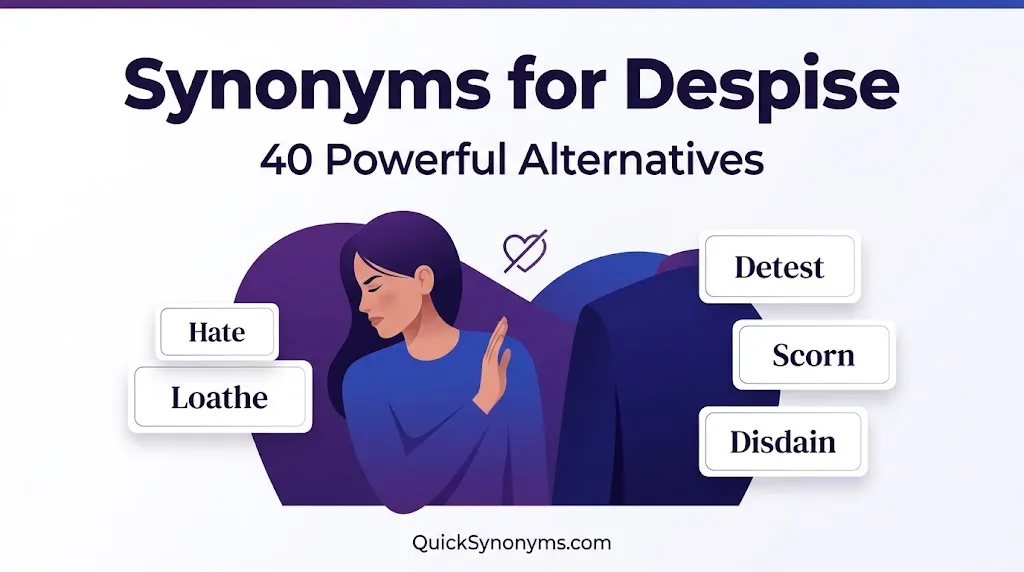
Despise means to strongly dislike someone or something and feel that they are unworthy of respect.
If you are looking for a despise synonym, words such as hate, loathe, detest, and abhor can help you express strong dislike more accurately.
Imagine a student who works hard on a project while a classmate mocks the effort.
The student may say, “I despise people who put others down.”
The word is commonly used when ordinary dislike is not strong enough to express deep dislike or contempt.
It can describe feelings toward people, actions, ideas, or behavior.
Learning synonyms for despise helps English learners express strong feelings with greater accuracy.
It also helps content writers avoid repeating the same word in essays, articles, stories, and everyday communication.
In this guide, you will learn the meaning, examples, grammar, history, pronunciation, word formation, and semantic categories of despise.
You will also discover 40 useful synonyms and close alternatives.
Despise Synonym: Meaning and Definition
Definition
Despise (Verb):
To strongly dislike someone or something and have very little respect for them.
Examples
- I despise people who treat others unfairly.
- She despises dishonesty in the workplace.
Connotative Meaning
(Connotation: the feeling or emotion that a word suggests beyond its basic meaning.)
- Positive tone: Usually not positive. The word may appear in a positive sentence when describing rejection of something harmful, such as “He despises cruelty.”
- Negative tone: It expresses a very strong negative feeling, often mixed with contempt or a lack of respect.
- Neutral tone: The word itself is strongly negative, although the speaker may use it in a factual statement about someone’s feelings.
Etymology
The word despise comes from Old French despire.
It came from the Latin word despicere, meaning “to look down upon” or “to look down from above.”
- Old English (450–1100): The modern word did not directly develop from a common Old English form. Similar ideas were expressed with native words meaning to scorn, hate, or hold in low regard.
- Middle English (1100–1500): Forms such as despisen entered English through Anglo-French and Old French influence.
- Modern English (1500–Present): Despise became established as a verb meaning to regard someone or something with strong dislike and contempt.
Pronunciation (IPA)
- IPA: /dɪˈspaɪz/
- Syllables: de-spise
Affixation Pattern of Despise
- Root: spis / spec, historically connected with the Latin idea of looking or seeing
- Prefix: de-, from Latin, contributing a sense related to looking down or away
- Suffix: No productive English suffix is added in the modern form.
Word Formations
- Despise: verb
- Despised: past tense and past participle
- Despising: present participle and gerund
- Despiser: noun for a person who despises someone or something
- Despisable: adjective meaning worthy of being despised
- Despicable: adjective meaning extremely bad or deserving hatred or contempt
40 Synonyms of Despise With Meaning & Examples
If you need a despise synonym, the best choice depends on the type and strength of negative feeling you want to express. Some alternatives show strong hatred, while others emphasize contempt, disrespect, criticism, rejection, or disgust.
1. Hate (Verb)
Meaning: To strongly dislike someone or something.
Examples:
- I hate dishonest behavior.
- She hates being treated unfairly.
2. Loathe (Verb)
Meaning: To dislike someone or something very strongly.
Examples:
- I loathe unnecessary arguments.
- He loathes people who break their promises.
3. Detest (Verb)
Meaning: To dislike something or someone intensely.
Examples:
- She detests rude behavior.
- They detest corruption.
4. Abhor (Verb)
Meaning: To strongly hate or feel intense disgust toward something.
Examples:
- He abhors violence.
- Many people abhor cruelty to animals.
5. Abominate (Verb)
Meaning: To hate something deeply because it seems extremely wrong or unpleasant.
Examples:
- She abominates injustice.
- He abominates acts of cruelty.
6. Execrate (Verb)
Meaning: To hate or strongly condemn something.
Examples:
- The writer execrated political corruption.
- She execrates dishonest practices.
7. Scorn (Verb)
Meaning: To treat someone or something as unworthy of respect.
Examples:
- He scorns people who cheat.
- She scorned the offer as beneath her.
8. Disdain (Verb)
Meaning: To consider someone or something unworthy of respect or attention.
Examples:
- She disdains arrogant people.
- He disdains cheap excuses.
9. Contemn (Verb)
Meaning: To regard someone or something as completely unworthy of respect.
Examples:
- The leader contemned dishonest officials.
- She contemns unfair treatment.
10. Revile (Verb)
Meaning: To attack someone with insulting or abusive words.
Examples:
- The crowd reviled the corrupt official.
- He was reviled for his dishonest actions.
11. Vilify (Verb)
Meaning: To speak about someone in a very negative and insulting way.
Examples:
- The article vilified the dishonest businessman.
- Critics vilified the policy.
12. Malign (Verb)
Meaning: To speak harmful and unfair things about someone or something.
Examples:
- They maligned her reputation.
- The rival group maligned the new leader.
13. Denounce (Verb)
Meaning: To publicly criticize or strongly condemn something.
Examples:
- The mayor denounced corruption.
- She denounced the cruel treatment of workers.
14. Condemn (Verb)
Meaning: To strongly express that someone or something is wrong or unacceptable.
Examples:
- We condemn acts of violence.
- The organization condemned the unfair decision.
15. Decry (Verb)
Meaning: To publicly criticize something as bad or harmful.
Examples:
- Experts decried the poor working conditions.
- The group decried unnecessary spending.
16. Disparage (Verb)
Meaning: To speak about someone or something as if it has little value.
Examples:
- Do not disparage other people’s work.
- He often disparages his competitors.
17. Belittle (Verb)
Meaning: To make someone or something seem less important or valuable.
Examples:
- She never belittles her students.
- He belittled my contribution to the project.
18. Deride (Verb)
Meaning: To mock or make fun of someone in a disrespectful way.
Examples:
- They derided his unusual ideas.
- The critics derided the proposal.
19. Spurn (Verb)
Meaning: To reject someone or something with strong disrespect.
Examples:
- She spurned his dishonest offer.
- He spurned their invitation.
20. Snub (Verb)
Meaning: To deliberately ignore or treat someone as unimportant.
Examples:
- She snubbed her former colleague.
- The manager snubbed the new employee.
21. Slight (Verb)
Meaning: To treat someone as unimportant or show disrespect toward them.
Examples:
- I did not mean to slight you.
- He felt slighted by the manager’s comment.
22. Shun (Verb)
Meaning: To deliberately avoid someone or something.
Examples:
- She shuns dishonest people.
- He shuns unnecessary conflict.
23. Reject (Verb)
Meaning: To refuse to accept or approve of someone or something.
Examples:
- They rejected the unfair proposal.
- She rejects dishonest business practices.
24. Resent (Verb)
Meaning: To feel anger or bitterness because of something unfair or unpleasant.
Examples:
- He resents being treated unfairly.
- She resented his rude behavior.
25. Dislike (Verb)
Meaning: To have a negative feeling toward someone or something.
Examples:
- I dislike arrogant behavior.
- She dislikes working with dishonest people.
26. Disfavor (Verb)
Meaning: To regard someone or something negatively or with little approval.
Examples:
- The committee disfavors unnecessary changes.
- He disfavors aggressive tactics.
27. Disapprove of (Verb Phrase)
Meaning: To believe that someone or something is wrong or unsuitable.
Examples:
- Her parents disapprove of his behavior.
- I disapprove of dishonest advertising.
28. Deplore (Verb)
Meaning: To strongly dislike or express sadness about something considered wrong.
Examples:
- We deplore acts of cruelty.
- She deplores unnecessary violence.
29. Hold in Contempt (Verb Phrase)
Meaning: To consider someone or something completely unworthy of respect.
Examples:
- He holds dishonest people in contempt.
- She holds corruption in contempt.
30. Have Contempt for (Verb Phrase)
Meaning: To have a strong feeling that someone or something is beneath respect.
Examples:
- They have contempt for dishonest leaders.
- She has contempt for people who exploit others.
31. Look Down On (Verb Phrase)
Meaning: To consider someone or something inferior.
Examples:
- He looks down on people with less money.
- Never look down on honest work.
32. Think Little of (Verb Phrase)
Meaning: To have a low opinion of someone or something.
Examples:
- She thinks little of his excuses.
- He thinks little of people who avoid responsibility.
33. Have No Regard for (Verb Phrase)
Meaning: To show no respect, concern, or appreciation for someone or something.
Examples:
- He has no regard for other people’s feelings.
- The company had no regard for safety rules.
34. Regard With Contempt (Verb Phrase)
Meaning: To view someone or something with strong disrespect.
Examples:
- She regarded his dishonest actions with contempt.
- They regard corruption with contempt.
35. Turn Up One’s Nose At (Verb Phrase)
Meaning: To show that you think someone or something is inferior or not good enough.
Examples:
- He turns up his nose at simple food.
- She turned up her nose at the cheap apartment.
36. Feel Aversion To (Verb Phrase)
Meaning: To have a strong feeling of dislike toward something.
Examples:
- She feels an aversion to dishonest behavior.
- He feels a strong aversion to cruelty.
37. Be Repelled By (Verb Phrase)
Meaning: To feel strong dislike or disgust toward someone or something.
Examples:
- She was repelled by his cruel behavior.
- He is repelled by dishonest practices.
38. Feel Disgust For (Verb Phrase)
Meaning: To feel intense dislike or disgust toward someone or something.
Examples:
- She feels disgust for cruel treatment.
- He feels disgust for dishonest behavior.
39. Detest Profoundly (Verb Phrase)
Meaning: To dislike someone or something at a very deep level.
Examples:
- She detests prejudice profoundly.
- He detests dishonesty profoundly.
40. Despise Deeply (Verb Phrase)
Meaning: To have an extremely strong feeling of dislike and contempt.
Examples:
- He despises deeply the people who exploit others.
- She deeply despises unfair treatment.
Prototype Meaning
The prototype meaning of despise is to feel very strong dislike toward a person, behavior, idea, or thing.
It also involves viewing that person or thing as unworthy of respect.
When people hear despise, they often imagine more than simple dislike.
They imagine a strong emotional reaction that may include contempt, disgust, anger, or a belief that something is morally or personally unacceptable.
For example, someone may dislike cold weather.
However, they may despise cruelty because they consider it deeply wrong.
Prototype Categorization
The 40 synonyms and close alternatives can be grouped by the type and strength of feeling they express.
This helps writers select a word that fits the exact context.
Strong Hatred
Hate, loathe, detest, abhor, abominate, execrate
These words express powerful dislike.
They are useful when emotional intensity is high.
Contempt and Disrespect
Scorn, disdain, contemn, hold in contempt, have contempt for, regard with contempt
These words emphasize the belief that someone or something is beneath respect.
Public Criticism
Denounce, condemn, decry, revile, vilify, malign
These words work well when the speaker openly attacks, criticizes, or condemns something.
Low Opinion
Disparage, belittle, think little of, look down on, have no regard for
These alternatives focus on treating someone or something as less valuable or important.
Rejection and Avoidance
Spurn, reject, shun, snub, slight
These words are useful when contempt is shown through rejection, ignoring, or avoiding someone.
General Dislike
Dislike, disfavor, disapprove of, deplore, feel aversion to
These words are often less intense than despise.
They can fit more moderate situations.
Disgust
Be repelled by, feel disgust for
These expressions emphasize strong feelings of disgust or emotional rejection.
Idiomatic Alternatives
Turn up one’s nose at, think little of, have no regard for
These phrases can make informal writing and conversation sound more natural.
Choosing the right category helps writers control emotional strength.
Dislike is mild.
Detest is very strong.
Scorn and disdain add the important idea of disrespect.
Antonyms of Despise
1. Love (Verb)
To feel deep affection or strong positive feelings toward someone or something.
2. Admire (Verb)
To respect or appreciate someone or something.
3. Respect (Verb)
To value someone or something and treat them with regard.
4. Appreciate (Verb)
To recognize the value or importance of someone or something.
5. Adore (Verb)
To love someone or something very strongly.
6. Cherish (Verb)
To love and value someone or something deeply.
7. Esteem (Verb)
To respect and admire someone or something.
8. Like (Verb)
To have a positive feeling toward someone or something.
Short Questions and Answers
What does despise mean?
Despise means to strongly dislike someone or something.
It also means considering them or it unworthy of respect.
If you need a despise synonym, common alternatives include hate, loathe, detest, and abhor, although each word can express a slightly different level or type of negative feeling.
When should despise be used?
Use despise when you want to express very strong dislike.
It is especially useful when the feeling includes contempt or a lack of respect.
Is despise positive or negative?
Despise is strongly negative.
It describes intense dislike, contempt, or lack of respect.
How is it different from similar words?
Dislike is usually weaker than despise.
Hate focuses on strong negative feelings.
Scorn and disdain emphasize disrespect.
Abhor often suggests moral disgust.
Reject mainly means refusing to accept something.
Conclusion
Learning despise and its synonyms gives English learners more ways to express strong negative feelings accurately.
Words such as hate, loathe, detest, abhor, scorn, disdain, condemn, disparage, and spurn may look similar.
However, each word carries a slightly different meaning or emotional strength.
Knowing these differences helps you choose the right word for a conversation, essay, story, email, or professional article.
Instead of repeating despise, you can select a synonym that shows hatred, contempt, criticism, rejection, avoidance, or simple dislike.
This makes your English more precise and natural.
Regular vocabulary practice can also strengthen both writing and speaking skills.
Try learning three to five synonyms each day.
Then create your own sentences with them.
Pay attention to context, tone, and grammar before replacing one word with another.
With daily practice, you can avoid repetition, expand your vocabulary, and speak and write with greater confidence.
Explore More Synonyms: Synonyms for Tumultuous: 36 Powerful Alternatives.

Senior English Language Expert
Eleanor Brooks specializes in English grammar, vocabulary, and word usage. She enjoys simplifying complex language concepts and creating practical resources that help learners write and speak with confidence.







1 thought on “Synonyms for Despise: 40 Powerful Alternatives”