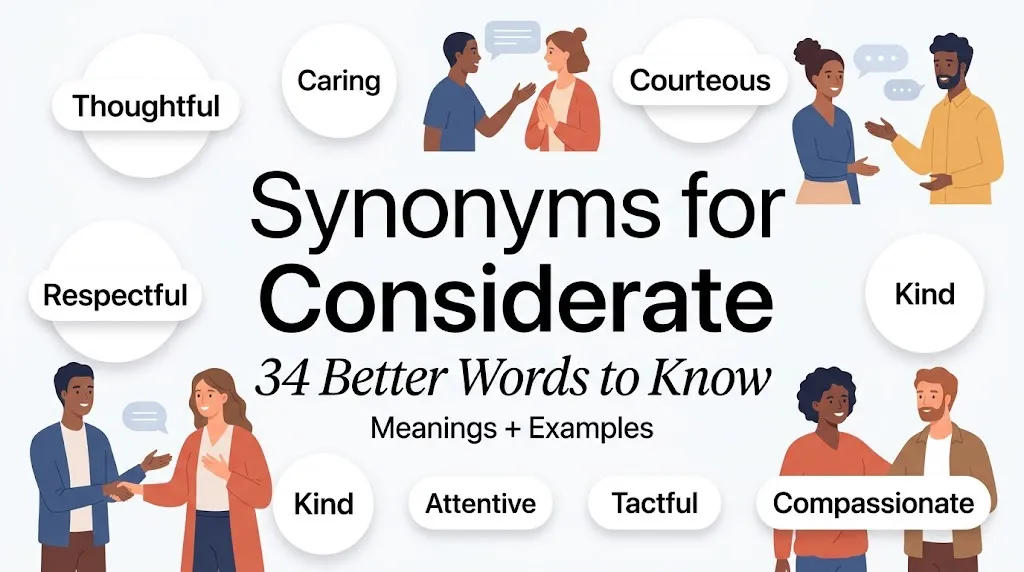
Synonyms for Considerate include thoughtful, caring, courteous, and respectful. Other useful alternatives include kind, attentive, tactful, and compassionate.
A considerate person thinks about other people’s feelings, needs, and comfort before acting. For example, if your friend is tired, you might keep your voice low so they can rest. That simple action is considerate.
The considerate meaning is closely linked to kindness, respect, and awareness. We often use this word to praise someone who thinks about how their actions may affect others.
Learning synonyms for considerate person can help you describe people’s behavior more clearly. It also gives English learners and writers more choices when the same word starts to feel repetitive.
In this guide, you will learn the considerate person meaning, useful synonyms, considerate antonyms, examples, pronunciation, etymology, grammar, and semantic categories. You will also learn when words such as kind, thoughtful, and courteous work best.
Meaning of Considerate
Definition
Considerate (Adjective):
Thinking about other people’s feelings, needs, wishes, or comfort before doing something.
The considerate person meaning is simple: a considerate person cares about how their words and actions affect other people.
Examples
- She was considerate and turned the music down while her brother was sleeping.
- He is a considerate person who always asks before borrowing something.
- She gave a considerate reply instead of embarrassing her coworker.
- It was considerate of him to offer his seat to an elderly passenger.
If you want to use considerate in a sentence, you can describe a person, action, decision, or behavior that shows care for others.
Connotative Meaning
(Connotation: the feeling or idea a word suggests beyond its basic meaning.)
- Positive tone: Kind, thoughtful, respectful, caring, and polite.
- Negative tone: Considerate itself is normally positive, but the related word inconsiderate has a negative tone.
- Neutral tone: It can simply describe behavior that takes another person’s needs into account.
Etymology
The word considerate comes from Latin consideratus, the past participle of considerare. The Latin verb carried the idea of examining or thinking about something carefully.
Over time, the word developed a stronger connection with careful thought about other people. Modern English uses considerate mainly for behavior that shows care, respect, and awareness.
Old English (450–1100)
The modern word considerate was not part of Old English. English speakers used different words to describe careful, thoughtful, or caring behavior.
Middle English (1100–1500)
After the Norman Conquest, English gained many French and Latin words. Terms related to consider entered and developed in English during this period of language change.
Modern English (1500–Present)
In modern English, considerate commonly means thoughtful toward other people. It can describe someone who notices another person’s needs and acts with care.
Pronunciation (IPA)
- IPA: /kənˈsɪdərət/
- Syllables: con-sid-er-ate
Affixation Pattern of Considerate
- Root: sider
- Prefix: con-
- Suffix: -ate
- Word formations:
- consider – verb
- considered – adjective or past participle
- consideration – noun
- considerate – adjective
- considerately – adverb
- considerateness – noun
- inconsiderate – adjective
- inconsiderately – adverb
- inconsideration – noun
34 Synonyms of Considerate With Meaning & Examples
1. Thoughtful (Adjective)
Meaning: Showing care by thinking about another person’s needs or feelings.
Examples:
- It was thoughtful of you to bring her dinner.
- He gave his friend a thoughtful gift.
2. Caring (Adjective)
Meaning: Showing kindness and concern for other people.
Examples:
- She is a caring friend.
- His caring nature makes people feel comfortable.
3. Courteous (Adjective)
Meaning: Showing good manners and respect toward others.
Examples:
- The receptionist was courteous to every visitor.
- Please be courteous when speaking to customers.
4. Respectful (Adjective)
Meaning: Showing respect for another person’s feelings, rights, or opinions.
Examples:
- He was respectful of her decision.
- Try to be respectful during the meeting.
5. Kind (Adjective)
Meaning: Friendly, helpful, and caring toward others.
Examples:
- She was kind to the new student.
- It was kind of him to help me.
Are kind and considerate synonyms?
Yes, they can be synonyms in many situations. Both can describe behavior that shows care for others. However, kind is broader, while considerate often emphasizes thinking about another person’s needs or comfort.
6. Attentive (Adjective)
Meaning: Paying close attention to another person’s needs or wishes.
Examples:
- The waiter was attentive to the guests.
- She is attentive to her children’s needs.
7. Tactful (Adjective)
Meaning: Careful with words so you do not upset or embarrass someone.
Examples:
- He gave a tactful answer.
- She was tactful when discussing the problem.
8. Compassionate (Adjective)
Meaning: Showing deep concern for someone who is suffering or struggling.
Examples:
- The nurse was compassionate toward the patient.
- She is a compassionate leader.
9. Sensitive (Adjective)
Meaning: Aware of other people’s feelings and careful not to hurt them.
Examples:
- He was sensitive to her situation.
- Be sensitive when discussing personal problems.
10. Understanding (Adjective)
Meaning: Showing that you recognize and accept another person’s feelings or situation.
Examples:
- My teacher was very understanding.
- She was understanding when I arrived late.
11. Accommodating (Adjective)
Meaning: Willing to change your plans or actions to help someone else.
Examples:
- The hotel staff were accommodating.
- He was accommodating when we changed the meeting time.
12. Polite (Adjective)
Meaning: Showing good manners and respect in social situations.
Examples:
- Please be polite to your guests.
- She gave a polite response.
13. Gracious (Adjective)
Meaning: Pleasant, kind, and respectful toward others.
Examples:
- She was gracious to everyone at the event.
- He gave us a gracious welcome.
14. Tolerant (Adjective)
Meaning: Willing to accept differences in people’s opinions or behavior.
Examples:
- She is tolerant of different opinions.
- A tolerant person listens without becoming angry.
15. Empathetic (Adjective)
Meaning: Able to understand another person’s feelings.
Examples:
- He is an empathetic manager.
- Her empathetic response helped me feel understood.
16. Sympathetic (Adjective)
Meaning: Showing care and concern for someone who is having a problem.
Examples:
- She was sympathetic when I lost my job.
- His sympathetic response comforted his friend.
17. Helpful (Adjective)
Meaning: Willing to provide assistance or make something easier for someone.
Examples:
- The assistant was helpful and friendly.
- Thank you for being so helpful.
18. Obliging (Adjective)
Meaning: Willing to do something helpful for another person.
Examples:
- The obliging clerk found the item for us.
- He was always obliging when neighbors needed help.
19. Diplomatic (Adjective)
Meaning: Careful and skillful when dealing with people or difficult situations.
Examples:
- She gave a diplomatic reply.
- A diplomatic approach can prevent conflict.
20. Deferential (Adjective)
Meaning: Showing polite respect toward someone, especially someone with authority.
Examples:
- He was deferential toward his manager.
- The employee remained deferential during the meeting.
21. Neighborly (Adjective)
Meaning: Friendly, helpful, and kind toward people who live nearby.
Examples:
- They showed a neighborly attitude.
- Her neighborly actions helped the elderly couple.
22. Unselfish (Adjective)
Meaning: Caring about other people’s needs instead of focusing only on yourself.
Examples:
- His unselfish actions helped the team.
- She made an unselfish decision.
23. Selfless (Adjective)
Meaning: Putting another person’s needs before your own.
Examples:
- Her selfless work helped many families.
- He made a selfless sacrifice for his friends.
24. Generous (Adjective)
Meaning: Willing to give time, help, money, or attention to others.
Examples:
- She was generous with her time.
- He gave us generous support.
25. Benevolent (Adjective)
Meaning: Showing a desire to do good and help others.
Examples:
- The organization has a benevolent mission.
- He was known as a benevolent employer.
26. Charitable (Adjective)
Meaning: Showing a willingness to help people in need.
Examples:
- She has a charitable attitude.
- His charitable work supports local families.
27. Gentle (Adjective)
Meaning: Kind, calm, and careful in the way you treat others.
Examples:
- She gave the child a gentle reminder.
- He was gentle when explaining the mistake.
28. Warm-hearted (Adjective)
Meaning: Naturally kind, friendly, and caring toward others.
Examples:
- She is a warm-hearted person.
- His warm-hearted nature attracts many friends.
29. Regardful (Adjective)
Meaning: Showing care or respect for someone or something.
Examples:
- He was regardful of everyone’s concerns.
- She remained regardful of the team’s needs.
30. Heedful (Adjective)
Meaning: Paying careful attention to someone or something.
Examples:
- She was heedful of the warning.
- He remained heedful of other people’s concerns.
31. Solicitous (Adjective)
Meaning: Showing great concern for someone’s comfort or well-being.
Examples:
- She was solicitous of her elderly parents.
- He was solicitous about his friend’s needs.
32. Civil (Adjective)
Meaning: Polite and respectful, especially during disagreement.
Examples:
- They remained civil during the argument.
- Please keep the discussion civil.
33. Well-mannered (Adjective)
Meaning: Behaving politely and showing good social manners.
Examples:
- The children were polite and well-mannered.
- He is a well-mannered guest.
34. Good-natured (Adjective)
Meaning: Naturally friendly, pleasant, and easy to deal with.
Examples:
- Her good-natured personality makes her easy to work with.
- He gave a good-natured response to the joke.
Prototype Meaning
The most typical meaning of considerate is being aware of how your actions affect other people.
When people hear this word, they often imagine a person who notices another person’s needs and responds with care. A considerate person may lower their voice, offer help, respect personal space, or think before speaking.
This is why considerate person meaning is closely connected with thoughtfulness and respect. The action does not need to be large. Small choices can show consideration too.
Prototype Categorization
The 34 synonyms above describe different forms of consideration.
- Thoughtful behavior: Thoughtful, caring, attentive, sensitive, understanding
- Good manners: Courteous, polite, respectful, civil, well-mannered
- Careful communication: Tactful, diplomatic, gentle, gracious
- Emotional concern: Compassionate, empathetic, sympathetic, solicitous
- Helpful behavior: Accommodating, helpful, obliging, neighborly
- Respect for others: Tolerant, deferential, regardful, heedful
- Selfless behavior: Unselfish, selfless, generous, benevolent, charitable
- Friendly personality: Warm-hearted, good-natured
This categorization helps writers choose a more precise word. For example, tactful is useful for careful speech, while accommodating is better when someone adjusts their plans to help another person.
If you are looking for a very considerate synonym, words such as thoughtful, caring, compassionate, and selfless can work well depending on the context.
Antonyms of Considerate
The main considerate antonyms describe behavior that ignores or fails to respect other people’s needs.
1. Inconsiderate (Adjective)
Meaning: Not thinking about other people’s feelings, needs, or comfort.
2. Thoughtless (Adjective)
Meaning: Showing little care for how your actions affect others.
3. Selfish (Adjective)
Meaning: Caring mainly about your own needs or interests.
4. Rude (Adjective)
Meaning: Showing poor manners or a lack of respect.
5. Careless (Adjective)
Meaning: Failing to think carefully about the effect of your actions.
6. Insensitive (Adjective)
Meaning: Showing little awareness of another person’s feelings.
7. Impolite (Adjective)
Meaning: Not showing good manners or proper respect.
If you need a not considerate synonym, words such as inconsiderate, thoughtless, selfish, and insensitive are common choices. The best option depends on why the person is being described as not considerate.
Short Questions and Answers
What does Considerate mean?
Considerate means thinking about other people’s feelings, needs, or comfort before you act.
For example, giving someone quiet space when they need rest is considerate.
When should Considerate be used?
Use considerate when describing a person, action, decision, or behavior that shows awareness of other people’s needs or feelings.
It works well in everyday conversation, workplace communication, essays, and personal descriptions.
Is Considerate positive or negative?
Considerate is normally a positive word.
It praises someone for being thoughtful, respectful, caring, and aware of other people’s needs.
How is it different from similar words?
Considerate is a broad word for behavior that takes other people into account.
Thoughtful often focuses on careful attention or a kind action. Courteous focuses more on manners. Tactful is mainly used for sensitive communication.
What word means considerate?
Several words can mean considerate, including thoughtful, caring, courteous, respectful, kind, attentive, and tactful.
The best choice depends on the situation. For example, courteous is useful when talking about manners, while thoughtful often describes a caring action.
What is the best synonym for consider?
The verb consider is different from the adjective considerate.
Depending on the context, synonyms for consider include think about, examine, evaluate, reflect on, and take into account. These are not direct synonyms for considerate.
What are some synonyms and antonyms for “considerate”?
Common synonyms include thoughtful, caring, kind, courteous, respectful, attentive, and compassionate.
Common antonyms include inconsiderate, thoughtless, selfish, rude, insensitive, and impolite.
Are kind and considerate synonyms?
Yes, kind and considerate can have similar meanings. Both can describe someone who treats others well.
However, kind is broader. Considerate specifically suggests that a person thinks about other people’s needs, feelings, or comfort.
Conclusion
Learning considerate and its synonyms gives you more ways to describe kindness, respect, and awareness. Each alternative has its own shade of meaning.
Words such as thoughtful, caring, courteous, and respectful are useful in everyday English. More specific choices such as tactful, empathetic, and accommodating can make your writing more precise.
Using different words also helps you avoid repetition. This can make essays, emails, conversations, and creative writing sound more natural.
Practice these words in your own sentences each day. Over time, you will become more confident in choosing the right synonym for each situation.
Explore More Synonyms: Synonyms for Ungrateful: 18 Better Words to Use.

Senior English Language Expert
Eleanor Brooks specializes in English grammar, vocabulary, and word usage. She enjoys simplifying complex language concepts and creating practical resources that help learners write and speak with confidence.









1 thought on “Synonyms for Considerate: 34 Better Words to Use”