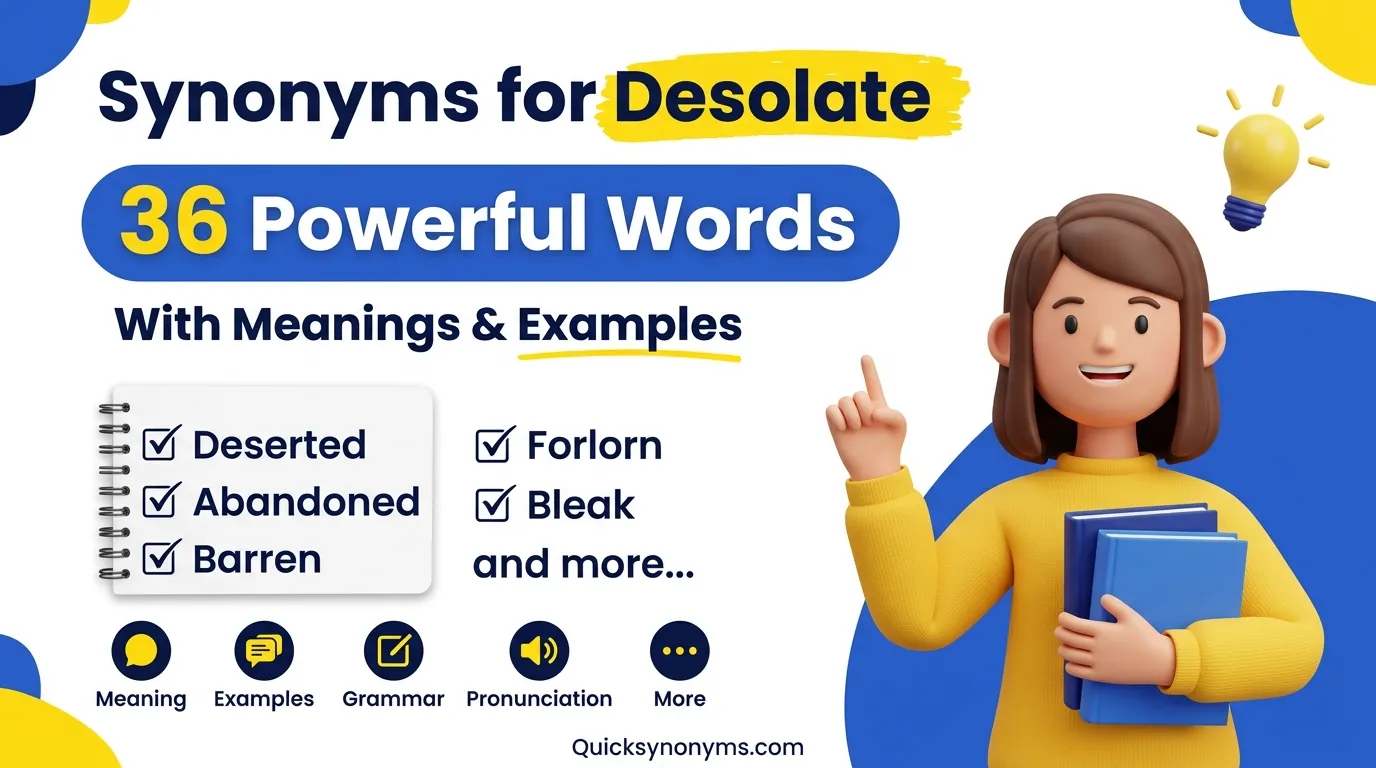
Synonyms for Desolate can help you describe a place that is empty, lonely, abandoned, or lacking life. The word is often used for a quiet street, an empty village, a dry land, or a person who feels deeply alone.
For example, a writer may call an abandoned house desolate instead of simply saying it is empty. Learning synonyms gives English learners more ways to express the same basic idea with the right level of feeling. In this guide, you will learn the meaning of desolate, its examples, grammar, history, pronunciation, and 36 useful synonyms grouped by meaning.
Meaning of Desolate
Definition
Desolate (Adjective): Empty, lonely, abandoned, or lacking life and comfort.
It can describe a physical place or a person’s emotional state.
Examples
- The old village looked desolate after everyone moved away.
- She felt desolate after losing her closest friend.
Connotative Meaning
Connotation is the feeling or idea that a word suggests beyond its basic meaning.
- Positive tone: Desolate is rarely positive, but writers may use it to show the quiet beauty of an untouched place.
- Negative tone: It often suggests sadness, loneliness, abandonment, emptiness, or ruin.
- Neutral tone: It can simply describe a place with few or no people, especially in factual writing.
Etymology
The word desolate comes from Latin desolatus, meaning “left alone” or “forsaken.” It is linked to desolare, meaning “to leave alone.”
The word entered English through Old French and Middle English forms related to desolate.
In Modern English, desolate can describe an empty place, a barren landscape, or a person who feels extremely lonely.
The idea of being left alone remains at the heart of the word.
Pronunciation
- IPA: /ˈdesələt/
- Syllables: des-o-late
Affixation Pattern
- Root: sol or sol- meaning alone
- Prefix: de- has a historical role in forming the word
- Suffix: -ate is part of the borrowed word formation
- Word formations:
- Desolate: adjective
- Desolate: verb
- Desolation: noun
- Desolately: adverb
- Desolateness: noun
36 Synonyms of Desolate
1. Abandoned (Adjective)
Meaning: Left empty because people have stopped using or living in a place.
Examples:
- The abandoned house stood near the forest.
- We walked past an abandoned factory.
2. Barren (Adjective)
Meaning: Unable to support much plant or animal life.
Examples:
- The land was dry and barren.
- Few plants could grow on the barren hill.
3. Bleak (Adjective)
Meaning: Cold, empty, and without much hope or comfort.
Examples:
- The town looked bleak in the winter rain.
- The future seemed bleak after the loss.
4. Cheerless (Adjective)
Meaning: Lacking happiness, warmth, or joy.
Examples:
- The room felt dark and cheerless.
- It was a cold and cheerless morning.
5. Deserted (Adjective)
Meaning: Empty because people have left or are not there.
Examples:
- The streets were deserted at midnight.
- They found a deserted beach.
6. Dreary (Adjective)
Meaning: Dull, gloomy, and lacking happiness.
Examples:
- The weather made the city look dreary.
- He spent a dreary afternoon alone.
7. Dismal (Adjective)
Meaning: Very gloomy, depressing, or lacking hope.
Examples:
- The empty house had a dismal look.
- The dark sky created a dismal mood.
8. Empty (Adjective)
Meaning: Containing no people or things.
Examples:
- The building was completely empty.
- We walked through an empty street.
9. Forsaken (Adjective)
Meaning: Abandoned or left completely alone.
Examples:
- The old church looked forsaken.
- They discovered a forsaken cabin in the hills.
10. Forlorn (Adjective)
Meaning: Lonely, sad, and without hope.
Examples:
- The child looked forlorn after the game.
- A forlorn house stood beside the road.
11. Gloomy (Adjective)
Meaning: Dark, sad, or without much hope.
Examples:
- The room was gloomy and cold.
- He had a gloomy view of the situation.
12. Isolated (Adjective)
Meaning: Far away from other people or places.
Examples:
- They lived in an isolated village.
- The cabin was isolated from the town.
13. Lonely (Adjective)
Meaning: Sad because of being alone or without company.
Examples:
- She felt lonely in the new city.
- The lonely road stretched for miles.
14. Lonesome (Adjective)
Meaning: Feeling or showing sadness because of being alone.
Examples:
- He felt lonesome after his friends left.
- A lonesome figure stood by the gate.
15. Neglected (Adjective)
Meaning: Not cared for properly.
Examples:
- The garden looked neglected.
- They repaired the neglected building.
16. Uninhabited (Adjective)
Meaning: Having no people living there.
Examples:
- They explored an uninhabited island.
- The region was mostly uninhabited.
17. Unoccupied (Adjective)
Meaning: Not being used or lived in.
Examples:
- The apartment has been unoccupied for months.
- We found an unoccupied building nearby.
18. Vacant (Adjective)
Meaning: Empty and available or unused.
Examples:
- Several houses stood vacant.
- The store had been vacant for years.
19. Solitary (Adjective)
Meaning: Alone or separated from others.
Examples:
- A solitary tree grew on the hill.
- He lived a solitary life.
20. Joyless (Adjective)
Meaning: Without happiness or pleasure.
Examples:
- The place had a joyless atmosphere.
- His days became dull and joyless.
21. Lifeless (Adjective)
Meaning: Without life, energy, or activity.
Examples:
- The town looked lifeless after sunset.
- The dry field appeared lifeless.
22. Miserable (Adjective)
Meaning: Very unhappy or uncomfortable.
Examples:
- He felt miserable after the loss.
- The cold room was a miserable place to stay.
23. Arid (Adjective)
Meaning: Extremely dry and lacking enough water for much plant life.
Examples:
- They crossed an arid desert.
- Few crops grow in the arid region.
24. Godforsaken (Adjective)
Meaning: Extremely remote, unpleasant, or seemingly forgotten.
Examples:
- They lived in a godforsaken village.
- The road led to a godforsaken place.
25. Unpeopled (Adjective)
Meaning: Having few or no people living in or using a place.
Examples:
- They crossed an unpeopled valley.
- The island remained unpeopled for years.
26. Unfrequented (Adjective)
Meaning: Rarely visited or used by people.
Examples:
- They followed an unfrequented path.
- The beach was quiet and unfrequented.
27. Wasted (Adjective)
Meaning: Damaged or ruined so that little useful life remains.
Examples:
- The storm left the fields wasted.
- They walked through a wasted landscape.
28. Ravaged (Adjective)
Meaning: Severely damaged or ruined.
Examples:
- The war left the region ravaged.
- The ravaged town needed years to recover.
29. Ruined (Adjective)
Meaning: Damaged so badly that something can no longer be used or restored easily.
Examples:
- They explored a ruined castle.
- The ruined building stood alone.
30. Despoiled (Adjective)
Meaning: Heavily damaged or stripped of valuable or beautiful things.
Examples:
- The forest was left despoiled after years of cutting.
- The once-rich land looked despoiled.
31. Bleakened (Adjective)
Meaning: Made or becoming more bleak and lacking hope or warmth.
Examples:
- The long winter bleakened the landscape.
- The news bleakened the mood of the town.
32. Bereft (Adjective)
Meaning: Left without someone or something important.
Examples:
- She was bereft after her father’s death.
- The village was bereft of its old community.
33. Abject (Adjective)
Meaning: Extremely unhappy, hopeless, or lacking dignity.
Examples:
- He lived in abject poverty.
- The prisoners faced abject conditions.
34. Wretched (Adjective)
Meaning: Very unhappy, poor, or unpleasant.
Examples:
- They lived in a wretched shelter.
- He felt wretched after the argument.
35. Despondent (Adjective)
Meaning: Very sad and without hope.
Examples:
- She became despondent after repeated failures.
- He sounded despondent during the call.
36. Melancholy (Adjective)
Meaning: Deeply sad or quietly thoughtful in a sad way.
Examples:
- The empty station had a melancholy mood.
- The song created a melancholy feeling.
Prototype Meaning
The most typical meaning of desolate is empty, abandoned, and lonely. When people hear this word, they often imagine a place with few or no people, such as an abandoned village, empty road, ruined building, or barren landscape.
However, desolate can also describe a person’s feelings. In this use, it suggests deep sadness and loneliness.
Prototype Categorization
Different synonyms of desolate work better in different situations.
Abandoned and Empty Places
Abandoned, deserted, forsaken, uninhabited, unoccupied, vacant, unpeopled, and unfrequented focus on the absence of people.
Use these when describing buildings, roads, villages, islands, or other places.
Sad and Lonely Feelings
Forlorn, lonely, lonesome, miserable, bereft, despondent, wretched, and melancholy focus more on emotional pain.
These words work well when describing people, feelings, or moods.
Dark and Gloomy Atmospheres
Bleak, dreary, dismal, gloomy, cheerless, joyless, and lifeless describe a place or situation that lacks warmth, energy, or hope.
These are useful in creative writing and descriptions.
Dry or Empty Landscapes
Barren, arid, and wasted are especially useful for land and natural environments.
They help describe places where plants, water, or signs of life are limited.
Damaged or Ruined Places
Ravaged, ruined, despoiled, and godforsaken can suggest serious damage, neglect, or a place that seems forgotten.
These words are useful when describing war zones, old buildings, damaged land, or remote places.
Extremely Negative Conditions
Abject and wretched focus more on very poor, painful, or unpleasant conditions.
They are stronger choices when the main idea is suffering rather than simple emptiness.
Antonyms
- Lively (Adjective): Full of energy and activity.
- Crowded (Adjective): Full of people or things.
- Inhabited (Adjective): Having people living there.
- Cheerful (Adjective): Happy and positive.
- Hopeful (Adjective): Expecting good things to happen.
- Vibrant (Adjective): Full of life, energy, and activity.
- Occupied (Adjective): Being used or lived in.
- Thriving (Adjective): Growing or doing very well.
Short Questions and Answers
What does desolate mean?
Desolate means empty, abandoned, lonely, or lacking life and comfort. It can describe a place or a person’s emotional state.
When should desolate be used?
Use desolate when you want to show more than simple emptiness. It often suggests loneliness, sadness, abandonment, or a lack of life.
Is desolate positive or negative?
Desolate usually has a negative connotation because it suggests loneliness, emptiness, sadness, or abandonment. In literary writing, it can sometimes describe the quiet beauty of an untouched place.
How is it different from similar words?
The exact meaning depends on the context. Deserted mainly means empty of people. Barren focuses on a lack of plant life. Forlorn focuses on sadness and loneliness. Bleak suggests a cold, gloomy, or hopeless feeling. Abandoned highlights the fact that people have left something behind.
Conclusion
Learning desolate and its synonyms gives you more precise ways to describe places, feelings, landscapes, and situations. Instead of using the same word again and again, you can choose deserted, barren, forlorn, bleak, lonely, or another word that matches your exact meaning.
These words can make your writing clearer and more expressive. They are also useful in speaking, schoolwork, stories, emails, and everyday English. Start by learning a few synonyms at a time. Then use each one in your own sentence. With regular practice, your vocabulary will grow, your writing will sound more natural, and you will feel more confident choosing the right word.
Discover More: Synonyms for Thrilling: 34 Powerful Words

Senior English Language Expert
Eleanor Brooks specializes in English grammar, vocabulary, and word usage. She enjoys simplifying complex language concepts and creating practical resources that help learners write and speak with confidence.






1 thought on “Synonyms for Desolate: 36 Powerful Words”