You clean out your closet and pull out a jacket you never wear. It just sits there, taking up space, unwanted by anyone in the house. That small moment captures the word perfectly. It describes something, or someone, that nobody desires, needs, or asks for.
The word shows up everywhere, from old clothes and spam emails to feelings of being left out socially. Because the idea comes up so often, repeating “unwanted” in every sentence makes writing feel dull and repetitive.
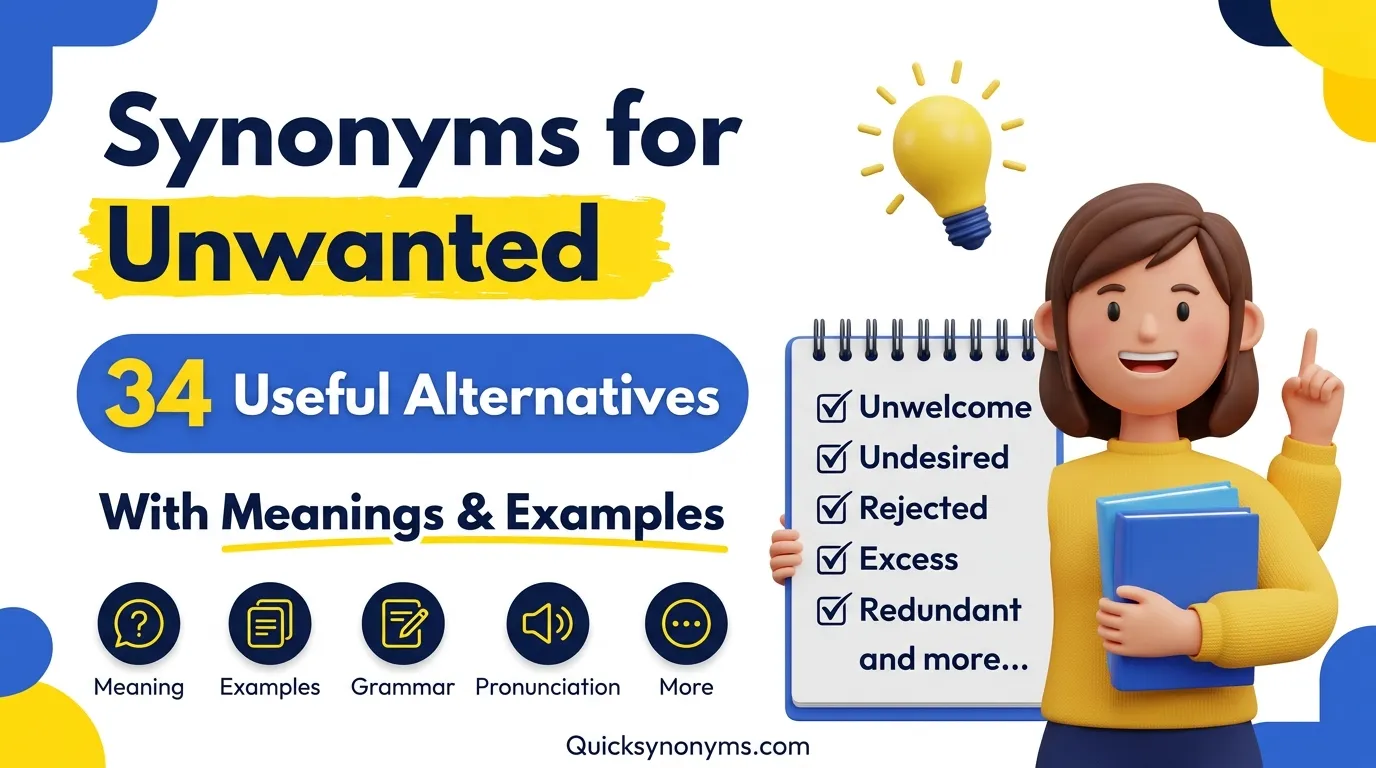
This article covers the meaning of unwanted, its history, pronunciation, word family, and 34 useful synonyms with examples so your writing sounds sharper and more natural.
Meaning of Unwanted
Definition
Unwanted (Adjective):
Not wanted, needed, or welcomed by anyone.
Examples
- The shelter is full of unwanted pets looking for homes.
- She felt unwanted at the family gathering.
Connotative Meaning
The tone of “unwanted” shifts slightly depending on what it describes.
- Positive tone: Rarely positive, though it can appear in relief, such as removing unwanted clutter.
- Negative tone: Used to describe rejection, exclusion, or things that cause discomfort, like unwanted attention.
- Neutral tone: Used in practical contexts, such as unwanted items in a warehouse or inbox.
(Connotation: the feeling or association a word carries beyond its basic meaning)
Etymology
The word unwanted is a combination of the prefix “un-” and the past participle of “want,” which traces back to the Old Norse word “vanta,” meaning to lack. Over time, “want” shifted from meaning “lack” to meaning “desire.”
- Old English (450–1100): The prefix “un-” was already common, used to reverse the meaning of a word.
- Middle English (1100–1500): “Want” entered English from Old Norse influence, carrying the sense of lacking something.
- Modern English (1500–Present): “Unwanted” formed as a natural negative of “wanted,” meaning not desired or needed.
Pronunciation (IPA)
- IPA: /ʌnˈwɒntɪd/
- Syllables: un-want-ed
Affixation Pattern of Unwanted
- Root: want (from Old Norse “vanta”)
- Prefix: un- (not)
- Suffix: -ed (past participle form)
- Word formations:
- Want (verb)
- Wanted (adjective)
- Unwanted (adjective)
- Unwantedness (noun, rare)
- Wanting (adjective, gerund)
34 Synonyms of Unwanted : With Meaning & Examples
1. Unwelcome (Adjective)
Meaning: Not received with pleasure or approval.
Examples:
- His comments were unwelcome at the meeting.
- She gave him an unwelcome piece of advice.
2. Undesired (Adjective)
Meaning: Not wished for or hoped for.
Examples:
- The medicine caused undesired side effects.
- They received undesired attention from the press.
3. Unsolicited (Adjective)
Meaning: Given or offered without being asked for.
Examples:
- She ignored the unsolicited advice from strangers.
- His inbox is full of unsolicited emails.
4. Uninvited (Adjective)
Meaning: Arriving or appearing without permission or invitation.
Examples:
- An uninvited guest showed up at the party.
- The comment felt uninvited and rude.
5. Unasked-for (Adjective)
Meaning: Given without being requested, often used casually.
Examples:
- He offered unasked-for opinions all evening.
- The unasked-for help actually saved time.
6. Unpopular (Adjective)
Meaning: Not liked or approved of by most people.
Examples:
- The policy proved unpopular with voters.
- He made an unpopular decision to cut the budget.
7. Disliked (Adjective)
Meaning: Regarded with dislike or disfavor.
Examples:
- The new rule was disliked by most staff.
- He felt disliked at his new school.
8. Rejected (Adjective)
Meaning: Refused or turned away.
Examples:
- The rejected application sat in the folder.
- She felt rejected after the breakup.
9. Spurned (Adjective)
Meaning: Firmly and often coldly refused, a literary word.
Examples:
- His spurned offer left him embarrassed.
- The spurned lover left town quietly.
10. Shunned (Adjective)
Meaning: Deliberately avoided by others.
Examples:
- The shunned employee ate lunch alone.
- Villagers shunned the old, abandoned house.
11. Excluded (Adjective)
Meaning: Kept out or left apart from a group.
Examples:
- She felt excluded from the group chat.
- Excluded students were not told about the trip.
12. Ostracized (Adjective)
Meaning: Excluded from a group, often as a form of punishment.
Examples:
- He was ostracized after the disagreement.
- The ostracized worker eventually quit.
13. Disowned (Adjective)
Meaning: No longer claimed or accepted, often used for people.
Examples:
- The disowned heir moved to another city.
- She felt disowned by her own team.
14. Discarded (Adjective)
Meaning: Thrown away because it is no longer needed.
Examples:
- Discarded furniture lined the street.
- He kept the discarded draft just in case.
15. Abandoned (Adjective)
Meaning: Left behind and no longer cared for.
Examples:
- The abandoned building sat empty for years.
- They found an abandoned puppy near the road.
16. Cast-off (Adjective)
Meaning: No longer wanted and given away or thrown out.
Examples:
- She wore her sister’s cast-off clothes.
- The shop sells cast-off furniture cheaply.
17. Outcast (Adjective)
Meaning: Rejected by society or a group, often used for people.
Examples:
- He felt like an outcast at the new job.
- The outcast animal wandered alone.
18. Undesirable (Adjective)
Meaning: Not wanted because it is unpleasant or unfit.
Examples:
- Loud noise is an undesirable side effect.
- The area gained a reputation as undesirable.
19. Unloved (Adjective)
Meaning: Not receiving affection or care, often used emotionally.
Examples:
- The unloved toy sat in the corner of the shop.
- He grew up feeling unloved by his relatives.
20. Uncalled-for (Adjective)
Meaning: Unnecessary and inappropriate, often describing behavior.
Examples:
- That remark was completely uncalled-for.
- Her rude tone felt uncalled-for.
21. Extra (Adjective)
Meaning: More than what is needed, often used casually.
Examples:
- We have extra chairs nobody needs.
- The extra noise was distracting.
22. Excess (Adjective)
Meaning: Beyond what is necessary or useful.
Examples:
- Excess baggage costs extra at the airport.
- They removed excess fat from the recipe.
23. Surplus (Adjective)
Meaning: More than required, often used in business or supply contexts.
Examples:
- The store sells surplus stock at a discount.
- Surplus workers were offered new roles.
24. Superfluous (Adjective)
Meaning: Unnecessary because it exceeds what is needed, a formal word.
Examples:
- He removed the superfluous details from the report.
- The extra step felt superfluous to the team.
25. Redundant (Adjective)
Meaning: No longer needed because it serves no purpose.
Examples:
- The old machine became redundant after the update.
- Several redundant phrases were cut from the essay.
26. Extraneous (Adjective)
Meaning: Not relevant or needed, often used in academic writing.
Examples:
- The editor removed extraneous information from the article.
- Extraneous noise made the recording unusable.
27. Unneeded (Adjective)
Meaning: Not required for a purpose.
Examples:
- They cleared out unneeded supplies from the garage.
- The unneeded step slowed the process down.
28. Unnecessary (Adjective)
Meaning: Not needed for a situation to work.
Examples:
- The trip involved unnecessary delays.
- Cutting unnecessary costs helped the budget.
29. Dispensable (Adjective)
Meaning: Able to be done without, not essential.
Examples:
- His role was seen as dispensable during cuts.
- The extra feature felt dispensable to users.
30. Expendable (Adjective)
Meaning: Not seen as important enough to keep or protect.
Examples:
- Workers felt expendable during the layoffs.
- The old equipment was treated as expendable.
31. Nonessential (Adjective)
Meaning: Not necessary for something to function properly.
Examples:
- Nonessential travel was avoided during the storm.
- They cut nonessential spending from the plan.
32. Useless (Adjective)
Meaning: Serving no purpose or value.
Examples:
- The broken tool became useless quickly.
- His useless advice only added confusion.
33. Obsolete (Adjective)
Meaning: No longer useful because it has been replaced.
Examples:
- The obsolete software slowed down the whole system.
- Old phone models quickly become obsolete.
34. Unrequired (Adjective)
Meaning: Not needed for a specific task or purpose.
Examples:
- The unrequired forms were removed from the process.
- Unrequired steps only add confusion for new staff.
Prototype Meaning
When people hear the word unwanted, they often picture something being pushed away or left behind, like an old item sitting in a donation pile or a person left out of a group. This image of rejection or excess sits at the center of the word, whether it applies to objects, feelings, or people.
Prototype Categorization
Grouping these synonyms makes it easier to choose the right word for the right context.
- Social or emotional rejection: Unwelcome, shunned, excluded, ostracized, unloved, outcast
- Refused offers or advances: Unsolicited, uninvited, unasked-for, spurned, rejected
- Extra or unneeded items: Extra, excess, surplus, superfluous, redundant, extraneous
- No longer useful: Dispensable, expendable, obsolete, useless, unnecessary, unneeded
- Formal or written tone: Undesirable, nonessential, unrequired, extraneous, superfluous
This grouping helps a writer match tone, whether describing feelings, business inventory, or writing style.
Antonyms of Unwanted
Desired (Adjective)
Strongly wished for or hoped to have.
Welcome (Adjective)
Gladly received or accepted.
Needed (Adjective)
Necessary or required for something.
Requested (Adjective)
Specifically asked for by someone.
Cherished (Adjective)
Held dear and cared for deeply.
Short Questions and Answers
What does unwanted mean?
It means not desired, needed, or welcomed, and it can describe objects, feelings, attention, or people.
When should unwanted be used?
Use it when describing something that nobody asked for or approves of, from unwanted items to unwanted comments.
Is unwanted positive or negative?
It almost always carries a negative tone, since it involves rejection, exclusion, or excess.
How is it different from similar words?
Words like “extra” or “surplus” focus on quantity beyond what is needed, while “unwanted” focuses more directly on the lack of desire or approval.
Conclusion
Learning synonyms for unwanted helps your writing feel more precise and far less repetitive. You can choose “redundant” for a business report, “unloved” for an emotional story, or “uninvited” when describing an unexpected guest.
Building this kind of vocabulary strengthens both writing and speaking. It helps you avoid repeating the same word again and again, and lets you match the exact shade of meaning a sentence calls for, from clutter in a garage to feelings of exclusion.
Try using a few of these new words in your own writing this week. Small, steady practice like this builds real confidence in English over time.
For more useful vocabulary, check out our related list of Synonyms for Desolate to expand your range even further.

Senior English Language Expert
Eleanor Brooks specializes in English grammar, vocabulary, and word usage. She enjoys simplifying complex language concepts and creating practical resources that help learners write and speak with confidence.