A football coach sits in the stands at a small-town game, quietly watching one player instead of the score. He is there to scout new talent before anyone else notices. That single word captures the whole idea, searching an area or a situation carefully to gather useful information before making a move.
People scout locations for movies, scout job candidates, and scout hiking trails before a trip. Because the word covers so many situations, using it in every sentence quickly feels repetitive.
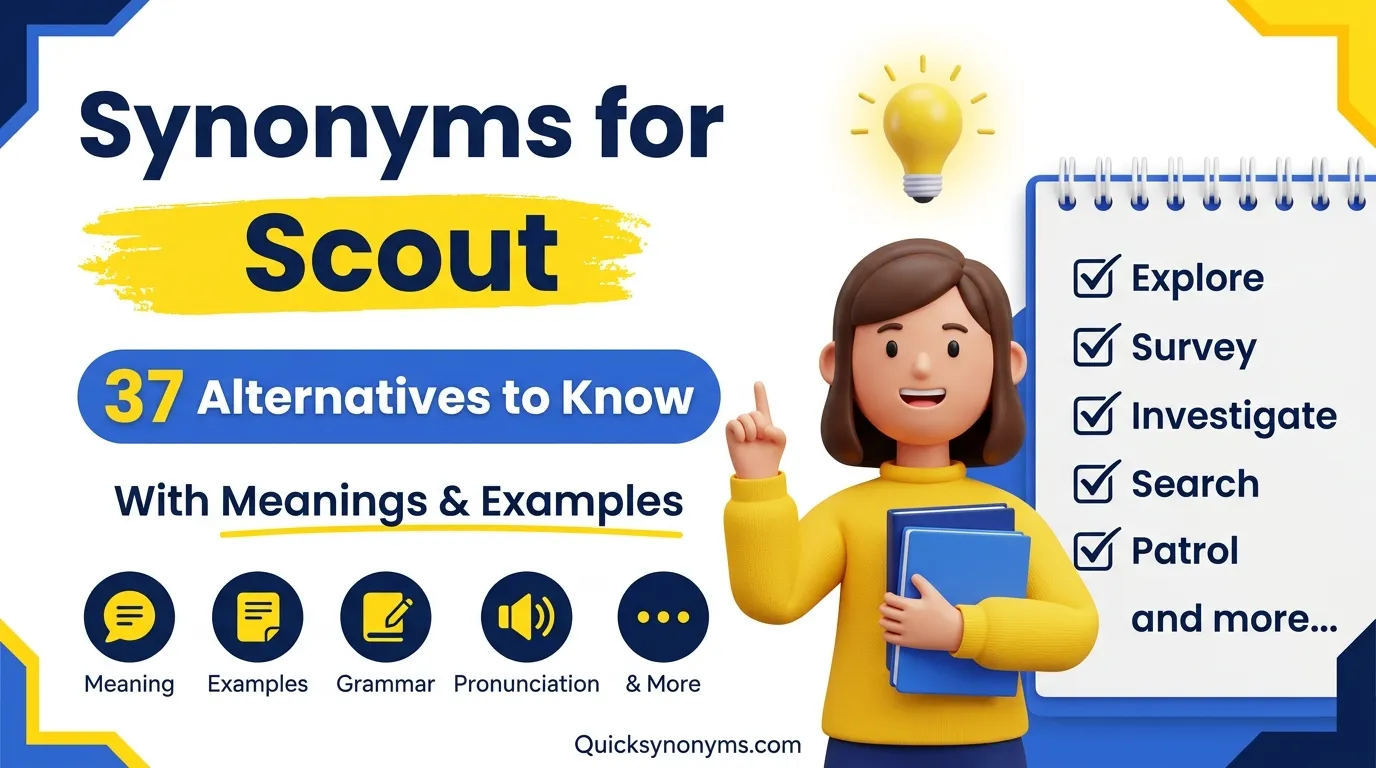
This article explains the meaning of scout, its history, pronunciation, word family, and 37 useful synonyms with examples so your writing and speech carry more range.
Meaning of Scout
Definition
Scout (Verb):
To explore or examine an area or situation carefully in order to gather information.
Examples
- The coach scouted three players before the final decision.
- They scouted the neighborhood before choosing a new apartment.
Connotative Meaning
The tone of “scout” shifts a little depending on the situation.
- Positive tone: Used for careful preparation, like scouting a good restaurant before a date.
- Negative tone: Used when someone secretly checks out a target for a harmful purpose, like scouting a house to rob.
- Neutral tone: Used in business or sports contexts, such as scouting talent or scouting market trends.
(Connotation: the feeling or association a word carries beyond its basic meaning)
Etymology
The word scout traces back to the Old French verb “escouter,” meaning to listen. That word came from the Latin “auscultare,” which also meant to listen attentively. Over time, the meaning shifted from simply listening to actively searching for information.
- Old English (450–1100): The concept existed through native words for spying or watching, though “scout” itself had not entered English yet.
- Middle English (1100–1500): English borrowed “escouter” from Old French, tied closely to military spying and listening for danger.
- Modern English (1500–Present): The word broadened beyond military use to cover talent searches, exploration, and general information gathering.
Pronunciation (IPA)
- IPA: /skaʊt/
- Syllables: scout (one syllable)
Affixation Pattern of Scout
- Root: scout (from Old French “escouter,” Latin “auscultare”)
- Prefix: none in the base form
- Suffix: none in the base form
- Word formations:
- Scout (verb, noun)
- Scouting (noun, gerund)
- Scouted (adjective, past tense)
- Scouter (noun, one who scouts)
- Scoutmaster (noun, compound form)
37 Synonyms of Scout : With Meaning & Examples
1. Explore (Verb)
Meaning: To travel through an unfamiliar area to learn about it.
Examples:
- They explored the coastline before setting up camp.
- She explored several career paths before choosing one.
2. Survey (Verb)
Meaning: To look over an area carefully, often to assess it.
Examples:
- The team surveyed the land before construction began.
- He surveyed the crowd looking for a familiar face.
3. Reconnoiter (Verb)
Meaning: To make a military-style observation of an area, often used in formal contexts.
Examples:
- The unit reconnoitered the valley before dawn.
- They reconnoitered the building’s exits in advance.
4. Investigate (Verb)
Meaning: To examine something closely to find facts or details.
Examples:
- Detectives investigated the scene for clues.
- She investigated the company before accepting the offer.
5. Search (Verb)
Meaning: To look thoroughly for something.
Examples:
- They searched the forest for the missing hiker.
- He searched online for a better deal.
6. Probe (Verb)
Meaning: To investigate something thoroughly, often looking beneath the surface.
Examples:
- Journalists probed the company’s financial records.
- The doctor probed further into her symptoms.
7. Canvass (Verb)
Meaning: To go through an area systematically gathering information or opinions.
Examples:
- Volunteers canvassed the neighborhood for votes.
- Police canvassed the street for witnesses.
8. Patrol (Verb)
Meaning: To move through an area regularly to check for danger.
Examples:
- Guards patrol the warehouse every night.
- The ranger patrols the park boundary daily.
9. Inspect (Verb)
Meaning: To examine something closely for quality or safety.
Examples:
- She inspected the apartment before signing the lease.
- Officials inspected the bridge after the storm.
10. Examine (Verb)
Meaning: To look at something in detail to understand it better.
Examples:
- The vet examined the injured bird carefully.
- He examined the contract line by line.
11. Observe (Verb)
Meaning: To watch something carefully, often for information.
Examples:
- Scientists observed the animals from a distance.
- She observed the meeting without speaking much.
12. Monitor (Verb)
Meaning: To watch something continuously over time.
Examples:
- The app monitors your daily steps.
- Analysts monitor the stock market closely.
13. Track (Verb)
Meaning: To follow the movement or progress of something.
Examples:
- They tracked the storm as it moved north.
- The app tracks your delivery in real time.
14. Trail (Verb)
Meaning: To follow someone or something closely, often quietly.
Examples:
- The detective trailed the suspect for hours.
- The dog trailed the scent through the woods.
15. Shadow (Verb)
Meaning: To follow someone closely, often without being noticed.
Examples:
- The bodyguard shadowed the celebrity all night.
- A reporter shadowed the senator for a week.
16. Tail (Verb)
Meaning: To follow someone secretly, often used informally.
Examples:
- The agent tailed the car for several blocks.
- He noticed someone tailing him downtown.
17. Case (Verb)
Meaning: To examine a place carefully beforehand, often with a hidden purpose.
Examples:
- The thieves cased the store before the robbery.
- He cased the parking lot before parking there.
18. Suss out (Phrasal Verb)
Meaning: To figure something out through careful observation, an informal expression.
Examples:
- She sussed out the best route to work.
- He tried to suss out the team’s real plan.
19. Check out (Phrasal Verb)
Meaning: To look at or investigate something to learn more, used casually.
Examples:
- Let’s check out the new restaurant downtown.
- He checked out the used car before buying it.
20. Look around (Phrasal Verb)
Meaning: To examine the surroundings casually.
Examples:
- We looked around the venue before booking it.
- She looked around the store for a while.
21. Prospect (Verb)
Meaning: To search an area for something valuable, often used in mining or business.
Examples:
- Early settlers prospected the hills for gold.
- Sales teams prospect for new clients daily.
22. Hunt (Verb)
Meaning: To search actively for something specific.
Examples:
- She hunted for an apartment near the office.
- They hunted through old files for the record.
23. Seek (Verb)
Meaning: To try to find or obtain something, often formal.
Examples:
- He sought advice from a trusted mentor.
- The company seeks new talent every quarter.
24. Look for (Phrasal Verb)
Meaning: To search for something, used commonly in everyday speech.
Examples:
- We are looking for a bigger office space.
- She looked for her keys all morning.
25. Spy (Verb)
Meaning: To watch someone or something secretly to gather information.
Examples:
- He spied on the neighbors through the fence.
- Agents spied on the meeting from a nearby car.
26. Snoop (Verb)
Meaning: To secretly look around, often out of curiosity, an informal word.
Examples:
- She snooped through his desk drawers.
- Don’t snoop around my messages.
27. Recon (Verb)
Meaning: To gather information about an area, a shortened, informal form of reconnoiter.
Examples:
- They reconned the building before the event.
- Let’s recon the venue this weekend.
28. Sound out (Phrasal Verb)
Meaning: To carefully test someone’s opinion or reaction before acting.
Examples:
- He sounded out his boss before making the request.
- She sounded out her friends about the idea first.
29. Feel out (Phrasal Verb)
Meaning: To gradually gather information about a situation before acting.
Examples:
- They felt out the market before launching the product.
- He felt out the room before giving his opinion.
30. Vet (Verb)
Meaning: To carefully check someone’s background before approval.
Examples:
- The company vets every new hire thoroughly.
- Editors vetted the article for accuracy.
31. Screen (Verb)
Meaning: To examine and evaluate candidates or options.
Examples:
- Recruiters screened hundreds of resumes.
- The clinic screens patients before appointments.
32. Scan (Verb)
Meaning: To look over something quickly to find key information.
Examples:
- She scanned the room for an empty seat.
- He scanned the report for major errors.
33. Sweep (Verb)
Meaning: To search an area thoroughly and systematically.
Examples:
- Security swept the building before the event.
- Teams swept the field looking for evidence.
34. Range (Verb)
Meaning: To move over a wide area while searching, often used for animals or explorers.
Examples:
- Wolves range across large stretches of forest.
- Early traders ranged far beyond their home region.
35. Forage (Verb)
Meaning: To search widely for something needed, often food or resources.
Examples:
- Deer forage through the woods at dawn.
- They foraged the shelves for spare parts.
36. Rove (Verb)
Meaning: To wander an area while looking around, often used in a literary sense.
Examples:
- His eyes roved across the crowded room.
- Explorers roved the coastline for weeks.
37. Comb (Verb)
Meaning: To search an area thoroughly and carefully.
Examples:
- Police combed the park for evidence.
- She combed through old emails for the address.
Prototype Meaning
When most people hear the word scout, they picture someone quietly watching from a distance, gathering information before anyone else notices, like a talent scout in the stands or a soldier checking the road ahead. This image of careful, purposeful searching sits at the center of the word, whether it applies to people, places, or opportunities.
Prototype Categorization
Grouping these synonyms makes it easier to choose the right word for the right situation.
- Careful searching or exploring: Explore, search, hunt, seek, look for, comb
- Secretive or hidden observation: Spy, snoop, tail, shadow, case, trail
- Formal or professional checking: Investigate, vet, screen, survey, inspect, examine
- Casual, everyday phrases: Check out, look around, suss out, sound out, feel out
- Wide, roaming movement: Range, rove, forage, patrol, sweep
This grouping helps a writer match tone, whether describing a detective novel, a business report, or a casual conversation.
Antonyms of Scout
Ignore (Verb)
To pay no attention to something.
Overlook (Verb)
To fail to notice or check something.
Avoid (Verb)
To deliberately stay away from something.
Neglect (Verb)
To fail to give proper attention or care.
Disregard (Verb)
To not consider or take notice of something.
Short Questions and Answers
What does scout mean?
It means to search or explore an area carefully in order to gather information, often before making a decision.
When should scout be used?
Use it when describing careful preparation or investigation, such as scouting talent, locations, or opportunities.
Is scout positive or negative?
It usually carries a neutral to positive tone, though it can sound negative when used for secretive or harmful purposes.
How is it different from similar words?
Words like “spy” suggest secrecy and hidden intent, while “scout” more often suggests open, purposeful preparation or research.
Conclusion
Learning synonyms for scout helps your writing feel more precise and much less repetitive. You can choose “vet” for a hiring context, “recon” for a casual, quick check, or “comb” when describing a thorough search.
Building this kind of vocabulary strengthens both writing and speaking. It helps you avoid repeating the same word again and again, and lets you capture the exact tone a sentence needs, from a detective’s quiet trail to a coach watching new talent.
Try using a few of these new words in your own sentences this week. Small, steady practice like this builds real confidence in English over time.
For more useful vocabulary, check out our related list of Synonyms for Agent to expand your range even further.

ESL Writing Coach
Olivia Bennett helps English learners strengthen their writing, expand their vocabulary, and communicate more naturally. Her content is designed to make everyday and professional English simple and accessible.