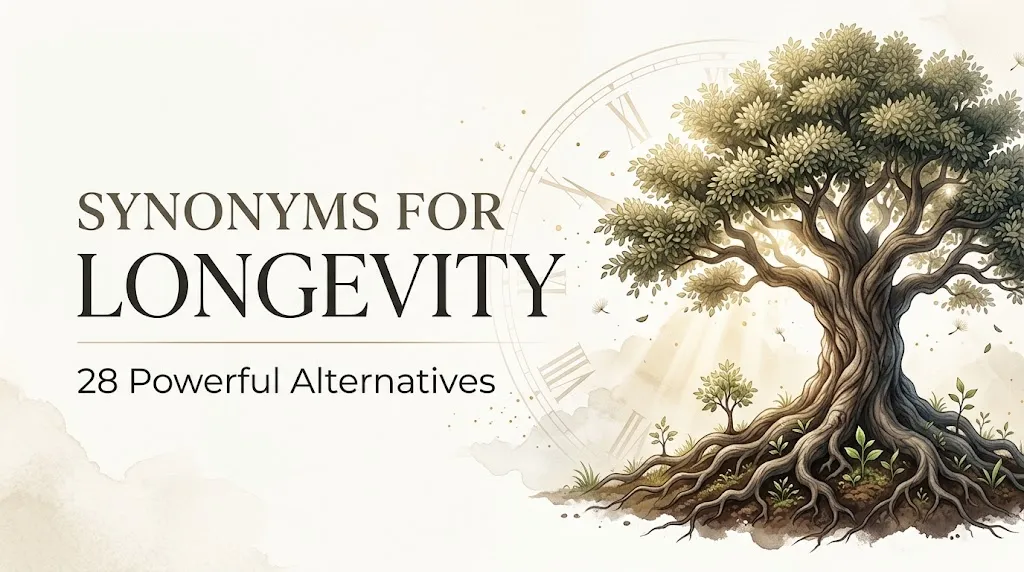
Longevity means a long life or the ability of a person, animal, object, or idea to last for a long time.
Imagine a family celebrating a grandparent’s 100th birthday. Everyone may talk about the person’s healthy habits, strong spirit, and long life. In this situation, longevity is a natural word because it focuses on living or lasting for many years.
The word is also useful when we talk about products, careers, traditions, businesses, and ideas that remain useful or popular over time.
Learning synonyms for longevity helps English learners avoid using the same word again and again. It also helps writers choose words that fit different meanings and situations.
In this guide, we explain the meaning, synonyms, examples, grammar, history, pronunciation, word formation, and semantic groups related to longevity.
Meaning of Longevity
Definition
Longevity (Noun):
Longevity means a long life or the ability to live, exist, remain useful, or stay successful for a long time.
Examples
- Regular exercise may improve a person’s longevity.
- The simple design gives the product excellent longevity.
Connotative Meaning
Connotation: The feeling or idea that a word suggests beyond its basic meaning.
- Positive tone: Longevity often suggests health, strength, success, value, or lasting quality.
- Negative tone: It can sometimes suggest something continuing for too long, especially when the context is unpleasant.
- Neutral tone: In science, business, and general writing, longevity can simply describe how long something lives, exists, or remains useful.
Etymology
The word longevity entered English in the early 17th century. It came from Late Latin longaevitatem, meaning “great age” or “long life.” The Latin word longaevus was built from longus, meaning “long,” and aevum, meaning “age,” “lifetime,” or “time.”
Old English (450–1100)
The modern word longevity was not yet an English word during the Old English period. However, its Latin roots are connected with the older idea of long life and extended time. The English word long already existed in Old English as lang.
Middle English (1100–1500)
During Middle English, English developed many words and expressions connected with age, life, duration, and length. The exact noun longevity had not yet become established in English.
Modern English (1500–Present)
Longevity appeared in English around the 1610s. It developed from Late Latin and came to mean unusually long life or the length and duration of life. Today, it can also describe how long something remains useful, successful, or popular.
Pronunciation (IPA)
- IPA: /lɒnˈdʒev.ə.ti/ (UK), /lɑːnˈdʒev.ə.t̬i/ (US)
- Syllables: lon-ge-vi-ty
Cambridge lists the stress on the third syllable and gives separate UK and US pronunciations.
Affixation Pattern of Longevity
- Root: long + aev (related to age or lifetime)
- Prefix: None
- Suffix: -ity
- Word formations:
- longevity – noun: long life or lasting existence
- longevous – adjective: long-lived or long-lasting, especially in relation to life
- longevously – adverb: in a long-lasting or long-lived way
- longeval – adjective: long-lived; rare and archaic
The related adjective longevous comes from Latin longaevus, formed from longus “long” and aevum “age, time, lifetime.”
28 Synonyms of Longevity With Meaning & Examples
1. Long Life (Noun Phrase)
Meaning: A life that continues for many years.
Examples:
- A healthy diet may support a long life.
- Her family is known for long life.
2. Lifespan (Noun)
Meaning: The length of time a person, animal, or thing exists.
Examples:
- The average lifespan of this species is 15 years.
- Proper care can increase the lifespan of a machine.
3. Lifetime (Noun)
Meaning: The entire period during which a person or thing is alive or exists.
Examples:
- He achieved many goals during his lifetime.
- The product has a lifetime of about ten years.
4. Life Expectancy (Noun Phrase)
Meaning: The expected number of years that a person or group is likely to live.
Examples:
- Better healthcare has increased life expectancy.
- Scientists study factors that affect life expectancy.
5. Duration (Noun)
Meaning: The amount of time that something continues or lasts.
Examples:
- The medication has a short duration.
- The building has survived for the duration of many generations.
6. Endurance (Noun)
Meaning: The ability to continue or last despite difficulty.
Examples:
- The athlete showed great endurance.
- The material is valued for its endurance.
7. Durability (Noun)
Meaning: The ability of something to remain useful or strong for a long time.
Examples:
- Customers like the durability of this phone.
- The chair is known for its durability.
8. Permanence (Noun)
Meaning: The quality of continuing without ending or changing.
Examples:
- The stone structure gives the garden a sense of permanence.
- The company questioned the permanence of the new policy.
9. Continuity (Noun)
Meaning: The state of continuing without interruption.
Examples:
- The project needs continuity to succeed.
- The tradition has survived through continuity between generations.
10. Continuance (Noun)
Meaning: The act or state of continuing for a period of time.
Examples:
- The agreement allows for the continuance of the program.
- The continuance of the tradition depends on younger people.
11. Persistence (Noun)
Meaning: The ability to continue despite problems or opposition.
Examples:
- Her persistence helped her finish the project.
- The persistence of the tradition is remarkable.
12. Staying Power (Noun Phrase)
Meaning: The ability to remain successful, useful, or popular for a long time.
Examples:
- This brand has impressive staying power.
- The song has shown surprising staying power.
13. Lastingness (Noun)
Meaning: The quality of continuing for a long time.
Examples:
- The lastingness of the material makes it valuable.
- Writers often consider the lastingness of their work.
14. Sustainability (Noun)
Meaning: The ability to continue successfully over a long period.
Examples:
- The company is focused on financial sustainability.
- Sustainable farming can support long-term food production.
15. Survival (Noun)
Meaning: The state of continuing to live or exist.
Examples:
- Clean water is important for survival.
- The survival of the old tradition surprised researchers.
16. Perpetuity (Noun)
Meaning: A state of continuing forever or for an unlimited period.
Examples:
- The land was placed in trust in perpetuity.
- The rule was intended to remain in perpetuity.
17. Eternity (Noun)
Meaning: Endless time or a period with no beginning or end.
Examples:
- The poem speaks about love lasting for eternity.
- The wait seemed to last an eternity.
18. Immortality (Noun)
Meaning: The state of living or lasting forever.
Examples:
- The king dreamed of achieving immortality.
- Great writers may gain a kind of cultural immortality through their work.
19. Endlessness (Noun)
Meaning: The quality of having no apparent end.
Examples:
- The desert gave him a feeling of endlessness.
- The story explores the endlessness of time.
20. Everlastingness (Noun)
Meaning: The quality of continuing forever or for a very long time.
Examples:
- The poem celebrates the everlastingness of love.
- The monument represents the everlastingness of the nation.
21. Resilience (Noun)
Meaning: The ability to recover, survive, or remain strong after difficulty.
Examples:
- The tree showed remarkable resilience after the storm.
- The company’s resilience helped it survive difficult years.
22. Stability (Noun)
Meaning: The quality of remaining steady and lasting without major change.
Examples:
- Financial stability can help a business survive.
- The family’s stability supported the children.
23. Robustness (Noun)
Meaning: The quality of being strong enough to last or withstand difficult conditions.
Examples:
- The robustness of the system makes it reliable.
- Engineers tested the robustness of the machine.
24. Tenacity (Noun)
Meaning: The quality of continuing firmly despite difficulty.
Examples:
- Her tenacity helped her build a successful career.
- The plant survived because of its tenacity.
25. Prolongation (Noun)
Meaning: The act of making something continue for a longer period.
Examples:
- The treatment may lead to the prolongation of life.
- The prolongation of the project increased its cost.
26. Extended Duration (Noun Phrase)
Meaning: A period that continues longer than usual.
Examples:
- The battery works well during extended duration use.
- The building remained in service for an extended duration.
27. Long-Lasting Quality (Noun Phrase)
Meaning: The ability of something to remain useful, strong, or effective for a long time.
Examples:
- Buyers value the long-lasting quality of the product.
- The material is famous for its long-lasting quality.
28. Long-Livedness (Noun)
Meaning: The quality of living or existing for a long time.
Examples:
- The long-livedness of the species interests scientists.
- Researchers studied the long-livedness of several trees.
Prototype Meaning
The most typical meaning of longevity is a long life or long-lasting existence. When people hear this word, they usually think about someone living to an advanced age, but the word can also describe animals, products, careers, traditions, businesses, and ideas that remain useful or successful for many years. This wider meaning makes longevity useful in health, science, business, technology, and everyday writing.
Prototype Categorization
The 28 synonyms above can be grouped by the type of lasting quality they describe:
- Long life: long life, lifespan, lifetime, life expectancy, long-livedness focus mainly on how long a person, animal, or living thing exists.
- Long duration: duration, prolongation, extended duration, continuance focus on the length of time something continues.
- Strength and survival: endurance, durability, resilience, robustness, tenacity, survival describe the ability to remain strong or continue under difficult conditions.
- Permanent existence: permanence, continuity, perpetuity, eternity, immortality, endlessness, everlastingness suggest very long or unlimited existence.
- Long-term success: staying power, sustainability, stability, persistence work well when discussing businesses, ideas, traditions, careers, or projects.
- Lasting quality: lastingness, long-lasting quality describe the ability of something to remain useful or effective.
This categorization helps writers choose a synonym based on the exact meaning they want. For example, lifespan works well for an object or species, while staying power is better for popularity or success. Durability suits products, while immortality suggests something that lasts forever.
Antonyms of Longevity
1. Short Life (Noun Phrase)
Meaning: A life that lasts for a short period.
2. Brevity (Noun)
Meaning: The quality of lasting or continuing for only a short time.
3. Transience (Noun)
Meaning: The state of lasting for a short time and then passing away.
4. Temporariness (Noun)
Meaning: The quality of being temporary rather than lasting.
5. Mortality (Noun)
Meaning: The state of being subject to death.
6. Ephemerality (Noun)
Meaning: The quality of existing or lasting for a very short time.
Short Questions and Answers
What does longevity mean?
Longevity means a long life or the ability of someone or something to exist, remain useful, or stay successful for a long time.
When should longevity be used?
Use longevity when you want to discuss long life, long-term existence, lasting usefulness, or continued success.
Is longevity positive or negative?
Longevity is usually positive or neutral. It often suggests health, strength, durability, or lasting success. Its meaning depends on the context.
How is longevity different from similar words?
Longevity is a broad word for long life or lasting existence. Lifespan focuses on the length of existence, durability focuses on physical strength, and staying power often focuses on continued popularity or success.
Conclusion
Learning longevity and its synonyms can make your English clearer, stronger, and more flexible. Words such as lifespan and lifetime are useful when discussing life or existence, while durability works well for products and materials. Words such as persistence, endurance, and resilience describe the ability to continue through challenges.
More powerful words such as perpetuity, eternity, and immortality suggest an extremely long or endless existence. Knowing these differences helps you avoid repetition and choose the right word for each situation. It can also improve your writing, speaking, and vocabulary confidence. Practice using a few new synonyms each day. Over time, this simple habit can help you express ideas more naturally and accurately.
Read more: Resume Synonyms for Manage: 25 Strong Verbs

ESL Writing Coach
Olivia Bennett helps English learners strengthen their writing, expand their vocabulary, and communicate more naturally. Her content is designed to make everyday and professional English simple and accessible.





1 thought on “Synonyms for Longevity: 28 Words to Know”