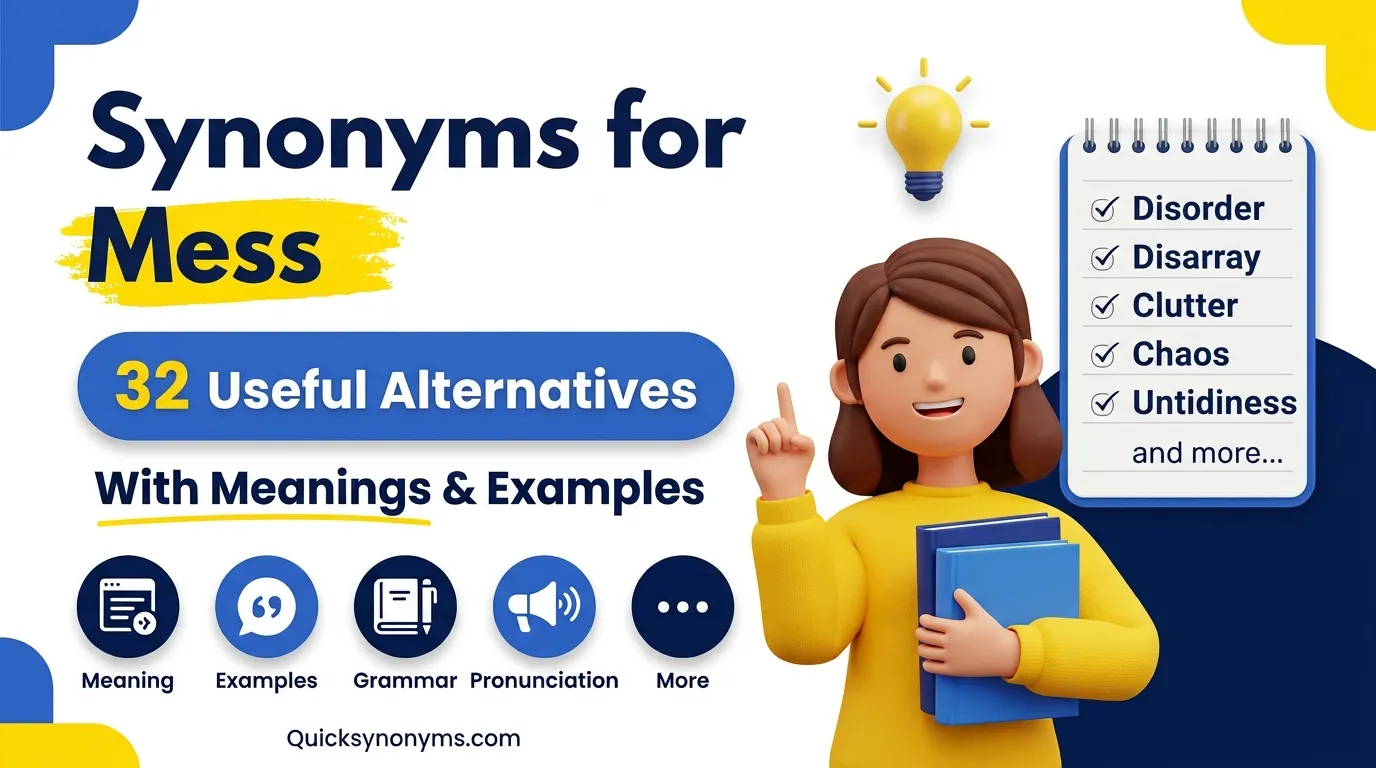
Mess means a dirty, untidy, or confused state. You may use it when your room is full of clothes, papers, and other things with no order. The word is common in daily English because it quickly describes a place, situation, or state that lacks order.
Synonyms help English learners express the same idea in different ways. They also help writers choose a word that gives the right level of meaning, from simple untidiness to serious confusion.
This article covers the meaning of mess, examples, grammar, history, pronunciation, and 32 useful synonyms. It also groups these words by meaning so you can choose the best one for each situation.
Meaning of Mess
Definition
Mess (noun): a dirty, untidy, or confused state.
Examples
- My bedroom is a complete mess.
- Please clean up the mess in the kitchen.
Connotative Meaning
- Positive tone: Usually none, though a playful mess may feel harmless.
- Negative tone: Suggests dirt, disorder, confusion, or trouble.
- Neutral tone: Can simply describe a state that lacks order.
Etymology
The word mess entered English from Old French mes, meaning a portion of food or a serving. It later developed meanings connected with a group eating together and then with disorder or confusion.
- Old French: Mes meant a portion or serving of food.
- Middle English: Mess referred to a serving of food and later a group eating together.
- Modern English: The word developed its common senses of disorder, untidiness, and a difficult situation.
Pronunciation (IPA)
- IPA: /mes/
- Syllables: mess
Affixation Pattern of Mess
- Root: mess
- Prefix: None
- Suffix: None
- Word formations:
- mess: noun
- mess: verb
- messy: adjective
- messiness: noun
- messed: verb form
- messing: verb form
32 Synonyms of Mess: With Meaning and Examples
1. Disorder (noun)
Meaning: A state in which things are not arranged neatly or properly.
Examples:
- The files were in complete disorder.
- The room was left in disorder.
2. Disarray (noun)
Meaning: A state of being untidy or badly arranged.
Examples:
- The books were scattered in disarray.
- Her desk was in complete disarray.
3. Clutter (noun)
Meaning: A collection of things covering an area in an untidy way.
Examples:
- Too much clutter filled the office.
- She removed the clutter from her desk.
4. Chaos (noun)
Meaning: A state of complete confusion and disorder.
Examples:
- The kitchen was in chaos.
- The sudden move caused chaos in the house.
5. Untidiness (noun)
Meaning: The state of being messy or not neat.
Examples:
- His untidiness annoyed his roommate.
- The room showed signs of untidiness.
6. Confusion (noun)
Meaning: A lack of order or clear understanding.
Examples:
- The new rules caused confusion.
- There was confusion in the crowded hall.
7. Turmoil (noun)
Meaning: A state of great confusion or disorder.
Examples:
- The company was in turmoil.
- The decision caused turmoil among the workers.
8. Tangle (noun)
Meaning: A confused mass or complicated situation.
Examples:
- The cables were a tangled mess.
- We found ourselves in a legal tangle.
9. Shambles (noun)
Meaning: A state of great disorder or poor condition.
Examples:
- The old office was a shambles.
- After the party, the house was a shambles.
10. Jumble (noun)
Meaning: A confused mixture of things.
Examples:
- The drawer contained a jumble of keys.
- His notes were a jumble of ideas.
11. Hodgepodge (noun)
Meaning: A confused mixture of different things.
Examples:
- The room was a hodgepodge of old furniture.
- Her speech became a hodgepodge of ideas.
12. Muddle (noun)
Meaning: A confused or disorganized state.
Examples:
- The paperwork was a complete muddle.
- His thoughts were in a muddle.
13. Heap (noun)
Meaning: A disorganized pile of things.
Examples:
- A heap of clothes covered the chair.
- He left a heap of papers on the floor.
14. Pile (noun)
Meaning: A group of things placed on top of one another.
Examples:
- There was a pile of books on the floor.
- She sorted through the pile of clothes.
15. Clump (noun)
Meaning: A group of things gathered closely together.
Examples:
- A clump of papers lay beside the printer.
- He found a clump of wires under the desk.
16. Accumulation (noun)
Meaning: A growing collection of things gathered over time.
Examples:
- The accumulation of boxes filled the room.
- Dust formed an accumulation under the bed.
17. Litter (noun)
Meaning: Small unwanted things scattered around an area.
Examples:
- Litter covered the empty room.
- Please remove the litter from the floor.
18. Debris (noun)
Meaning: Scattered remains or unwanted pieces left after something happens.
Examples:
- Debris covered the floor after the storm.
- Workers cleared the debris from the building.
19. Rubbish (noun)
Meaning: Waste or unwanted things.
Examples:
- Rubbish was scattered around the yard.
- He took the rubbish outside.
20. Untidiness (noun)
Meaning: A lack of neatness or order.
Examples:
- The teacher noticed the untidiness of the room.
- His untidiness made the small space feel worse.
21. Squalor (noun)
Meaning: A very dirty and unpleasant living condition.
Examples:
- The building was in terrible squalor.
- They worked to remove the family from squalor.
22. Sloppiness (noun)
Meaning: A lack of care, order, or neatness.
Examples:
- His sloppiness made the office look untidy.
- The report showed some sloppiness.
23. Neglect (noun)
Meaning: A lack of care that allows something to become dirty or damaged.
Examples:
- The garden suffered from neglect.
- Years of neglect damaged the house.
24. Disorganization (noun)
Meaning: A lack of proper order or planning.
Examples:
- The office suffered from disorganization.
- Poor disorganization slowed the project.
25. Confusion (noun)
Meaning: A state in which things or ideas are unclear or mixed up.
Examples:
- The instructions created confusion.
- Confusion spread through the group.
26. Complication (noun)
Meaning: A problem that makes a situation harder to manage.
Examples:
- The delay created another complication.
- We faced several complications.
27. Predicament (noun)
Meaning: A difficult or unpleasant situation.
Examples:
- He found himself in a difficult predicament.
- The mistake put us in a strange predicament.
28. Plight (noun)
Meaning: A difficult or troubling situation.
Examples:
- The workers faced a serious plight.
- She explained the family’s difficult plight.
29. Fix (noun)
Meaning: A difficult situation that someone needs to escape or solve, in informal English.
Examples:
- He was in a real fix.
- We were in a fix after the car broke down.
30. Trouble (noun)
Meaning: A difficult or unpleasant situation.
Examples:
- We got into trouble at work.
- The broken door caused trouble.
31. Predicament (noun)
Meaning: An awkward or difficult situation.
Examples:
- The lost passport left her in a predicament.
- He did not know how to escape the predicament.
32. Hotchpotch (noun)
Meaning: A confused mixture of different things.
Examples:
- The room was a hotchpotch of colors and furniture.
- His argument was a hotchpotch of unrelated ideas.
Prototype Meaning
The most typical meaning of mess is a state of physical untidiness. When people hear the word, they often imagine a room, desk, kitchen, or other place covered with scattered or poorly arranged things.
Prototype Categorization
- Physical disorder: disorder, disarray, clutter, untidiness, jumble, heap, pile, clump, accumulation, litter. Use these for rooms, desks, objects, papers, clothes, and other physical things.
- Strong confusion: chaos, confusion, turmoil, tangle, shambles, muddle, hodgepodge, hotchpotch. Use these when things are badly mixed, unclear, or difficult to control.
- Dirt and poor conditions: debris, rubbish, squalor, sloppiness, neglect. Use these when a mess involves waste, dirt, poor care, or bad conditions.
- Problems and difficult situations: complication, predicament, plight, fix, trouble. Use these when mess means a difficult situation rather than physical untidiness.
- Lack of organization: disorganization. Use this when a mess results from poor planning or poor organization.
Grouping helps you choose a synonym that matches the exact meaning of mess. Some words describe physical disorder, while others describe confusion or a difficult situation.
Antonyms of Mess
- Order (noun): A neat and organized state.
- Cleanliness (noun): The state of being clean.
- Neatness (noun): The quality of being tidy and well arranged.
- Organization (noun): A clear and orderly arrangement.
- Tidiness (noun): The quality of being neat and orderly.
- Clarity (noun): A clear and easy-to-understand state.
- Arrangement (noun): An orderly way of placing things.
- Harmony (noun): A pleasing state of order and agreement.
Short Questions and Answers
What does Mess mean?
Mess means a dirty, untidy, disorganized, or confused state. It can also mean a difficult situation.
When should Mess be used?
Use mess when describing physical untidiness or a difficult situation. The exact meaning depends on the context.
Is Mess positive or negative?
Mess usually has a negative meaning because it suggests disorder, dirt, confusion, or trouble.
How is it different from similar words?
Clutter usually means too many objects in one place. Chaos suggests much stronger confusion and disorder, while disarray focuses on things being badly arranged.
Conclusion
Learning synonyms for mess gives you more ways to describe disorder, confusion, and difficult situations. Words such as clutter, disarray, chaos, and muddle can make your writing more exact and interesting.
These words also help you avoid repeating mess in everyday speech and written English. By learning their small differences, you can choose a word that better matches the situation and tone.
Try using a few of these synonyms in your own sentences each day. Daily vocabulary practice can improve your English, strengthen your writing, and build confidence when you speak.
Learn More: Synonyms for Compatible: 30 Words to Know

Lexicographer & Vocabulary Specialist
Nathan Carter focuses on English vocabulary, synonyms, antonyms, and word meanings. He is passionate about producing clear, accurate, and easy-to-understand language guides for readers of all levels.