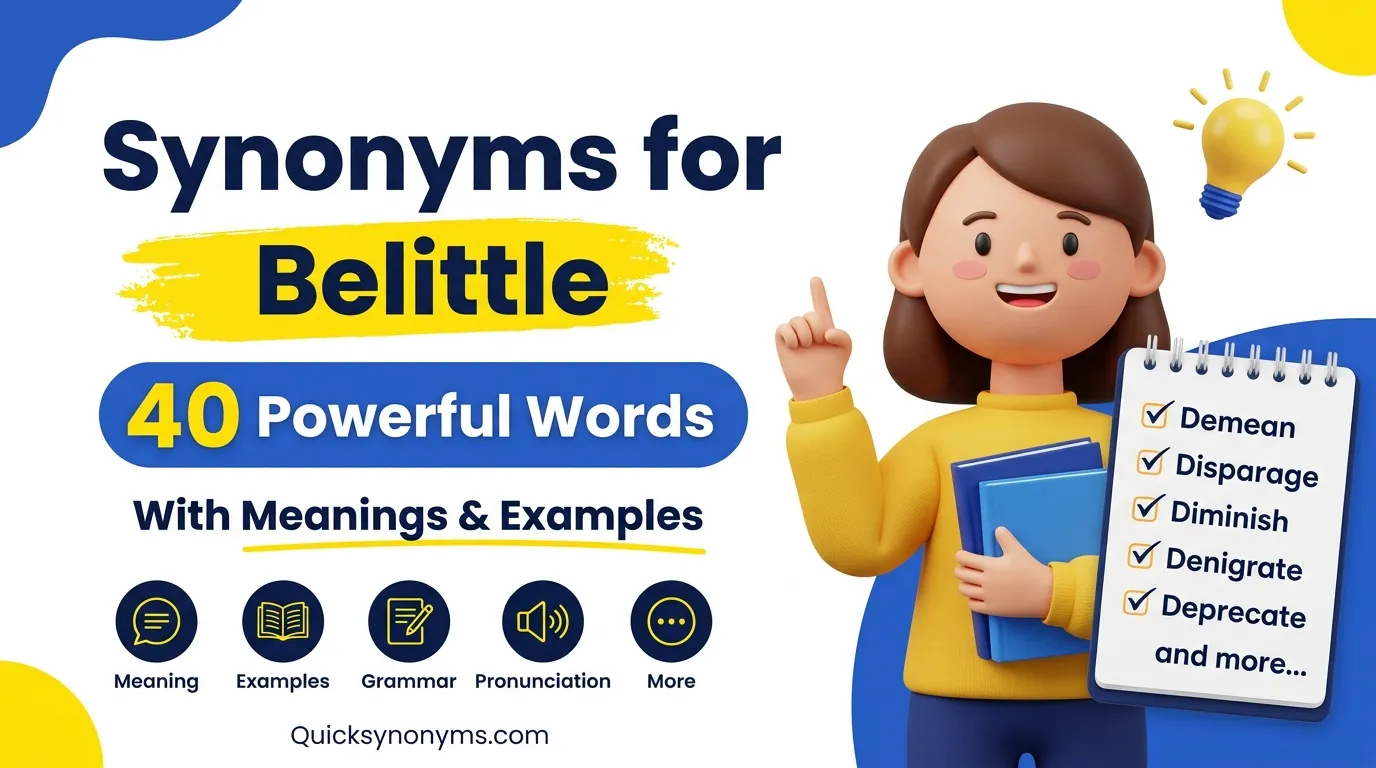
Synonyms for Belittle are words that describe making someone or something seem less important, valuable, or capable. You might belittle someone by mocking their ideas, skills, work, or achievements.
Synonyms help English learners express criticism with greater accuracy. They also help writers avoid repetition and choose words that match the tone and strength of their message.
This article covers the meaning of belittle, examples, grammar, history, pronunciation, and 40 useful synonyms. It also groups the words by meaning to help you choose the right word for each situation.
Meaning of Belittle
Definition
Belittle (verb): to make someone or something seem less important, valuable, or capable.
Examples
- Do not belittle her hard work.
- He often belittles other people’s ideas.
Connotative Meaning
- Positive tone: Usually none.
- Negative tone: Insulting, disrespectful, or dismissive.
- Neutral tone: Making something seem less important or valuable.
Etymology
Belittle is an English formation made from be- and little. It was formed to express the idea of making something little or less important.
- Old English: Not applicable as the modern verb belittle did not exist.
- Early Modern English: The word was formed from be- and little.
- Modern English: Belittle means to make someone or something seem unimportant, weak, or inferior.
Pronunciation (IPA)
- IPA: /bɪˈlɪtəl/
- Syllables: be-lit-tle
Affixation Pattern of Belittle
- Root: little
- Prefix: be-
- Suffix: None
- Word formations:
- belittle: verb
- belittled: verb, past tense
- belittling: verb, present participle
- belittlement: noun
40 Synonyms of Belittle: With Meaning and Examples
1. Demean (verb)
Meaning: To make someone seem less worthy or respected.
Examples:
- His comments demeaned the new employee.
- She refused to demean her colleagues.
2. Disparage (verb)
Meaning: To speak about someone or something as if it has little value.
Examples:
- He disparaged her creative work.
- The critic disparaged the new design.
3. Diminish (verb)
Meaning: To make something seem less important or valuable.
Examples:
- Do not diminish his achievements.
- The comment diminished the value of her work.
4. Denigrate (verb)
Meaning: To unfairly criticize someone or something.
Examples:
- The article denigrated the artist’s work.
- She did not want to denigrate his efforts.
5. Deprecate (verb)
Meaning: To express disapproval of something or someone.
Examples:
- He often deprecated modern teaching methods.
- She deprecated the idea during the meeting.
6. Discredit (verb)
Meaning: To make someone or something seem untrustworthy or unworthy of belief.
Examples:
- The report tried to discredit the researcher.
- False claims can discredit a respected expert.
7. Devalue (verb)
Meaning: To make someone or something seem less valuable.
Examples:
- Do not devalue your own skills.
- The remark devalued her contribution.
8. Underrate (verb)
Meaning: To judge someone or something as less good or important than it really is.
Examples:
- Never underrate her ability.
- Many people underrate the value of practice.
9. Underestimate (verb)
Meaning: To think someone or something is less capable or important than it really is.
Examples:
- Do not underestimate your opponent.
- They underestimated the team’s strength.
10. Demeanour (noun)
Meaning: A person’s outward behavior or manner.
Examples:
- His calm demeanour impressed the guests.
- Her friendly demeanour made everyone comfortable.
11. Humiliate (verb)
Meaning: To make someone feel ashamed or embarrassed.
Examples:
- He tried to humiliate his classmate.
- She never humiliates people in public.
12. Insult (verb)
Meaning: To speak or act in a way that shows disrespect.
Examples:
- His words insulted the entire team.
- She did not mean to insult anyone.
13. Mock (verb)
Meaning: To make fun of someone or something.
Examples:
- The students mocked his accent.
- It is wrong to mock someone’s mistakes.
14. Ridicule (verb)
Meaning: To make someone or something look foolish through words or actions.
Examples:
- They ridiculed his suggestion.
- The comedian ridiculed the strange rule.
15. Deride (verb)
Meaning: To make fun of someone or something in a disrespectful way.
Examples:
- The speaker derided the opposing idea.
- Critics derided the unusual design.
16. Scorn (verb)
Meaning: To treat someone or something as unworthy of respect.
Examples:
- She scorned his simple proposal.
- He scorned their concerns.
17. Disdain (verb)
Meaning: To treat someone or something as unworthy or unimportant.
Examples:
- He disdained their advice.
- She disdained the old method.
18. Trivialize (verb)
Meaning: To make something seem less serious or important.
Examples:
- Do not trivialize the problem.
- His joke trivialized a serious issue.
19. Minimize (verb)
Meaning: To make something seem smaller or less important.
Examples:
- She minimized her own success.
- The report minimized the risks.
20. Discount (verb)
Meaning: To treat something as less important or valuable.
Examples:
- Do not discount her experience.
- The manager discounted his concerns.
21. Degrade (verb)
Meaning: To treat someone with disrespect or lower their dignity.
Examples:
- No one should degrade another person.
- The comments degraded the workers.
22. Decry (verb)
Meaning: To publicly criticize something strongly.
Examples:
- Leaders decried the unfair treatment.
- The group decried the harmful practice.
23. Criticize (verb)
Meaning: To point out faults or problems.
Examples:
- It is easy to criticize someone else’s work.
- She criticized the plan fairly.
24. Condemn (verb)
Meaning: To strongly express that something is wrong.
Examples:
- The organization condemned the unfair act.
- Many people condemned his rude behavior.
25. Reproach (verb)
Meaning: To express disappointment or disapproval toward someone.
Examples:
- She reproached him for his harsh words.
- He reproached himself for the mistake.
26. Taunt (verb)
Meaning: To tease someone in a cruel or insulting way.
Examples:
- The boys taunted the new student.
- He taunted his rival during the game.
27. Tease (verb)
Meaning: To make fun of someone, sometimes in an unkind way.
Examples:
- They teased him about his mistake.
- She disliked being teased about her accent.
28. Shame (verb)
Meaning: To make someone feel ashamed or embarrassed.
Examples:
- Do not shame people for their mistakes.
- The comment shamed him in front of his friends.
29. Snub (verb)
Meaning: To treat someone as unimportant or unworthy of attention.
Examples:
- She snubbed his invitation.
- The manager snubbed the junior employee.
30. Patronize (verb)
Meaning: To treat someone as if they are less intelligent or capable.
Examples:
- Please do not patronize me.
- His tone patronized the new workers.
31. Talk down to (verb)
Meaning: To speak to someone as if they are less intelligent or important.
Examples:
- He never talks down to his students.
- She felt that her manager talked down to her.
32. Look down on (verb)
Meaning: To consider someone or something less worthy or important.
Examples:
- Never look down on people because of their jobs.
- He tends to look down on beginners.
33. Put down (verb)
Meaning: To criticize or insult someone in a way that lowers their confidence.
Examples:
- She often puts down her brother.
- Do not put down yourself after a mistake.
34. Run down (verb)
Meaning: To criticize someone or something repeatedly.
Examples:
- He keeps running down his former employer.
- The article ran down the new product.
35. Cut down (verb)
Meaning: To make someone or something seem less important or powerful.
Examples:
- His words cut down her confidence.
- The criticism cut down their enthusiasm.
36. Play down (verb)
Meaning: To make something seem less important or serious.
Examples:
- The company played down the problem.
- She played down her success.
37. Discrediting (verb)
Meaning: Making someone or something seem less trustworthy or worthy of respect.
Examples:
- The campaign was aimed at discrediting the researcher.
- Discrediting someone’s work without evidence is unfair.
38. Undermine (verb)
Meaning: To weaken someone’s confidence, authority, or position.
Examples:
- His comments undermined her confidence.
- The rumor undermined the team’s trust.
39. Decry (verb)
Meaning: To openly criticize something as wrong or harmful.
Examples:
- The group decried the unfair policy.
- Activists decried the poor treatment of workers.
40. Slight (verb)
Meaning: To treat someone as unimportant or show a lack of respect.
Examples:
- She felt slighted by his rude reply.
- The manager slighted the junior staff.
Prototype Meaning
The most typical meaning of belittle is to make a person, achievement, idea, or effort seem less important or valuable than it really is. People often imagine someone using words or actions that lower another person’s confidence or status.
Prototype Categorization
- Making someone seem inferior: Demean, Disparage, Denigrate, Deprecate, Degrade, Patronize, Slight. Use these when a person is treated as less worthy, capable, or respected.
- Making something seem less important: Diminish, Devalue, Underrate, Underestimate, Trivialize, Minimize, Discount, Play down. Use these when reducing the perceived value or importance of something.
- Mocking or insulting: Humiliate, Insult, Mock, Ridicule, Deride, Taunt, Tease, Shame, Put down. Use these when words or actions make someone feel foolish, embarrassed, or hurt.
- Rejecting or criticizing: Discredit, Decry, Criticize, Condemn, Reproach, Scorn, Disdain. Use these when expressing strong criticism or treating an idea as unworthy.
- Ignoring or weakening status: Snub, Talk down to, Look down on, Run down, Cut down, Undermine, Discrediting. Use these when lowering someone’s social standing, confidence, or authority.
Grouping synonyms helps writers see the difference between insulting a person and minimizing the importance of an idea. It also makes word choice more precise.
Antonyms of Belittle
- Praise (verb): To express approval or admiration.
- Respect (verb): To treat someone as worthy of regard.
- Honor (verb): To show great respect.
- Value (verb): To consider someone or something important.
- Appreciate (verb): To recognize the value of something.
- Admire (verb): To regard someone or something with approval.
- Exalt (verb): To praise or raise someone to a higher position.
Short Questions and Answers
What does Belittle mean?
Belittle means to make someone or something seem less important, valuable, or capable.
When should Belittle be used?
Use belittle when someone unfairly lowers the importance, value, or ability of a person, idea, achievement, or effort.
Is Belittle positive or negative?
Belittle is negative because it usually suggests disrespect, criticism, or an attempt to make someone feel less important.
How is it different from similar words?
Diminish often means making something seem less important. Disparage means speaking negatively about someone or something, while demean focuses more on lowering a person’s dignity or status.
Conclusion
Learning belittle and its synonyms can make your English more precise and expressive. Words such as demean, disparage, diminish, and denigrate can describe different ways of lowering the value or importance of someone or something.
Some words focus on people, while others work better for ideas, achievements, or problems. For example, humiliate focuses on embarrassment, while trivialize focuses on making something seem less serious.
Using the right synonym can make your writing clearer and more powerful. Practice a few new words each day, create simple sentences, and notice how they are used in real English. Daily vocabulary practice can build stronger English skills and confidence.
Keep Reading: Synonyms for Defy: 38 Words to Know

English Teacher & Linguistics Writer
Grace Whitmore creates engaging educational content on vocabulary, word usage, and effective communication. Her goal is to help learners build confidence through clear and practical English guidance.