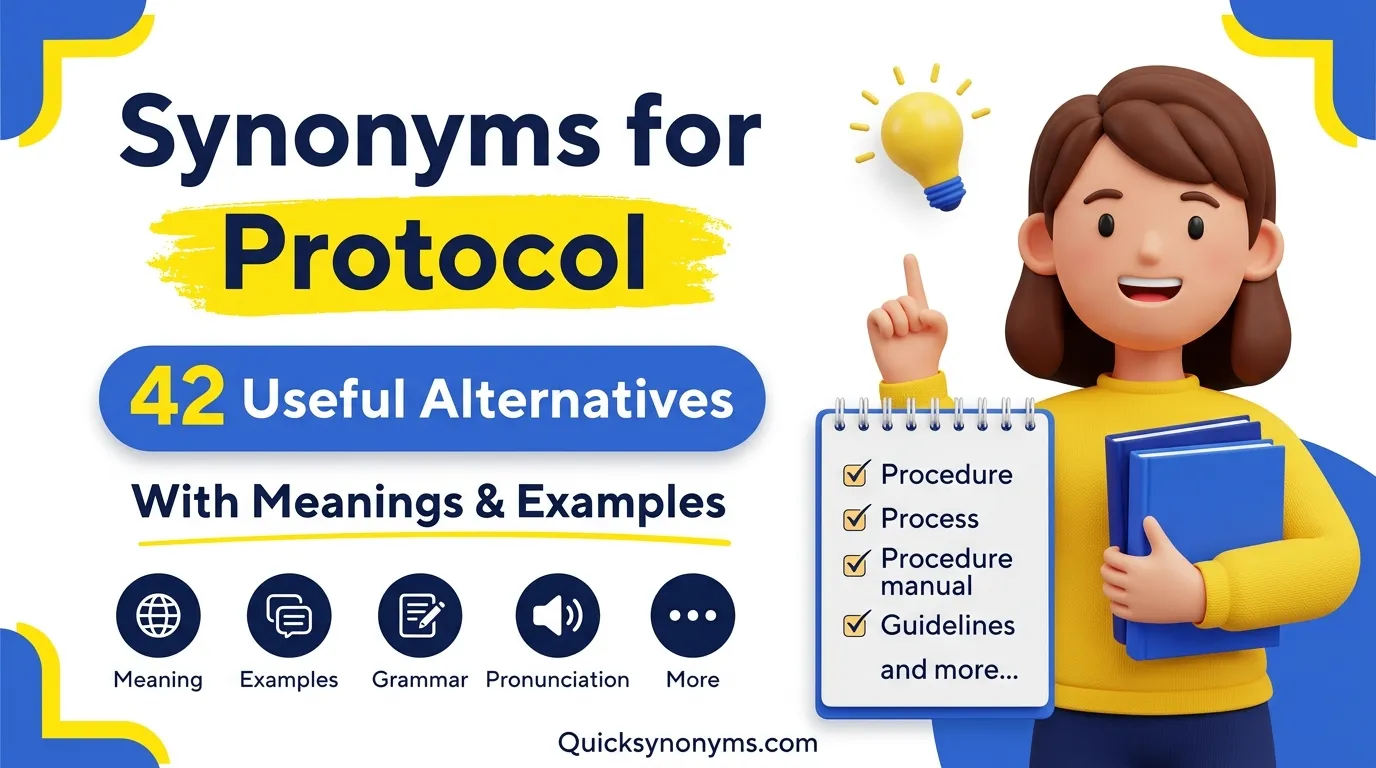
Synonyms for Protocol are words that describe a set of rules, steps, or accepted ways of doing something. You may use protocol in workplaces, hospitals, laboratories, computer networks, or formal events.
Synonyms help English learners understand different ways to talk about rules and procedures. They also help writers avoid repetition and choose words that fit formal, technical, or everyday situations.
This article covers the meaning of protocol, examples, grammar, history, pronunciation, and 42 useful synonyms. It also groups the words by meaning to make them easier to learn and use.
Meaning of Protocol
Definition
Protocol (noun): a set of rules or steps that explains how something should be done.
Examples
- The hospital has a strict safety protocol.
- Please follow the protocol during the experiment.
Connotative Meaning
- Positive tone: Organized, safe, formal, and reliable.
- Negative tone: Can suggest strict or complicated rules.
- Neutral tone: A set of accepted rules or procedures.
Etymology
Protocol comes from Greek prōtokollon, meaning the first sheet of a document. It later passed through Latin and French before developing its modern meanings.
- Greek: prōtokollon referred to the first sheet attached to a document.
- Middle English: The word entered English through French and Latin forms.
- Modern English: Protocol came to mean a formal set of rules, procedures, or accepted practices.
Pronunciation (IPA)
- IPA: /ˈproʊtəkɔːl/
- Syllables: pro-to-col
Affixation Pattern of Protocol
- Root: Greek prōtokollon
- Prefix: None
- Suffix: None
- Word formations:
- protocol: noun, verb
- protocols: noun
- protocolled: verb
- protocoling: verb
42 Synonyms of Protocol: With Meaning and Examples
1. Procedure (noun)
Meaning: An established way of doing something.
Examples:
- Follow the safety procedure carefully.
- The office has a clear procedure for complaints.
2. Process (noun)
Meaning: A series of actions used to achieve a result.
Examples:
- The hiring process takes two weeks.
- We need to improve the approval process.
3. Procedure manual (noun)
Meaning: A document that explains how tasks should be done.
Examples:
- Check the procedure manual before starting.
- The new staff received a procedure manual.
4. Guidelines (noun)
Meaning: General rules that explain how something should be done.
Examples:
- Please follow the safety guidelines.
- The teacher gave us clear guidelines.
5. Rules (noun)
Meaning: Instructions that tell people what they can or cannot do.
Examples:
- Everyone must follow the rules.
- The club has strict rules.
6. Regulations (noun)
Meaning: Official rules made by an authority.
Examples:
- The company follows safety regulations.
- New regulations affect the industry.
7. Policy (noun)
Meaning: An official plan or set of principles used to guide actions.
Examples:
- The company has a privacy policy.
- The school changed its attendance policy.
8. Standard (noun)
Meaning: An accepted level or method used as a guide.
Examples:
- The laboratory follows a high safety standard.
- This is the industry standard.
9. Practice (noun)
Meaning: An accepted or usual way of doing something.
Examples:
- This is common practice in the industry.
- Good safety practice prevents accidents.
10. Method (noun)
Meaning: A particular way of doing something.
Examples:
- This method saves time.
- We tested a new method of training.
11. System (noun)
Meaning: An organized set of rules or methods.
Examples:
- The school uses a simple system.
- The payment system is secure.
12. Framework (noun)
Meaning: A basic structure that guides actions or decisions.
Examples:
- The law provides a useful framework.
- We need a clear framework for the project.
13. Code (noun)
Meaning: A set of rules or principles for behavior or action.
Examples:
- Employees must follow the safety code.
- The professional code protects clients.
14. Code of conduct (noun)
Meaning: Rules that explain expected behavior.
Examples:
- All members must follow the code of conduct.
- The school updated its code of conduct.
15. Etiquette (noun)
Meaning: Accepted rules for polite behavior.
Examples:
- Business etiquette can vary by culture.
- Good dining etiquette is important at formal events.
16. Convention (noun)
Meaning: An accepted way of behaving or doing something.
Examples:
- The meeting followed normal convention.
- Social convention affects formal behavior.
17. Custom (noun)
Meaning: A usual way of behaving in a particular group or culture.
Examples:
- Removing shoes is a local custom.
- The ceremony follows an old custom.
18. Tradition (noun)
Meaning: A belief or practice passed down over time.
Examples:
- The ceremony follows an old tradition.
- Family tradition shaped the event.
19. Formality (noun)
Meaning: A formal rule or action expected in a situation.
Examples:
- Signing the form was just a formality.
- The event required several formalities.
20. Ritual (noun)
Meaning: A fixed series of actions performed in a particular situation.
Examples:
- The morning ritual starts at sunrise.
- The ceremony included a traditional ritual.
21. Routine (noun)
Meaning: A regular way of doing something.
Examples:
- Safety checks are part of our daily routine.
- The morning routine is simple.
22. Course of action (noun)
Meaning: A planned way of dealing with a situation.
Examples:
- We need to choose the safest course of action.
- The manager suggested a new course of action.
23. Approach (noun)
Meaning: A particular way of dealing with a task or problem.
Examples:
- We need a careful approach to the problem.
- Her approach improved the process.
24. Plan (noun)
Meaning: A set of actions prepared for a purpose.
Examples:
- The emergency plan worked well.
- We created a detailed plan.
25. Blueprint (noun)
Meaning: A detailed plan for how something should be done or built.
Examples:
- The project needs a clear blueprint.
- The guide became a blueprint for future work.
26. Prescription (noun)
Meaning: A recommended way to deal with a problem or situation.
Examples:
- The report offered a prescription for reform.
- His plan was a practical prescription for success.
27. Mandate (noun)
Meaning: An official order or requirement to do something.
Examples:
- The agency issued a new mandate.
- The safety mandate applies to all workers.
28. Directive (noun)
Meaning: An official instruction about what should be done.
Examples:
- The manager issued a new directive.
- Staff must follow the safety directive.
29. Instruction (noun)
Meaning: Information that tells someone how to do something.
Examples:
- Read the instructions before using the machine.
- The teacher gave clear instructions.
30. Command (noun)
Meaning: An order that tells someone to do something.
Examples:
- The officer gave a clear command.
- Everyone followed the command.
31. Order (noun)
Meaning: An instruction given by someone with authority.
Examples:
- The workers followed the order.
- He received an official order.
32. Rulebook (noun)
Meaning: A book containing rules for an activity or organization.
Examples:
- Check the rulebook before the match.
- The club updated its rulebook.
33. Playbook (noun)
Meaning: A set of planned methods or actions for handling situations.
Examples:
- The team created a crisis playbook.
- The manager used the company’s playbook.
34. Checklist (noun)
Meaning: A list of tasks that need to be completed.
Examples:
- Use the safety checklist before takeoff.
- The nurse reviewed the checklist.
35. Algorithm (noun)
Meaning: A set of steps used to solve a problem or complete a task.
Examples:
- The software uses an algorithm to sort data.
- Engineers developed a faster algorithm.
36. Specification (noun)
Meaning: A detailed description of required features or standards.
Examples:
- The product must meet the specification.
- Engineers checked every specification.
37. Standard operating procedure (noun)
Meaning: A fixed set of steps for performing a regular task.
Examples:
- Follow the standard operating procedure.
- The lab updated its standard operating procedure.
38. Operating procedure (noun)
Meaning: A set of steps used to operate or manage something.
Examples:
- The machine has a clear operating procedure.
- Staff learned the new operating procedure.
39. Protocols (noun)
Meaning: Established rules for handling a particular situation.
Examples:
- The hospital updated its safety protocols.
- Security protocols protect the building.
40. Workflow (noun)
Meaning: The way tasks move through a system or organization.
Examples:
- The new workflow saves time.
- We changed the office workflow.
41. Operating rules (noun)
Meaning: Rules that explain how a system or organization should work.
Examples:
- Staff must follow the operating rules.
- The machine has strict operating rules.
42. Methodology (noun)
Meaning: A system of methods used for a particular purpose.
Examples:
- The research uses a clear methodology.
- The team changed its testing methodology.
Prototype Meaning
The most typical meaning of protocol is a formal set of rules or procedures that tells people how to act or complete a task. People often imagine safety instructions, workplace procedures, medical rules, or formal behavior.
Prototype Categorization
- Rules and official instructions: Rules, Regulations, Policy, Code, Code of conduct, Mandate, Directive, Instruction, Command, Order. Use these when referring to requirements or instructions from an authority.
- Procedures and methods: Procedure, Process, Procedure manual, Guidelines, Standard, Practice, Method, System, Methodology, Operating procedure, Standard operating procedure. Use these when describing an organized way to complete a task.
- Planning and structure: Framework, Course of action, Approach, Plan, Blueprint, Prescription, Workflow, Checklist. Use these when focusing on planning, structure, or a sequence of actions.
- Social and formal behavior: Etiquette, Convention, Custom, Tradition, Formality, Ritual. Use these when protocol refers to accepted behavior at formal or social events.
- Technical and specialized use: Algorithm, Specification, Playbook, Operating rules. Use these for technical systems, detailed requirements, or planned responses.
Grouping these words helps you see that protocol can have different uses. Choose the synonym that best matches whether you mean rules, procedures, behavior, planning, or technical systems.
Antonyms of Protocol
- Improvisation (noun): Acting without a fixed plan or procedure.
- Disorder (noun): A lack of organization or rules.
- Chaos (noun): Complete confusion or lack of order.
- Informality (noun): A relaxed style without strict formal rules.
- Spontaneity (noun): Acting naturally without planning.
- Flexibility (noun): The ability to change methods when needed.
- Randomness (noun): Lack of a fixed pattern or method.
Short Questions and Answers
What does Protocol mean?
Protocol means a set of rules or procedures that explains how something should be done.
When should Protocol be used?
Use protocol when talking about formal procedures, safety rules, technical standards, or accepted ways of behaving.
Is Protocol positive or negative?
Protocol is usually neutral. It can suggest organization and safety, but it may also suggest strict or formal rules.
How is it different from similar words?
Procedure focuses on the steps used to complete a task. Policy gives general rules or principles, while etiquette focuses on accepted social behavior.
Conclusion
Learning protocol and its synonyms can improve your vocabulary for work, technology, education, and formal situations. Words such as procedure, guidelines, rules, and regulations can help you describe different types of instructions.
The best synonym depends on the context. Use procedure for a series of steps, policy for an official guiding rule, and etiquette for polite social behavior. This makes your writing clearer and more accurate.
Practice these words in short sentences each day. Read how they are used in real English, write your own examples, and learn a few new terms at a time. Daily vocabulary practice can build stronger English skills and confidence.
See Synonyms: Synonyms for Engineering: 36 Useful Alternatives

ESL Writing Coach
Olivia Bennett helps English learners strengthen their writing, expand their vocabulary, and communicate more naturally. Her content is designed to make everyday and professional English simple and accessible.