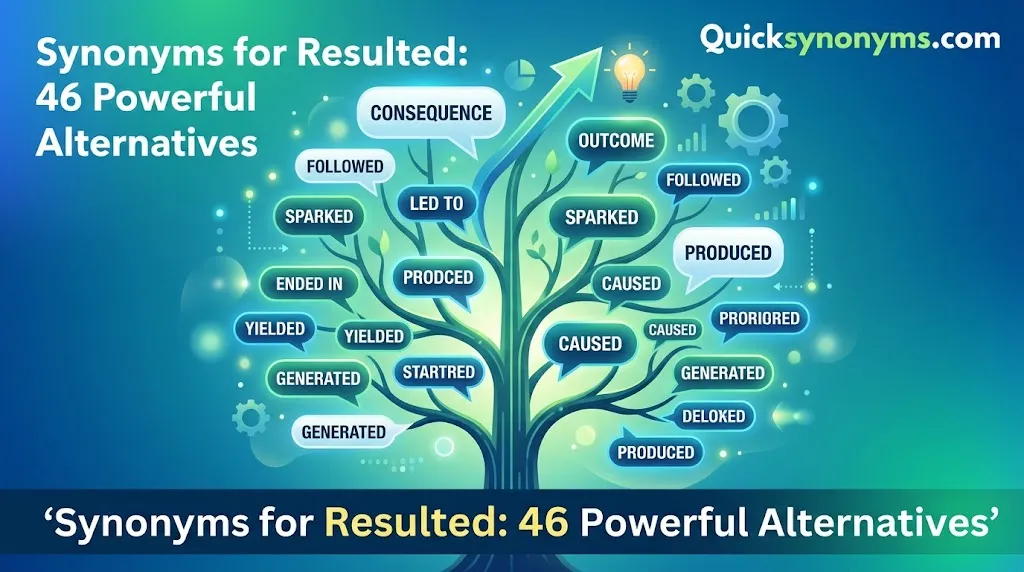
Synonyms for resulted include led to, caused, produced, generated, yielded, triggered, prompted, contributed to, brought about, and culminated in.
Resulted means that something happened because of something else. For example, a small mistake in a report may have resulted in a delay. The word is common in everyday English, school writing, business reports, news, and academic work. It helps us show a clear link between an action and its outcome.
Still, using resulted again and again can make writing sound dull. Learning synonyms gives English learners more ways to explain causes, effects, changes, and outcomes. Content writers can also use these alternatives to make sentences more natural and precise.
In this guide, you will learn the meaning of resulted, its grammar, origin, pronunciation, word formation, and 46 useful synonyms. Each synonym includes a simple meaning and examples. You will also see semantic categories that can help you choose the right word for different situations.
Meaning of Resulted
Definition
Resulted (Verb):
Resulted means happened as an effect or outcome of something else.
Examples
- The heavy rain resulted in serious flooding.
- Poor planning resulted in several delays.
Connotative Meaning
Connotation means the feeling or idea that a word suggests beyond its basic meaning.
- Positive tone: It can describe a good outcome, such as success resulting from hard work.
- Negative tone: It can describe an unwanted outcome, such as damage resulting from an accident.
- Neutral tone: It can simply describe a cause-and-effect relationship without showing emotion.
Etymology
The word resulted comes from the verb result, which developed from Latin.
- Old English (450–1100): The modern word result was not part of Old English vocabulary. Related ideas were expressed with words meaning “happen,” “follow,” or “come from.”
- Middle English (1100–1500): English adopted result through Anglo-French and Latin influence.
- Modern English (1500–Present): Result became widely used for an outcome or consequence. Resulted developed as its regular past-tense and past-participle form.
The Latin source resultare carried the idea of “springing back” or “rebounding.” Over time, the meaning developed toward something that follows from a cause.
Pronunciation (IPA)
- IPA: /rɪˈzʌltɪd/
- Syllables: re-sult-ed
Affixation Pattern of Resulted
- Root: sult
- Prefix: re-
- Suffix: -ed
- Word formations:
- result – noun / verb
- results – noun / verb
- resulted – verb
- resulting – verb / adjective
- resultant – adjective / noun
- resultantly – adverb
The word result is historically related to Latin resultare. The modern English form is not best understood as a simple modern re- + sult construction, even though this can be useful as a basic learning pattern.
46 Synonyms of Resulted With Meaning & Examples
1. Led to (Verb Phrase)
Meaning: Caused something to happen or develop.
Examples:
- The error led to a major delay.
- Her hard work led to better results.
2. Caused (Verb)
Meaning: Made something happen.
Examples:
- The storm caused severe damage.
- His mistake caused confusion.
3. Produced (Verb)
Meaning: Created or brought about an outcome.
Examples:
- The new plan produced positive results.
- The experiment produced an unexpected effect.
4. Brought About (Verb Phrase)
Meaning: Caused a particular change or event.
Examples:
- The reform brought about major changes.
- Better training brought about improved performance.
5. Created (Verb)
Meaning: Made something happen or exist.
Examples:
- The decision created new opportunities.
- Poor communication created problems.
6. Generated (Verb)
Meaning: Produced an effect, result, or response.
Examples:
- The campaign generated strong interest.
- The idea generated several useful solutions.
7. Yielded (Verb)
Meaning: Produced a particular result or benefit.
Examples:
- The research yielded useful information.
- The investment yielded good returns.
8. Ended In (Verb Phrase)
Meaning: Finished with a particular outcome.
Examples:
- The argument ended in an apology.
- The discussion ended in a new agreement.
9. Gave Rise To (Verb Phrase)
Meaning: Caused something to develop or happen.
Examples:
- The discovery gave rise to new questions.
- The conflict gave rise to social changes.
10. Arose From (Verb Phrase)
Meaning: Developed or happened because of something.
Examples:
- The problem arose from poor planning.
- The disagreement arose from a misunderstanding.
11. Stemmed From (Verb Phrase)
Meaning: Came or developed from a particular cause.
Examples:
- The issue stemmed from a simple error.
- Her concerns stemmed from past experience.
12. Followed From (Verb Phrase)
Meaning: Happened as a natural consequence of something.
Examples:
- The decision followed from careful research.
- The changes followed from new evidence.
13. Came From (Verb Phrase)
Meaning: Had something as its source or cause.
Examples:
- The confusion came from unclear instructions.
- The idea came from a classroom discussion.
14. Developed From (Verb Phrase)
Meaning: Gradually formed because of something earlier.
Examples:
- The project developed from a simple idea.
- The conflict developed from a minor disagreement.
15. Originated From (Verb Phrase)
Meaning: Began or started from a particular source.
Examples:
- The tradition originated from an ancient custom.
- The problem originated from poor communication.
16. Triggered (Verb)
Meaning: Caused something to start suddenly.
Examples:
- The announcement triggered a strong reaction.
- The news triggered a public debate.
17. Prompted (Verb)
Meaning: Caused someone to act or caused an event to happen.
Examples:
- The complaint prompted an investigation.
- The discovery prompted further research.
18. Induced (Verb)
Meaning: Caused a particular condition or event.
Examples:
- The drug induced sleep.
- The treatment induced a rapid response.
19. Brought On (Verb Phrase)
Meaning: Caused something, often an unpleasant event or condition.
Examples:
- Stress brought on his headache.
- The heat brought on several problems.
20. Contributed To (Verb Phrase)
Meaning: Helped cause a particular result.
Examples:
- Lack of sleep contributed to the accident.
- Her efforts contributed to the team’s success.
21. Culminated In (Verb Phrase)
Meaning: Reached a final and important result.
Examples:
- Months of training culminated in a major victory.
- The talks culminated in a formal agreement.
22. Ended With (Verb Phrase)
Meaning: Finished with a particular event or outcome.
Examples:
- The meeting ended with a clear decision.
- The story ended with a surprising twist.
23. Brought Forth (Verb Phrase)
Meaning: Caused something new to appear or develop.
Examples:
- The invention brought forth new opportunities.
- The discussion brought forth several ideas.
24. Sparked (Verb)
Meaning: Caused an activity, reaction, or event to begin.
Examples:
- The article sparked a lively debate.
- The discovery sparked public interest.
25. Provoked (Verb)
Meaning: Caused a strong reaction or response.
Examples:
- His comments provoked an angry response.
- The decision provoked public criticism.
26. Initiated (Verb)
Meaning: Caused something to begin.
Examples:
- The announcement initiated a new discussion.
- The program initiated several changes.
27. Turned Into (Verb Phrase)
Meaning: Changed or developed into something else.
Examples:
- A small issue turned into a major problem.
- The meeting turned into a useful discussion.
28. Evolved Into (Verb Phrase)
Meaning: Gradually changed into a new form.
Examples:
- The idea evolved into a successful business.
- The project evolved into a larger program.
29. Grew Into (Verb Phrase)
Meaning: Gradually developed into something larger or different.
Examples:
- The small project grew into a major company.
- Their friendship grew into a strong partnership.
30. Gave Way To (Verb Phrase)
Meaning: Was replaced by something new.
Examples:
- The old system gave way to a modern one.
- Fear gave way to confidence.
31. Paved the Way For (Verb Phrase)
Meaning: Created conditions that made something possible.
Examples:
- The research paved the way for a new treatment.
- Early success paved the way for expansion.
32. Set Off (Verb Phrase)
Meaning: Caused an event or reaction to begin.
Examples:
- The announcement set off a debate.
- The alarm set off a rapid response.
33. Influenced (Verb)
Meaning: Had an effect on something or someone.
Examples:
- The decision influenced future policies.
- Her advice influenced his choice.
34. Affected (Verb)
Meaning: Produced a change in something or someone.
Examples:
- The storm affected thousands of people.
- The delay affected the entire schedule.
35. Delivered (Verb)
Meaning: Produced or provided a particular result.
Examples:
- The new strategy delivered strong results.
- The campaign delivered impressive growth.
36. Yielded an Outcome (Verb Phrase)
Meaning: Produced a specific result.
Examples:
- The study yielded an outcome that surprised researchers.
- The experiment yielded an important outcome.
37. Produced an Outcome (Verb Phrase)
Meaning: Caused a particular result to occur.
Examples:
- The policy produced an outcome that benefited workers.
- The test produced an unexpected outcome.
38. Generated an Effect (Verb Phrase)
Meaning: Created a noticeable effect.
Examples:
- The campaign generated an effect across the market.
- The treatment generated an effect within hours.
39. Caused an Outcome (Verb Phrase)
Meaning: Made a particular result happen.
Examples:
- The decision caused an outcome that nobody expected.
- The change caused an outcome that affected the team.
40. Produced a Consequence (Verb Phrase)
Meaning: Created a consequence or later effect.
Examples:
- The action produced a consequence for the company.
- The mistake produced serious consequences.
41. Created a Consequence (Verb Phrase)
Meaning: Made a particular consequence occur.
Examples:
- The decision created consequences for the community.
- Poor planning created serious consequences.
42. Brought About an Effect (Verb Phrase)
Meaning: Caused a noticeable effect.
Examples:
- The new policy brought about an effect on spending.
- Better communication brought about positive effects.
43. Led Into (Verb Phrase)
Meaning: Caused something to move or develop into another stage.
Examples:
- The discussion led into a debate.
- The first lesson led into a practical exercise.
44. Developed Into (Verb Phrase)
Meaning: Changed gradually into a different or more advanced state.
Examples:
- The idea developed into a full business plan.
- The small event developed into a yearly tradition.
45. Initiated a Result (Verb Phrase)
Meaning: Started a process that produced an outcome.
Examples:
- The decision initiated a result that changed the project.
- The action initiated results across the organization.
46. Brought About a Result (Verb Phrase)
Meaning: Caused a specific outcome to happen.
Examples:
- The reform brought about a result that improved services.
- Their efforts brought about positive results.
Prototype Meaning
The most typical meaning of resulted is “caused a particular outcome” or “happened as a consequence of something.” When people hear resulted, they usually think of a clear cause-and-effect relationship. One event, action, choice, or condition happens first, and another event follows because of it.
Prototype Categorization
The 46 alternatives can be grouped by their main meaning:
- Direct Cause: caused, led to, brought about, produced, generated, created. These are useful when one thing clearly makes another thing happen.
- Source or Origin: arose from, stemmed from, came from, developed from, originated from. These work well when explaining where a problem, idea, or event began.
- Strong Reaction: triggered, prompted, provoked, sparked, set off. These are useful for sudden reactions, debates, changes, or events.
- Development and Change: evolved into, turned into, grew into, developed into, led into. These describe gradual movement from one state to another.
- Final Outcome: ended in, culminated in, ended with, yielded, delivered. These emphasize the final result.
- Contribution and Influence: contributed to, influenced, affected. These are better when something is only one factor among several causes.
- Opportunity or Progress: paved the way for, gave rise to, brought forth, gave way to. These describe change, opportunity, replacement, or development.
- Explicit Outcome Phrases: produced an outcome, generated an effect, caused an outcome, produced a consequence, brought about a result. These are useful when you want to make the cause-and-effect relationship very clear.
This categorization helps writers avoid choosing a synonym only because it looks similar. The best choice depends on whether you want to stress the cause, source, reaction, development, contribution, or final outcome.
Antonyms of Resulted
1. Prevented (Verb)
Meaning: Stopped something from happening.
2. Avoided (Verb)
Meaning: Kept something unwanted from happening.
3. Prevented From Happening (Verb Phrase)
Meaning: Stopped an event or outcome before it occurred.
4. Failed to Cause (Verb Phrase)
Meaning: Did not produce the expected result.
5. Stopped (Verb)
Meaning: Caused an activity or process to end rather than continue.
6. Blocked (Verb)
Meaning: Prevented something from developing or occurring.
7. Eliminated (Verb)
Meaning: Removed something so that it could no longer occur.
Short Questions and Answers
What does Resulted mean?
Resulted means that something happened as a consequence or outcome of another thing.
When should Resulted be used?
Use resulted when you want to show a clear connection between a cause and an outcome. It is common in formal, academic, professional, and everyday writing.
Is Resulted positive or negative?
Resulted is neutral. Its tone depends on the outcome. It can describe success, failure, damage, improvement, or any other consequence.
How is it different from similar words?
Resulted focuses on the connection between a cause and an outcome. Caused usually gives stronger emphasis to the cause, while led to often sounds natural and flexible. Stemmed from focuses more on the source of something, and culminated in emphasizes a final outcome after a process.
Conclusion
Learning resulted and its synonyms can make your English stronger and more flexible. Instead of using the same word in every sentence, you can choose alternatives such as led to, caused, produced, triggered, stemmed from, culminated in, or contributed to based on your meaning.
These words help you explain cause, effect, change, reaction, and outcomes more clearly. They are useful in essays, reports, articles, business writing, conversations, and academic work. Understanding the small differences between them also helps you sound more natural and precise.
For better vocabulary, practice using a few new synonyms every day. Write your own sentences and compare how each word changes the meaning. With regular practice, you can avoid repetition, improve your writing and speaking, and build greater confidence in English.
Explore More Synonyms: Synonyms for Captivate: 40 Striking Alternatives

English Teacher & Linguistics Writer
Grace Whitmore creates engaging educational content on vocabulary, word usage, and effective communication. Her goal is to help learners build confidence through clear and practical English guidance.









1 thought on “Synonyms for Resulted: 46 Powerful Alternatives”