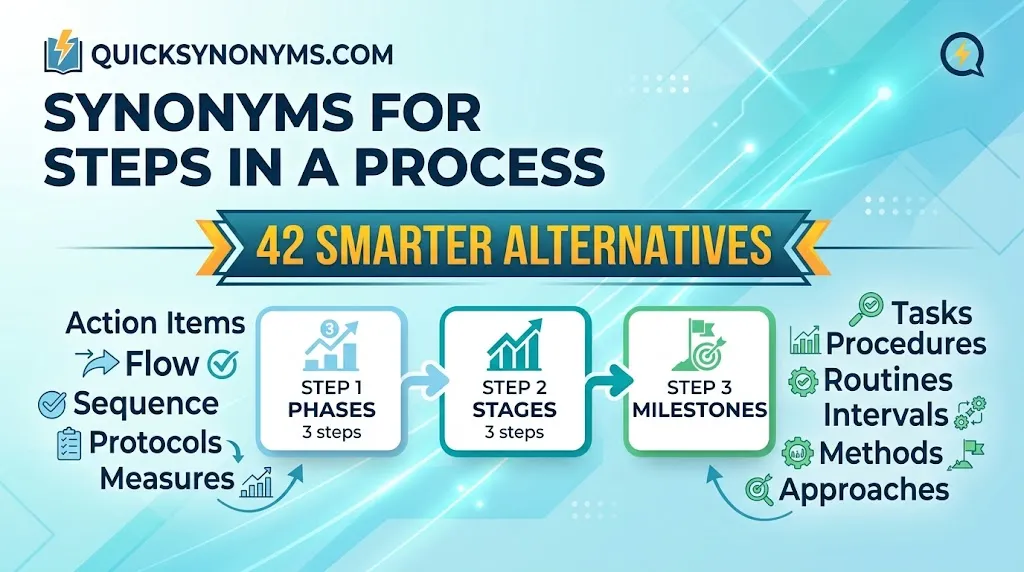
The best synonyms for steps in a process include stages, phases, procedures, actions, tasks, operations, methods, instructions, sequence, progression, milestones, components, workflows, checkpoints, and action items.
Steps in a process means the actions or stages that are followed to complete a task or reach a goal.
For example, when you bake a cake, you follow several steps. You prepare the ingredients, mix them, bake the mixture, and then serve the cake.
This phrase is common because it makes an activity easy to understand. It shows what happens and in what order.
Learning synonyms for steps in a process helps English learners use better and more varied vocabulary. It also helps writers avoid repeating the same phrase.
Different synonyms can focus on stages, actions, instructions, progress, or parts of a system.
In this guide, you will learn the meaning, synonyms, examples, grammar, etymology, pronunciation, and semantic categories of steps in a process.
Meaning of Steps in a Process
Definition
Steps in a process (Noun Phrase):
The individual actions or stages followed in a particular order to complete a task or achieve a result.
Examples
- Follow the steps in the process carefully.
- The guide explains the steps in a process from start to finish.
Connotative Meaning
Connotation: The feeling or idea that a word suggests beyond its basic meaning.
- Positive tone: It can suggest organization, progress, clarity, and success.
- Negative tone: It can suggest a long, difficult, or complicated procedure.
- Neutral tone: It simply describes the ordered parts of an activity.
Etymology
The phrase steps in a process is made from common English words. It does not come from one single ancient expression.
- Old English (450–1100): Step came from Old English stæpe, meaning a step, pace, or movement of the foot. Process ultimately comes from Latin prōcēdere, meaning “to go forward.”
- Middle English (1100–1500): Step developed into forms such as steppe. Process entered English through Anglo-French and Latin.
- Modern English (1500–Present): Step gained a figurative meaning connected with action and progress. Process became widely used for a series of actions or changes.
Pronunciation (IPA)
- IPA: /stɛps ɪn ə ˈprɑːsɛs/
- Syllables: steps in a pro-cess
Affixation Pattern of Steps in a Process
Because steps in a process is a phrase, it does not have one root, prefix, and suffix pattern.
- Root: step and process
- Prefix: None for the complete phrase.
- Suffix: None for the complete phrase.
Word Formations
- step – noun / verb
- steps – plural noun / verb
- stepped – past-tense verb / adjective
- stepping – gerund / present participle
- process – noun / verb
- processes – plural noun / verb
- processed – past-tense verb / adjective
- processing – gerund / present participle
- procedure – noun
- procedural – adjective
- progress – noun / verb
- progressive – adjective / noun
42 Synonyms of Steps in a Process With Meaning & Examples
1. Stages (Noun)
Meaning: Different points or parts that occur during a process.
Examples:
- The project has several important stages.
- We reviewed all the stages before starting.
2. Phases (Noun)
Meaning: Separate periods or parts of a developing process.
Examples:
- The project will be completed in three phases.
- Each phase has a clear goal.
3. Procedures (Noun)
Meaning: Established ways of doing something in an organized order.
Examples:
- Follow the safety procedures carefully.
- The company updated its hiring procedures.
4. Actions (Noun)
Meaning: Things that someone does to achieve a particular result.
Examples:
- Each action moves the project forward.
- The next action is to contact the client.
5. Tasks (Noun)
Meaning: Specific pieces of work that need to be completed.
Examples:
- Divide the project into smaller tasks.
- Complete each task before moving forward.
6. Operations (Noun)
Meaning: Organized activities performed as part of a system or process.
Examples:
- The factory improved its daily operations.
- These operations must follow company rules.
7. Measures (Noun)
Meaning: Actions taken to achieve a purpose or solve a problem.
Examples:
- The team took several measures to improve quality.
- These measures helped reduce costs.
8. Moves (Noun)
Meaning: Individual actions taken toward a goal.
Examples:
- The first move is to identify the problem.
- Her next move was to contact the manager.
9. Methods (Noun)
Meaning: Particular ways of doing something.
Examples:
- We tested several methods.
- This method makes the process faster.
10. Instructions (Noun)
Meaning: Information that tells someone what to do.
Examples:
- Read the instructions before beginning.
- The instructions explain each part of the task.
11. Directions (Noun)
Meaning: Guidance about how to do something.
Examples:
- Follow the directions carefully.
- The manual gives clear directions.
12. Sequence (Noun)
Meaning: A particular order in which things happen.
Examples:
- Complete the actions in the correct sequence.
- The sequence begins with planning.
13. Progression (Noun)
Meaning: Movement from one stage or point to another.
Examples:
- The progression of the project was smooth.
- The chart shows the progression of each stage.
14. Milestones (Noun)
Meaning: Important points or achievements during a process.
Examples:
- We reached several major milestones.
- The first milestone is completing the design.
15. Components (Noun)
Meaning: Individual parts that together form a larger system.
Examples:
- Planning is one of the key components.
- The process has several important components.
16. Parts (Noun)
Meaning: Individual sections or elements of something larger.
Examples:
- The process has four main parts.
- Each part must be completed correctly.
17. Elements (Noun)
Meaning: Basic parts that contribute to a whole.
Examples:
- Communication is an important element of the process.
- The plan contains several key elements.
18. Activities (Noun)
Meaning: Things people do as part of a task or process.
Examples:
- The training includes several activities.
- These activities prepare workers for the final stage.
19. Guidelines (Noun)
Meaning: General rules or advice that explain how to proceed.
Examples:
- Follow the project guidelines.
- The guidelines explain the expected procedure.
20. Workflows (Noun)
Meaning: Organized sequences of tasks used to complete work.
Examples:
- The software improves business workflows.
- We created new workflows for the team.
21. Stages of Development (Noun Phrase)
Meaning: Different points through which something develops.
Examples:
- The product passes through several stages of development.
- Testing is an important stage of development.
22. Course of Action (Noun Phrase)
Meaning: A planned way of acting to achieve a goal.
Examples:
- We need to choose the best course of action.
- The manager suggested a new course of action.
23. Sequence of Actions (Noun Phrase)
Meaning: A series of actions performed in a particular order.
Examples:
- The manual shows the correct sequence of actions.
- Follow the sequence of actions carefully.
24. Routines (Noun)
Meaning: Regular sequences of actions or activities.
Examples:
- Follow the daily routine.
- The morning routine includes several simple tasks.
25. Practices (Noun)
Meaning: Common or accepted ways of doing something.
Examples:
- The company follows good safety practices.
- These practices improve workplace quality.
26. Process (Noun)
Meaning: A series of actions that produces a result.
Examples:
- The company uses a clear hiring process.
- The process has several stages.
27. Action Items (Noun Phrase)
Meaning: Specific tasks that need to be completed.
Examples:
- The meeting ended with several action items.
- Assign each action item to a team member.
28. Checkpoints (Noun)
Meaning: Points where progress is checked during a process.
Examples:
- The project has several checkpoints.
- We review the work at each checkpoint.
29. Benchmarks (Noun)
Meaning: Standards or points used to measure progress.
Examples:
- The team set several benchmarks.
- These benchmarks help measure progress.
30. Transitions (Noun)
Meaning: Changes from one stage or activity to another.
Examples:
- The process includes several important transitions.
- Smooth transitions can save time.
31. Key Points (Noun Phrase)
Meaning: Important parts of a process or explanation.
Examples:
- The guide highlights the key points.
- Review the key points before the meeting.
32. Stages of Work (Noun Phrase)
Meaning: Different parts of a work activity.
Examples:
- The manager explained the stages of work.
- Each stage of work has a deadline.
33. Procedure Steps (Noun Phrase)
Meaning: Individual actions that make up a procedure.
Examples:
- The manual lists all the procedure steps.
- Follow the procedure steps in order.
34. Sequential Actions (Noun Phrase)
Meaning: Actions performed one after another in a set order.
Examples:
- The system requires several sequential actions.
- These sequential actions reduce errors.
35. Process Elements (Noun Phrase)
Meaning: Individual parts that form a complete process.
Examples:
- Planning is one of the main process elements.
- We reviewed each process element.
36. Stages of Progress (Noun Phrase)
Meaning: Points that show movement toward a goal.
Examples:
- The report describes the stages of progress.
- We tracked the project’s stages of progress.
37. Actions Required (Noun Phrase)
Meaning: Specific things that must be done.
Examples:
- The document lists the actions required.
- Complete all actions required before submission.
38. Instructions to Follow (Noun Phrase)
Meaning: Directions explaining what should be done in order.
Examples:
- The package includes instructions to follow.
- There are simple instructions to follow before installation.
39. Stages of Procedure (Noun Phrase)
Meaning: Separate parts of an organized procedure.
Examples:
- The document explains the stages of the procedure.
- Each stage of the procedure has a clear purpose.
40. Process Sequence (Noun Phrase)
Meaning: The ordered arrangement of actions within a process.
Examples:
- The diagram shows the process sequence.
- Check the process sequence before starting.
41. Course (Noun)
Meaning: The way in which a process or series of events develops.
Examples:
- The project followed a clear course.
- We monitored the course of the process.
42. Milestones (Noun)
Meaning: Important points that show progress toward a goal.
Examples:
- The team reached several key milestones.
- Each milestone showed progress on the project.
Prototype Meaning
The most typical meaning of steps in a process is a series of actions completed in a specific order.
When people hear this phrase, they usually imagine a task divided into smaller parts. These parts help someone move from the beginning to the final result.
The phrase mainly focuses on order, action, and progress.
Prototype Categorization
The 42 alternatives can be placed into several semantic groups.
This makes it easier for writers to select the word that best fits their sentence.
- Stages and Development: stages, phases, progression, stages of development, stages of progress, stages of work, transitions. These words work well when something develops over time.
- Actions and Tasks: actions, tasks, moves, action items, actions required, sequential actions. These focus on what someone needs to do.
- Procedures and Guidance: procedures, instructions, directions, guidelines, procedure steps, instructions to follow. These are useful for manuals and how-to content.
- Structure and Parts: components, parts, elements, process elements. These describe parts that form a larger system.
- Order and Flow: sequence, sequence of actions, process sequence, workflows, process, routines. These emphasize how activities are arranged.
- Progress and Measurement: milestones, checkpoints, benchmarks. These words focus on tracking progress.
- General Alternatives: methods, measures, activities, practices, key points, course of action, course. These offer flexible choices for different contexts.
Choosing the right category helps you avoid awkward or inaccurate word choices.
For example, phases works well for project development, while instructions works better for a user guide.
Antonyms of Steps in a Process
There is no exact one-word antonym for steps in a process. However, several words can express the opposite idea.
1. Disorder (Noun)
A lack of organization or clear order.
2. Randomness (Noun)
A condition where events do not follow a planned sequence.
3. Inaction (Noun)
Failure to take action.
4. Stagnation (Noun)
A lack of movement or progress.
5. Confusion (Noun)
A state where things are difficult to understand or organize.
6. Improvisation (Noun)
Action taken without a fixed plan or established sequence.
7. Disorganization (Noun)
A lack of clear structure or order.
Short Questions and Answers
What does steps in a process mean?
Steps in a process are the individual actions or stages followed in order to complete a task or achieve a result.
When should Steps in a Process be used?
Use steps in a process when explaining how something happens from beginning to end.
It is especially useful when the order of actions is important.
Is Steps in a Process positive or negative?
The phrase is usually neutral.
It simply describes an ordered series of actions. The surrounding context can make its meaning positive or negative.
How is it different from similar words?
Stages focus on periods of development.
Tasks focus on work that needs to be completed.
Instructions tell someone what to do.
Sequence focuses mainly on the order of events.
Conclusion
Learning steps in a process and its synonyms can make your English clearer and more flexible.
Words such as stages, phases, procedures, tasks, actions, workflows, milestones, checkpoints, and sequence can describe different parts of an organized activity.
Using these alternatives also helps you avoid repetition in essays, articles, reports, and everyday conversations.
English learners can use them to explain ideas with greater confidence.
Content writers can use them to make their writing more natural and engaging.
The most important thing is to choose a synonym that fits the exact context.
Try learning a few new words each day. Then use them in your own sentences to build stronger vocabulary and better English skills.
See More Synonym Guides: Synonyms for Powerful leader: 42 Strong Alternatives.

ESL Writing Coach
Olivia Bennett helps English learners strengthen their writing, expand their vocabulary, and communicate more naturally. Her content is designed to make everyday and professional English simple and accessible.











2 thoughts on “Synonyms for Steps in a Process: 42 Smarter Alternatives”