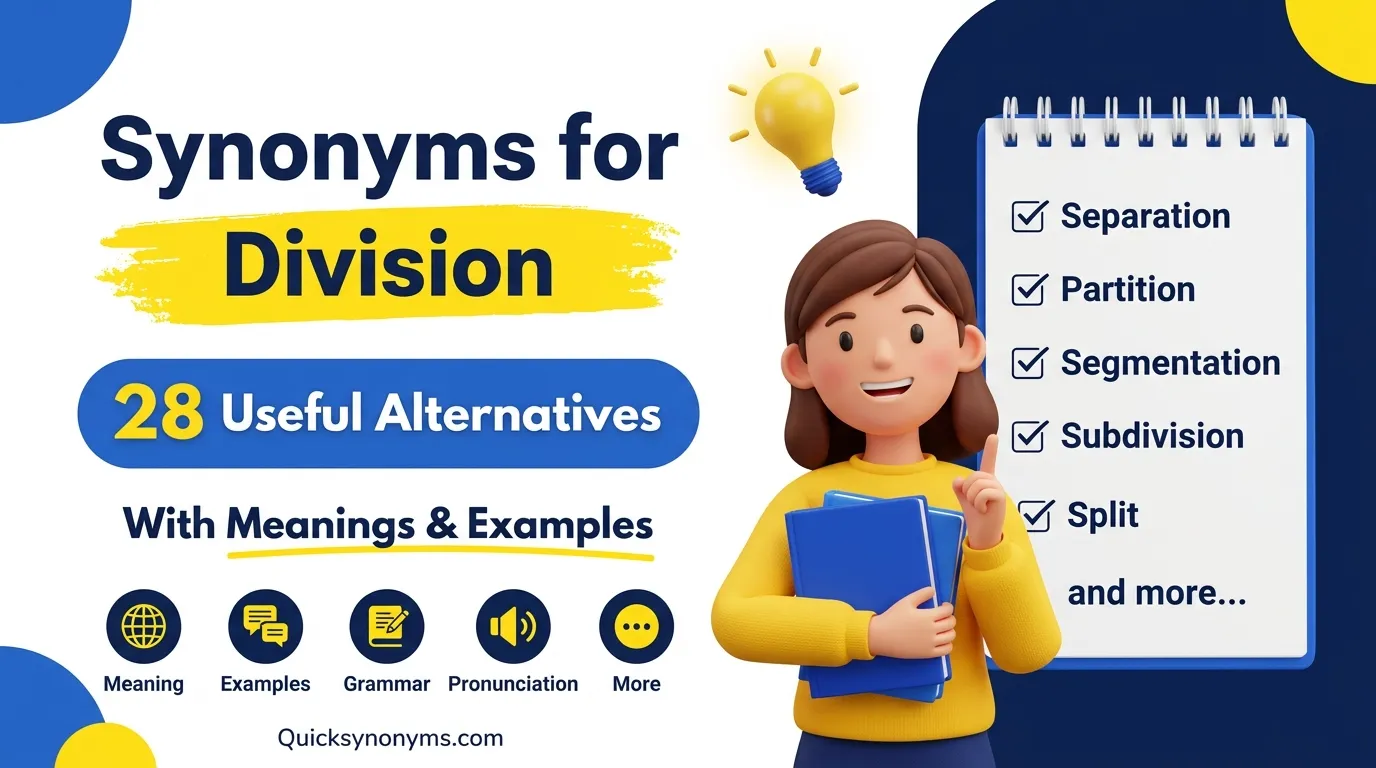
Division means the act of separating something into parts, groups, or sections. Imagine a teacher splitting a class into two teams for a game. That split is a division. The word is common in math, business, education, sports, and everyday life.
Learning synonyms for division helps English learners choose clearer words and avoid repeating the same term. It also helps writers match their word choice to the exact situation.
In this guide, you will learn the meaning of division, its history, pronunciation, grammar, and 28 useful synonyms. You will also see simple examples and semantic groups to help you understand when each word works best.
Meaning of Division
Definition
Division (Noun): The act of separating something into parts, groups, or sections.
Examples
- The division of the class made the activity easier.
- The company has a sales division and a marketing division.
Connotative Meaning
Connotation: The feeling or idea that a word suggests beyond its basic meaning.
- Positive tone: Division can suggest clear organization or useful grouping.
- Negative tone: It can suggest conflict, separation, or disagreement.
- Neutral tone: It can simply describe separating something into parts or groups.
Etymology
- Old English (450–1100): The modern word division was not an Old English word. Its deeper root comes from Latin dividere, meaning “to divide,” “separate,” or “distribute.”
- Middle English (1100–1500): Division entered English in the late 14th century through Old French division, from Latin divisionem. It meant separating something into parts or shares.
- Modern English (1500–Present): The word developed many uses, including mathematical division, organizational sections, military units, and separation between people or ideas.
Pronunciation (IPA)
- IPA: /dɪˈvɪʒən/
- Syllables: di-vi-sion
Affixation Pattern of Division
- Root: divis- from Latin dividere, meaning to separate or divide
- Prefix: None
- Suffix: -ion, which forms a noun describing an action, process, or result
Common word formations:
- divide (verb)
- divided (adjective/verb)
- dividing (verb/adjective)
- division (noun)
- divisional (adjective)
- divisive (adjective)
- divisiveness (noun)
- divider (noun)
- divisor (noun)
- divisible (adjective)
- indivisible (adjective)
- subdivide (verb)
- subdivision (noun)
28 Synonyms of Division With Meaning & Examples
1. Separation (Noun)
Meaning: The act of keeping people or things apart.
Examples:
- The separation of the two groups was necessary.
- A wall created a clear separation between the rooms.
2. Partition (Noun)
Meaning: A division that separates something into different parts or spaces.
Examples:
- The office has a glass partition.
- The partition divided the large room into two areas.
3. Split (Noun)
Meaning: A division that creates two or more separate parts.
Examples:
- The split between the teams was unexpected.
- We made a split between work and personal tasks.
4. Separation (Noun)
Meaning: The state or process of being separated.
Examples:
- The separation of the files made them easier to manage.
- Their separation created two independent groups.
5. Breakdown (Noun)
Meaning: The process of separating something into smaller parts for easier understanding.
Examples:
- The teacher gave us a breakdown of the topic.
- The report includes a breakdown of the costs.
6. Segmentation (Noun)
Meaning: The process of dividing something into distinct sections or groups.
Examples:
- Customer segmentation helps businesses understand buyers.
- The segmentation of the market revealed several groups.
7. Subdivision (Noun)
Meaning: A smaller section created by dividing a larger part.
Examples:
- The chapter has several subdivisions.
- Each subdivision covers a different topic.
8. Distribution (Noun)
Meaning: The act of sharing or spreading something among different people or places.
Examples:
- The distribution of food began at noon.
- The company planned the distribution of its budget.
9. Allocation (Noun)
Meaning: The act of giving specific amounts or resources to different people or groups.
Examples:
- The allocation of funds was carefully planned.
- Each department received an equal allocation.
10. Apportionment (Noun)
Meaning: The act of dividing something into shares or amounts.
Examples:
- The apportionment of costs was fair.
- They discussed the apportionment of the available resources.
11. Dissection (Noun)
Meaning: The act of separating something into parts for close study.
Examples:
- The students watched a dissection in biology class.
- The article provides a detailed dissection of the argument.
12. Classification (Noun)
Meaning: The process of putting things into groups based on shared features.
Examples:
- The classification of animals helps students study them.
- We used classification to organize the files.
13. Categorization (Noun)
Meaning: The act of placing things into different categories.
Examples:
- Categorization makes the information easier to find.
- The categorization of products improved the website.
14. Grouping (Noun)
Meaning: The act of putting similar people or things together.
Examples:
- The grouping of students was based on skill level.
- The grouping of the files saved time.
15. Segregation (Noun)
Meaning: The act of keeping different people or things apart.
Examples:
- The segregation of waste helps with recycling.
- The system uses segregation to separate different materials.
16. Demarcation (Noun)
Meaning: A clear line or boundary that separates two areas or things.
Examples:
- The fence marks the demarcation between the properties.
- The map shows a clear demarcation between the regions.
17. Boundary (Noun)
Meaning: A line or limit that separates one area or group from another.
Examples:
- The river forms a natural boundary.
- The boundary separates the two districts.
18. Divide (Noun)
Meaning: A separation or difference between two groups, areas, or ideas.
Examples:
- The river creates a natural divide.
- There is a clear divide between the two sections.
19. Disparity (Noun)
Meaning: A noticeable difference between two people, groups, or things.
Examples:
- The report showed a large disparity in income.
- There is a disparity between the two results.
20. Difference (Noun)
Meaning: A way in which two things are not the same.
Examples:
- There is a clear difference between the two plans.
- The difference in size was easy to see.
21. Disjunction (Noun)
Meaning: A separation or lack of connection between things.
Examples:
- There was a disjunction between the plan and its results.
- The study showed a disjunction between theory and practice.
22. Disunity (Noun)
Meaning: A lack of agreement or unity within a group.
Examples:
- Political disunity weakened the organization.
- The team showed signs of disunity.
23. Discord (Noun)
Meaning: Disagreement or conflict between people or groups.
Examples:
- The decision caused discord among the members.
- Long arguments created discord in the team.
24. Conflict (Noun)
Meaning: A serious disagreement or struggle between people or groups.
Examples:
- The conflict divided the community.
- They tried to resolve the conflict peacefully.
25. Disagreement (Noun)
Meaning: A situation in which people have different opinions.
Examples:
- Their disagreement lasted for several weeks.
- A small disagreement caused a larger division.
26. Faction (Noun)
Meaning: A smaller group within a larger group that has different views or interests.
Examples:
- One faction opposed the new plan.
- Several factions formed within the organization.
27. Branch (Noun)
Meaning: A separate section or part of a larger organization or system.
Examples:
- She works in the research branch.
- The company opened a new branch in the city.
28. Department (Noun)
Meaning: A separate section of an organization that has a specific function.
Examples:
- He works in the finance department.
- The company created a new sales department.
Prototype Meaning
The most typical meaning of division is the act of separating something into smaller parts, groups, or sections. When people hear the word, they may think of splitting a whole into clear parts. This can happen in math, business, school, sports, or everyday situations.
Prototype Categorization
- Physical separation: separation, partition, split, subdivision, divide describe things being separated into physical parts.
- Organization and grouping: segmentation, classification, categorization, grouping, branch, department focus on arranging things into groups or sections.
- Sharing and resources: distribution, allocation, apportionment describe dividing resources, money, duties, or supplies.
- Differences and boundaries: boundary, demarcation, disparity, difference, disjunction highlight a gap or line between things.
- Conflict and social division: disunity, discord, conflict, disagreement, faction describe divisions caused by different opinions or interests.
This categorization helps writers choose a word that matches the exact meaning they want instead of using division repeatedly.
Antonyms of Division
- Unity (Noun): A state in which people or things are joined together.
- Union (Noun): The act or state of joining separate things together.
- Connection (Noun): A link between people, things, or ideas.
- Integration (Noun): The process of combining separate parts into a whole.
- Combination (Noun): The act of joining two or more things together.
- Harmony (Noun): A state of agreement and cooperation.
- Wholeness (Noun): The state of being complete and undivided.
Short Questions and Answers
What does division mean?
Division means separating something into parts, groups, or sections.
When should division be used?
Use division when talking about separating a whole into parts, sharing something among groups, or describing a separate section of an organization.
Is division positive or negative?
It depends on the context. Division can describe useful organization, such as dividing work into sections. It can also describe conflict or disagreement between people.
How is it different from similar words?
Division is a broad word. Partition often describes physical separation, allocation focuses on giving resources, segmentation focuses on groups, and discord focuses on disagreement.
Conclusion
Learning the word division and its synonyms can make your English clearer and more flexible. Instead of using the same word again and again, you can choose terms such as separation, partition, segmentation, or allocation based on the meaning you need.
These words can strengthen both writing and speaking. They help you describe physical parts, groups, resources, boundaries, and disagreements with greater accuracy. A wider vocabulary also makes it easier to understand books, articles, lessons, and everyday conversations.
Try learning a few new synonyms each day. Write simple sentences with them and notice how their meanings change with context. With regular practice, you can avoid repetition, express ideas more clearly, and build greater confidence in English.
Discover More: Synonyms for Distribute: 35 Useful Alternatives

ESL Writing Coach
Olivia Bennett helps English learners strengthen their writing, expand their vocabulary, and communicate more naturally. Her content is designed to make everyday and professional English simple and accessible.