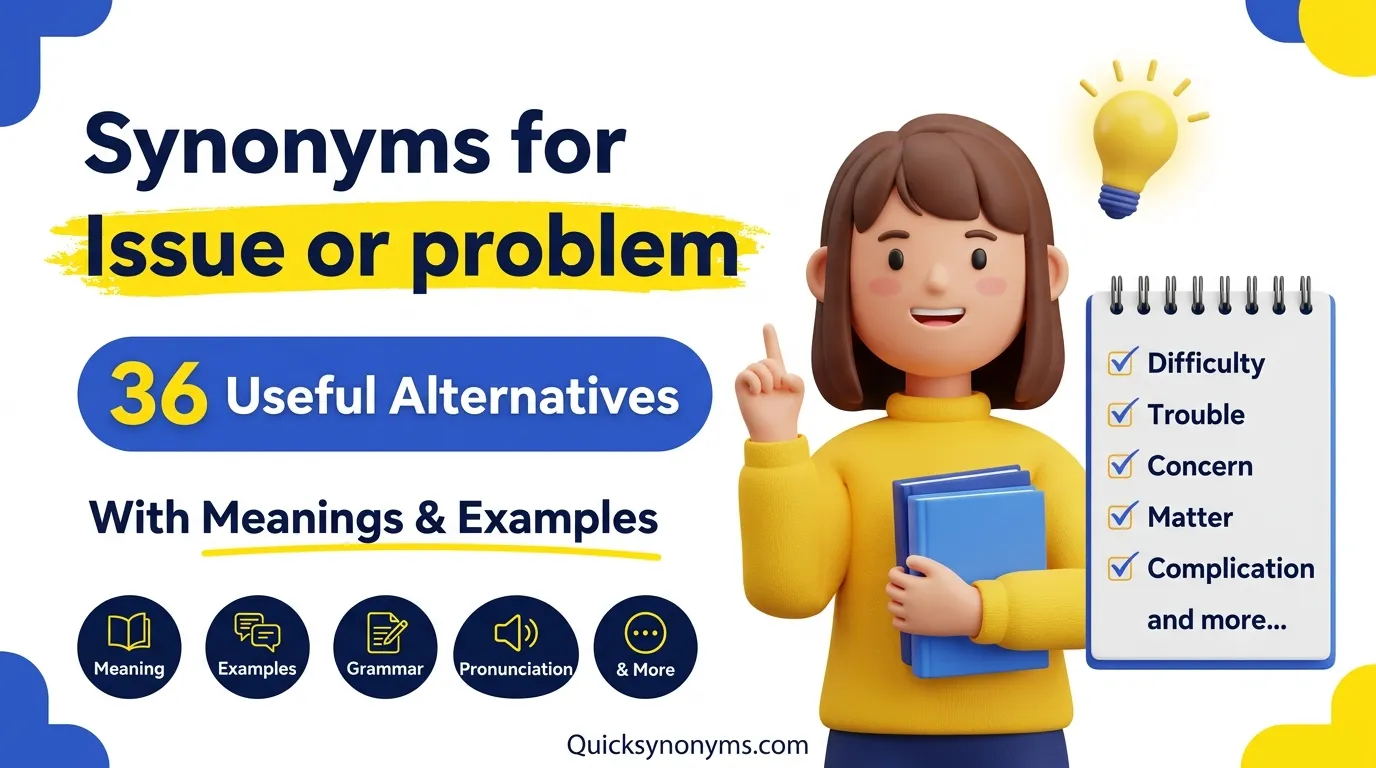
The words issue and problem describe something that needs attention, thought, or action. For example, a student may have a problem with homework, or a team may discuss an issue at work. These words are common in daily talks, school tasks, business meetings, and online writing.
Learning synonyms helps English learners speak with more ease and write with less repetition. It also helps content writers choose words that fit the topic, tone, and reader. While some synonyms describe a small concern, others point to a serious fault, conflict, or crisis.
This guide covers the meaning of issue and problem, 36 useful synonyms, clear examples, grammar, word origins, pronunciation, and related words. You will also learn how these words differ in meaning and tone, so you can choose the right word for each situation.
Meaning of Issue or problem
Definition
Issue or problem (noun): A matter, difficulty, or situation that needs attention, discussion, or a solution.
Examples
- We need to solve this problem before the next meeting.
- The team discussed the issue with the new plan.
Connotative Meaning
- Positive tone: A challenge may offer a chance to learn or improve.
- Negative tone: A problem may suggest trouble, harm, or failure.
- Neutral tone: An issue may simply be a matter that needs discussion.
(Connotation: the emotional or cultural feeling a word carries beyond its literal meaning.)
Etymology
The words issue and problem have different origins.
Issue: The word came through Old French issue, meaning an exit or a way out. It traces back to Latin exire, meaning “to go out.” Its sense later grew to include a matter for discussion.
Problem: The word came through Old French probleme from Latin problema and Greek problēma, meaning something put forward or a question for thought.
- Old English (450 to 1100): Not applicable to these direct word origins. Both words entered English through later language stages.
- Middle English (1100 to 1500): Issue came through Anglo-French and Old French. Problem came through French and Latin from Greek.
- Modern English (1500 to present): Both words developed broader uses. They can refer to matters for discussion, difficult situations, or things that need solutions.
Pronunciation (IPA)
- Issue: /ˈɪʃuː/ or /ˈɪsjuː/, depending on accent.
- Syllables: is-sue.
- Problem: /ˈprɒbləm/ in British English, /ˈprɑːbləm/ in American English.
- Syllables: prob-lem.
Affixation Pattern of Issue or problem
- Root: Issue and problem are base nouns with different historical roots.
- Prefix: None in either word in modern English.
- Suffix: The ending -ue in issue and -em in problem are not productive suffixes that change their meaning in modern English.
– Word formations:
- Issue (noun): a matter or concern.
- Issue (verb): to give or release something officially.
- Issued (verb, past tense): gave or released.
- Issuing (verb, present participle): giving or releasing.
- Problematic (adjective): difficult or likely to cause trouble.
- Problematically (adverb): in a way that causes difficulty.
- Problem-solving (noun or adjective): the act of finding solutions or relating to that act.
36 Synonyms of Issue or problem: With Meaning and Examples
1. Difficulty (noun)
Meaning: Something that is hard to do, understand, or manage.
Examples:
- She faced a difficulty with her school project.
- The main difficulty was finding enough time.
2. Trouble (noun)
Meaning: A situation that causes worry, harm, or difficulty.
Examples:
- The broken engine caused trouble during the trip.
- We had trouble opening the old door.
3. Concern (noun)
Meaning: A matter that causes worry or needs attention.
Examples:
- Safety is our main concern.
- The teacher raised a concern about the test results.
4. Matter (noun)
Meaning: A subject or situation that needs thought or action.
Examples:
- We must discuss this matter today.
- The manager handled the matter with care.
5. Complication (noun)
Meaning: Something that makes a situation harder to manage.
Examples:
- A sudden delay added a complication to the plan.
- The missing papers caused another complication.
6. Obstacle (noun)
Meaning: Something that blocks progress or makes a goal harder to reach.
Examples:
- Lack of money was an obstacle to the project.
- She found a way around every obstacle.
7. Challenge (noun)
Meaning: A difficult task or situation that needs effort.
Examples:
- Learning a new language can be a challenge.
- The team accepted the challenge with confidence.
8. Snag (noun)
Meaning: A small, unexpected problem that delays progress.
Examples:
- We hit a snag while booking the tickets.
- One last snag kept the website from launching.
9. Hitch (noun)
Meaning: A small problem that interrupts a plan or process.
Examples:
- The trip went well without a single hitch.
- We faced a hitch when the bus arrived late.
10. Dilemma (noun)
Meaning: A difficult choice between two or more options.
Examples:
- She faced a dilemma about which job to accept.
- His dilemma was whether to save money or travel.
11. Predicament (noun)
Meaning: A difficult situation that is hard to escape.
Examples:
- He found himself in a predicament after losing his keys.
- The lost hikers faced a serious predicament.
12. Quandary (noun)
Meaning: A state of doubt when it is hard to decide what to do.
Examples:
- I was in a quandary over which course to choose.
- The offer left her in a quandary.
13. Crisis (noun)
Meaning: A serious situation that needs quick action.
Examples:
- The hospital faced a staff crisis.
- Quick planning helped the town manage the crisis.
14. Conflict (noun)
Meaning: A clash between people, ideas, or needs.
Examples:
- The conflict between the two teams grew worse.
- They worked together to end the conflict.
15. Dispute (noun)
Meaning: A disagreement between people or groups.
Examples:
- The neighbors had a dispute over the fence.
- Both sides tried to settle the dispute peacefully.
16. Malfunction (noun)
Meaning: A failure in how a machine or system works.
Examples:
- A malfunction stopped the lift.
- The technician fixed the computer malfunction.
17. Fault (noun)
Meaning: A defect or error that makes something work poorly.
Examples:
- A fault in the wiring caused the lights to fail.
- The mechanic found a fault in the engine.
18. Defect (noun)
Meaning: A flaw that makes something faulty or less useful.
Examples:
- The factory found a defect in the new product.
- A small defect made the screen hard to read.
19. Flaw (noun)
Meaning: A weakness or fault in a person, plan, or object.
Examples:
- The plan had one major flaw.
- A flaw in the design made the chair unsafe.
20. Error (noun)
Meaning: Something done or judged incorrectly.
Examples:
- An error in the report changed the final result.
- The system showed an error during the update.
21. Mistake (noun)
Meaning: An action or choice that is wrong or incorrect.
Examples:
- I made a mistake when I entered the date.
- Her mistake taught her to check her work.
22. Glitch (noun)
Meaning: A small, often temporary fault in a system or device.
Examples:
- A glitch caused the app to close.
- The website had a brief glitch this morning.
23. Setback (noun)
Meaning: An event that slows progress or makes success harder.
Examples:
- The canceled order was a setback for the shop.
- She returned to training after a short setback.
24. Barrier (noun)
Meaning: Something that prevents or limits progress.
Examples:
- High costs were a barrier to buying a home.
- Language can be a barrier to clear communication.
25. Hurdle (noun)
Meaning: A difficulty that must be overcome to reach a goal.
Examples:
- Passing the final test was her last hurdle.
- The team overcame a major hurdle before launch.
26. Hardship (noun)
Meaning: A condition that causes great difficulty or suffering.
Examples:
- The family faced hardship after the flood.
- Many people endured hardship during the long winter.
27. Adversity (noun)
Meaning: A difficult or painful situation that tests a person.
Examples:
- She stayed hopeful in the face of adversity.
- The team grew stronger through adversity.
28. Drawback (noun)
Meaning: A feature or fact that makes something less useful or appealing.
Examples:
- The main drawback of the phone is its short battery life.
- One drawback of the plan is its high cost.
29. Weakness (noun)
Meaning: A lack of strength or a feature that reduces quality.
Examples:
- Poor planning was a weakness in the project.
- The review revealed a weakness in the design.
30. Limitation (noun)
Meaning: A rule, condition, or weakness that restricts what is possible.
Examples:
- Time was a major limitation for the team.
- The tool has a limitation when handling large files.
31. Controversy (noun)
Meaning: A public disagreement that causes strong debate.
Examples:
- The new rule caused controversy at school.
- The decision sparked controversy among local residents.
32. Grievance (noun)
Meaning: A complaint about something seen as unfair.
Examples:
- Workers raised a grievance about their pay.
- She filed a grievance after the unfair decision.
33. Complaint (noun)
Meaning: A statement that something is wrong or unsatisfactory.
Examples:
- The customer made a complaint about the late order.
- The office received a complaint about the noise.
34. Puzzle (noun)
Meaning: A confusing matter that is hard to understand or explain.
Examples:
- The missing file was a puzzle for the staff.
- His sudden change of plans remained a puzzle.
35. Mess (noun)
Meaning: A confused or badly managed situation.
Examples:
- Poor planning turned the event into a mess.
- We had to clean up the mess after the system failed.
36. Emergency (noun)
Meaning: A serious and urgent situation that needs immediate action.
Examples:
- The fire created an emergency at the school.
- Staff called for help during the medical emergency.
Prototype Meaning
The most common meaning of an issue or problem is a situation that needs attention or a solution. People often imagine a broken device, a missed deadline, a disagreement, or a task that does not go as planned. The exact meaning depends on the setting. A snag is often small, while a crisis or emergency can be serious and urgent.
Prototype Categorization
- General difficulties: Difficulty, trouble, concern, matter, complication. Use these words for common situations that need attention or action.
- Blocks to progress: Obstacle, challenge, snag, hitch, barrier, hurdle, setback. Use these when something delays a task or makes a goal harder to reach.
- Hard choices: Dilemma, predicament, quandary, puzzle. Use these when a person feels unsure or cannot find an easy answer.
- Serious situations: Crisis, hardship, adversity, emergency, mess. Use these for urgent, painful, or badly managed situations. Note that emergency and crisis suggest greater urgency than a general problem.
- Disagreements and complaints: Conflict, dispute, controversy, grievance, complaint. Use these when people disagree or believe something is unfair.
- Faults and errors: Malfunction, fault, defect, flaw, error, mistake, glitch, weakness, limitation. Use these for failures, incorrect actions, or weaknesses in a system, plan, or object.
- Negative features: Drawback. Use this when describing a disadvantage of a choice, product, or plan.
Grouping synonyms helps writers see small differences in meaning. It also makes it easier to choose a word that fits the topic and tone.
Antonyms of Issue or problem
- Solution (noun): An answer that solves a problem.
- Answer (noun): A reply or way to resolve a question.
- Resolution (noun): A firm decision or a way to settle a problem.
- Agreement (noun): A shared decision between people or groups.
- Harmony (noun): A state of peace and good relations.
- Success (noun): The achievement of a goal.
- Advantage (noun): A feature that gives a benefit.
- Benefit (noun): Something helpful or good.
Short Questions and Answers
What does Issue or problem mean?
An issue or problem is a matter or situation that needs attention, discussion, or a solution.
When should Issue or problem be used?
Use problem when something is wrong or hard to solve. Use issue when talking about a matter that needs attention or discussion. Both words are common in school, work, and daily life.
Is Issue or problem positive or negative?
Both words are often linked to difficulty, so they can have a negative tone. However, issue can be neutral when it means a topic for discussion, and a challenge can sound positive when it offers a chance to learn.
How is it different from similar words?
A difficulty is something hard to manage or do. A concern is a matter that causes worry or needs attention. A complication makes an already difficult situation harder to manage.
Conclusion
Learning synonyms for issue or problem helps you express ideas with greater care. Words such as difficulty, concern, and obstacle describe different kinds of trouble, while crisis, malfunction, and dispute point to more specific situations. Choosing the right word helps readers understand what you mean.
A wider vocabulary also makes speaking and writing more natural. English learners can use these words in schoolwork, conversations, emails, and work reports. Content writers can use them to avoid repetition and make their writing clearer for readers and search engines.
Start by learning a few synonyms each day. Write your own examples, read them aloud, and use the words in real conversations. Daily vocabulary practice will help you build stronger English skills and speak with more confidence.
Learn More: Synonyms for Crew: 38 Useful Alternatives

ESL Writing Coach
Olivia Bennett helps English learners strengthen their writing, expand their vocabulary, and communicate more naturally. Her content is designed to make everyday and professional English simple and accessible.