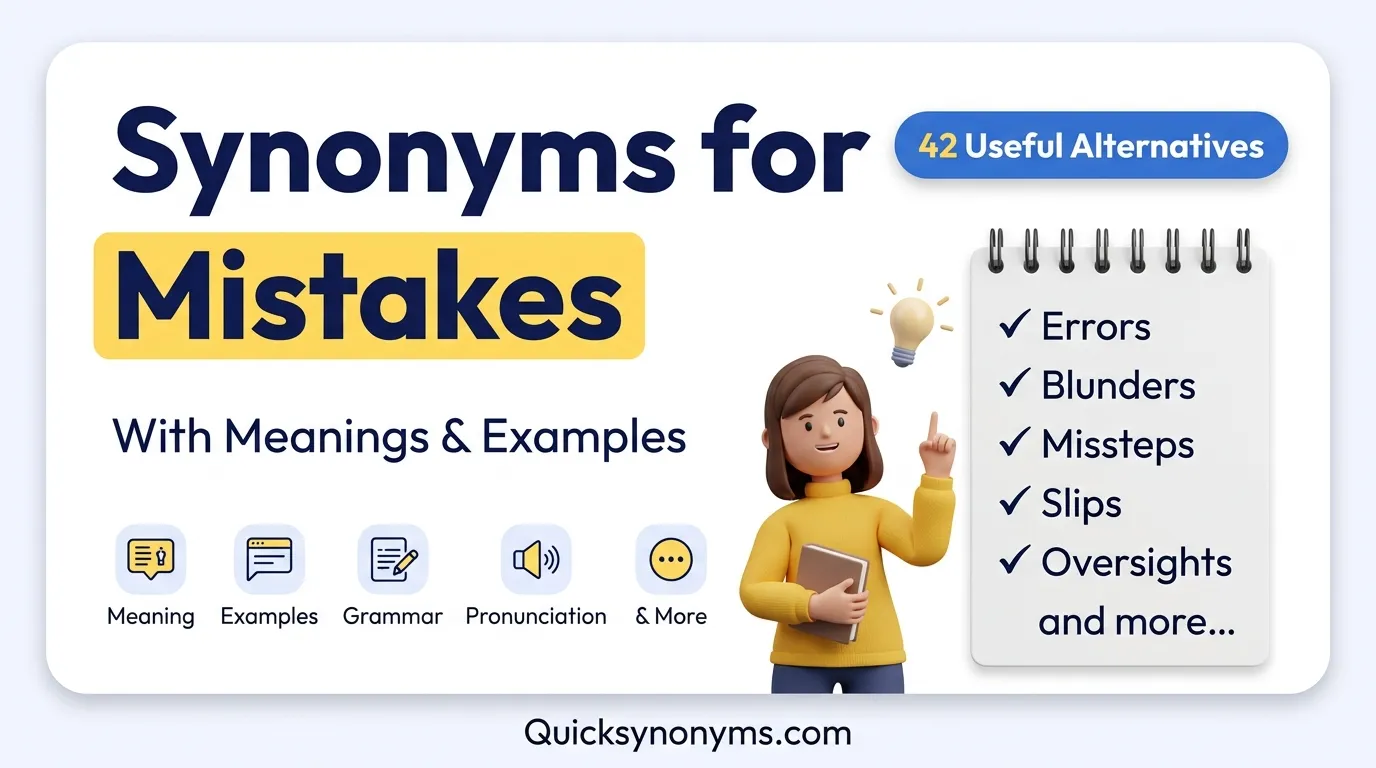
Mistakes are things we do or say incorrectly, often because of poor judgment, lack of knowledge, or simple carelessness. For example, a student may make mistakes on a test, while a writer may notice mistakes in a sentence before publishing it. The word is common because everyone makes mistakes in daily life.
Learning synonyms for mistakes helps English learners and content writers use clearer and more varied language. Instead of repeating the same word, you can choose a word that shows the exact type or seriousness of the problem.
This article explains the meaning of mistakes, its history, pronunciation, grammar, and 42 useful synonyms with simple examples. It also groups the words into semantic categories to make choosing the right word easier.
Meaning of Mistakes
Definition
Mistakes (Noun): Incorrect actions, choices, statements, or judgments that happen when someone does something wrong.
Examples
- We all make mistakes while learning something new.
- The editor found several mistakes in the article.
Connotative Meaning
Connotation: The feeling or idea that a word suggests beyond its basic meaning.
- Positive tone: Mistakes can suggest learning, growth, and improvement when someone learns from them.
- Negative tone: Mistakes can suggest carelessness, poor judgment, or failure when they cause serious problems.
- Neutral tone: Mistakes can simply describe something that was done incorrectly without strong emotion.
Etymology
The word mistakes comes from the verb mistake, which developed from mis- meaning “wrongly” or “badly” and take. The basic idea was to take or understand something wrongly.
- Old English (450–1100): The parts behind the word can be traced to Old English forms related to mis-, meaning wrongly, and tacan, meaning to take.
- Middle English (1100–1500): Forms of mistake developed with the sense of taking wrongly or misunderstanding something.
- Modern English (1500–Present): Mistake became established as both a verb and noun. The plural noun mistakes refers to more than one incorrect action, choice, or judgment.
Pronunciation (IPA)
- IPA: /mɪˈsteɪks/
- Syllables: mis-takes
Affixation Pattern of Mistakes
- Root: take
- Prefix: mis- meaning wrongly, badly, or incorrectly
- Suffix: -s, an inflectional ending showing the plural form
- Word formations:
- mistake: noun and verb
- mistakes: plural noun and third-person singular verb
- mistaken: adjective and past participle
- mistaking: present participle and gerund
- mistakenly: adverb
- mistaker: noun for a person who makes a mistake, though uncommon
42 Synonyms of Mistakes: With Meaning & Examples
1. Errors (Noun)
Meaning: Incorrect actions, answers, decisions, or statements.
Examples:
- The teacher corrected my errors.
- Small errors can change the meaning of a sentence.
2. Blunders (Noun)
Meaning: Serious or careless mistakes caused by poor judgment.
Examples:
- The manager made several blunders.
- His blunders caused a major delay.
3. Faults (Noun)
Meaning: Problems or defects caused by something being wrong.
Examples:
- The report contains several faults.
- The engineer found faults in the system.
4. Missteps (Noun)
Meaning: Mistakes in judgment, behavior, or action.
Examples:
- The company admitted its recent missteps.
- One political misstep damaged his reputation.
5. Slips (Noun)
Meaning: Small mistakes made accidentally or without intention.
Examples:
- I made a slip while writing the answer.
- A few slips appeared in the final draft.
6. Oversights (Noun)
Meaning: Mistakes caused by failing to notice or consider something.
Examples:
- The missing name was an oversight.
- We found two important oversights in the plan.
7. Inaccuracies (Noun)
Meaning: Details that are not correct or accurate.
Examples:
- The article contains several inaccuracies.
- The editor removed factual inaccuracies.
8. Misjudgments (Noun)
Meaning: Wrong decisions caused by poor judgment.
Examples:
- His misjudgments hurt the project.
- The coach admitted some early misjudgments.
9. Miscalculations (Noun)
Meaning: Wrong estimates or judgments about a situation.
Examples:
- Their cost calculations included several miscalculations.
- A small miscalculation caused a large loss.
10. Misunderstandings (Noun)
Meaning: Mistakes caused by understanding something incorrectly.
Examples:
- The argument started because of a misunderstanding.
- Clear communication can prevent misunderstandings.
11. Misconceptions (Noun)
Meaning: Wrong ideas or beliefs about something.
Examples:
- The lesson corrected common misconceptions.
- Many people have misconceptions about grammar.
12. Inconsistencies (Noun)
Meaning: Differences or contradictions that make something incorrect or unclear.
Examples:
- The editor noticed inconsistencies in the report.
- These inconsistencies need to be fixed.
13. Omissions (Noun)
Meaning: Important things that were accidentally left out.
Examples:
- The document had several omissions.
- The omission of one fact changed the report.
14. Inadvertencies (Noun)
Meaning: Accidental actions or mistakes caused by a lack of attention.
Examples:
- The errors were simple inadvertencies.
- A few inadvertencies appeared in the document.
15. Inexactitudes (Noun)
Meaning: Statements or details that are not completely accurate.
Examples:
- The article contained a few inexactitudes.
- The editor corrected the inexactitudes before publication.
16. Inexactnesses (Noun)
Meaning: Lack of exactness or accuracy.
Examples:
- The data showed several inexactnesses.
- These inexactnesses made the results less useful.
17. Inaccuracies (Noun)
Meaning: Incorrect facts, details, or measurements.
Examples:
- The researcher corrected the inaccuracies.
- The report contained factual inaccuracies.
18. Fallacies (Noun)
Meaning: Errors in reasoning that make an argument unsound.
Examples:
- The writer used several logical fallacies.
- The debate exposed a serious fallacy.
19. Misapplications (Noun)
Meaning: Mistakes caused by using an idea, rule, or method incorrectly.
Examples:
- The problem came from misapplications of the rule.
- Misapplications of grammar rules can confuse readers.
20. Misinterpretations (Noun)
Meaning: Incorrect understandings of words, actions, or information.
Examples:
- His comments led to several misinterpretations.
- The teacher cleared up the student’s misinterpretation.
21. Misreadings (Noun)
Meaning: Incorrect understandings of written or spoken information.
Examples:
- The mistake came from a misreading of the instructions.
- Misreadings can cause serious confusion.
22. Misrepresentations (Noun)
Meaning: False or incorrect descriptions of something.
Examples:
- The report contained several misrepresentations.
- The company corrected the misrepresentation quickly.
23. Misuses (Noun)
Meaning: Incorrect or improper uses of something.
Examples:
- The teacher explained common misuses of the word.
- The guide lists common misuses of punctuation.
24. Faults (Noun)
Meaning: Defects, weaknesses, or mistakes in something.
Examples:
- The reviewer pointed out several faults.
- The machine has a few minor faults.
25. Failures (Noun)
Meaning: Attempts or actions that do not achieve the desired result.
Examples:
- The project had several failures.
- We can learn from our failures.
26. Lapses (Noun)
Meaning: Temporary failures in attention, judgment, or behavior.
Examples:
- It was a brief lapse in concentration.
- His lapse in judgment caused trouble.
27. Faux Pas (Noun)
Meaning: A socially embarrassing mistake.
Examples:
- Asking about her age was a social faux pas.
- He made a small faux pas at the dinner.
28. Gaffes (Noun)
Meaning: Careless mistakes, especially in speech or public behavior.
Examples:
- The speaker made a few embarrassing gaffes.
- His comment was seen as a major gaffe.
29. Stumbles (Noun)
Meaning: Mistakes or difficulties that slow progress.
Examples:
- The team had a few stumbles at first.
- Early stumbles helped them improve.
30. Misadventures (Noun)
Meaning: Unfortunate experiences caused by mistakes or bad decisions.
Examples:
- The trip was full of small misadventures.
- His misadventures taught him to plan better.
31. Wrongdoings (Noun)
Meaning: Actions that are wrong or harmful.
Examples:
- The investigation uncovered serious wrongdoings.
- The company apologized for its wrongdoings.
32. Faultiness (Noun)
Meaning: The state of being defective, incorrect, or imperfect.
Examples:
- The faultiness of the data affected the study.
- The test revealed the faultiness of the system.
33. Missteps (Noun)
Meaning: Poor actions or decisions that create problems.
Examples:
- The new leader learned from his missteps.
- Several missteps delayed the project.
34. Glaring Errors (Noun Phrase)
Meaning: Very obvious and serious mistakes.
Examples:
- The report contained several glaring errors.
- The editor quickly noticed the glaring errors.
35. Careless Errors (Noun Phrase)
Meaning: Mistakes caused by not paying enough attention.
Examples:
- She lost points because of careless errors.
- Careless errors are easy to avoid with careful checking.
36. Typographical Errors (Noun Phrase)
Meaning: Mistakes made while typing or printing text.
Examples:
- The article had several typographical errors.
- We corrected the typographical errors before publishing.
37. Judgement Errors (Noun Phrase)
Meaning: Mistakes caused by making a poor decision or assessment.
Examples:
- The incident involved several judgment errors.
- Good training can reduce judgment errors.
38. Procedural Errors (Noun Phrase)
Meaning: Mistakes caused by not following the correct process or procedure.
Examples:
- The audit found several procedural errors.
- Procedural errors delayed the application.
39. Logical Errors (Noun Phrase)
Meaning: Mistakes in reasoning or thinking.
Examples:
- The argument contains a logical error.
- Students should learn how to identify logical errors.
40. Computational Errors (Noun Phrase)
Meaning: Mistakes made while calculating or processing numbers.
Examples:
- The final result included a computational error.
- The software helped detect computational errors.
41. Human Errors (Noun Phrase)
Meaning: Mistakes made by people rather than machines or systems.
Examples:
- The problem was caused by human error.
- Better training can reduce human errors.
42. Miscalculations (Noun)
Meaning: Mistakes in calculating, estimating, or judging something.
Examples:
- Their miscalculations led to higher costs.
- One small miscalculation changed the final result.
Prototype Meaning
The most typical meaning of mistakes is errors made when someone does something incorrectly. When people hear the word, they usually imagine a wrong answer, poor choice, typing error, forgotten detail, or incorrect action. Mistakes can be small and harmless or serious and costly.
Prototype Categorization
- General errors: errors, faults, inaccuracies, inexactnesses describe things that are simply incorrect.
- Serious mistakes: blunders, glaring errors, misjudgments, miscalculations suggest mistakes with greater impact.
- Small or accidental mistakes: slips, lapses, oversights, stumbles often describe minor or unplanned errors.
- Thinking and understanding mistakes: misconceptions, misunderstandings, misinterpretations, misreadings, fallacies relate to incorrect thinking or understanding.
- Communication mistakes: gaffes, faux pas, misrepresentations are useful when speech, social behavior, or descriptions are involved.
- Writing and technical mistakes: typographical errors, logical errors, computational errors, procedural errors identify specific types of mistakes.
This categorization helps writers choose a more exact word instead of using mistakes for every situation.
Antonyms of Mistakes
- Successes (Noun): Results that achieve the desired goal.
- Correctness (Noun): The quality of being right or accurate.
- Accuracy (Noun): The quality of being correct and precise.
- Achievements (Noun): Successful results gained through effort.
- Perfections (Noun): States of having no faults or defects.
- Solutions (Noun): Correct answers or ways to solve problems.
- Certainties (Noun): Things known to be true or correct.
Short Questions and Answers
What does mistakes mean?
Mistakes means incorrect actions, choices, answers, statements, or judgments.
When should mistakes be used?
Use mistakes when you want to describe things that were done or understood incorrectly. It is a common and flexible word for everyday English.
Is mistakes positive or negative?
Mistakes is usually neutral or negative. However, the word can have a positive meaning when mistakes are viewed as useful opportunities to learn and improve.
How is it different from similar words?
Mistakes is a broad word. Blunders often suggest serious errors, slips suggest small accidental errors, oversights involve things that were missed, and misjudgments involve poor decisions.
Conclusion
Learning synonyms for mistakes gives you more ways to explain errors clearly. Words such as errors, blunders, slips, oversights, missteps, and misjudgments can show the exact kind of mistake you mean. This makes your writing more precise and interesting.
A wider vocabulary also strengthens speaking and helps you avoid repeating the same word. When you know the difference between similar words, you can choose language that fits the situation better. This builds confidence in English and makes your ideas easier to understand.
Try learning a few new synonyms each day. Write simple sentences with them and use them in real conversations or writing. With regular practice, words like mistakes and their alternatives will become easier to use naturally.
Read more: Synonyms for Not real: 30 Useful Alternatives

Lexicographer & Vocabulary Specialist
Nathan Carter focuses on English vocabulary, synonyms, antonyms, and word meanings. He is passionate about producing clear, accurate, and easy-to-understand language guides for readers of all levels.